• Security incident: ISF was recently accessed by intruders. Please change your password, and change it anywhere else you used it. Read more

Merged Fireballs and Backdraft in WTC1 Basement and Lobby

So Swing quotes one of the longest posts in the history of the world, mentions only one point at the very end, manages to totally screw up his objection.

Nice.

What a maroon.
 
Last edited:
16.5:

Actually, some of that stuff in the quote box is Swing's words. He still doesn't understand how the quote function works.

So typically I skim over the post, noting only the mistakes that immediately jump out, and throw his ignorance back (it's not hard to find). THe major issue here (as with the majority of his arguments) is that he doesn't understand what's been said to him, so instead of asking for clarification or doing (*gasp!*) research to correct this deficiency, he simply chooses an argument he does understand and has been Troofer-Trained to contradict and assumes it's the one that was made.

He's like that old vending machine at the little corner market. Sure, you may want Coca-Cola, but you're just as likely to find the only buttons on the machine are for Orange Crush or RC.
 
Last edited:
I cant believe SD mentioned Jack Kelley as his FBI theory source. Beyond silly. He lied and you believed it as gospel.

The idiot made it up and I believe it was on 912 he was interviewed.

Oh, dear foot in mouth again SD
 
Deflagration Versus FAE detonation

To illustrate the difference between a deflagration and a FAE detonation:

First a backdraft. (Skip almost to the end)


Then a FAE detonation


Notice that the backdraft produces a far more impressive fireball than the FAE detonation, but it did not hurt the firefighters standing close to it. While the fireball in the FAE video did not even touch the mannequin figure it was still shredded to pieces by the supersonic shock wave (don't be confused by the thermal image). A human standing where the figure stood would have been dead!

People got burned by the fireballs in WTC, had it been a FAE or some other high explosive they would have died instantly. And there would have been lots and lost of people with destroyed eardrums and ringing ears.
 
I cant believe SD mentioned Jack Kelley as his FBI theory source. Beyond silly. He lied and you believed it as gospel.

The idiot made it up and I believe it was on 912 he was interviewed.

Oh, dear foot in mouth again SD
How do you expect a truther to figure out things; they are stuck open loop loony tunes on 9/11. They do not stop to correct lies and errors, they just press on to the next big lie.
 
you state that NIST reports multiple fireballs. [...] Here we see that NIST does state a fireball traveled down the shaft. No jet fuel, no multiple fireballs, but just one fireball. [...]
Here is your quote from a previous comment supporting the fireball.
“R.Mackey -Anti-falling devices notwithstanding, there were lifts that did fall. I wouldn't have suggested this otherwise. The huge fireball in the sublevels cited by William Rodriguez did, in fact, issue from a freight elevator shaft after the elevator fell due to the impacts.”

Again, you contradict yourself, this time with your own words!

That's a lie. Nowhere did I, and nowhere did NIST, suggest that these were all caused by a single fireball. Each of those events was distinct. Mr. Rodriguez only saw one fireball, but you can't seriously suggest that he must have seen every fireball.

This isn't your only lie, either:

Your theory based upon your own model is of course that at least 100 gallons of jet fuel made its way un-detected, un-ignited to the basement, pooled there,

There's another lie. I expressly told you that I wasn't treating a "pool" in my last post. You cling to this because it's the only way you can possibly misinterpret me, and thus pretend that you might somehow be right.

Don't forget, according to your model, you need that jet fuel to make its way to the basement undeterred to be ignited all at once. It also has to bypass everything that might ignite it on the way down and it has to do it undetected.
Your model or theory has the jet fuel pooling.

Pack of lies. For goodness sake, man, it's on the same page as this post! Just scroll up and read!

Your model assumes the exact fuel vapor/air ratio is correct as well.

Lie. Well, maybe breathtaking incompetence, but since I already addressed this, I'm comfortable calling this a lie.

Your model doesn't disperse the fuel. It places it in the middle, suspended in air, of an empty cube.

This is how I know you're lying. Since when do "pools" get suspended in mid-air?? Even when you butcher my words, you can't tell the same lie twice.

[Morellis quote] "I know of people that got killed in the basement. I know of people that got broken legs in the basement. People got re-constructive surgery because the walls hit them in the face.”
You know injuries consistent with concussion and incident overpressure not burns from fire.

Lie. They were killed by stuff falling and collapsing, not overpressure. Even the quote that you brought to the discussion suggests as much.

And for the finale….it is nearly impossible to set off a massive and complex FAE, but according to RMackey’s world, the nearly impossible was indeed achieved by a much more complex and smaller FAE in the basement! Classic!

Lie

Your theory:
1. Lots of jet fuel after a massive plane crash...
2. Makes it way to the basement all at once, in one volume, undetected

Lie

Rmackey, you sir are my new Professor of Contradictions and Impossibilities.
Stick to rockets because you would be laughed out of the classroom.

I have been a teacher, and one stupid student's laughter troubleth me not.

That's eight lies in one post. The rest of what you wrote is merely ignorant or foolish.

I'm not going to waste much more breath on you if you're simply going to prevaricate with every post. Fix your eight lies above, and if you do so, I'll try to help you through the rest of your confusion. But if you do not, then I see no point in further humoring a charlatan. Anyone can make up nonsense. You're hardly special in that regard.
 
leftysergeant said:
"We aren't saying that the fuel pooled, you are saying that we said it. We are not that stupid."
Ooops....:covereyes
Firefighter Timothy Brown: We finally set up -- prior to this I believe it was the west side of the core of the building there were elevators. Someone had come to me and said that there were people trapped in one of those elevators. So I ran around the corner, and the hoist way doors were open, but the elevator car was only showing about two feet at the top of the door. You could see all the legs of the people that were in the elevator. I would guess there were about eight people in the elevator. The elevator pit was on fire with the jet fuel. People were screaming in the elevator. They were getting smoked and cooked. There weren't a lot of firemen there at the time. I grabbed some of the Port Authority employees and asked them where the fire extinguishers were and told them to get as many fire extinguishers as they could so we could try and fight this fire. As they were doing that, firemen started showing up, and I started asking them to get big cans, let's try to put this fire out.
source

leftysergeant said:
"We aren't saying that the fuel pooled, you are saying that we said it. We are not that stupid."
Ooops....:covereyes
Swing Dangler said:
Ok, let me get this straight. The plane crashes, spills jet fuel all the way down Shaft 50 without it igniting into a fireball. Mr. Arturo whose elevator car's emergency breaks save his life experiences none of this jet fuel cascading down his shaft collecting in the bottom nor do anyone else in the basement witness or describe pools of jet fuel.
source

Dave Rogers said:
If he was in the elevator car, and the jet fuel went round its outside, what would he notice? If the jet fuel collected in the elevator shaft wells, who would be there to observe it?
source

R.Mackey said:
False choice fallacy.


Your opening statement describes what I think happened to create the
fireball that Rodriguez reported. That doesn't mean there was only one. Do
you have any idea of how much jet fuel total there was in the building?? Or
how many paths there were from point of impact to the bottom?
source

Dave Rogers said:
Just out of interest, is the following a possible scenario?


(1) Plane hits tower, fuel deflagrates.

(2) Due to oxygen exhaustion inside the tower, some fuel remains unburned,
particularly close to the centre where the lift shafts are.

(Combustion continues around the outside of the floor because of the air
supply through the windows broken by the initial deflagration.)

(3) Some of the unburned fuel falls into the lift shaft and falls to the
bottom, passing around the lift. At this point it isn't burning because it
was extinguished by (2).

(4) Some other event (electrical spark? falling burning debris?) then ignites the fuel at the bottom of the lift shaft (where there is now enough oxygen to support combustion), causing a fireball.


Since (4) isn't necessarily directly related to (3), it could take place
some significant time later. Since the fuel doesn't travel down the lift
shaft as a fireball, the fireball can precede the fall of the lift.
Everyone's account is corroborated.


Any problems with that, anyone?


Dave
source

Apparently, nobody had any problems with that.

Sounds good to me, but I can hear Swing already, "Source? Evidence?" Of course, his lack of evidence for bombs hasn't deterred him.
source

With regards to Mackey's "wild over estimate" energy calculation, according to him, in reality if we have just 290Kg of jet fuel, the fuel explosion would not be efficient and it would not consume the total 290Kg at once. According to Mackey's calculation, an explosion required to produce this "wild over estimate" of 5psi, would need to consume all 290Kg at once.
So, if R.Mackey's 290Kg of jet fuel figure is not consumed in the one explosion, any amount of fuel consumed less than 290Kg in an explosion would
produce less than his so called "wild over estimate" of 5 psi.

Going by Norseman's posted figures,
EFFECTS OF EXPLOSION DESTRUCTIVE PEAK PRESSURE
GLASS SHATTERING : 0-5 PSI
FIREFIGHTER KNOCKDOWN: 1.PSI
WOOD PARTITION COLLAPSE: 1-2 PSI
CINDERBLOCK WALL COLLAPSE: 2-3 PSI
BRICK WALL COLLAPSE: 7-8 PSI
FIREFIGHTER LUNG DAMAGE: 15 PSI
THRESHOLD FOR FATALITIES: 35 PSI
50% FATALITIES: 50 PSI
99 FATALITIES: 99 PSI

Even if in reality 290Kg of jet fuel in the basement could produce 5psi, does that appear to be a "wild over estimate"? Even if we accept the minimalistic estimates of damage to the lower levels put forward by many here. Their is no denying the glass was shattered, and I think it's safe to say the lobby plate glass was far from your average glass.

There can be more energy in a bunch of candles, than their can be in a hand grenade, but of course a bunch of candles are not going to blow you to pieces anytime soon.
So its important to look at not only how much energy is contained within a substance, but also how that energy is released. Perhaps R.Mackey would like to apply his energy calculation to the figures NIST gave us for the initial deflageration upon impact on the towers?
The impact explosion consumed 1000-3000 gallons of fuel. 1 gallons equals 3 kg (rounded down). 3000 kg containing an energy of 129 giga joules. 3000 gallons equals then 387 giga joules. The average therfore is 258 gj, that's twenty times the amount of the energy released by the 290kg R.Mackey thinks is sufficient to explain all the damage.

One has to wonder, how such a great release of energy, produced, according to official reports, - no great overpressures. The reason is of course that not all the energy was released at once, but as FEMA states within two seconds and not in microseconds. So we have here 1000-3000 gallons of aerolized fuel exploding in a deflagration, producing no significant pressure wave, and one tenth to one thirtieth of that, produced pressure reducing walls of several basement levels to rubble within seconds of the impact. How did 100% of the people on floor 91 of the north tower, survive? The floor below the lowest point of impact where above a 1000-3000 deflageration took place.

In R.Mackey's model, 290Kg of fuel in the form of gas, explodes all at once. Although R.Mackey has told us plenty of times there was enough air, he neglects to mention that unless all of this 290Kg of jet fuel had a fuel air ratio of .7 to 5% then, not all of it will burn at once. Again, if less than 290Kg of fuel burns at once, we get less than 5psi in R.Mackey's model. Hardly a "wild over estimate".

All this nonsense above, trying to pin Swing Dangler on a unintentional, detonation comment, is irrelevant. If we are talking about igniting a fuel/air mixture, the mixture must be between the lower and upper explosive limits. Fuel alone does not burn, when a pool of fuel is on fire, it is the top vapour (fuel/air) layer that is burning. Your example leftysergeant, of your fuel/air mixture being too rich in your car, is simply when the mixture is too rich to ignite in the cylinder of the engine. The unburnt fuel is expelled through the exhaust, and later ignites in the exhaust when the fuel can mix with air.

As R.Mackey has mentioned, it's unlikely the fuel burned all at once, we also
know through various accounts their were numerous explosions/fireballs.

According to Arturo Griffith, he experienced 2 explosions after stopping, blowing the elevator doors in.

When the elevator finally stopped, they had an explosion (1) that bring the doors inside the elevator, and I think I'm sure that that was what broke my leg. And then they had another explosion (2) and the panel that threw me, you know, against the wall, and I guess I was unconscious for a couple of minutes because somebody else was in the elevator with me, and they say that they was trying to get my attention and they didn't get no response from me.
source

Arturo shared the elevator car with Marlene Cruz, after the 2 were rescued
from the car, Arturo witnessed a fireball emerge from the shaft.

'I don't know who saved me. It was so black and smoky. I couldn't see nothin',' Arturo said. 'When they got me out, I told them there was someone else down there, a woman. They went back to get her. Seconds after they pulled her out, a ball of fire came down the shaft (3). They almost got killed.'
source

So we already have 3 possible explosions/fireballs

What about the account of Edward McCabe?

I was in the refrigeration plant in tower 1 sub basement 4. I was passing through when I felt a slight shifting of the building. I froze right where I stood and listened....nothing.. about 30 seconds past and to my left about 30 feet from me was a stairway leading up to a door. this door explodes off its hinges and white smoke came into the plant.
source

After the plane impact, Arturo Griffith plummets in an elevator then
experiences 2 explosions, does not respond, is rescued, tells the rescuers to get Cruz, then Cruz is rescued.
Their is a significant amount of time after the initial explosions, then Arturo witnesses a fireball which does not appear to have created significant over pressure.

After the plane impact?, an estimated 30 seconds later Edward McCabe witnesses a door blown of it's hinges on the perimeter of the WTC.

Due to the timing, the damage caused by the explosion McCabe witnesses, and also the lack of pressure from the fireball Arturo witnesses, it is unlikely this fireball witnessed by Arturo, caused the explosion witnessed by McCabe.

If McCabe's account is accurate, and we only have the official story to work with, this explosion must have come from shafts 6 and 7.

Due to the location of shafts 6 and 7, it seems unlikely that the first and most explosive blast would originate from shafts 6 and 7. See NIST's fuel
distribution figures, note that shafts 6 and 7 are to the right of the red line, and were less affected by jet fuel than shaft 50.
wtcbasementfinistfuel1cy9.jpg


R.Mackey tells us,
And over 70% of witnesses interviewed from the whole ruddy tower smelled jet fuel. That's thousands of witnesses. If they can smell it, that means it's been aerosolized. And that means it can explode.

Actually thats far from correct, otherwise the next time I lite a cigarette within a km of the airport, I'm going to do some damage. A human can smell fuel at as low as 1 part per million, for a jet fuel/air mixture to ignite, we need to be in a range between 7000ppm to 50000ppm. Any attempted ignition outside of this range, and the mixture will either be too lean or too rich to ignite.

Hazardous exposure levels came into effect in 2003.
The American Conference of Governmental Industrial Hygienists (ACGIH) lists the threshold limit values (TLVs) for jet fuel as an eight-hour time-weighted average (TWA) of 200 mg/m3 (total aerosol and vapor). This converts to approximately 30 parts per million (ppm) when expressed in isobutylene units.
source

We are talking about Griffith being in an elevator, with a fuel air mixture surrounding him, of between 233 to 1666 times higher than the above set hazardous exposure levels, yet Griffith does not find this significant enough for any mention? And in the very least, is not overcome by fumes?

It is impossible that Arturo & Cruz would not have noticed significant amounts of liquid fuel cascading in, and around, his open car. It is also near impossible that Arturo & Cruz would not have noticed a significant amount of fuel vapour forming in and around his car.

Given the above, it would appear the jet fuel did not reach the lower levels until a short time after Griffith and Cruz were out of the shaft. Given the location of shafts 6, 7, and 50, and NIST's jet fuel distribution figures, it would be reasonable to assume that the fuel did not reach the lower levels of shafts 6 and 7 until around the same time, or later than it did shaft 50. For this reason, it's unlikely the initial explosions Arturo experienced, originated from shaft 6 & 7.

Furthermore, if the "new jref hypothesis" is that the fuel was formed into an aerosol as it fell down the shafts, then why was the damage so localised to the lower levels and not up the length of the shaft?
Why an exploded shaft of floor 22, when the surrounding floors were undamaged?

With regards to overpressure estimates, Mackey says,

We can describe the damage qualitatively:

a.. There was extensive damage to interior and furniture over a wide area.
b.. Damage to the structure, however, was minor to negligible.
c.. There are no reports of anyone being killed by the blast. The
principal danger was fire.

Their are plenty of reports of people killed in the basement, there is no evidence they weren't killed by the blast as R.Mackey claims.

Here is one from the lobby,

"There was one body inside the lobby. Looked like his legs were chopped off. I don't know where he came from, but he had already had a triage tag on him. It was a civilian. I don't know where he came from, how he died. Looked like his clothes were a little burnt up on him, but his legs were chopped off."
source

I think it's safe to say this guy didn't die from burns.

And minor structural damage?

It seems now accepted by everyone except for gravy that in order for McCabe's account to be correct that 3 walls and a door were blown off between McCabe and the 6 and 7 shafts. I've given my reasons why I believe this coridoor would have been masonry, and am trying to confirm this. It seems that the knee jerk reaction on jref is to minimize damage and claim everything was light weight plasterboard. Hardly sceptical.

And how much force would be required to break through one of the plasterboard elevator shaft walls?

We only have to read the account of Perrito Blanco.
"Then I smelled smoke. This changed things. We had to get out. I got out my handkerchief and covered my nose and mouth. Then I remembered that it was better to wet it so I dipped it in my milk. I suggested to the others to do the same. We pried open the doors again and laid down the window-washer's pole to keep the door open. It was the perfect size. Now we started kicking the hell out of the wall in front of us. It was no use. It was sheetrock, a.k.a. plasterboard or drywall, in 2 feet wide sections with a steel frame around it. It hardly moved. We would have to dig through it."

""Eventually, someone got through the wall. We now had a hole about the diameter of a finger and fresh air was coming through. The elevator shaft
wall turned out to be 3 inches thick. It consisted of 3 ply of one inch sheetrock held together by the steel frame I mentioned. We continued to chip away and kick at the wall. Then I noticed John the window-washer was holding a piece of the squeegee that had come off. It was the part where the pole screwed in. It was triangular with 2 pointy corners and the corner where the pole screwed in. I grabbed it and started hacking to one side of the hole and another guy worked on the other side. Then I got the idea to try and score the wall so that when we kicked at it, there would be weak points. As we took turns kicking the wall, my foot finally went through and we had a nice sized hole now. We took turns kicking at the edges of the hole making it bigger. Eventually, we had a hole about 2-3 feet high by 1 foot wide. But there was another wall on the other side. "
source

Here's an interesting quote that puts the damaged structure at a little more than a few pesky pieces of broken plaster board.

"When the group reached the third floor, rescuers told them to be careful of the water. The sprinkler systems had been activated and gone haywire. Water was flowing out underneath the door into the stairwell and there weren't any safety strips on the painted steel stairs.

""When I got to the bottom, where the subway ran through the building, there
was five inches of water on the floor," she said.

"Rescuers told Colfer and the others they were going to open a set of doors
and then guide them through.

""They threw open the doors and it was dark, but you saw one small light,"
she said.

"Once her eyes were acclimated to the darkness, she saw concrete slabs where the walls were on the floor and that the concrete ceiling above had
collapsed.

""It was like a bomb had exploded," she said. "I thought, this structure has
this much damage and I'm on the bottom. What does the rest of the building
look like?"
source

 
Last edited:
Finally, perhaps someone here would like to attempt to tell me why local elevator bank A appears to have 5 out of 6 of its doors blown off?

We find the evidence here in this quote,

We get into the lobby of the north tower and the first elevator bank, there was one elevator out of the six that still had the lights on, but they couldn?t get it to work. Meanwhile, all the other elevators were blown off their doors. So we tried the next elevator bank of six and they finally got one that worked to the 24th floor. I think it was captain of 21 he went up to check. He went up and he came back down. He went up with his guys and someone from the truck took the elevator. And then the other engine went up in the next load, 22, and on the load after that, the truck was going up. They wanted one of our guys to run the elevators since there was only one truck, so I gave the control radio to Fireman Louie Cacchioli.
source

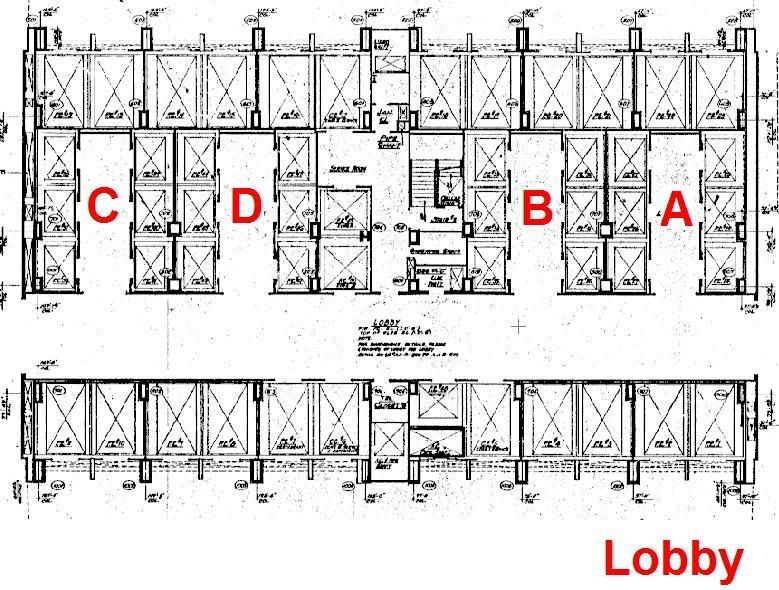
First lets look at the lobby
lobby.jpg


The locations of the elevator banks A,B,C and D i've added, are correct to the floorplans.

In the quote, we hear that when firefighter Lieutenant Bill Wall first enters the north tower, they tried an elevator in the first bank. Only one of the elevators still had its lights on, the rest had their doors blown off. This quote is excellent, because we know that Lieutenant Bill Wall is referring to a local elevator bank, not any of the express elevators or freight elevators. We know this because Lieutenant Bill tells us the bank he is referring to has 6 elevators in its bank, and this could only mean a local bank. He also then tells us he tries the next elevator bank of 6, a bank which they were able to find a working elevator, which took them as high as the 24th floor.

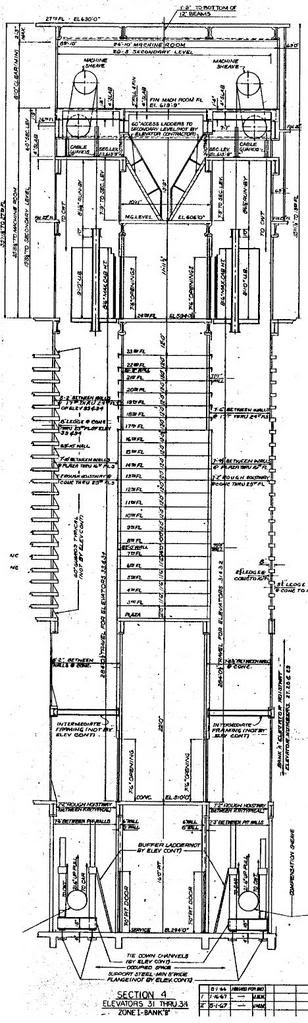
By looking at the local elevator elevations, we see that just one local bank had a top floor of floor 24.
That bank is bank B.
bankB.jpg


So we know that the elevator Lieutenant Bill Wall took up to the 24th floor was located within bank B. This also means that the first bank that Lieutenant Bill describes as having all elevator doors blown off except for just 1 shaft, had to of been bank A.
Because in order for bank B to have been the next bank after the first bank, this could only mean the first bank was bank A.

From Lieutenant Bill Wall's detailed account, it is clear that upon entering the north tower lobby, Lieutenant Bill entered the core of the building from the east. First trying a local elevator in bank A, then finding a working elevator in bank B.

So tell me debunkers, how does jet fuel find its way into bank A?
A bank of local elevators which only serviced up to floor 16, and then on floor 19 became floorspace for toilets.
A bank which was nowehere near the only 3 elevator shafts which had continuity from the impact zone to the lower levels.

Here we see a poor quality screenshot taken from the east of the core, looking west.
wtcbasementlobbycoredamue9.jpg


Local elevator bank A is located in the first opening closest to us on the right hand side. It is where the man in the yellow shirt appears to be emerging from.

Note that this area does not appear to be burnt.

If the account of Lieutenant Bill Wall is correct, then the screenshot shows where Lieutenant Bill would have entered the core area.

Debunkers often say, explosives do not produce significant flame, and the burnt area we see within the centre of the core, would not have been produced by explosives.
Ok, we know that it was possible for a jet fuel fireball to emerge from shafts 6, 7, or 50, it's also possible that this fuel fireball was what caused the burnt walls and ceiling shown in the screenshot, as the centre of the core is where shafts 6, 7, and 50 were located.

Lieutenant Bill Wall tells us bank A had 5 out of 6 of its elevator doors blown off. Their appears to be no burnt walls or ceiling around elevator bank A.

Do the debunkers have this right?

The centre of the core area, where quite possibly burning jet fuel emerged, is black and charred. Elevator bank A, where Lieutenant Bill witnesses blown elevators, remains unburnt. Unburnt just like the rest of the lobby we see in the Naudet-brother documentary, marble panels removed, blown plate glass windows, and fine dust.

Besides the fact that jet fuel cannot explain the damage to elevator bank A, the screenshot of the core further backs up the evidence that the fuel fireball, and the explosions were 2 seperate events.

In one damaged area we see charred walls and ceiling, in another damaged area we see none. Therefore, it's unlikely the damage in the seperate areas, was caused by the same phenomena.

Does anyone else corroborate the account of Lieutenant Bill Wall, that elevator bank A was damaged?

Perhaps, but Lieutenant Bill's account was much more descriptive than most.
Here are just a few accounts that could be describing the same damage.

[Walsh:] What else I observed in the lobby was that -- there's basically two areas of elevators. There's elevators off to the left-hand side which are really the express elevators. That would be the elevators that's facing north. Then on the right-hand side there's also elevators that are express elevators, and that would be facing south. In the center of these two elevator shafts would be elevators that go to the lower floors. They were blown off the hinges. That's where the service elevator was also.

[B.C. Congiusta:] Were these elevators that went to the upper floors? They weren't side lobby elevators?

[Walsh:] No, no, I'd say that they went through floors 30 and below.

[B.C. Congiusta:] And they were blown off?

[Walsh:] They were blown off the hinges, and you could see the shafts. The elevators on the extreme north side and the other express elevator on the extreme south side, they looked intact to me from what I could see, the doors anyway.
source
Note, Walsh is describing the local elevators within the core.

Tom Canavan:
"We got down to the first floor, and where the steps led out was in between the elevator banks in the lobby, of one world trade, on the concourse. Big security guard just standing there pointing, pointing east, saying just go.
And i remember looking around and all the elevator doors were almost knocked off, they were all crooked. So we made the turn, we went through the turnstyle, at that point we could see the concourse level, through the doors. All the lights were out, but the sprinklers were on. All of the glass in all of the windows and doors were shattered."
source
Note, Canavan comes out of stairway B, which is in the centre of the core. He turns to the east to exit, this means he passes elevator bank A, and is possibly describing them.

Firefighter Peter Fallucca: Before we got in, all the elevators were crashed down in the lobby, and we were going to the stairwell. See all the elevators were crashed down, big slabs of marble on the floor, all the ceiling tiles of the dropped ceiling was falling down, wires hanging. You see wires and stuff hanging inside the elevator shafts, because the doors were blown right off the elevators. (...) There was one body inside the lobby. Looked like his legs were chopped off. I don't know where he came from, but he had already had a triage tag on him. It was a civilian. I don't know where he came from, how he died. Looked like his clothes were a little burnt up on him, but his legs were chopped off.“
source
Note, Fallucca is heading for the stairwell, the only stairwell in the lobby is stairway B, stairway A & C start on the concourse level. Fallucca had to pass the local elevators, and was possibly describing them.

Firefighter William Green: We entered in through the front doors of the lobby. The lobby was screwed. All the windows were already broken. Marble walls that surrounded the elevator shaft, they were cracked and broken. I’m still thinking a bomb went off.

We headed for the B staircase. It was pretty much in the center of the core. We had to go through these turnstiles. I remember there was a lot of rubble on the floor there. There was elevator doors ajar. There were elevator doors missing. I could see an elevator car twisted in the shaft.
I remember I looked up at the ceiling because I thought maybe the ceiling got charred because there was a bunch of rubble on the floor. It was about three feet high in the middle. The ceiling wasn’t charred. So I had thought the floor blew up.
source
Note, Green is again heading for stairway B, and is possibly describing the local elevators
 
Here's an interesting quote that puts the damaged structure at a little more than a few pesky pieces of broken plaster board.


Quote:
"When the group reached the third floor, rescuers told them to be careful of the water. The sprinkler systems had been activated and gone haywire. Water was flowing out underneath the door into the stairwell and there weren't any safety strips on the painted steel stairs.

""When I got to the bottom, where the subway ran through the building, there
was five inches of water on the floor," she said.

"Rescuers told Colfer and the others they were going to open a set of doors
and then guide them through.

""They threw open the doors and it was dark, but you saw one small light,"
she said.

"Once her eyes were acclimated to the darkness, she saw concrete slabs where the walls were on the floor and that the concrete ceiling above had
collapsed.

""It was like a bomb had exploded," she said. "I thought, this structure has
this much damage and I'm on the bottom. What does the rest of the building
look like?"

source
[/QUOTE]

Hard Line did you actually read this part of the article, it continues from where you stopped:
Colfer and the others felt their way up a ramp, which brought them back up into the shopping mall level of the WTC building. At that point, the time for calm and order was over.

"We're going to throw these doors open and we want you to run!" rescuers told Colfer and the others.

"They threw open the doors and it was all this brightness and we did," she said. "We just ran."

Colfer ran as fast as she could. She wasn't out of the building five minutes when One World Trade Center collapsed.

This was taking place after WTC 2 had collapsed. The collapse of WTC 2 forced them to evacuate through the basement levels. The collapsed concrete she saw was caused by the collapse of WTC 2 on to the areas surrounding WTC 1. So your quote is useless for your purpose of fitting in some bombes.
 
Hard Line did you actually read this part of the article, it continues from where you stopped:


This was taking place after WTC 2 had collapsed. The collapse of WTC 2 forced them to evacuate through the basement levels. The collapsed concrete she saw was caused by the collapse of WTC 2 on to the areas surrounding WTC 1. So your quote is useless for your purpose of fitting in some bombes.

Where did I say that this was evidence of the basement explosions?

I used the quote as an example of the basement structure.
 
Look, this line of argument is not only pointless, it's just plain bizarre.

*snip*

I will tackle the energy "questions," below.

*snip*
---

I strongly suspect this entire exercise won't change your totally unsupported and fantastical beliefs one bit, but maybe I'm wrong. Justify my optimism. Try to understand. Take all the time you need.
:D:D:D

Posts like that is the reason I simply love this forum. And must be the reason only the most logic-impervious of truthers and other true-believers dare to venture here.

In essence,

Truther: "[assumptions, allegations, accusations, illogic inferences, cherry-picking, lies, plain nonsense]"

Person like Mackey, Gravy, Norseman, et al: "[Clear concise explanations backed by solid background knowledge, references, calculations, impeccable logic]"

Truther: "[Even more nonsense]"

The only thing that puzzles me is: Even if their belief is unswayable, they MUST be able to see how bad they are made to look?

Hans
 
Due to the location of shafts 6 and 7, it seems unlikely that the first and most explosive blast would originate from shafts 6 and 7. See NIST's fuel
distribution figures, note that shafts 6 and 7 are to the right of the red line, and were less affected by jet fuel than shaft 50.
[qimg]http://img65.imageshack.us/img65/7144/wtcbasementfinistfuel1cy9.jpg[/qimg]

Why did you use Case A when NIST used Case B aircraft damage for WTC 1 in their global model since Case B best fitted real life results? (NIST NCSTAR 1-6 page 235)

This figure from NIST NCSTAR 1-2 (page 201) shows estimated Case B fuel distribution:
181414756944418e99.jpg


That would bring a lot more fuel across your red line, hard lines.

(The NIST reports can be found here)
 
Why did you use Case A when NIST used Case B aircraft damage for WTC 1 in their global model since Case B best fitted real life results? (NIST NCSTAR 1-6 page 235)

This figure from NIST NCSTAR 1-2 (page 201) shows estimated Case B fuel distribution:
[qimg]http://www.internationalskeptics.com/forums/imagehosting/181414756944418e99.jpg[/qimg]

That would bring a lot more fuel across your red line, hard lines.

(The NIST reports can be found here)
My point was that shaft 50 was more affected by fuel than shafts 6 & 7.
That point has not changed.
 
It appears that this quote,

Firefighter Timothy Brown: We finally set up -- prior to this I believe it was the west side of the core of the building there were elevators. Someone had come to me and said that there were people trapped in one of those elevators. So I ran around the corner, and the hoist way doors were open, but the elevator car was only showing about two feet at the top of the door. You could see all the legs of the people that were in the elevator. I would guess there were about eight people in the elevator. The elevator pit was on fire with the jet fuel. People were screaming in the elevator. They were getting smoked and cooked. There weren't a lot of firemen there at the time. I grabbed some of the Port Authority employees and asked them where the fire extinguishers were and told them to get as many fire extinguishers as they could so we could try and fight this fire. As they were doing that, firemen started showing up, and I started asking them to get big cans, let's try to put this fire out.

Was not in regards to WTC 1 but WTC 2.

See here,
FF TIMOTHY BROWN #9110458
The second plane hit. Again I did not feel that. We did not know that happened until a fireman came into the lobby and told us that another plane had hit number two, the south tower. Calvin directed me to go to the command post in the south tower to help the Fire Department with their operation there and to let him know everything that was going on. I'm not exactly sure how I got there. I remember going out through a broken window and running I believe south along the West Street side of the complex as fast as I could so I wouldn't get hit by anything. I remember running across a parking lot. It was across from the hotel, which would have been the southeast corner of Liberty an West. There's a parking lot there. It was near the pedestrian walkway and all that. [...] So I remember running across a lot of debris. I didn't have on fire gear, so I remember trying to avoid the fire as much as I could. I ran into the doors of the Two World Trade on the Liberty Street side. I saw Chief Burns inside there. He was the first fire personnel that I saw in the lobby. I asked him if there was anything I could do to help. He was like, well, it's just like -- there was nothing anybody could do except try and get people out. So we tried to encourage -- I remember seeing a six-person team from ESU in that lobby. I directed them to wait. I directed them to wait and not to go upstairs until they reported in to Chief Burns so we had some accountability of who they were and where they were going to go. They finally did communicate with Chief Burns, and then they went upstairs. Again, an orderly evacuation of two. A lot of people were leaving. We finally set up -- prior to this I believe it was the west side of the core of the building there were elevators. Someone had come to me and said that there were people trapped in one of those elevators. So I ran around the corner, and the hoist way doors were open, but the elevator car was only showing about two feet at the top of the door. You could see all the legs of the people that were in the elevator. I would guess there were about eight people in the elevator. The elevator pit was on fire with the jet fuel. People were screaming in the elevator. They were getting smoked and cooked. There weren't a lot of firemen there at the time. I grabbed some of the Port Authority employees and asked them where the fire extinguishers were and told them to get as many fire extinguishers as they could so we could try and fight this fire. As they were doing that, firemen started showing up, and I started asking them to get big cans, let's try to put this fire out.
source

What does this mean?

Swing Dangler could be correct in his statement of the WTC 1 witnesses.

Some jref members still at one point hypothesized that unburnt fuel pooled in the bottom of the shafts.

Jet fuel falling from impact zone, could have reached the pits of an elevator in liquid form.

And, gravy now has at least 2 accounts in his paper on the north tower witnesses, that are referring to the south tower.

Further to the account of Judy Colfer describing collapsed concrete walls and ceiling in the lower basement. Whilst their is no evidence that this wasn't caused by the collapse of tower 2, their is also no evidence this wasn't caused by the explosions in the basement.
Colfer tells us she exited via the subway level.
Their were witnesses to an explosion in the subway, and also this report from a PAPD officer
transcript 10
pg 9
SEPTEMBER 11,2001
PATH - CHANNEL 021
RADIO TRAINMASTER (R2)
DURATION: 3.33 HOURS

PAPD OFFICER DESK: Police desk to 800.
PAPD OFFICER 800: (Inaudible)
PAPD OFFICER DESK: Eight hundred (Inaudible) three nine.
PAPD OFFICER 33: Three-three, desk.
PAPD OFFICER DESK: Go, thirty-three.
PAPD OFFICER 33: Myself and (Inaudible) to the Trade Center responding with scott
packs to the B-4 level. There's a report of a cave-in, and people trapped.
PAPD OFFICER DESK: Roger, three-three and eight-two Houston, World Trade
responding B-4 level on a report of a cave-in.
PAPD OFFICER: ESU units, do you copy?
PAPD OFFICER 33 : Three-three, desk.
PAPD OFFICER DESK: Go, three-three.
PAPD OFFICER 33: There's also been a cave-in at the platform of the PATH plaza ...there's a live electrical, and water running. Turn off the power in that area.PAPD OFFICER DESK: Roger.
PAPD OFFICER TRUCK ONE: Truck one, desk.
PAPD OFFICER: Truck one, go.
PAPD OFFICER DESK: Three-three is reporting that there is a cave-in, B-4 level, at
the World Trade, copy? A possibility of people trapped.
source

So it's quite possible this damage was caused before the collapse of the south tower.

But, let me guess, the cave-in in at the platform of the PATH plaza, was plasterboard?
 
Where did I say that this was evidence of the basement explosions?

I used the quote as an example of the basement structure.

I will reluctantly give you the benefit of doubt here. But she says the concrete celling above had collapsed, and we know that the floors slabs were made of concrete. So my take is that the concrete slabs on the floor were from the ceiling, and not the walls. It was also very dark.

But I do not think you are here to just ask questions. So if you believe that the damage in the Lobby and the basement levels at the time of aircraft impact were caused by something else than deflagration of unburned jet fuel fumes/droplets traveling down the elevator shafts, please state your theory.
 
Further to the account of Judy Colfer describing collapsed concrete walls and ceiling in the lower basement. Whilst their is no evidence that this wasn't caused by the collapse of tower 2, their is also no evidence this wasn't caused by the explosions in the basement.
Colfer tells us she exited via the subway level.
Their were witnesses to an explosion in the subway, and also this report from a PAPD officer
Quote:
transcript 10
pg 9
SEPTEMBER 11,2001
PATH - CHANNEL 021
RADIO TRAINMASTER (R2)
DURATION: 3.33 HOURS

PAPD OFFICER DESK: Police desk to 800.
PAPD OFFICER 800: (Inaudible)
PAPD OFFICER DESK: Eight hundred (Inaudible) three nine.
PAPD OFFICER 33: Three-three, desk.
PAPD OFFICER DESK: Go, thirty-three.
PAPD OFFICER 33: Myself and (Inaudible) to the Trade Center responding with scott
packs to the B-4 level. There's a report of a cave-in, and people trapped.
PAPD OFFICER DESK: Roger, three-three and eight-two Houston, World Trade
responding B-4 level on a report of a cave-in.
PAPD OFFICER: ESU units, do you copy?
PAPD OFFICER 33 : Three-three, desk.
PAPD OFFICER DESK: Go, three-three.
PAPD OFFICER 33: There's also been a cave-in at the platform of the PATH plaza ...there's a live electrical, and water running. Turn off the power in that area.PAPD OFFICER DESK: Roger.
PAPD OFFICER TRUCK ONE: Truck one, desk.
PAPD OFFICER: Truck one, go.
PAPD OFFICER DESK: Three-three is reporting that there is a cave-in, B-4 level, at
the World Trade, copy? A possibility of people trapped.
source

So it's quite possible this damage was caused before the collapse of the south tower.

But, let me guess, the cave-in in at the platform of the PATH plaza, was plasterboard?

In the sub levels of WTC many of the walls were made of masonry blocks like the one on this page:

http://www.espionageinfo.com/Vo-Z/World-Trade-Center-1993-Terrorist-Attack.html

That includes the walls separating the footprint of WTC 1 from the rest of the basement levels and parts of the corridors inside B-4. But the elevator shafts looks as though they were made of drywall boards with facing tiles on the outside if you study the architectural drawings for that level carefully.

They were not load bearing and not reinforced.

But according to Vincent Dunn's table you only need 2-3 PSI to knock down cinderblock wall like the one in the picture above. Well within the R.Mackey's worst case scenario.
EFFECTS OF EXPLOSION DESTRUCTIVE PEAK PRESSURE
GLASS SHATTERING : 0-5 PSI
FIREFIGHTER KNOCKDOWN: 1.PSI
WOOD PARTITION COLLAPSE: 1-2 PSI
CINDERBLOCK WALL COLLAPSE: 2-3 PSI
BRICK WALL COLLAPSE: 7-8 PSI
FIREFIGHTER LUNG DAMAGE: 15 PSI
THRESHOLD FOR FATALITIES: 35 PSI
50% FATALITIES: 50 PSI
99 FATALITIES: 99 PSI

So yes jet fuel deflagration could easily cave in a block wall between WTC 1 and the PATH area. But it did not collapse the wall between McCabe in the Refrigeration Plant and the interior of WTC 1 within equal distance from the elevator shafts as the PATH area.

I happened to skim through several Port Authority transcripts and police reports last night, and I do not think that the transcript you posted above is as straight forward as you assume when I look at the complete context of several transcripts and reports.
 
Last edited:
I will take a break in posting replies to your posts hard lines. But reading your first post I strongly suggest you take another round on the difference between a deflagration and a detonation.
 
Actually, I'd like to see that PSI list, because I have a VERY STRONG suspiscion that the "glass shattering" bit should be 0 to 0.5 PSI, rather than 0-5. I could not, however, find any other source on a cursury search that listed specific pressures.

However, I did find an interesting article about explosive damage, here. The relevent portion is about 4/5ths of the way down the page:
The air-blast shock wave is the primary damage mechanism in an explosion. The pressures it exerts on building surfaces may be several orders of magnitude greater than the loads for which the building is designed. The shock wave also acts in directions that the building may not have been designed for, such as upward on the floor system. In terms of sequence of response,the air-blast first impinges on the weakest point in the vicinity of the device closest to the explosion, typically the exterior envelope of the building. The explosion pushes on the exterior walls at the lower stories and may cause wall failure and window breakage. As the shock wave continues to expand, it enters the structure, pushing both upward and downward on the floors.

Floor failure is common in large-scale explosive attacks, because floor slabs typically have a large surface area for the pressure to act on and a comparably small thickness. In terms of the timing of events,the building is engulfed by the shockwave and direct air-blast damage occurs within tens to hundreds of milliseconds from the time of detonation.If progressive collapse is initiated, it typically occurs within seconds.

Glass is often the weakest part of a building,breaking at low pressures compared to other components such as the floors, walls, or columns.Past incidents have shown that glass breakage may extend for miles in large external explosions. High-velocity glass fragments have been shown to be a major contributor to injuries in such incidents. For incidents within downtown city areas,falling glass poses a major hazard to passersby on the sidewalks below and prolongs post-incident rescue and cleanup efforts by leaving tons of glass debris on the street.

Blast can cause significant casualties. During the bombing of the Murrah Federal Building, 168 people were killed. Severity and type of injury patterns incurred in explosive events may be related to the level of structural damage. The high pressure of the air-blast that enters through broken windows can cause eardrum damage and lung collapse.As the air-blast damages the building components in its path, missiles are generated that cause impact injuries. Airborne glass fragments typically cause penetration or laceration-type injuries.Larger fragments may cause non-penetrating, or blunt trauma,injuries. Finally, the air-blast pressures can cause occupants to be bodily thrown against objects or to fall. Lacerations due to high-velocity flying glass fragments have been responsible for a significant portion of the injuries received in explosion incidents. In the bombing of the Murrah Federal Building in Oklahoma City, for instance, 40 percent of the survivors in the building cited glass as contributing to their injuries. Within nearby buildings, laceration estimates ranged from 25 percent to 30 percent.

This just fits in perfectly with what we've been trying to explain to Swing here. The injuries sustained and the damage to the structure are NOT consistent with explosives.
 

ISF - Join now!

Every member here is approved by hand. No bots, no spam, just people who care about evidence and honest debate.

Membership is free!

Create your free account

Back
Top Bottom