leftysergeant said:
"We aren't saying that the fuel pooled, you are saying that we said it. We are not that stupid."
Ooops....

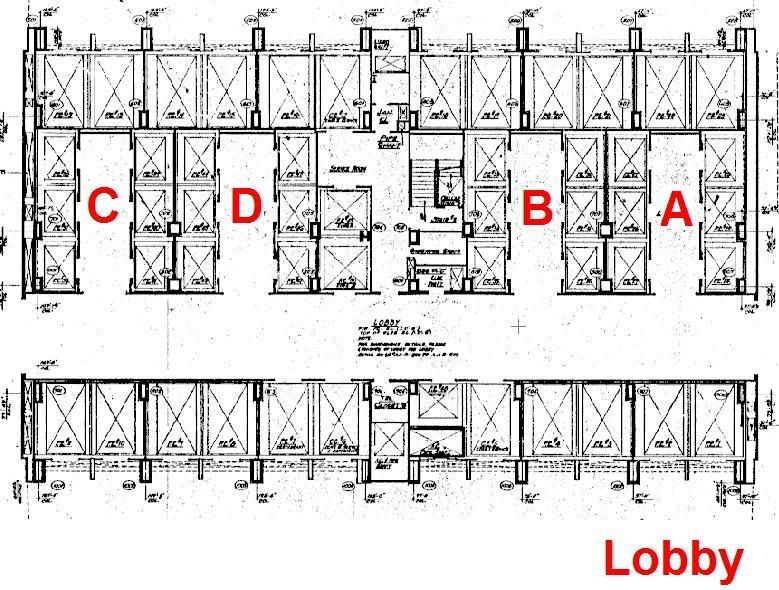
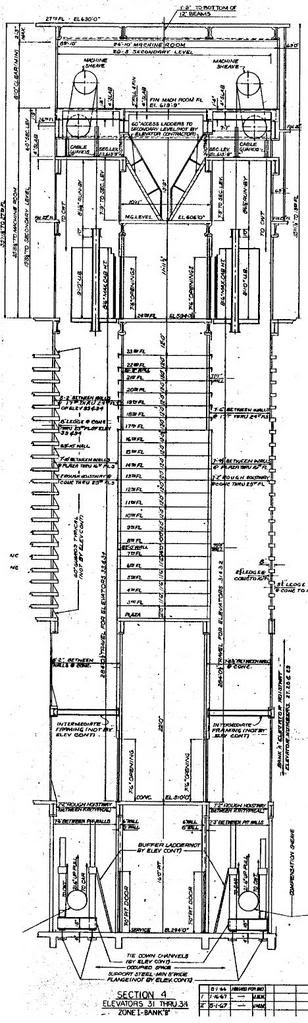
Firefighter Timothy Brown: We finally set up -- prior to this I believe it was the west side of the core of the building there were elevators. Someone had come to me and said that there were people trapped in one of those elevators. So I ran around the corner, and the hoist way doors were open, but the elevator car was only showing about two feet at the top of the door. You could see all the legs of the people that were in the elevator. I would guess there were about eight people in the elevator. The elevator pit was on fire with the jet fuel. People were screaming in the elevator. They were getting smoked and cooked. There weren't a lot of firemen there at the time. I grabbed some of the Port Authority employees and asked them where the fire extinguishers were and told them to get as many fire extinguishers as they could so we could try and fight this fire. As they were doing that, firemen started showing up, and I started asking them to get big cans, let's try to put this fire out.
source
leftysergeant said:
"We aren't saying that the fuel pooled, you are saying that we said it. We are not that stupid."
Ooops....
Swing Dangler said:
Ok, let me get this straight. The plane crashes, spills jet fuel all the way down Shaft 50 without it igniting into a fireball. Mr. Arturo whose elevator car's emergency breaks save his life experiences none of this jet fuel cascading down his shaft collecting in the bottom nor do anyone else in the basement witness or describe pools of jet fuel.
source
Dave Rogers said:
If he was in the elevator car, and the jet fuel went round its outside, what would he notice? If the jet fuel collected in the elevator shaft wells, who would be there to observe it?
source
R.Mackey said:
False choice fallacy.
Your opening statement describes what I think happened to create the
fireball that Rodriguez reported. That doesn't mean there was only one. Do
you have any idea of how much jet fuel total there was in the building?? Or
how many paths there were from point of impact to the bottom?
source
Dave Rogers said:
Just out of interest, is the following a possible scenario?
(1) Plane hits tower, fuel deflagrates.
(2) Due to oxygen exhaustion inside the tower, some fuel remains unburned,
particularly close to the centre where the lift shafts are.
(Combustion continues around the outside of the floor because of the air
supply through the windows broken by the initial deflagration.)
(3) Some of the unburned fuel falls into the lift shaft and falls to the
bottom, passing around the lift. At this point it isn't burning because it
was extinguished by (2).
(4) Some other event (electrical spark? falling burning debris?) then ignites the fuel at the bottom of the lift shaft (where there is now enough oxygen to support combustion), causing a fireball.
Since (4) isn't necessarily directly related to (3), it could take place
some significant time later. Since the fuel doesn't travel down the lift
shaft as a fireball, the fireball can precede the fall of the lift.
Everyone's account is corroborated.
Any problems with that, anyone?
Dave
source
Apparently, nobody had any problems with that.
Sounds good to me, but I can hear Swing already, "Source? Evidence?" Of course, his lack of evidence for bombs hasn't deterred him.
source
With regards to Mackey's "wild over estimate" energy calculation, according to him, in reality if we have just 290Kg of jet fuel, the fuel explosion would not be efficient and it would not consume the total 290Kg at once. According to Mackey's calculation, an explosion required to produce this "wild over estimate" of 5psi, would need to consume all 290Kg at once.
So, if R.Mackey's 290Kg of jet fuel figure is not consumed in the one explosion, any amount of fuel consumed less than 290Kg in an explosion would
produce less than his so called "wild over estimate" of 5 psi.
Going by Norseman's posted figures,
EFFECTS OF EXPLOSION DESTRUCTIVE PEAK PRESSURE
GLASS SHATTERING : 0-5 PSI
FIREFIGHTER KNOCKDOWN: 1.PSI
WOOD PARTITION COLLAPSE: 1-2 PSI
CINDERBLOCK WALL COLLAPSE: 2-3 PSI
BRICK WALL COLLAPSE: 7-8 PSI
FIREFIGHTER LUNG DAMAGE: 15 PSI
THRESHOLD FOR FATALITIES: 35 PSI
50% FATALITIES: 50 PSI
99 FATALITIES: 99 PSI
Even if in reality 290Kg of jet fuel in the basement could produce 5psi, does that appear to be a "wild over estimate"? Even if we accept the minimalistic estimates of damage to the lower levels put forward by many here. Their is no denying the glass was shattered, and I think it's safe to say the lobby plate glass was far from your average glass.
There can be more energy in a bunch of candles, than their can be in a hand grenade, but of course a bunch of candles are not going to blow you to pieces anytime soon.
So its important to look at not only how much energy is contained within a substance, but also how that energy is released. Perhaps R.Mackey would like to apply his energy calculation to the figures NIST gave us for the initial deflageration upon impact on the towers?
The impact explosion consumed 1000-3000 gallons of fuel. 1 gallons equals 3 kg (rounded down). 3000 kg containing an energy of 129 giga joules. 3000 gallons equals then 387 giga joules. The average therfore is 258 gj, that's twenty times the amount of the energy released by the 290kg R.Mackey thinks is sufficient to explain all the damage.
One has to wonder, how such a great release of energy, produced, according to official reports, - no great overpressures. The reason is of course that not all the energy was released at once, but as FEMA states within two seconds and not in microseconds. So we have here 1000-3000 gallons of aerolized fuel exploding in a deflagration, producing no significant pressure wave, and one tenth to one thirtieth of that, produced pressure reducing walls of several basement levels to rubble within seconds of the impact. How did 100% of the people on floor 91 of the north tower, survive? The floor below the lowest point of impact where above a 1000-3000 deflageration took place.
In R.Mackey's model, 290Kg of fuel in the form of gas, explodes all at once. Although R.Mackey has told us plenty of times there was enough air, he neglects to mention that unless all of this 290Kg of jet fuel had a fuel air ratio of .7 to 5% then, not all of it will burn at once. Again, if less than 290Kg of fuel burns at once, we get less than 5psi in R.Mackey's model. Hardly a "wild over estimate".
All this nonsense above, trying to pin Swing Dangler on a unintentional, detonation comment, is irrelevant. If we are talking about igniting a fuel/air mixture, the mixture must be between the lower and upper explosive limits. Fuel alone does not burn, when a pool of fuel is on fire, it is the top vapour (fuel/air) layer that is burning. Your example leftysergeant, of your fuel/air mixture being too rich in your car, is simply when the mixture is too rich to ignite in the cylinder of the engine. The unburnt fuel is expelled through the exhaust, and later ignites in the exhaust when the fuel can mix with air.
As R.Mackey has mentioned, it's unlikely the fuel burned all at once, we also
know through various accounts their were numerous explosions/fireballs.
According to Arturo Griffith, he experienced 2 explosions after stopping, blowing the elevator doors in.
When the elevator finally stopped, they had an explosion (1) that bring the doors inside the elevator, and I think I'm sure that that was what broke my leg. And then they had another explosion (2) and the panel that threw me, you know, against the wall, and I guess I was unconscious for a couple of minutes because somebody else was in the elevator with me, and they say that they was trying to get my attention and they didn't get no response from me.
source
Arturo shared the elevator car with Marlene Cruz, after the 2 were rescued
from the car, Arturo witnessed a fireball emerge from the shaft.
'I don't know who saved me. It was so black and smoky. I couldn't see nothin',' Arturo said. 'When they got me out, I told them there was someone else down there, a woman. They went back to get her. Seconds after they pulled her out, a ball of fire came down the shaft (3). They almost got killed.'
source
So we already have 3 possible explosions/fireballs
What about the account of Edward McCabe?
I was in the refrigeration plant in tower 1 sub basement 4. I was passing through when I felt a slight shifting of the building. I froze right where I stood and listened....nothing.. about 30 seconds past and to my left about 30 feet from me was a stairway leading up to a door. this door explodes off its hinges and white smoke came into the plant.
source
After the plane impact, Arturo Griffith plummets in an elevator then
experiences 2 explosions, does not respond, is rescued, tells the rescuers to get Cruz, then Cruz is rescued.
Their is a significant amount of time after the initial explosions, then Arturo witnesses a fireball which does not appear to have created significant over pressure.
After the plane impact?, an estimated 30 seconds later Edward McCabe witnesses a door blown of it's hinges on the perimeter of the WTC.
Due to the timing, the damage caused by the explosion McCabe witnesses, and also the lack of pressure from the fireball Arturo witnesses, it is unlikely this fireball witnessed by Arturo, caused the explosion witnessed by McCabe.
If McCabe's account is accurate, and we only have the official story to work with, this explosion must have come from shafts 6 and 7.
Due to the location of shafts 6 and 7, it seems unlikely that the first and most explosive blast would originate from shafts 6 and 7. See NIST's fuel
distribution figures, note that shafts 6 and 7 are to the right of the red line, and were less affected by jet fuel than shaft 50.
R.Mackey tells us,
And over 70% of witnesses interviewed from the whole ruddy tower smelled jet fuel. That's thousands of witnesses. If they can smell it, that means it's been aerosolized. And that means it can explode.
Actually thats far from correct, otherwise the next time I lite a cigarette within a km of the airport, I'm going to do some damage. A human can smell fuel at as low as 1 part per million, for a jet fuel/air mixture to ignite, we need to be in a range between 7000ppm to 50000ppm. Any attempted ignition outside of this range, and the mixture will either be too lean or too rich to ignite.
Hazardous exposure levels came into effect in 2003.
The American Conference of Governmental Industrial Hygienists (ACGIH) lists the threshold limit values (TLVs) for jet fuel as an eight-hour time-weighted average (TWA) of 200 mg/m3 (total aerosol and vapor). This converts to approximately 30 parts per million (ppm) when expressed in isobutylene units.
source
We are talking about Griffith being in an elevator, with a fuel air mixture surrounding him, of between 233 to 1666 times higher than the above set hazardous exposure levels, yet Griffith does not find this significant enough for any mention? And in the very least, is not overcome by fumes?
It is impossible that Arturo & Cruz would not have noticed significant amounts of liquid fuel cascading in, and around, his open car. It is also near impossible that Arturo & Cruz would not have noticed a significant amount of fuel vapour forming in and around his car.
Given the above, it would appear the jet fuel did not reach the lower levels until a short time after Griffith and Cruz were out of the shaft. Given the location of shafts 6, 7, and 50, and NIST's jet fuel distribution figures, it would be reasonable to assume that the fuel did not reach the lower levels of shafts 6 and 7 until around the same time, or later than it did shaft 50. For this reason, it's unlikely the initial explosions Arturo experienced, originated from shaft 6 & 7.
Furthermore, if the "new jref hypothesis" is that the fuel was formed into an aerosol as it fell down the shafts, then why was the damage so localised to the lower levels and not up the length of the shaft?
Why an exploded shaft of floor 22, when the surrounding floors were undamaged?
With regards to overpressure estimates, Mackey says,
We can describe the damage qualitatively:
a.. There was extensive damage to interior and furniture over a wide area.
b.. Damage to the structure, however, was minor to negligible.
c.. There are no reports of anyone being killed by the blast. The
principal danger was fire.
Their are plenty of reports of people killed in the basement, there is no evidence they weren't killed by the blast as R.Mackey claims.
Here is one from the lobby,
"There was one body inside the lobby. Looked like his legs were chopped off. I don't know where he came from, but he had already had a triage tag on him. It was a civilian. I don't know where he came from, how he died. Looked like his clothes were a little burnt up on him, but his legs were chopped off."
source
I think it's safe to say this guy didn't die from burns.
And minor structural damage?
It seems now accepted by everyone except for
gravy that in order for McCabe's account to be correct that 3 walls and a door were blown off between McCabe and the 6 and 7 shafts. I've given my
reasons why I believe this coridoor would have been masonry, and am trying to confirm this. It seems that the knee jerk reaction on jref is to minimize damage and claim everything was light weight plasterboard. Hardly sceptical.
And how much force would be required to break through one of the plasterboard elevator shaft walls?
We only have to read the account of Perrito Blanco.
"Then I smelled smoke. This changed things. We had to get out. I got out my handkerchief and covered my nose and mouth. Then I remembered that it was better to wet it so I dipped it in my milk. I suggested to the others to do the same. We pried open the doors again and laid down the window-washer's pole to keep the door open. It was the perfect size. Now we started kicking the hell out of the wall in front of us. It was no use. It was sheetrock, a.k.a. plasterboard or drywall, in 2 feet wide sections with a steel frame around it. It hardly moved. We would have to dig through it."
""Eventually, someone got through the wall. We now had a hole about the diameter of a finger and fresh air was coming through. The elevator shaft
wall turned out to be 3 inches thick. It consisted of 3 ply of one inch sheetrock held together by the steel frame I mentioned. We continued to chip away and kick at the wall. Then I noticed John the window-washer was holding a piece of the squeegee that had come off. It was the part where the pole screwed in. It was triangular with 2 pointy corners and the corner where the pole screwed in. I grabbed it and started hacking to one side of the hole and another guy worked on the other side. Then I got the idea to try and score the wall so that when we kicked at it, there would be weak points. As we took turns kicking the wall, my foot finally went through and we had a nice sized hole now. We took turns kicking at the edges of the hole making it bigger. Eventually, we had a hole about 2-3 feet high by 1 foot wide. But there was another wall on the other side. "
source
Here's an interesting quote that puts the damaged structure at a little more than a few pesky pieces of broken plaster board.
"When the group reached the third floor, rescuers told them to be careful of the water. The sprinkler systems had been activated and gone haywire. Water was flowing out underneath the door into the stairwell and there weren't any safety strips on the painted steel stairs.
""When I got to the bottom, where the subway ran through the building, there
was five inches of water on the floor," she said.
"Rescuers told Colfer and the others they were going to open a set of doors
and then guide them through.
""They threw open the doors and it was dark, but you saw one small light,"
she said.
"Once her eyes were acclimated to the darkness, she saw concrete slabs where the walls were on the floor and that the concrete ceiling above had
collapsed.
""It was like a bomb had exploded," she said. "I thought, this structure has
this much damage and I'm on the bottom. What does the rest of the building
look like?"
source