• Quick note - the problem with Youtube videos not embedding on the forum appears to have been fixed, thanks to ZiprHead. If you do still see problems let me know.

Simple Challenge For Bigfoot Supporters

Status
Not open for further replies.
And she is a quite a lady, too...


"That's why the Lady is a Bigfooter..."

_1406579_sinatra150.jpg
 
I never need an apology from you, oh hairy one!:D

Besides, I agree with the premise of your statement.

BTW, have you had a chance to get Richard Nelson's book, "Make Prayers to the Raven"? As an anthropologist yourself, I can virtually guarantee that you'd find it outstanding.

No, I haven't gotten it yet. I've been very busy finishing my book on traditional NA bigfoot stories. Now that I'm done, I can read something I chose to read vs. have to read!
 
...You seem to indicate a continent-wide dispersal of sasquatches and a limited movement in seeking resources thereof. As one of the hypothetically largest NA mammals (in addition to the 84 identified) how do you think they are able to maintain such a population with varying survival strategies across the continent and at the same time to this point avoid identification?

Firstly, "continent wide dispersal" might be confusing to some. An example would be brown and black bear densities in Alaska:

Brown bears are found statewide, with the odd exception of a few islands in Southeast (which also happen to be strongholds of exceptionally high black bear densities). But while brown bears are found throughout Alaska, the Gulf of Alaska coast (along with the huge islands of the Alexander and Kodiak Archipelagos) boast densities of nearly one bear per square mile, while in the Arctic (north of the Brooks Range) densities are about 1 bear per 300 square miles.

I think sasquatch densities are similar. It has been well discussed on BFF how sasquatch report densities are highest (continent wide) where precipitation is at or greater than 200 inches per year. This coincides almost perfectly with black bear densities.

Thus what we are left with are pockets of high densities continent wide, not a "continent-wide" dispersal.

Secondly, I've repeatedly written here and at BFF that I suspect some of these "pockets" are in danger of extinction. I don't think they can sustain themselves genetically forever in a contained, besieged condition.

Long migrations (like from Florida to the Big Swamp in Texas, for example) increases the odds of exposure, and I suspect the saturation of humanity between those two areas discourages (or at least impedes) migration by young, wandering males, which then lowers exposure to humanity.

Or in reference to this question...

Do you have any thoughts or surmations about what sasquatches adaptive survival strategies might be in Alaska?

...it would seem to get an answer I must order, wait for delivery, and then read the book you recommend.

I'm sorry. It would be tough to explain it all in an internet post, and Nelson does a much better job of explaining what the Koyukon told him, but in short:

The Koyukon claim that in their region (sub-arctic), the "woodsman" hibernates like a bear. If these creatures live in such a region, this would have to be so.

I agree that claim introduces the "primates don't hibernate" line, and I really don't want to get into such a game with the likes of LTC over it, so I hesitate to state it..........

But there it is. The aboriginals of the area claim it, it does make some biological sense, and we are left to wonder.

So, in that case, having read the book do you have any thoughts regarding the adaptive survival strategies of sasquatches in the areas of Alaska where you think they might exist?

In the case of Southeast Alaska, I don't think any "adaptive survival strategies" are needed. They are well built to exist there, the area is incredibly remote, it is incredibly lush, and food for all (including humans) abound.

In the case of the Yukon drainage, if these creatures exist there, they must hibernate during the winter, and that is exactly what the aboriginal peoples claim.

Again, if you have any questions for the skeptical, please share.

I have none.

Even if I did, I doubt I'd be impressed with the answers.

Call me skeptical...............
 
Last edited:
No, it's just now gone to the publisher, and I'm sure we're going to be adding additional detail (like maps). So hopefully, it will be available this summer, at the latest. It is, of course, more of a anthropologic study than a book about bigfoot (ie., there are no sighting reports, hair, prints, poop, or otherwise).
 
So are you saying that the evidence is so sucky for the trackway being seven miles long that you don't really know if that claim is true? Are we back to taking the words of folks as gospel? What about Heironimus?

Yes, what about him? Maybe you could show us the muscle definition in the Morris suit, now that I''ve shown what he looks like bulked up in a costume.

I know the distance was measured in some way, I just didn't ask what method was used. This was a casual conversation with the co-discoverer, not an interogation.
 
No, it's just now gone to the publisher, and I'm sure we're going to be adding additional detail (like maps). So hopefully, it will be available this summer, at the latest. It is, of course, more of a anthropologic study than a book about bigfoot (ie., there are no sighting reports, hair, prints, poop, or otherwise).

Good. I have plenty of those.

Dave Murphy's book should be out sometime this year, too. I was feeling rather dismal after I finally got Jeff's book after such a long wait. What was there to look forward to? Was there life after Meldrum? And now I see that yes! there are new worlds to conquer and more books to buy! In the meantime I've been spending too much on DVDs and I haven't even finished Raincoast Sasquatch yet.
 
That was the professional opinion of deputies at the scene.


Why do you think hoaxes explain all this when in circumstances like those they would be so completely unlikely?

Open field, no fences, fresh deep snow, huge stride, no sign of any kind of human activity in the area..................

Aside from the sheer improbability of a hoax in a case like that, who would go to all that trouble? Don't even try to sell me on the idea of an escaped circus clown on stilts with heating devices in the oversized feet to compact the snow and prevent spatter.

Don't call me Wu, Hatter.

Ok A.) I don't describe it all as hoaxing just one of the many reasons and B.) I would think the crop circles would suffice here as an example of just how ingenious human beings can be and the kind of trouble they would go to to effect a hoax....but that's just me.
 
A good hoaxer is one who tricks Lu without her knowing it. Forget about that happening. She has psychic powers to out them all. That's why the Lady is a PGF Fan.

That's exactly what I'm saying. It borders on conceit how Bigfoot Nation just knows beyond a shadow of a doubt that something could not have been hoaxed.

IMO....until such time as we have confirmed the existence of Bigfeetsus (which I would say is highly unlikely to ever happen.) Hairy Biped of Unusual Size should always be trumped as an explanation of anything Bigfooty by either hoaxing,misidentification,hallucination and/or outright lying.

I'm going with hoaxing (ie witness was hoaxed) and misidentification as the two frontrunners...but that's just me.
 
I'm going with hoaxing (ie witness was hoaxed) and misidentification as the two frontrunners...but that's just me.

Well, those two causes will cover every kind of Bigfoot claim if Bigfoot doesn't actually exist.

Lying is a hoaxing, and hallucinations result in misidentifications.
 
Oh desertyeti, would it be ok for me to post these pictures over on the BFF? I think it would make an interesting contrast to the photos posted by wolftrax. For the record, unless my eyesight is poor, I don't think it shows the same sort of casting artifacts that tube and wolftrax produced with their experiments. In fact, all I see are regular pour marks (that I get myself) that I don't think is being mistaken for dermal ridges.

Below are photos of a track cast (whole specimen and close up of the central portion) I made by pouring hydrostone plaster on top of a recently poured (still damp) plaster cast of roughly BF-proportions. The pseudo-dermals are quite a bit smaller than those seen in the "Onion Mountain" and other prints, and in fact, are just about the correct size to be human or ape dermatoglyphics. But they're dessication ridges, not dermals. They are clearly visible on the perimeters of the larger, more obvious pour boundaries of the casting material.

The importance of this specimen, in my mind is that it shows that dessication can occur even in a damp substrate (not-yet-cured plaster), as long as there is enought of a chemical reaction to draw water out. Gypsum is a great mineral for doing this, as are clays of many types (as Tube and I have both discussed before).

This specimen adds yet one more example of very convincing-looking pseudo-dermals forming completely in absence of real features. The case for any BF print showing real dermals is even weaker now (actually, dead in my opinion), since these pseud-dermals are apparently a lot more common and a lot easier to produce than many would have us believe.
Sorry for injecting science into the topic of BF.
 
More grist for the mill...

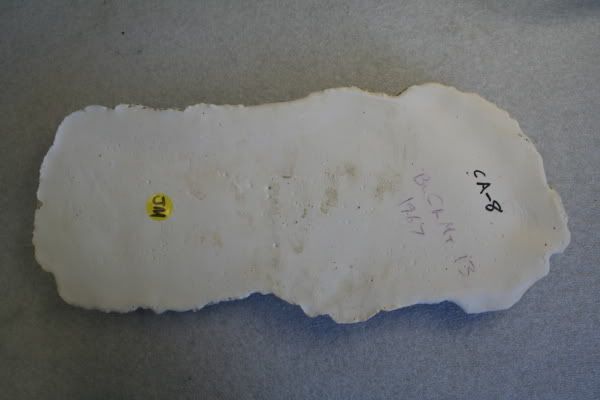
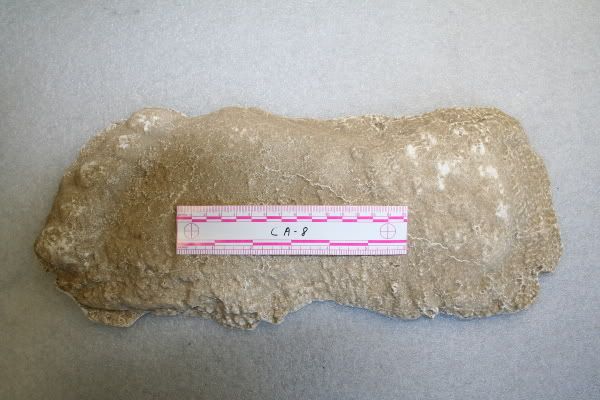
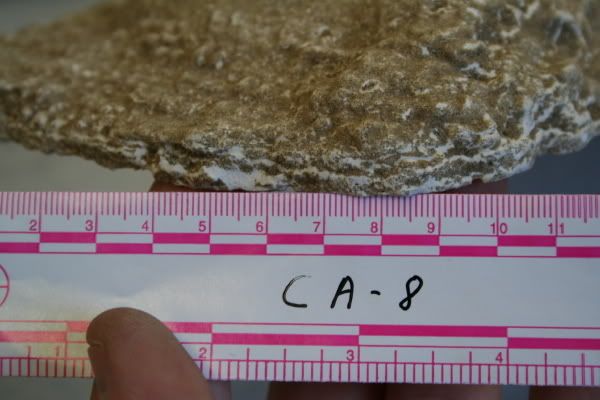
Here are some photos of CA-8, another one of the Blue Creek Mountain - Onion Mountain casts. It appears to be the LEFT cast of the 13" trackway. Depending on what is plaster "sprue" or pouring overflow, the ruler in the photo plus the number 13 written on the dorsal surface of the cast suggests that the cast is indeed 13 inches long.

IMG_3406.jpg

IMG_3408-1.jpg


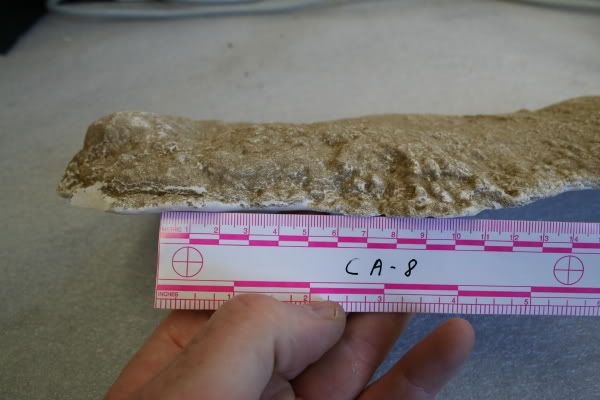
Ridges are seen on the periphery of this cast too, though not as defined as on CA-19 or even CA-6.

IMG_3409.jpg


IMG_3412.jpg


IMG_3414.jpg


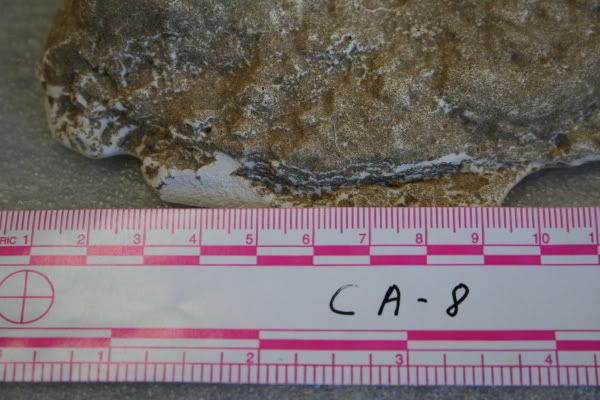
These ridges strike me as verging on simply random texture, but they are indeed distributed in the way known desiccation ridges are. My take on them is that they are MOST LIKELY desiccation ridges.

The last photo in this series is intriguing, as it seems to be of the very posterior edge of the heel, in what is probably the "sprue" or plaster overflow. I regret not documenting this more carefully, as it would PROVE that we are seeing ridges on the cast where they CANNOT be dermal ridges.
 
IMO, because those people aren't very interested in being informed on the subject or, conversely, they are and wouldn't define their thoughts regarding the matter as 'lame explain-aways' and remain unconvinced as to what's presented as reliable evidence of bigfoot.

Good answer.

Understood. OK, let's talk about hair. What makes you think that something other than sasquatch has been safely ruled out? Have they not been described as for all intents and purposes indistinguishable from human hair?

Dr. W. Henner Fahrenbach, right? There's the lack of a medulla, which actually is one of the distinguishing characteristics. The problem has been in getting enough unfragmented DNA to permit sequencing. Purported sasquatch hair tends to be about 3" long but has tapered ends, meaning it's never been cut. Comparison to hairs of other North American mammals show they're not a match. One report put them in the human, gorilla, chimpanzee group, but they were none of those.

This is from Dr. Carlton Coon:

"Professor Stephen I Rosen of the University of Maryland has identified its hair as that of a previously unknown primate--and he has hair on file for most of the living primates of the world. He has given me permission to state that its scale pattern is primate, its pigment dense and black like that of a lowland gorilla, and its internal structure "unusual." This last refers of course to the medulla, which is quite variable among the living races of man.

On this substantially impeccable evidence we may be justified to state that a primate other than man, which is either a pongid (ape), or hominid (kind of man) is alive in Washington, even if the hairs did not come off the animal identified as the creator of the local disturbance."

http://www.bigfootencounters.com/articles/coon.htm

Results of DNA testing such as "too close to human to rule out contamination" don't bother me much, since contamination can happen at the vial manufacturing level, but our DNA is only about 1% different from chimpanzees. We're dealing with an unidentified, bipedal hominid primate that may be more closely related to humans than chimpanzees are.

Please be aware that for the sake of control I'm going to disregard any exchange between you and another member related to the Q&A as it contaminates the process. Doing this by PM defeats the purpose and you're free to engage or ignore any comments.

If you really are sincere in a desire to change perspectives on the subject than I'm exactly the type of person you should engage in this manner as I've already stated that any flaws in my understanding will be objectively learned from. Please remember my interest is not in enhancing or seeking affirmation for a disbelief in bigfoot.

I thought I detected a hint of neutrality early on. That's a rare commodity on this board. I'd much rather discuss than engage in warfare.

I don't really have a question at this time. Huntster seems better at that than I am, so I'll let him ask two while I pass.
 
The hoaxers are no more likely to be shot at, seen, or photographed than sasquatch, imo.

It's the same old tired junk.

If the prints are where no one would see them, then they're real because no hoaxer would bother...

If the prints are in Grand Central Station, they're real because a hoaxer would have been seen...

It's just so Conveeeeeeeenient isn't it??

IMO.... the best option for hoaxery is way out in the boonies. First off no one to bother you or witness you faking tracks but also it lends an air of realism...because the "nobody would bother" excuse is automatically invoked by Bigfoot Nation whenever it is finally found.

Which begs this question.....how long do you think such a trackway (hoaxed or otherwise) would stay relatively intact way out in the boonies? Months? Years? Also wouldn't age help lend an air of authenticity to the find? Sort of giving the thing character....rocks and twigs all along the trackway, leaves strewn over it...tracks obviously looked old or whatever...I don't know just thinking out loud I guess....I mean wouldn't you want the thing to look aged a bit? If you were haoxing it that is??

I'm thinking the good hoaxers do not need nor desire immediate payoff...so they set about finding a nice suitably remote location where they can work without interruption....can go back many many times over a a period of months or maybe even years for that matter till satisfied with results as well as to remove sign of human activity...and than just sit back and wait for it to be discovered....and consequently drooled over by Bigfoot Nation.

Why is that not plausible??
 
Let me add something to the challenge :

Who can pick out the known dermal detail from the alleged detail,
along with a known artifact detail ?

Do you think it would require a fingerprint expert, or a well papered anthropologist to tell for sure ?

[qimg]http://www.intergate.com/~gregorygatz/images/SKIN3.gif[/qimg]

At least one fingerprint expert I know of, has staked his reputation on the conclusion that one of the swatches above, is an impression of dermals from a non-human, North American primate ...
OK, count me in. Labeling the photo's as they appear:

A B
C D

a) dessication ridges
b) alleged detail
c) known detail
d) dessication ridges

What do I get if I win?
 
Sure. But I'm slow sometimes, got a lot on my plate. Sorry if I missed anything previous but I'm too scared to go back through the pages.
Great, thank you. I don't think I'd want to wade through it if I didn't have to either.
Yes...percentage is about 98%
Gotcha. OK, in your opinion, if within reason money and time was not a restricting factor, what would your best advice be for me if I was intent on seeing a live sasquatch?
Question to you: Why, as a skeptic, do you care what I/huntster/LAL believe? Our opinions are just that, opinions. Without proof, I wouldn't expect you or anyone else for that matter to change your opinions, so why the cursority?
Mad Hom earlier said he wasn't quite sure of the point to which I responded:
The point of a simple structured Q&A is that with people like Lu and Hunt you have people that are confident in there positions and have given the matter more than a good deal of thought.

In such a dialogue any inherit flaws or inconsistencies in any of our perspectives on the matter will make themselves apparent. This means if I or they are taking something however seemingly inconsequential for granted we'll be able to identify and learn from it. If I'm confident in myself and my position on the subject than I have no reason to be reluctant at such a dialogue and if I'm not than I really shouldn't be expounding anything anyway.
This of course applies to yourself as well. Individually, Huntster's outdoors/wildlife/hunting experience along with a find of what was interpreted as sasquatch sign, LAL's detailed general knowledge, and your professional background and experience make you all uniquely qualified participants for the dialogue.
 
Status
Not open for further replies.

Back
Top Bottom