• Quick note - the problem with Youtube videos not embedding on the forum appears to have been fixed, thanks to ZiprHead. If you do still see problems let me know.

Simple Challenge For Bigfoot Supporters

Status
Not open for further replies.
Lu, do you think the indicated margins in those ancient tracks was a feature of the foot of the subject, or maybe of erosion of the substrate?

The arrows actually point to possible midtarsal bending. Those features may well be of the foot. Dr. White was consulted on the possibility of insect burrowing. Do you know what they are?

I'm trying to point out that a sharp, or "monolithic margin" is a poor means of identifying a fake.

Tube seems unaware Wallace hoaxing in Northern California has been thoroughly debunked. I'm quite sure Wallace wasn't around to make the prints above. And I hope tube hasn't convinced himself his fakes would fool anyone.
 
I'm not sure how to respond to that. Those tracks appear indistinct and eroded. The multiple creases in them look like features in the rock that are unrelated to the foot.

The Bigfoot tracks in question seem to have much better definition and preservation. It seems pretty reasonable that the mono-margins found decent BF tracks is likely to be a feature of the foot. Tube showed how fake feet cause the mono-margin. He also showed how flat rigid fake feet cause a mid-tarsal break.

I think tube could pull off a successful trackway hoax with what he has learned.
 
Another obvious way to make fake tracks is with a composite technique, i.e. excavation and compression. See how in my fake track all the little plants and moss get squished into the bottom of the track?

Now if you READ KRANTZ you come across this photo on page 39 of a track associated with the fabulous Paul Freeman. KRANTZ is trying to wow us with how a flexible foot must have conformed over the rock in the track. Yeah, I've got to give to Freeman on this one, the rock was a nice touch. But you can see the soil has actually been excavated, as all the little plants are gone from the bottom of the track!

You can tell that a compression happened after the excavation, as the track had the magical DERMAL RIDGES impressed into them. Krantz made much of the dermal ridges, but kudos to Chilcutt for identifying them as human, due to multiple core impressions.
 

Attachments

  • IMG_4751.jpg
    IMG_4751.jpg
    122.8 KB · Views: 1
  • IMG_4770.jpg
    IMG_4770.jpg
    71.1 KB · Views: 2
I guesss Paul Freeman was in Manitoba, too ;):

footprint_3.gif


http://blogcritics.org/archives/2005/05/31/171547.php

Chilcutt determined the dermals on that cast, as opposed to the cast that was "touched up" in the toe area, were human?

May we have a statement from Chilcutt on that, please?
 
Originally Posted by Huntster
To learn the truth.

The search may provide some "truths", but not all possible ones. It couldn't really provide a truth that Bigfoot does not exist.

Correct, but at least if wildlife management agencies made a good faith effort for the first time ever, they will have lived up to their responsibility.

Quote:
And the whole point in discovery is to confirm the truth. We can't get there if we don't look for it.

We can't show that BF does not exist, even if we go looking for it.

Is that your goal? To prove that bigfoot doesn't exist?

If bigfoot is found to exist, will you be angry?

What will you do if the appropriate agencies do act?

Demonstrate? Conduct civil disobedience? Manufacturer fake prints?

Just how far are you willing to go to defeat the responsible measure of trying to find out whether these creatures exist?

Quote:
A proper investigation will eventually determine the truth.

...and I think a bullet or truck grill should have already determined the truth by now.

Maybe what you think doesn't mean squat.

Quote:
William Parcher: I think that the only hope for a big funded search would have to come from private enterprise that is already predisposed to Bigfoot existing.

Quote:
Huntster: We've had that. It ain't cutting it.

First, that "private enterprise" is "enterprising", and that in itself is a source of ordnance for the denialists.

Secondly, that "private enterprise" has no authority whatsoever (legal, scientific, or otherwise) to determine anything that is potentially this important.

Thirdly, that "private enterprise" is under no oversight whatsoever.

Catch the clue..........

I think that the enterprising nature of private enterprises is what would produce the best results.

That hasn't been the case thus far, therefore the evidence indicates that you're wrong.

That enterprise can list cash, fame and scientific history-making as its rewards after a confirmation.

Where is this "cash" coming from?

Didn't I already ask you that?

Where's the answer?

They can decide themselves the ranking of the importance of those rewards, but nonetheless they will get all three.

Says who? You?

Where does the cash come from?

That enterprise probably wouldn't be the authority to make the meaningful scientific evaluations of the body. I do doubt that the enterprise itself would have any trouble determining that the 9 foot ape carcass in their truck is "that Bigfoot thing that everyone has been talking about". The scientists will later tell you where it seems to fit in the evolutionary scheme.

Which "scientists" are those?

Quote:
Me: Many are going to be looking for a return on investment.

You: Official agencies (charged with management, anyway) aren't supposed to be looking for a "return on investment."

I'm assuming you mean government agencies. Their return doesn't have to be monetary. They would be looking for a return that represents global cultural enrichment that comes from an increasing knowledge of the natural world. If they put the body on display in a national museum and charge admission - they could possibly recoup search costs.

The existing wildlife management agencies in the United States is split between state and federal governments, with some Native American management on some Indian lands, and in some states (specifically Texas) private management on large private land holdings.

If state and perhaps federal wildlife management agencies were funded to perform an active hunt for a sasquatch, or even just to rapidly respond to a current sasquatch event, and if they were successful in acquiring proof of existence, they are the very entities who would be legally able to authorize the proper scientific entities to study the phenomenon. They are the ones who issue capture permits, research permits, as well as award biological research contracts.

The private enterprise game has been tried more than once, they were poorly managed, poorly funded, disintegrated due to either tyranny or other lack of continuity problems, and if they were successful, the return on their investment would be controlled by the wildlife management agencies, anyway (unless they tried to profit from it without properly announcing their discovery).

The time to do this right has been long overdue.
 
I'm not sure how to respond to that. Those tracks appear indistinct and eroded. The multiple creases in them look like features in the rock that are unrelated to the foot.

You could start by identifying them. Do you know what they are?
 
Originally Posted by Huntster
Why are you so focused on who gets the money?

I'm just saying that somebody should get very rich when they confirm Bigfoot.

How?

Who pays?

Are you implying that I can run out and shoot a bigfoot, then sell him to the highest bidder from the back of my pickup truck?

You can't even remove rocks and flowers from federal lands without permission. Berry picking is regulated.

Quote:
The goal is to buy the truth.

That would be a good purchase. But you can't buy a truth like, "Bigfoot doesn't exist." As close as it could get to that would be, "This particular funded search did not confirm Bigfoot."

That's right.

And we won't hear either "Eureka!" or "This particular funded search did not confirm Bigfoot until an effort to look is made.
 
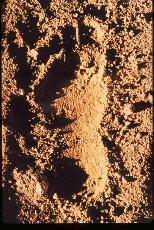
Check out the cool monolithic margins below! Can you identify the prints?

Uhhh, maybe someone could point out to Lu that monolithic margins involve where the toes join the foot..

Maybe Lu could show us the toes on those prints, and some dermal ridges..

And maybe something about how millions of year old prints might have a little bit of weathering to them; not to mention there is little to go on with those rock formations other than wishful thinking...
 
You can tell that a compression happened after the excavation, as the track had the magical DERMAL RIDGES impressed into them. Krantz made much of the dermal ridges, but kudos to Chilcutt for identifying them as human, due to multiple core impressions.

Hey Tube.. Check out those prints Lu just linked to as well as the one above..

Grass all around, except for in the body of the print ...

That shows you how sophisticated a crowd we are dealing with here; and Lu keeps pointing to this stuff and saying:

" See.. There really is a Bigfoot.. It's real I tell you ... "
 
That shows you how sophisticated a crowd we are dealing with here; and Lu keeps pointing to this stuff and saying:

" See.. There really is a Bigfoot.. It's real I tell you ... "

Yeah, you assume a certain level of sophistication among your readers, but sometimes you just have to spell everything out.

So here we go.

I'm not talking about 3.5 million year old tracks. I'm talking about fresh tracks. If you look at fresh tracks made by real toes in fine enough substrates, you learn certain things. One is that real toes create scalloped margins, just like a cheese grater does to a block of cheese. Another is that real tracks exhibit pressure releases. These are two features conspicuously absent in the Blue Creek Mountain track seen here.

To defend this track as that of Bigfoot could be written off as the raving of an Internet fanatic, except that Meldrum himself champions it as real! Not only that, but, according to his new book, this track was made by Patty herself, double ball and all!

I find it hard to believe, but no one in Bigfootery seems to have noticed that the left and the right tracks from Blue Creek Mountain ARE NOT EVEN BILATERALLY SYMMETRICAL!

Once you start working through this stuff, instead of simply regurgitating the dogma of Krantz, Meldrum, Green, et al, you really start to see how cartoonish all this stuff is. It's all a huge ridiculous joke. I continue to like the idea of Bigfoot on an esthetic level, much like how "Arena" is my favorite Star Trek episode, but take the "hard physical evidence" seriously? No way.
 

Attachments

  • BCMpic.jpg
    BCMpic.jpg
    44.8 KB · Views: 1
  • IMG_2232.jpg
    IMG_2232.jpg
    106.4 KB · Views: 1
  • post-2-1107299424.jpg
    post-2-1107299424.jpg
    64.7 KB · Views: 1
Uhhh, maybe someone could point out to Lu that monolithic margins involve where the toes join the foot..

Maybe you should check out Matt's website.

"Note how when pressed deeply enough, the track exhibits a “monolithic margin” or an unbroken arc at grade which represents where the leading edge of an unbroken object made contact with the soil. The leading edge of each individual toe at grade becomes straighter."

http://www.orgoneresearch.com/fake_feet_and Monolithic Margins.htm

Maybe Lu could show us the toes on those prints, and some dermal ridges..

Those prints actually were in volcanic ash, come to think of it.

And maybe something about how millions of year old prints might have a little bit of weathering to them;

After excavation, certainly. Just how would they weather while buried? Just how would weathering produce a sharp edge?

not to mention there is little to go on with those rock formations other than wishful thinking...

Do you know what they are? This should be easy since I've already identified them. Since you're referring to both as "millions of year old prints", it would appear you don't.

Getting back to "monolithic margins", this is Rick's answer to you on BFF:

" 'QUOTE(Skeptical Greg @ Oct 15 2006, 08:22 PM)

Wolftrax and RayG, Y'all go too !

There ...


O.K, now what about them monolithic margins ?'


Monolithic Margin – I take it that we are talking about the continuous edge line at the toes, which should have been broken or “scalloped”, following around the edges of them, producing an unbroken spline with no radical deviations of an arc centering somewhere on the sole of the track/cast versus centering on individual digits.

When I make a copy of a cast, I think Titmus did this as well, the original is placed on a very flat surface (this has been discussed before on the BFF by the way). No matter how flat one has made the dorsal side of a track, it will not be planar enough to stop liquids from running between it and the surface… so clay is squeezed in there to form a seal. If this wasn’t done the duplication liquids (latex) would surround the original cast and cure that way. Now how would you get the original out and still be able to use the hardened rubber mold to pour duplicate castings?

As far as I know, all casts that Matt has been working with have been duplicates made by someone. Duplicate casts made with rubber molds would exhibit this detail.

This seems perfectly normal to me in casts. As far as the one picture shown in Matt’s treatment... I see strong shadows with a hint of toe scalloping along the toe line, with the toes actually dug into the obviously raised ground level there and surface adhesion above them.

Was this margin present in Matt's bare foot tracks as well or absent?"

http://www.bigfootforums.com/index.php?s=&showtopic=16414&view=findpost&p=346690


No, I'm not "peeking through the filter". I decided to take you off for awhile. I'm getting your stupid posts via e-mail notifications.
 
Last edited:
What amazes me is that these BF footprints so often look fakey to skeptics and real to believers.

From my own perspective, it's hard to articulate my evaluation other than saying they just look fake to me. Even before I was told that real footprints should have some evidence of a push-off and that we shouldn't accept a defined mono-margin... they looked fake to me.
 
Yeah, you assume a certain level of sophistication among your readers, but sometimes you just have to spell everything out.

And I see you're doing it in your old, familiar way. I thought you left "bigfootery". Did I celebrate too soon?

I think DY called me a "Bigfoot enthusiast". I don't think it was a compliment. Perhaps you shouldn't call your "associate" that.

"Since I'm not a geologist, I decided to double check this notion with someone who is. Anton Wroblewski is both a PhD geologist, and a Bigfoot enthusiast."

http://www.orgoneresearch.com/testing_the_soil.htm

Got a match for that mismatched print with the mismatched Wallace wooden foot?

Could it be the photo was taken at an angle? Did you manage to cop more of Green's photos before they were pulled or did you just cherry pick the ones you think support your POV?

Are you ready with a statement from Chillcutt about human dermal ridges flowing over that rock? Was Ed Palma wrong?
 
Last edited:
Hey Tube.. Check out those prints Lu just linked to as well as the one above..

Grass all around, except for in the body of the print ...

That shows you how sophisticated a crowd we are dealing with here; and Lu keeps pointing to this stuff and saying:

" See.. There really is a Bigfoot.. It's real I tell you ... "

I have, of course, never said any such thing. What does that make you?

My point, which you seem to have missed entirely, is that there are other ways the center of a print can be clear. The weight can push in debris, e.g. (I don't think tube weighs upwards of 500 lbs.). In this case the print was on an anthill. The scoftics on the blog didn't notice that, but it's quite clear.

footprint_5.gif
 
So, from volcanic ash to silica and the lines didn't appear using OM soil. Am I getting that right?

"After 10 phone calls to the USGS and the NRCS, I had a few questions answered. My argument all along is simply this "If you are going to prove or disprove something, you should be as accurate to the original as possible". Matt Crowley early on started out with Plaster of Paris - but quickly moved on to other casting agents such as Hydrocal, and the soil he is using to test in is volcanic ash, along with other substrates I will add, but when he challenged me - the specific challenge was to use volcanic ash.

Guess what??

After these phone calls and discussions with soil survey scientists (who know what they are talking about) I have discovered the amount of volcanic ash in the soil in and around the Onion Mountain cast area is not even registered as a factor. There is no mention of this in any of the most recent reports dated 1979 and approved in 1984. These soil samples also predate the Mount St Helens erruption, and there was not an active volcano in that area during the time this cast was made.

I also discovered volcanic ash breaks down fairly quickly. In as little as 2 years, it can have a whole new chemical make-up and/or structure.

So, what does this mean?

I am currently in the process of trying to obtain this soil to test for "crowley lines". Will I get them? I dont know, but I will report all of my findings and keep everyone up to date.

I would like to thank Mr. Crowley for suggesting I challenge myself and do these tests for myself as that was very good advice. Am I nit picking Matt Crowleys work? No, I really do not think so, as my questions are valid, right on target, and have yet to be explained. If these "crowley lines" are so easily duplicated - why didnt I get them? I dont know.

It would be nice to know which casts and which artifacts were found in which substrates using which medium, like with a chart. I will be testing Plaster of Paris in hopefully typical soil from the Onion Mt. area with the method described to me by John Green, under the conditions he remembers.

Obviously Matt (Crowley) has found that under certain curcumstances these lines can appear. I don't know if he can describe what conditions will prevent them from appearing, however. I feel that both are needed to fully understand what is taking place.

So the real question is, with the materials, conditions and method employed by John Green in 1967 on Onion Mt., N. Cal. could these lines have been introduced artifically; not really something that was in the original tracks?


To be Continued........"

http://txsasquatch.blogspot.com/2006_05_01_txsasquatch_archive.html

And she continued here:

http://txsasquatch.blogspot.com/search?q=casting

"I was unable to duplicate Matt's work. I did exactly as I was instructed, and I could not do it. I have the feeling it may have everything to do with the casting agent. But, something we need to consider is this. Matt's work for the most part was in Volcanic ash - and Im sure that ash moved much easier under the weight of the casting agent. This soil is not the same - at all. If you look at the full foot cast you will see a depression in the soil (in the arch area) - that is where the casting agent made first contact with the soil - and it abruptly stops. Another thing to consider - soil is not Volcanic Ash. There is a big difference between the two.

My work is still ongoing - and if I can answer any questions I will be more than happy to. I will not guess - or make assumptions. I am not saying this is the final word on anything - and I am open to any and all suggestions. I am not doing this to trash Matt Crowley or his work, I just want answers and I want the truth, just as many of you do.

So, I think its pretty safe to say - based on this test: Dermal Ridges and Flexion Creases are possible in the soil from the Logging Road of Onion Mountain."

 
LAL, those pictures of tracks in the snow you posted and talking about faking tracks gave me a possibly simple way to fake such tracks (in snow, at least).

One simply needs a long pole, say two meters, which at either has a little extensions at ninety degree angles. Attached at each end on the extensions are your shapes serving as left and right bigfoot prints.

Kitikaze:
It's interesting that you picked one of the exact methods we used as kids to fake footprints. We had about a 12' aluminum pole with a threaded rod attached at 90 deg. at one end and a small counterweight at the other. We used a flat plywood foot at the end of the threaded rod to plant foot prints, mostly in snow, but occasionally in wet ground. I should mention here that, as Bigfoot wasn't part of our time or place, we were hoaxing "Devil's footprints", based on the accounts such as the 1855 event in England. Frank Edward's Stranger Than Science was our Bible, so it's kind of funny to find out we misread it: I discovered later the footprints in England were six inches apart and shaped like horseshoes. In our case we decided to make them inhumanely far apart, and made up our own symmetrical two-toed version of what we thought a "devil's foot" would look like. (I've seen some close resemblances to our foot purported to be "alien" feet, so I guess we were ahead of our time).

It's funny to me that people seem so innocent about hoaxing: I always assumed everyone did these kind of things. We faked many UFO pictures, tried various UFO schemes like the laundry bag balloons and lighted kites, pulled "ghosts" across fishing line tied between trees, gathered up christmas trees for mysterious instant forests, etc. Surely you done something like this, haven't you?

There's two points I'll make that might be germane to the broader issue.

First, we never tried to get people interested in our hoaxes, never called the newspaper or anything like that: our projects were mostly technical challenges, though obviously we also liked the idea of messing with people, giving them a bit of mystery. We had no motive, other than personal satisfaction-- I guess it's a kid thing. We would make our footprints across a golf course at the edge of town that we had no expectation anyone would notice, just because it was a interesting problem.

Secondly, we thought a lot about how to make the hoaxes as convincing and uncanny as possible. For our Devil's Footprints, or example, we planted the footprints exactly in straight lines (per Edwards), and we took special pains to make them go over obstacles, fences, shed roofs, etc. If you walk along one side of a stone fence, for another instance, you can reach over at intervals and plop footprints in apparently pristine snow. I'm not suggesting that hoaxes are responsible for any specific event, nor for all footprint events, but considering the size of the US, there must be millions of people like my 12 year-old self, their ingenuity bent to the problem of tricking people, and with capabilities beyond my kid-neighborhood's extremely limited resources and attention spans.

OT, but who didn't read Stranger Than Science as a kid and not quiver? Edward's story of the girl with fanged bite marks appearing as others held her terrified me for years.
 
I'm not talking about 3.5 million year old tracks. I'm talking about fresh tracks. If you look at fresh tracks made by real toes in fine enough substrates, you learn certain things. One is that real toes create scalloped margins, just like a cheese grater does to a block of cheese.

Like this?

img007a.JPG


I think we can rule out hoaxing on trackways that are 3.5 million and 400,000 years old respectively, don't you?

To defend this track as that of Bigfoot could be written off as the raving of an Internet fanatic, except that Meldrum himself champions it as real! Not only that, but, according to his new book, this track was made by Patty herself, double ball and all!

Here's the photo and caption. Much better match than with Wallace wood, I'd say. BTW, Jeff is a specialist in primate foot anatomy and teaches anatomy and anthropology. Tube makes lamps.
 

Attachments

  • BC + Patty.jpg
    BC + Patty.jpg
    42.6 KB · Views: 55
I'm sorry I can't get these larger and clearer. I really miss the global space on BFF.
 
Is there an actual copy of that challenge we can read somewhere ?

I had a link but it is dead now ...

No, no one is going to collect that $100,000 dollars ..

If everyone can actually read the document, they will see why ...

It works like this..

People who believe Bigfoot prints are real, will dictate the conditions under which someone will try to fool them.

They will know in advance that you are making fake prints, then they will decide if you have fooled them or not ...

Surely you understand there is a problem with that ? Or, do you ?

You were obviously not listening. Who said nobody will collect that reward? Do you have any proof of this, not wild supposition?

If Desert Yeti and chums could find a way to fake an intricate trackway and be fairly convincing with it then there are a LOT of people within the bigfoot community who will at least take note of it. It could end up even embarrasing the Willow Creek or Green Green statement if an equally impressive trackway was found, regardless if Willow Creek/John Green are stubborn. The very worst it could do would be to gain a lot of attention within the bigfoot community. In this internet day and age it would get a LOT of attention. There are more people than you think within the bigfoot community who are trying to find answers, even if those answers are not really what they would like to hear. You know, there are a hell of a lot of scoftics who spend an inordinant amount of time each day on bigfoot message boards poo pooing everything. Why not spend that time trying to actually achieve something, especially if the idea has already been considered?

By the way, LAL already gave the details of where the challenge is to be found. Simply read it in the book she refered to. I have seen it online. I'll see if I can find it again.
 
Status
Not open for further replies.

Back
Top Bottom