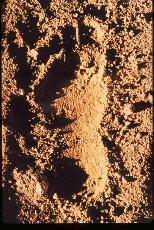
So, from volcanic ash to silica and the lines didn't appear using OM soil. Am I getting that right?
"After 10 phone calls to the USGS and the NRCS, I had a few questions answered. My argument all along is simply this "If you are going to prove or disprove something, you should be as accurate to the original as possible". Matt Crowley early on started out with Plaster of Paris - but quickly moved on to other casting agents such as Hydrocal, and the soil he is using to test in is volcanic ash, along with other substrates I will add, but when he challenged me - the specific challenge was to use volcanic ash.
Guess what??
After these phone calls and discussions with soil survey scientists (who know what they are talking about) I have discovered the amount of volcanic ash in the soil in and around the Onion Mountain cast area is not even registered as a factor. There is no mention of this in any of the most recent reports dated 1979 and approved in 1984. These soil samples also predate the Mount St Helens erruption, and there was not an active volcano in that area during the time this cast was made.
I also discovered volcanic ash breaks down fairly quickly. In as little as 2 years, it can have a whole new chemical make-up and/or structure.
So, what does this mean?
I am currently in the process of trying to obtain this soil to test for "crowley lines". Will I get them? I dont know, but I will report all of my findings and keep everyone up to date.
I would like to thank Mr. Crowley for suggesting I challenge myself and do these tests for myself as that was very good advice. Am I nit picking Matt Crowleys work? No, I really do not think so, as my questions are valid, right on target, and have yet to be explained. If these "crowley lines" are so easily duplicated - why didnt I get them? I dont know.
It would be nice to know which casts and which artifacts were found in which substrates using which medium, like with a chart. I will be testing Plaster of Paris in hopefully typical soil from the Onion Mt. area with the method described to me by John Green, under the conditions he remembers.
Obviously Matt (Crowley) has found that under certain curcumstances these lines can appear. I don't know if he can describe what conditions will prevent them from appearing, however. I feel that both are needed to fully understand what is taking place.
So the real question is, with the materials, conditions and method employed by John Green in 1967 on Onion Mt., N. Cal. could these lines have been introduced artifically; not really something that was in the original tracks?
To be Continued........"
http://txsasquatch.blogspot.com/2006_05_01_txsasquatch_archive.html
And she continued here:
http://txsasquatch.blogspot.com/search?q=casting
"I was unable to duplicate Matt's work. I did exactly as I was instructed, and I could not do it. I have the feeling it may have everything to do with the casting agent. But, something we need to consider is this. Matt's work for the most part was in Volcanic ash - and Im sure that ash moved much easier under the weight of the casting agent. This soil is not the same - at all. If you look at the full foot cast you will see a depression in the soil (in the arch area) - that is where the casting agent made first contact with the soil - and it abruptly stops. Another thing to consider - soil is not Volcanic Ash. There is a big difference between the two.
My work is still ongoing - and if I can answer any questions I will be more than happy to. I will not guess - or make assumptions. I am not saying this is the final word on anything - and I am open to any and all suggestions. I am not doing this to trash Matt Crowley or his work, I just want answers and I want the truth, just as many of you do.
So, I think its pretty safe to say - based on this test: Dermal Ridges and Flexion Creases are possible in the soil from the Logging Road of Onion Mountain."



 :
: