• Security incident: ISF was recently accessed by intruders. Please change your password, and change it anywhere else you used it. Read more

Bigfoot - The Patterson-Gimlin Film

Status
Not open for further replies.
Nice pics.

Does evolution has to make sense? If arboreal traits are lost, why do Gorillas still have them when they're too heavy for life in the trees? Why do we? The appendix is an important part of the rat intestine. In us it does little but get infected. Why do we still have them?

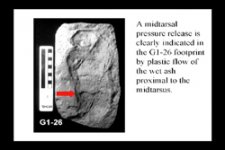
Below is a hominid print from Terra Amata some 400,000 years old. Does it have a rigid arch? That seems to be a Homo specialty and a rather late one at that. Do the Laetoli prints show a rigid arch? Note also the pressure disc on the chimpanzee print.

The gorilla foot cast just needs a little rearrangement of the toes to look a lot like a sas cast. Sasquatch prints are not like enlarged human feet (a mistake hoaxers have tended to make).

White has said the idea that the common ancestor looked like a Chimp is simply wrong. (Toumai's plane of the foramen magnum was just like that of other known bipedal primates.) Bipedalism seems to have been the norm in ancient hominoids, knuckle and fist walking a later adaptation in the Great Apes (all can still walk bipedally).

Frankly, your assumption evolution should make sense makes as much sense as your assertion Sasquatches would have died out because of our pollution.
 

Attachments

  • Terra Amata.jpg
    Terra Amata.jpg
    130.5 KB · Views: 1
  • Gorilla cast.jpg
    Gorilla cast.jpg
    47.4 KB · Views: 1
  • Laetoli smaller.jpg
    Laetoli smaller.jpg
    32.2 KB · Views: 93
  • Chimp Print In Sand smaller.jpg
    Chimp Print In Sand smaller.jpg
    38.3 KB · Views: 92
Last edited:
Evolution is goalless and directionless. It just kind of works out that way.
 
Last edited:
More on XIX century gorillas...

http://www.museum.vic.gov.au/history/gorillas.html
Shows a 1865 engraving from DuChaillu's specimens at Melbourne. Some interesting pieces of info there.

The first live adult gorilla was delivered to London zoo in 1860 or 1887, depending on the source.
http://www.bornfree.org.uk/zoocheck/londonzoo.shtml
or
http://www.nde.state.ne.us/SS/irish/unit_2.html

R.M. Ballantyne's 1861 "The Gorilla Hunters"
http://www.athelstane.co.uk/ballanty/gorilla/gorilla.htm
Was the first fictional book where gorillas had a major role.

Not exactly gorillas, but at
http://pin.primate.wisc.edu/av/art/jardine_plates.html
http://pin.primate.wisc.edu/av/art/jardine_intro.html
There are plates from Sir Williams Jardine's 1833 book "The Natural History of Monkeys". It can provide an idea of the renderings avaliable by then. Note: his work was criticized by Keulemans.

Keulemans, BTW, provided us this nice rendering:
http://www.finerareprints.com/animals/keulemans_monkey/vol_animals_keul_monk_2798.htm in 1894

Enough templates for apeman tales in the late 1880s... And if we also include chimps as possible templates, the number of avaliable sources are quite bigger and were around for more time.
 
Nice pics.

Does evolution has to make sense? If arboreal traits are lost, why do Gorillas still have them when they're too heavy for life in the trees? Why do we? The appendix is an important part of the rat intestine. In us it does little but get infected. Why do we still have them?
Gorillas still spend a lot of time at trees. Females and juveniles climb trees (at least the lowermost and thicker branches) and make nests at them. Large silverbacks don't - unless the trees are pretty strong. Thus, the features are not useless, cumbesrome and a potential source of problems.

The ammount deaths from appendix infections on our ancestors was enough to provide a serious evolutionary disadvantage?

You are not talking about a residual feature, but of a fully functional feature that has clear evolutionary disadvantages.

Below is a hominid print from Terra Amata some 400,000 years old. Does it have a rigid arch? That seems to be a Homo specialty and a rather late one at that. Do the Laetoli prints show a rigid arch? Note also the pressure disc on the chimpanzee print.
Note that you are talking about relatively small apes that still spent a lot of time at trees.

So, why bigfeet are supposed to have them?

The gorilla foot cast just needs a little rearrangement of the toes to look a lot like a sas cast. Sasquatch prints are not like enlarged human feet (a mistake hoaxers have tended to make).
"A little rearrangement"?
Please, LAL... Look at toe shape and disposition.

The big toe would have to move from the nearly 45 degree with the foot axis to a nearly paralell disposition. Toes shape and lenght would have to change. Foot lenght would also have to change.

White has said the idea that the common ancestor looked like a Chimp is simply wrong. (Toumai's plane of the foramen magnum was just like that of other known bipedal primates.) Bipedalism seems to have been the norm in ancient hominoids, knuckle and fist walking a later adaptation in the Great Apes (all can still walk bipedally).
Its been alreay discussed here if knuckle walking was previous or post bipedalism. Apart from the fact that I have not seen any relevance of this to this particular discussion, let me remind you that flexible feet are an adaptation for climbing trees and the known large bipedal apes don't have them. This is relevant to the discussion.

Frankly, your assumption evolution should make sense makes as much sense as your assertion Sasquatches would have died out because of our pollution.
First, point me exactly where I said they should "have died out because our polution".

Second, I have never said evolution should make sense. I wrote:
Thus, from an evolutionary point of view, it makes sense to have prehnsile feet.
It means the feature in question (flexible feet) is not expect as the outcome of the evolutionary process of a large bipedal primate that no longer spends a considerable ammount of time climbing trees. Its a far cry from saying it should make sense. Its a figure of language, just like saying "the evolutionary point of view".

Now, on a OT note, we can indeed go in to a discussion if evolution should or not make sense. If you define "making sense" as "producing logic results", the answer might as well be yes. But this is a discusion for another thread. Open one at the Science and Technology forum if you are interested to go further.

Now, back to the point after this diversion,
And, at last but no least, non-flexible feet do generate impressions similar to those shown as evidence for mid tarsal feet.
Why should I conclude bigfeet have them, if my own footprints wearing boots may show similar effects, other people's footprints also show the same effect, flexible feet at large bipedal primates are unlikely and there's no reliable evidence that bigfeet are real?
 
Originally Posted by Huntster
.....I had compared sasquatch reports on Prince of Wales Island in SE Alaska to Kodiak Island. Both islands are large (#2 and #3 largest under the U.S. flag), both islands have significant salmon runs, have a similar population, and that population is predominately native.

POW Island is densely forested, has a very high density of sasquatch reports, as well as native lore about them, has no brown bears at all, and has one of the highest black bear densities in North America.

Kodiak Island is not densely forested, has one of the highest brown bear densities on Earth, has no black bears at all, has no sasquatch reports, and no native sasquatch lore.

I still await a "skeptic" to explain why all those things are true.

Explain what ?

If sasquatchery is a social phenomenon of legends, manufacture, hoax, etc., why do such like places and cultures not have similar sasquatch histories and current claims?

Glickman has an explanation:

...The relationship in the clustered data is the correlation
between population density and frequency: the Group
A correlation of +0.9661 is high relative to the Group B
correlation of +0.1244.
A second relationship in the clustered data is the correlation
between population and frequency. When Group A
is separated from the dataset, its correlation to population
rises from +0.1192 to +0.5664.
Group A is differentiated from Group B by its high correlation
to population density. This is consistent with the
model of receiving a report of a cataloged animal (Eq. 1).


Let’s assume that manufactured reports will be uniformly
distributed across the population. If the rate of
manufactured reports is constant, then the frequency of
reports should correlate to population. To some degree,
this is seen in Group B. There may be other unidentified
influencing factors such as mean media exposure to Bigfoot,
which may influence the density of manufacturing.
The author speculates that Group A and Group B represent
different phenomenon. Group B may represent
manufactured reports because of the correlation to population,
whereas Group A may represent a different phenomenon
because of its correlation to population
density. The author hypothesizes that if Green’s data is
the superposition of multiple phenomena that this is the
expected result.

What's your explanation?
 
......However, even though I am not totally convinced that sasquatch are in other areas I do find some areas interesting. I wouldn't write it off and dismiss it completely (and I admit to knowing less about the subject of sasquatch elsewhere than LAL does) but as I said before I find it neater and more logical to concentrate on the idea of sasquatch in the PNW, south east Alaska, BC and western Alberta areas than being widespread over many different states in the east and south of the U.S.

I agree, and if sasquatches are present in the Southeast US, they would definately be more likely to be endangered as a species than if in the PNW, where sighting frequency is so much higher and human population so much less dense.

All the more reason for the appropriate wildlife management authorities to look into the matter.
 
Originally Posted by Huntster
There were a very few partial gorilla specimens. Several skulls and a few other bones, and not even a complete skeleton.

DuChaillu delivered the first complete carcass to the west.

Huntster, the TYPE specimens were provided by Savage. Type specimens should be good enough when it comes to preservation to allow a description of the genus or species and future studies.

Savage and Wyman were the Meldrums of the day.

Originally Posted by Huntster
And there is lots of discussion and published papers regarding sasquatches today, as well as unidentifed DNA on record, at least one good film, and a number of footprint casts.

Got a specimen?
Got reliable pictures or stills?
No.

And we've been to the "unidentified DNA" issue. Its useless.

Perhaps to a denialist it's useless.

To those who don't discount the possibility out of hand, it's evidence.

Originally Posted by Huntster
Please list the books and newspapers which provided those "images." I'd be especially interested in those prior to DuChaillu's return. I'd like to see what was "built" using just a skull and a few bones.

Oh, the very books from DuChaillu or his caricatures could provide the imagery source...

DuChaillu saw a gorilla. He was the first to bring back a carcass.

What were gorillas said to look like between 1847 and 1861?

How would western North Americans know that?

As has been pointed out, DuChaillu's descriptions were widely disparaged in North America for years.

Or Sir Richard Burton's book...
Two Trips to Gorilla Land & the Cataracts of the Congo

Published in 1876, Burton being one of the explorers who confirmed DuChaillu's claims, along with Stanley and others.

Originally Posted by Huntster
Correct. It doesn't take you anywhere, either.

In fact, it takes us all nowhere.

Then,what about dropping the "denialist" line?

Because denialists exist, and some of them participate on this forum.

The complains against "scientists at ivory towers" are also useless and won't help your cause.

I don't have a "cause", except perhaps to lure denialists into firmly entrenching their positions.
 
Last edited:
Savage and Wyman were the Meldrums of the day.
Nope.
They described a species based on specimens (that are still avaliable nowdays).
Their reports were published at peer-reviewed journals.
There was no major fuss regarding their discovery.
Meldrum, Krantz, et al... How they compare with the above?

Another flawed analogy.

Perhaps to a denialist it's useless.

To those who don't discount the possibility out of hand, it's evidence.
Nope.
Please go back to the post where I explained why its useless and counter the arguments. Just saying those who don't accept it are "denialists" is an ad hom and useless when it comes to backing your claim that "it is evidence".

Unless you say its useless evidence... Or unreliable, flimsy, shaky...

DuChaillu saw a gorilla. He was the first to bring back a carcass.
But the animals were already known to science, there were already specimens avaliable and there was no dispute regarding their existence.

What were gorillas said to look like between 1847 and 1861?

How would western North Americans know that?
Do you have any evidence thay did not knew about them?

What people though gorillas looked like between 1847 and 1861? A wild guess, since I am short in time to perform a search: like an overgrown chimp, or maybe something like the chimp renderings at Sir Williams Jardine's 1833 book. That would be the general public -better be more specific, those with access to books, newspapers and magazines- and interest on the subjects. The naturalists' view? A bit more precise, I would say, since they had access to Savage and Wyman papers that included decriptions.

BTW, if you are curious, why don't you do some research by yourself?

As has been pointed out, DuChaillu's descriptions were widely disparaged in North America for years.
The reception problems he faced were not solely due to his descriptions of the animal, but mainly due to the tales he told and for some reason did not manage to back.

Published in 1876, Burton being one of the explorers who confirmed DuChaillu's claims, along with Stanley and others.
And with other books and possibly newspaper and magazine articles provided a background over which tales such as Jacko could be built.

Because denialists exist, and some of them participate on this forum.
I suggest you to red the following article
http://www.ukskeptics.com/article.php?dir=articles&article=the_open_mind.php
Since you are using "denialist" as some use "close minded", the article may be enlightening to you, if you read it with an open mind (pun intended). Again, the way you use it, its merely an ad hom and can not help your point.

Well constructed arguments and reasonings, backed reliable evidence can help your point.

I don't have a "cause", except perhaps to lure denialists into firmly entrenching their positions.
By producing ad homs instead of arguments even this "cause" of yours is doomed to utter failure.

You know, one might get the impression you have little to ad to the debate. Something I hope is not the case.
 
Originally Posted by Huntster
Savage and Wyman were the Meldrums of the day.

Nope.
They described a species based on specimens (that are still avaliable nowdays).
Their reports were published at peer-reviewed journals.
There was no major fuss regarding their discovery.
Meldrum, Krantz, et al... How they compare with the above?[/quote]

Both Krantz and Meldrum have published papers describing evidence (spoor) which have not been peer reviewed because the peers refuse to review it.

Another flawed analogy.

More like flawed peers.

Originally Posted by Huntster
DuChaillu saw a gorilla. He was the first to bring back a carcass.

But the animals were already known to science, there were already specimens avaliable and there was no dispute regarding their existence.

The animals were partly known to some in science.

BTW, if you are curious, why don't you do some research by yourself?

I have. I'm debating the record with you.

Originally Posted by Huntster
As has been pointed out, DuChaillu's descriptions were widely disparaged in North America for years.

The reception problems he faced were not solely due to his descriptions of the animal, but mainly due to the tales he told and for some reason did not manage to back.

He did "bring back." He was the first to bring a complete specimen back.

And he told no "tales" that weren't later confirmed:

....The book was greeted with shouts of laughter and derision from one end of the American continent to the other. Mr and Mrs and Miss Gorilla was the common jest, and the name Du Chaillu became a byword for a fanciful storyteller. Du Chaillu was only 26 when his first book was published. He was unable to answer satisfactorily the storm [p. 284] of questions hurled at him; consequently nobody believed him, except Harper and Brothers in the United States and the Royal Geographical Society in England, both of whom valiantly and vigorously defended his truthfulness.....

....Gradually each of Du Chaillu's discoveries was confirmed by later explorers - by Schweinfürth, Stanley, Sir Harry Johnston, and others.....

Why are you so desperate to downplay Du Chaillu's role? Because he wasn't a "scientist"?

Originally Posted by Huntster
Because denialists exist, and some of them participate on this forum.

I suggest you to red the following article
http://www.ukskeptics.com/article.ph..._open_mind.php
Since you are using "denialist" as some use "close minded", the article may be enlightening to you, if you read it with an open mind (pun intended).

I get a full education regarding denial and closed minds on this forum, thanks.

Again, the way you use it, its merely an ad hom and can not help your point.

Again, I have no delusion that anybody here will be convinced of anything. I'll wait for the proof, and if I'm still around when it comes, I'll be back.
 
You are not talking about a residual feature, but of a fully functional feature that has clear evolutionary disadvantages.

Not so. Sas young may spend time in trees (we don't know that they don't) and flexible feet are a clear advantage on rocky terrain. They wouldn't be "weeded out" any more than the appendix has been.

"A little rearrangement"?
Please, LAL... Look at toe shape and disposition.

The big toe would have to move from the nearly 45 degree with the foot axis to a nearly paralell disposition. Toes shape and lenght would have to change. Foot lenght would also have to change.


The great toe only needs to move forward and be a bit less opposed. (Mountain gorillas already show signs of their more terrestial lifestyle in their feet. The foot and heel is relatively broader than in the Lowland Gorilla.) The other toes are long enough and only need to be separted more. The heel is wide enough and size would increase along with the overall size of the animal.

Both the gait and the foot shape (especially the elongated heel) may be adaptations for great weight and a mountainous environment.

Its been alreay discussed here if knuckle walking was previous or post bipedalism. Apart from the fact that I have not seen any relevance of this to this particular discussion, let me remind you that flexible feet are an adaptation for climbing trees and the known large bipedal apes don't have them. This is relevant to the discussion.

What known large bipedal apes don't have them? You mean us? Our ancestors did.

The point is, a rigid arch is not necessary for habitual bipedalism. That seems to have developed only in Homo. Early bipedal hominids didn't have it; they didn't start out with it and then lose it for an arboreal lifestyle.

First, point me exactly where I said they should "have died out because our polution".


I will when I have time to do a thorough search. I think it was during one of our go-rounds about fossils or roadkill, but I'm not sure of the thread. I replied we're at the top of the food chain and we're still here.

Why should I conclude bigfeet have them, if my own footprints wearing boots may show similar effects, other people's footprints also show the same effect, flexible feet at large bipedal primates are unlikely and there's no reliable evidence that bigfeet are real?


There's reliable evidence. If you insist on trying to explain it away with imaginative alternatives, go ahead. Trackways have gone up inclines people had to climb. The toes dug in deeply. Try that with fake feet. Try it in snow.
 
The great toe only needs to move forward and be a bit less opposed. (Mountain gorillas already show signs of their more terrestial lifestyle in their feet. The foot and heel is relatively broader than in the Lowland Gorilla.) The other toes are long enough and only need to be separted more. The heel is wide enough and size would increase along with the overall size of the animal.
A bit less opposed?
Please take a look at the comparsions I posted. Check the angle between big toe and foot axis, compare the lenght and shape of the big toe. These are not small changes, these are major modifications.

BTW, if the alleged bigfoot feet look so much as human, why should anyone think the bone and muscle structure to be different? Specially when human feet can produce footprints that looks very much like those claimed to be from bigfeet? even when using boots?

Perhaps because some of the bigfoot footprints in question were made by carved wood and had human feet as models?

Both the gait and the foot shape (especially the elongated heel) may be adaptations for great weight and a mountainous environment.
Adaptations evolved at wich animal's feet? Gorillas or bigfeet?

Please remember that if you are talking about bigfeet, their alleged habitat (present and pas) is far from being restricted to mountainous terrains. Assuming a flexible feet would be usefull to mountainous terrains -and I guess it would only be usefull at very rough terrain- it would still not be the best thing at most of the alleged habitat of the creature.

What known large bipedal apes don't have them? You mean us? Our ancestors did.
Exactly what ancestors, LAL?

Please understand that it has to be at least the size or weight of a human... And adapted for a lifestyle that does not involves spending large ammounts of time climbing trees.

The point is, a rigid arch is not necessary for habitual bipedalism. That seems to have developed only in Homo. Early bipedal hominids didn't have it; they didn't start out with it and then lose it for an arboreal lifestyle.
Early bipedal hominids had different lifestyles and sizes, and flexible feet were usefull for them. Why we don't have them, if they are so nice?

Because the genus Homo explored different niches, spending much more time wandering at the ground, thus developing rigid feet with small toes. And since similar problems have similar solutions...

I will when I have time to do a thorough search. I think it was during one of our go-rounds about fossils or roadkill, but I'm not sure of the thread. I replied we're at the top of the food chain and we're still here.
I think making statements or claims about another person without being able to back them is not very correct. Specially when an appeal to ridicule is attempted.

You should have written "I think you said..." or something like that, since you are not able to produce a link. And be open to the possibility that you are mistaken.

There's reliable evidence. If you insist on trying to explain it away with imaginative alternatives, go ahead. Trackways have gone up inclines people had to climb. The toes dug in deeply. Try that with fake feet. Try it in snow.
LAL, "imaginative alternatives" are more abundant in the posts of those who defend the position bigfeet are real. An example is that quote of yours regarding the "small changes" needed for a gorilla feet become similar to a fakefoot.

There are many others. This generic quote, exposing such imaginative reasoning is another example: "[insert hoaxer name here] hoaxed some things, but you can't prove every evidence he provided was a hoax, he provided good evidence".
 
Both Krantz and Meldrum have published papers describing evidence (spoor) which have not been peer reviewed because the peers refuse to review it.


More like flawed peers.
Evidence?

Or its just an ad hom to other persons?

The animals were partly known to some in science.
Of course, if you are involved with electromagnetism, you would have little time for gorillas...

Still, the species were accepted by naturalists.

Or can you show us some evidence the existence of gorillas was questioned by "mainstream science" after Savage's work?

I have. I'm debating the record with you.
Then, would you care to show your findings?

Why are you so desperate to downplay Du Chaillu's role? Because he wasn't a "scientist"?
Its just another topic raised to defend the position "bigfeet are real". And it has not received more attention from my part than any other that I have touched. The claim was laying around for a long time, I decided to check it and found the facts did not support the analogy between gorillas+Duchaillu+mainstream science and bigfoot+cryptozoologists+mainstream science.

Its basically what we've been trying to do since the start of the threads: look at the pieces of evidence and reasonings carefully and discuss them using critical thinking.

I get a full education regarding denial and closed minds on this forum, thanks.
Ah, another ad hom... You should read that article. Really.

Again, I have no delusion that anybody here will be convinced of anything. I'll wait for the proof, and if I'm still around when it comes, I'll be back.
Again, I would not hold my breath...

I have little hope the defenders of the claim "bigfeet are real" will change their minds. But I am debating, since I thinks there's always something to be learned. And who knows, maybe someday someone comes with an interesting evidence or reasoning. The bigfoot threads allowed me to meet some very interesting people and some nice interactions.

But the constant ad homs don't and can't add anyhting usefull to it. Got evidence, reasonings, arguments, OK, let's talk. But if a person's major resources are ad homs, you are not being helpfull to you cause, whatever it is. The person already "lost" it.
 
Originally Posted by Huntster
Both Krantz and Meldrum have published papers describing evidence (spoor) which have not been peer reviewed because the peers refuse to review it.

More like flawed peers.

Evidence?

Common sense. The peers appear to be ideological fundamentalists.

Or its just an ad hom to other persons?

If they don't like it, they can "ad hom" me back.

Originally Posted by Huntster
The animals were partly known to some in science.

Of course, if you are involved with electromagnetism, you would have little time for gorillas...

Like wildlife managers today, with plenty of time for spotted owls and snail darters, but no time or effort whatsoever to check out the claims of the public?

Originally Posted by Huntster
Why are you so desperate to downplay Du Chaillu's role? Because he wasn't a "scientist"?

Its just another topic raised to defend the position "bigfeet are real".

We don't know if "bigfeet are real", and we're not likely to know anytime soon, because the appropriate people don't give much of a damn, and aren't looking into the matter.
 
I didn't post any trail cam pics. Again, what are you talking about?
Sorry I haven't responded sooner. The other day while I was on the forum I had an unfortunate case of baby meets pc. I was referring to the images you posted in post #4978. Were those not supposed to be trailcam pics? My apologies if I'm mistaken.
 
Common sense. The peers appear to be ideological fundamentalists.
Conclusions based on "common sense" may be deeply flawed. Any basic physics book will provide a number of examples of this.

And saying "peers appear to be ideological fundamentalists", is an ad hom , a sweeping generalization and by no means provide any backing to your statement on flawed peers.

If they don't like it, they can "ad hom" me back.
For what purpose?
Would it help in any discussion?
Its not a bar brawl.

Like wildlife managers today, with plenty of time for spotted owls and snail darters, but no time or effort whatsoever to check out the claims of the public?
Huntster, even back in the 1800 there was specialization. I fail to see why someone involved with research on electromagnetism (the example I gave) should have been well informed on gorillas... But still, they could be.

You have evidence the existence of gorillas was questioned by "mainstream science" after Savage's work?

We don't know if "bigfeet are real", and we're not likely to know anytime soon, because the appropriate people don't give much of a damn, and aren't looking into the matter.
Why they don't give a damn?
Because the evidence is flimsy, shaky, unreliable and entangled with hoaxes. Because many of the very defenders of the position "bigfeet are real" ehxibit a tendency to display poor data handling skils. And resorting to ad homs will never be of any help. On the contrary.

Ranting will be of no help either. But a carefull data handling, the dumping of unreliabe data and stopping or decreasing useless ad homs and rants may help.
 
A bit less opposed?
Please take a look at the comparsions I posted. Check the angle between big toe and foot axis, compare the lenght and shape of the big toe. These are not small changes, these are major modifications.

Look at the cast of the Mountain Gorilla foot. Small changes.
BTW, if the alleged bigfoot feet look so much as human, why should anyone think the bone and muscle structure to be different? Specially when human feet can produce footprints that looks very much like those claimed to be from bigfeet? even when using boots?

They don't look human. They're a third wider, the toes are proportionately longer, the heel is elongated and wider, there's no arch, and where there is dermal ridge detail, it isn't a match for humans or any known ape.
Perhaps because some of the bigfoot footprints in question were made by carved wood and had human feet as models?

None have been shown here so far.

There have been hoaxes. Even the method is known. In one, a tenager put feet on backwards and ran down a hill. The shape gave him away. In another college students carved prints, cast them and impressed the resulting casts in soil for 16 prints. Ingenious, but transparent. In a more recent case in Pennsylvania, there was evidence of much beer drinking. They had the number of toes wrong on some of the prints they'd made by sculpting them into the soil.

Adaptations evolved at wich animal's feet? Gorillas or bigfeet?

Both. Gorillas have been evolving too.

Please remember that if you are talking about bigfeet, their alleged habitat (present and pas) is far from being restricted to mountainous terrains. Assuming a flexible feet would be usefull to mountainous terrains -and I guess it would only be usefull at very rough terrain- it would still not be the best thing at most of the alleged habitat of the creature.

There would be no reason to lose it in the mountainous regions of China, and none in crossing the land bridge. The largest population in the US seems to be in the Cascades. Those are mountains.

Georgia is flatter and so is Ohio, but still swampy or forested. Aside from not possessing the genetics to build a rigid arch, a heavy animal wouldn't find such an arch very usefull on any terrain.

Flatfooted humans walk quite well, by the way.

Exactly what ancestors, LAL?

Gracile Australopithecines.
Please understand that it has to be at least the size or weight of a human... And adapted for a lifestyle that does not involves spending large ammounts of time climbing trees.

Do we have feet for much other than the gracile Australopithecines? They were smaller than humans.

What known large bipedal apes were you talking about?

Early bipedal hominids had different lifestyles and sizes, and flexible feet were usefull for them. Why we don't have them, if they are so nice?

Mutation.
Because the genus Homo explored different niches, spending much more time wandering at the ground, thus developing rigid feet with small toes. And since similar problems have similar solutions...

In an article on a possible Orangutan ancestor found in Thailand, it mentions fossil apes weren't adapted to an arboreal lifestyle. I'm having search engine problems, but I'll post it when I can search without disconnecting. There's been a discovery since then of a possible common ancestor that seem to have been arboreal, but the midtarsal break may have evolved in ground-dwellers.

I think making statements or claims about another person without being able to back them is not very correct. Specially when an appeal to ridicule is attempted.

You should have written "I think you said..." or something like that, since you are not able to produce a link. And be open to the possibility that you are mistaken.

I can produce the link, but I need time to do the search. I'm surprised you don't seem to remember it. I'll never forget it.

I'm not trying to ridicule you, but I do think you sometimes get a little carried away.
LAL, "imaginative alternatives" are more abundant in the posts of those who defend the position bigfeet are real. An example is that quote of yours regarding the "small changes" needed for a gorilla feet become similar to a fakefoot.

Not imaginative at all. The pro side has the evidence. About all the opposition can do is reiterate variations on "Looks like a suit/fake foot/elk lay to me".

Mountain Gorilla's are more terrestial and their feet are already showing changes. What's so imaginative about that?

We share about 99% DNA with Chimpanzees, but look how much difference is in that 1%. Our feet are really different.

There are many others. This generic quote, exposing such imaginative reasoning is another example: "[insert hoaxer name here] hoaxed some things, but you can't prove every evidence he provided was a hoax, he provided good evidence".

You mean Freeman? Marx? What about Tollgate, Ore.? Those people had no connection with Paul Freeman at all, yet a cast they took is like the print in Freeman 1994.

Marx certainly, and Freeman possibly resorted to some fakery when interest waned. Stupid, but that does not negate the value of evidence both brough in. (I disagree with John Green on that. But throwing out all their evidence doesn't hurt the case much.

Cliff Crook's assessment of the Skookum Cast, sight unseen, was good enough for Daegling. Crook's a known hoaxer.

Is it okay when sceptics do it?
 
Last edited:
Sorry I haven't responded sooner. The other day while I was on the forum I had an unfortunate case of baby meets pc. I was referring to the images you posted in post #4978. Were those not supposed to be trailcam pics? My apologies if I'm mistaken.

Apology accepted. They're photos of Chimp feet in a print box. I haven't figured out how to imbed uploaded images in the post yet. This was the context:

" 'Quote:
And we've been to the mid-tarsal break discussion before. Assuming bigfeet are real, the foot and toe morphology inferred from bigfeet fooprints does not match the ones observed in real primates with flexible feet.'

They're not chimps or gorillas, but see below."

When I posed those on BFF Dan Chamberlain said they look like costume feet.
 
We share about 99% DNA with Chimpanzees, but look how much difference is in that 1%.

Especially when that itty-bitty 1% equates to at least 150,000,000 DNA sequences. :cool:

Cliff Crook's assessment of the Skookum Cast, sight unseen, was good enough for Daegling.
You keep saying that as though it's true. Good enough for what? Insertion in the book? Agreement with his assertion? I saw no blatant agreement in Daegling's book, and I've already provided a quote and page source. Do you have something to the contrary? (with quote/page source of course). I'm guessing there are a great many that agree with Crook's assessment that it might be an elk and not a bigfoot.

Crook's a known hoaxer.
No argument from me on that. No mention of Crook in Meldrum's book, nor Marx either. Somewhat surprising considering the inside jacket of the front cover refers to bigfootdom as "a controversial field mined with hoaxes and sensationalism." Wallace seems to be the only confirmed hoaxer that Jeff addresses, and he devotes an entire chapter to him, though he seems far too accepting of Freeman's contributions.

RayG
 
Look at the cast of the Mountain Gorilla foot. Small changes.
Look at the comparsion below and tell me if those are "small changes"...
real_brakes1.jpg


They don't look human. They're a third wider, the toes are proportionately longer, the heel is elongated and wider, there's no arch, and where there is dermal ridge detail, it isn't a match for humans or any known ape.
Oh, they don't look human?

To me, they look much more similar to humans than to gorillas, chimps and australopithecines. Toe shape (specially the big toe) and relative lenght are much more similar to what can be seen at the feet from humans tha at the feet of gorillas. Same is valid for the rest of the foot.

But you might be correct, superposed bear prints and prints of fakefeet are not really a match for humans or known apes...

None have been shown here so far.

There have been hoaxes. Even the method is known. In one, a tenager put feet on backwards and ran down a hill. The shape gave him away. In another college students carved prints, cast them and impressed the resulting casts in soil for 16 prints. Ingenious, but transparent. In a more recent case in Pennsylvania, there was evidence of much beer drinking. They had the number of toes wrong on some of the prints they'd made by sculpting them into the soil.
Those are the only known hoaxes?

You think all possible hoaxing methods are known?

Perhaps you are being a bit too bold here...


Both. Gorillas have been evolving too.
Gorillas are evolving, of course.
But first demonstrate bigfeet are real, than we can say they have been evolving. Of course, the bigfoot mythos and lore evolve...

There would be no reason to lose it in the mountainous regions of China, and none in crossing the land bridge. The largest population in the US seems to be in the Cascades. Those are mountains.

Georgia is flatter and so is Ohio, but still swampy or forested. Aside from not possessing the genetics to build a rigid arch, a heavy animal wouldn't find such an arch very usefull on any terrain.
First, how can you say they don't have the genetics to buil a rigid arch? Do you know the genes that are responsible for it in primates? Has bigfoot's DNA been obtained and decoded?

Second, assuming they evolved in Asia, mountainous regions are a small part of it. And don't forget that even in mountainous regions, only a small part of the terrain is rugged enough to justify such adaptation.

Even assuming Gigantopithecus are indeed bigfeet, I am not aware of any evidence that they lived only in mountainous terrains.

Flatfooted humans walk quite well, by the way.
So what?

Gracile Australopithecines.


Do we have feet for much other than the gracile Australopithecines? They were smaller than humans.
My toes are nothing like theirs... Neither are the toes seen at alleged bigfoot tracks...

What known large bipedal apes were you talking about?
What genus of large bipedal apes you know?
Hint: The members of one of the species use a tool called internet to debate, information exchange and storage, fun, work, etc.

Mutation.
Oh, yes... But what influences which specific mutation "types" will be passed to the next generations?

In an article on a possible Orangutan ancestor found in Thailand, it mentions fossil apes weren't adapted to an arboreal lifestyle. I'm having search engine problems, but I'll post it when I can search without disconnecting. There's been a discovery since then of a possible common ancestor that seem to have been arboreal, but the midtarsal break may have evolved in ground-dwellers.
AFAIK, the bipedal extinct apes were at least semi arboricolal.

And since flexible feet do not provide an advantage to ground-dwellers...

I can produce the link, but I need time to do the search. I'm surprised you don't seem to remember it. I'll never forget it.

I'm not trying to ridicule you, but I do think you sometimes get a little carried away.
Assuming I wrote it, why you'll never forget it?

BTW, whenever you find the quote -if it actually exist- please provide the propper context.

On an OT digression, "top-of-the-food-chain" species are actually more prone to experience problems with chemical polution. The bald eagle is an example.
http://www.usflag.org/baldeagle.html
http://www.baldeagleinfo.com/eagle/eagle11.html

Aniway, one thing is to say species that have elevated "status" in the food network may suffer from pollution, but to say the the species should die by pollution is completely different.

I think maybe you got a little carried away...

Not imaginative at all. The pro side has the evidence. About all the opposition can do is reiterate variations on "Looks like a suit/fake foot/elk lay to me".
That was a major understatement.

If the evidence is as good as you claim, we would not be discussing its quality here. Neither you would have such a difficult time attempting to counter the reasonings we present.

Mountain Gorilla's are more terrestial and their feet are already showing changes. What's so imaginative about that?
And still their feet are very different from ours... Because they still spend a lot of times at trees... We don't.

We share about 99% DNA with Chimpanzees, but look how much difference is in that 1%. Our feet are really different.
Check RayG's post.

You mean Freeman? Marx? What about Tollgate, Ore.? Those people had no connection with Paul Freeman at all, yet a cast they took is like the print in Freeman 1994.

Marx certainly, and Freeman possibly resorted to some fakery when interest waned. Stupid, but that does not negate the value of evidence both brough in. (I disagree with John Green on that. But throwing out all their evidence doesn't hurt the case much.
To "produce" evidence to "warm up" things is unethical and puts every piece of "evidence" the are involved in quarentine.

I've seen similar arguments from UFO and paranormal folks when their psychics or contactees are caught with their pants down. And some UFOlogists and paranormalists still insist "the rest of the evidence the produced should not be dumped just because it was proved some evidence was hoaxed".

Naïve reasoning. Or dishonest.

Again: if there's a suspect of fraud, drop the evidence, or at least put it in to quarentine.

Cliff Crook's assessment of the Skookum Cast, sight unseen, was good enough for Daegling. Crook's a known hoaxer.

Is it okay when sceptics do it?
Check RayG's post.

 
Last edited:
Status
Not open for further replies.

ISF - Join now!

Every member here is approved by hand. No bots, no spam, just people who care about evidence and honest debate.

Membership is free!

Create your free account

Back
Top Bottom