• Quick note - the problem with Youtube videos not embedding on the forum appears to have been fixed, thanks to ZiprHead. If you do still see problems let me know.

Has Anyone Seen A Realistice Explanation For Free Fall Of The Towers?

Status
Not open for further replies.
Originally Posted by Huntsman :
Plastic, plenum-rated conduit will.


I do not know what, "Plastic, plenum-rated" conduit is, but I seriously doubt it existed in 1967.

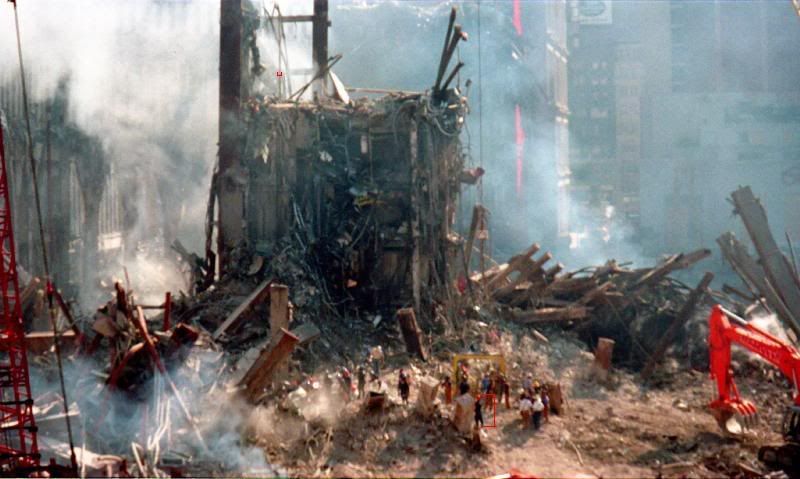
Check the size of the loop formed by the bar sticking out the top center of the core wall at base, it is perhaps 15 feet in diamter and close to a 360 degree bend.

How does this happen at the bottom of a supposed collapse of debri with weak conduit or pipe? It is super rigid and there are more than one of them. No chance of this being anything but something very strong that was heavily heated and stressed in a uniform fashion over its length except one side was much hotter.

Plenum - in layman's terms, as I understand it, is cable/conduit that meets the fire codes that are relevent to dead-air spaces in buildlings.

Also, please show your work that you used to arrive at
Check the size of the loop formed by the bar sticking out the top center of the core wall at base, it is perhaps 15 feet in diamter and close to a 360 degree bend.
 
Check reading and comprehension skills. I said column and beam, not floor trusses. Only raw evidence is qualified for this discussion.
Nice try. You posted below a picture in response to Apollyon's reference to floor trusses and joists. Are you now telling me that you didn't mean for any part of that picture to represent a truss? If so, why would you answer a question about a truss with a picture of something that's not a truss, without explaining yourself? Or are you convinced that a "floor beam" isn't a truss?

And look at the schematics. The floor is not composed of beams, it's composed of trusses. Now, note in Figure 2-9 that the cross-section of a "main double truss" is very narrow, and that a "transverse truss" is not even composed of a solid web. These things are not pictured—so maybe that picture doesn't actually represent what you purport that it does.

And come on, answer the criticism regarding the schematic. Where's the core?
 
Last edited:
Originally Posted by Huntsman :
Plastic, plenum-rated conduit will.


I do not know what, "Plastic, plenum-rated" conduit is, but I seriously doubt it existed in 1967.

Probably not, but that doesn't mean it wasn't installed later.

Cat 5 network cable didn't exist in 1967 either, but I bet the WTC was wired for networking in almost all of it's offices.

Check the size of the loop formed by the bar sticking out the top center of the core wall at base, it is perhaps 15 feet in diamter and close to a 360 degree bend.

I'll accept this portion, although it appears closer to 180 degrees than 360 degrees, and it appears more like a slightly flexible tubing that lay over due to gravity.

How does this happen at the bottom of a supposed collapse of debri with weak conduit or pipe?
Because collapses aren't deterministic, but chaotic. How did people survive at the bottom ofa collapse? It happens.
It is super rigid and there are more than one of them.
Have any evidence of it being "super-rigid"? You can't tell this from a single still photo, or even from a video unless there's something pushing on it. It's at least moderatly rigid, but could well be some type of plastic tubing or conduit. Heck, it could be condensation drains for the air conditioners.
No chance of this being anything but something very strong that was heavily heated and stressed in a uniform fashion over its length except one side was much hotter.
Unless it wasn't. You haven't supported this assertion, and even this assertion, assuming it was true, doesn't support rebar.

Looking more closely at it, I'm still leaning towards some sort of thick metal cabling, such as might be expected on an elevator.

Here's a thought, can you point out the original source of the picture? Not on your web page, I want to know exactly what the picture was of, and if it does happen to be the bottom of one of the elevator shafts.
 
Last edited:
what is the scale of this photo so I can measure the "rebar" and verify it is exactly 3" on 4' centers?

Can you prove that is from the interior of the building and not the exterior load bearing walls.

How could I tell the difference in this photo between 3" rebar and a 3" conduit? How could I tell the difference in this photo between 3" rebar and the elevator guides you claim exist in another photo? Speaking of this other photo, what insane person would install elevator guides before the elevator shafts were built? What did they attach them to? The nearest concrete, according to you, is 7 stories down.

Christophera.

What kevin said.

I have already given my estimate of the size of the image which shows that you cannot see something 3" wide.

Dave
 
The beam clips are still on the column indexing the beams!!!!!!
Yes. They are welded on.

And tubing is LESS likely to bend smoothly when heated.
Really? So a piece of conduit stuffed with cable and wiring is going to kink eaily when heated and bent, particularly when bent in the large radius that your picture shows?

Stick with pencil pushing.
/looks at steel-toed boots I'm wearing

/looks at hard hat with my name on it sitting on the shelf behind me

Hmmm. It appears you're speculating erroneously yet again. How unsurprising.

I show the core wall at base is 17 feet thick.
You don't "show" anything. Or is using MS Paint (badly, I might add) to create colored arrows your idea of making something proof positive?
 
With regard to the use of the word plenum above, this refers to the enclosed spaces, usually between floors, where cables are run. Because when new cables are put in it is cheaper to leave the old ones in position the cables are usually low smoke / low fume rated. I presume any plastic ducting which may be used would also be low smoke / low fume.

(I have been involved in fire testing of these types of cables)

(for an American co. in case anyone thinks that because of my location the testing may not be relevant)

Dave
 
In the spirit of this thread:

BUTTERSCOTCH NUT BAR

1 cup unsalted butter (2 sticks)

2-1/4 cups dark brown sugar, packed

3 large eggs

2-2/3 cups all-purpose unbleached flour

2-1/2 teaspoon baking powder

1 teaspoon salt

1 package (6 oz) butterscotch chips

1 cup walnuts, chopped

1. Preheat oven to 350 degrees F. Grease a 9 x 13 inch pan.
2. In a medium-sized bowl, combine the flour, baking powder and salt. Set aside.
3. Melt butter in a heavy bottomed saucepan, and stir in brown sugar. Remove from heat, and let cool for 10 minutes, until tepid.
4. Beat eggs, and then stir in butter / sugar mixture in portions. Beat after each addition until smooth. Stir flour mixture into the butter/sugar/egg mixture. Batter will be thick. Stir in butterscotch chips and nuts.
5. Spread evenly in baking pan. Bake for about 35 - 45 minutes. Let cool in the pan on wire cake rack. Cut into bars.

This recipe is especially popular with kids.
 
Looking more closely at it, I'm still leaning towards some sort of thick metal cabling, such as might be expected on an elevator.

the photo has two arrows pointing to things that are supposedly high tensile rebar. the one on the left has a silvery sheen and stands upright. The one on the right appears to loop around. The one on the right could be cable, the one on the left I don't think could, just because I don't think it could remain upright like that. The silvery color indicates to me it is anything but rebar. I've never seen silver rebar. brown, green, even black. Never silver.
 
the photo has two arrows pointing to things that are supposedly high tensile rebar. the one on the left has a silvery sheen and stands upright. The one on the right appears to loop around. The one on the right could be cable, the one on the left I don't think could, just because I don't think it could remain upright like that. The silvery color indicates to me it is anything but rebar. I've never seen silver rebar. brown, green, even black. Never silver.

You're right, I've been focusing on the looping strand.

I'm still leanign towards various conduit types. Many of the pastic conduits are made to be semi-rigid/flexible, to assist in threading them through existing structures. This is more commonly used when additions are made to an existing building (as would be expected in upgrades to a building built in 1967).

And I'd still say it's more likely that a flexible or semi-rigid structure would make a nice, even loop like that. Something rigid would be more likely to make a sharp-angle bend or break (IMHO).

The ones standing straight I'd suspect are metal conduit pipe or even water supply pipes.
 
Ok, this is quick and dirty pixel counting, so take with some salt and please point any math of measurement errors.

But here we have the core of the North Tower, and with people for scaling.


WTC1working.jpg


Going with the person in the foreground, the one with the red hardhat. I'm getting a height of 33 pixels. Guessing the person to be at a height of 6 feet, I'm getting 1 pixel is 2.18 inches (6/33*12).

Checking the "rebar" I'm getting a width of 4 pixels or 8.72 inches. Well over the 3 inch width claimed. Also I would not be surprised if the "rebar" was wider, given that it is further back then the person used to scale off of.
 
Much better pic, azazal. It does appear that the looping portion has a 90 degree bend. Of course, it looks much less like a loop, and more like two 90 degree bends making a square, that's leaning over to the left.

I'm dropping elevator cable now. I'm pretty sure that's conduit or water pipe, or a similar structure.
 
Don't the kids add kind of a spam flavor when added to the recipe?


Kevin, I’d like to respond with a joke, but this thread has finally worn me out. Christo is just another loony crank, and I confess that all loonies eventually weary and depress me; they’re not amusing forever. I suppose you could say that he’s beaten me.

But I know that you better men will keep after him. September 11 was – it still is, for me it happens again and again -- too dreadful an event to be allowed to fall into the hands of ugly-spirited fantasists. Their nasty spewing is easy to refute, and would be even if it weren’t so madly, impossibly, staggeringly implausible.

Keep at it stubbornly, guys. You’re winning a fight that’s important to all of us.
 
Conduits/Cables

Just wanted to back up Huntsman on this one.

I work for an electrical contractor, and the drooping/looping objects are pretty much exactly what I would expect to see cable and/or conduits do when involved in such a collapse.

This also matches with the approximate size azazal calculated. While a quick google search for '3" rebar' turns up several tables of rebar sizes, most which list 2.257" as the largest rebar size.

Based on both the size issue and the color issue mentioned by kevin, I don't see how it could be rebar in any form. Since it must be something, my thought is that the objects are most likely cables or conduit of some sort.


On a quick tangent, I would just like to thank everyone who has been going back and forth about this. (That's thanks for everyone at this forum, just not this thread.) Having seen Loose Change cold, and then going online and finding this site is a breath of fresh air to me. Keep up the excellent posts everyone! :clap: :clap:

Edit: grammar gremlins got me.
 
I do not know what, "Plastic, plenum-rated" conduit is, but I seriously doubt it existed in 1967.


I don't know what it is either, so I'm not about to make a statement about its existence, then or now.

Amazing. You claim ignorance about something, and then in the same sentence have no problem feeling qualified to comment on its very existence. Kind of like you've been doing with every other topic in this thread.
 
I do not ignore "the fact that there should have been litterally a colossal amount of concrete there, by claiming it was pulverised totally." I show it was pulverised totally except for one piece of the thick base of the core, where I actually show it.

Chris, you still haven't answered to my claim that you can still see non-pulverised concrete in the first picture.

The second picture is difficult to interpret because of its low quality. Can you find a better file of the same image ?

Also, how have you been able to identify that the dark "column" in your oft-posted picture is the core ?
 
Status
Not open for further replies.

Back
Top Bottom