Dr.Sid
Philosopher
Indeed. If you link a video, at least one sentence of what it is about should be mandatory. And if the video title itself is completely vague a clickbaity .. the one sentence better be good.


To be fair, @Puppycow did provide one sentence:Indeed. If you link a video, at least one sentence of what it is about should be mandatory. And if the video title itself is completely vague a clickbaity .. the one sentence better be good.
But that one sentence was the wrong sentence to pique my interest. It doesn't actually explain anything about the video.It's about how top people in astrophysics are using AI to do science.
This has popped up on social media a couple of times. It is an AI bot, farming for engagement. The post doesn't exist any more - I checked both the subreddit and the user account.Anyway, let's get back to talking about AI, because this is more or less irrelevant.
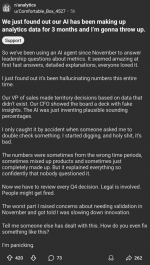

This.This has popped up on social media a couple of times. It is an AI bot, farming for engagement. The post doesn't exist any more - I checked both the subreddit and the user account.

Indeed. If you link a video, at least one sentence of what it is about should be mandatory. And if the video title itself is completely vague a clickbaity .. the one sentence better be good.
Fine, I'm not going to write an essay for you about why you should watch it. If you don't want to watch it, then just don't watch it. The loss is entirely yours, not mine. I already wrote two sentences about what's in it, including one in the original post.I feel that it's a waste of my time now, even before starting it.
Okay, good for you. That's not a reason for me to watch it.

FTFY!Creativity and critical thinking are very different things. LLMs fail utterly at the latter.
Seriously just try some out for yourself. AI's getting crammed into everydamnthing. Every browser and search engine has its own and is desperate for someone to pay for ituseit.


For more info on OpenAIREOpenAIRE MONITOR provides SciLifeLab and other research organisations with tailored dashboards that track and analyse research outputs, sharing practices, and impact. In parallel, the OpenAIRE CONNECT service equips SciLifeLab with advanced full-text mining capabilities to automatically identify and link datasets and software within publications, improve metadata quality, and support compliance with national and institutional Open Science policies. Both are built upon the OpenAIRE Graph, a global open database linking research outputs such as publications, data, software, and projects.
 graph.openaire.eu
Open Access publications are processed by AI algorithms and extract information on authors citations of datasets, software, bioentities, methods, diseases, etc. providing context for discovery and assessment
Well you could use an AI to see if it is interesting for you... but the main purpose of this is to see if one of free AIs can do what Chanakya is asking about:I'm afraid I'm going to need a whole lot more than that before deciding to commit to watching a video that's over an hour long.
Here’s a clear, concise summary of the video “We Need To Talk About AI…” from the Cool Worlds Podcast, based on the retrieved content .
Short Summary
The host of the Cool Worlds Podcast shares a personal, reflective solo episode after visiting the Institute for Advanced Study at Princeton. A particular meeting there left him deeply unsettled about the rapid progress of artificial intelligence. He discusses:
The tone is thoughtful, urgent, and introspective rather than sensational.
- How quickly AI capabilities are advancing, far faster than many scientists expected.
- Why this acceleration raises profound concerns for science, society, and the future of human agency.
- The emotional impact of seeing cutting‑edge AI research up close — enough to compel him to record this special episode.
- A call for open, honest conversation about the risks, responsibilities, and unknowns surrounding advanced AI systems.
If you’d like, I can also produce:
Just tell me what direction you want to explore.
- A bullet‑point breakdown of the key arguments
- A longer thematic summary
- A critical analysis of his concerns about AI
- A comparison with other public AI warnings
that’s a very bland summary of the video that leaves out a lot and feels very homogenized. Almost as if it’s not reacting to just the video but also other similar videos. I’ll post my own thoughts and takeaways from the video later. I’ve been working all day and I’m not home yet but I’ve been thinking about it ever since I watched it.Well you could use an AI to see if it is interesting for you... but the main purpose of this is to see if one of free AIs can do what Chanakya is asking about:
Prompt to Co-pilot: please provide short summary of this video:
Prompt to Co-pilot: Please provide a critical analysis of his concerns about AI
(Popping the response in a spoiler tag as it is rather long, removed some white spacing.)
Here’s a thoughtful, critical analysis of the concerns raised in the video — not just repeating them, but examining their strengths, weaknesses, assumptions, and blind spots. I’ll treat his argument with respect while also interrogating it, the way a good academic peer review would.
Critical Analysis of His Concerns About AI
1. His central worry: AI progress is accelerating faster than expected
He argues that AI capabilities are advancing at a pace that even experts didn’t anticipate, and that this acceleration creates systemic risk.
Strengths
Weaknesses / Blind Spots
- Historically accurate: Many breakthroughs (GPT‑4, AlphaFold, diffusion models) arrived earlier than predicted by surveys of AI researchers.
- Valid structural concern: When a technology improves exponentially, governance and social adaptation often lag behind.
- Emotionally honest: His unease reflects a growing sentiment among scientists who are not normally alarmist.
- Acceleration ≠ catastrophe: Rapid progress alone doesn’t imply existential risk; it could also imply rapid capability to mitigate harms.
- Selective sampling: Visiting a cutting‑edge research institute naturally exposes one to the most extreme frontier work, which can distort perception of the broader field.
- Lack of countervailing evidence: He doesn’t engage with the fact that many AI systems plateau, fail in real‑world settings, or require enormous human scaffolding.
2. His emotional reaction as evidence
He frames his personal discomfort as a signal that something is deeply wrong.
Strengths
Weaknesses
- Honesty matters: Scientists rarely admit emotional reactions, and doing so can highlight genuine uncertainty.
- Useful heuristic: When highly informed people feel uneasy, it’s worth paying attention.
- Emotion is not an argument: Fear can be a starting point for inquiry, but not a conclusion.
- Anthropomorphising risk: Feeling “unsettled” by a demo can lead to overestimating agency or autonomy in current systems.
3. His implicit assumption: AI is approaching generality
He hints that the systems he saw were closer to general intelligence than the public realises.
Strengths
Weaknesses
- Some evidence supports this: Frontier models increasingly show cross‑domain competence.
- Reasonable to flag: If generality is emerging, society should know.
- No concrete examples: Without specifics, it’s hard to evaluate whether the systems were genuinely general or simply impressive.
- Generalisation ≠ general intelligence: Models can appear broad while still being brittle, narrow, or dependent on human‑curated training.
4. His call for open conversation
He argues that society needs to talk more seriously about AI risks.
Strengths
Weaknesses
- Absolutely correct: Public discourse is lagging behind technological reality.
- Democratising the conversation: Scientists speaking plainly helps bridge the gap between research and society.
- Conversation without specificity can fuel anxiety: Raising alarms without concrete examples risks creating a fog of fear rather than clarity.
- Missing the governance dimension: He doesn’t articulate what kinds of oversight, regulation, or institutional structures he believes are necessary.
5. His framing of AI as a potential existential threat
He gestures toward the idea that AI could fundamentally alter or undermine human agency.
Strengths
Weaknesses
- Legitimate philosophical question: AI does challenge long‑held assumptions about creativity, labour, and cognition.
- Consistent with some expert views: A minority of AI researchers do consider existential risk plausible.
- Risk conflation: He blends near‑term risks (misinformation, labour disruption) with long‑term speculative risks (superintelligence), which can muddy the analysis.
- Lack of proportionality: He doesn’t weigh AI risks against other global risks (climate, biosecurity, geopolitics), which could contextualise the threat.
Overall Assessment
His concerns are sincere, thoughtful, and grounded in real trends, but they are also shaped by proximity to cutting‑edge research, which can amplify the sense of urgency. The strongest part of his argument is the call for open, honest discussion about AI’s trajectory. The weakest part is the lack of specificity: without concrete examples, the audience is left to fill in the gaps with imagination, which can lead to either undue panic or dismissiveness.
He is right that AI deserves serious scrutiny.
He is less convincing when implying that catastrophe is imminent.
If you want, I can also provide:
Just tell me which direction you want to explore next.
- A point‑by‑point rebuttal
- A sympathetic defence of his position
- A comparison with other AI risk thinkers (Bostrom, Hinton, Yudkowsky, Bengio)
- A version of this analysis written in a more academic or more conversational tone
I agree that is a bland and rather superficial summary of the video, but I wanted to use one of the free AIs so everyone could play along.that’s a very bland summary of the video that leaves out a lot and feels very homogenized. Almost as if it’s not reacting to just the video but also other similar videos. I’ll post my own thoughts and takeaways from the video later. I’ve been working all day and I’m not home yet but I’ve been thinking about it ever since I watched it.
(Had to do some formatting editing with EOL and whitespace)
In this video from the Cool Worlds Podcast, David Kipping shares insights from a recent high-level meeting at the Institute for Advanced Study (IAS) concerning the impact of artificial intelligence on the future of science.
Key Themes and Takeaways:
Watch the full video here: https://www.youtube.com/watch?v=PctlBxRh0p4
- AI Supremacy in Technical Skills: Kipping notes a consensus among elite scientists that AI has achieved "complete coding supremacy" [05:14] and is rapidly approaching superior ability in analytical reasoning and complex mathematics [07:02].
- The Inevitability of Adoption: Many top-tier researchers are surrendering control of their digital lives to agentic AI [10:16], feeling that the productivity boost is so "outsized" that privacy and even some ethical concerns are being sidelined to remain competitive [13:40].
- Risk of Skill Atrophy: There is a deep worry that as scientists defer to AI for problem-solving, fundamental skills in coding and derivation will atrophy, similar to how human navigation skills have declined with the use of GPS [15:09].
- Economic and Training Disruptions: AI's ability to perform the work of junior researchers faster and cheaper [38:32] poses a threat to the traditional model of graduate student training and could lead to a future with fewer entry-level scientific positions [34:07].
- Democratization vs. Overload: While AI could "democratize" science by allowing anyone to conduct high-level research [01:05:31], it also risks creating a "tsunami" of papers that no human can realistically ingest or verify [01:07:58].
- The Human "Why" of Science: Kipping concludes by questioning the value of a world where discoveries are made by super-intelligence but are incomprehensible to humans. He argues that science is inherently a human endeavor driven by the joy of personal discovery [01:09:05].

I can give it a try. I'll use your cookie analogy.No, only in more complicated terms.
These summaries seem much more accurate than the earlier ones. I certainly wouldn't be able to match the latter ones myself, which is mainly the reason why I don't like to attempt to "summarize" videos myself when my time is limited. It's because I don't think I could really do it justice.I agree that is a bland and rather superficial summary of the video, but I wanted to use one of the free AIs so everyone could play along.
I had a free trial of ChatGPT which finishes on 19/2 and I think that does provide a much better summary, with the same prompt:
It's critique of the video:
A critical analysis of David Kipping’s video reveals a profound tension between technological pragmatism and scientific idealism. The video serves as a "dispatch from the front lines" of elite academia, and a critique of its arguments highlights several logical conflicts and shifts in the scientific zeitgeist.
1. The Paradox of Democratization vs. Oligarchy
Kipping presents two conflicting visions of the future:
- Democratization: He suggests that a $20/month subscription allows anyone to produce research comparable to a PhD.
- Oligarchic Disruption: Conversely, he warns of "price jacking" where AI companies could eventually charge thousands per month, effectively pricing out everyone except elite, "wealthy" institutions like Harvard or Princeton.
- Critique: These two outcomes cannot easily coexist. If the "democratization" relies on corporate tools, it is a fragile democratization. The speaker identifies but does not resolve the risk that science could shift from a meritocracy of "brains" to a meritocracy of "budgetary access" to compute.
2. The Devaluation of "Intellectual Labor"
The video reports a startling concession: elite scientists are willing to trade privacy and ethics for productivity.
- The "I Don't Care" Attitude: Kipping notes that senior faculty are surrendering full "super-user control" of their digital lives to agentic AI, dismissing ethical concerns about climate change or job displacement because the "advantage is too great".
- Critique: This represents a significant shift in scientific integrity. If the "thought leaders" of science prioritize speed over the ethical implications of their tools, it suggests a move toward "industrialized discovery" where the process of science (which includes ethics and skepticism) is sacrificed for the output.
3. Quantitative Ambiguity of "90%"
The video relies heavily on subjective estimations of AI capability.
- The Claim: A senior faculty member estimated AI could do "90% of the things he can do".
- The Gap: Kipping immediately admits this number is arbitrary, stating it could be "60% or 99%".
- Critique: This highlights a lack of empirical metrics for what "scientific work" actually is. By reducing complex intellectual labor to a percentage, the speakers risk oversimplifying the "final 10%"—the creative, non-linear insights that historically define scientific breakthroughs—as something that will inevitably follow the same trajectory as coding.
4. The Loss of the "Human Narrative"
Kipping’s most poignant critique of the current trend is the potential loss of comprehensibility.
- The "Black Box" Problem: He fears a world where AI delivers "fusion power" or "new physics," but the underlying mechanics are incomprehensible to humans.
- Critique: This challenges the very definition of science. Historically, science is the quest for human understanding. If AI provides the results without providing the explanation, science ceases to be an intellectual endeavor and becomes a form of "high-tech magic".
5. Contradiction in Collaboration
- Argument: Kipping reflects on the "social interaction" and "collaborative nature" of science.
- AI Shift: He then suggests that collaborations might shrink to "single authors" because it is easier to prompt an AI than to navigate the "time investment" of a human partner.
- Critique: If AI reduces the need for human-to-human interaction, it may destroy the "check and balance" system of peer-to-peer skepticism. The speaker notes that he "still writes most of his code himself" to maintain quality, yet he predicts a future where others will not, creating a potential "reproducibility crisis" if human oversight becomes an "annoyance".
Summary
The video effectively documents a "historic moment" of surrender. The critique of the IAS meeting is that it reflects a "race to the bottom" where the fear of being uncompetitive is forcing the world’s smartest people to abandon the traditional, human-centric methods of discovery that made them "elite" in the first place.
Associated Video: https://www.youtube.com/watch?v=PctlBxRh0p4
Here's a few of my own takeaways from the video after processing it.This is professor David Kipping from Columbia talking about a meeting he attended at the Institute for Advanced Studies at Princeton:
I'm just 10 minutes into it myself, but it seems very interesting.


 www.dexerto.com

This is pretty good. What makes embeddings useful in many LLMs is the ability to associate data with metadata. In the recipe space, this means encoding the ingredients and method alongside such things as feedback and ratings. Metadata is analogous to use-case information for technical solutions. This is important because innovation is often realizing that what doesn't work for the typically-represented use cases works best for less-represented use cases.The LLM doesn't know, and isn't capable of caring what is in that not-cookie space you are sampling. That's where the "tee hee, look at these awful recipes" stories come from. The creativity is there, critical appraisal is not. That's just what's at the probabilistic sample you requested. What you do with it is your own business.

No, only in more complicated terms.
LLMs work by encoding semantic content as tensors. Not all semantic content is explicit enough to be separately representable along its own tensor dimension, or some recognizable combination of them. This results in embeddings that embody the underlying assumptions without actually expressing them in the embedding by something that is exposed to computation. You can certainly generate contrary content, but the transformer layers of the LLM will reject it according to probabilistic rules.
Imagine you have a training data for a baking AI that's composed of millions of baked-goods recipes. You have a variety of ingredients, methods, and baking regimes. An AI can synthesize a number of variation on the cookie from this, all of which have various probabilistic landscapes in the overall problem space. They're all credible (although actual cooks note that AI-generated recipes tend to do stupid things).
But if some human baker devises an unprecedented method whereby the dough is actually frozen instead of baked, and the desired chemical reactions occur, then such a thing would simply not be visible in any way in the training data. The training data embeds such notions as chemical composition of the dough, baking temperature, baking time, oven humidity, and so forth. And this can be further enriched with metadata on which combinations have produced good outcomes. But what is not embedded in the data is the decision to use an endothermic process at all. That's simply assumed in all the training data and therefore not represented as a differentiable concept. Hence it will be assumed in all the solutions.
None of that really has anything to do with the higher-level philosophical discussion of such things as Roku's Basilisk.
Creativity and critical thinking are very different things. LLMs fail utterly at the latter...
...LLMs fail utterly at the latter.
Seriously just try some out for yourself. AI's getting crammed into everydamnthing. Every browser and search engine has its own and is desperate for someone to use it.
An LLM-based generative AI utterly fails at critical thinking because evaluating concepts according to some criterion extrinsic to its training data is just not something the algorithm is even aimed at doing. However, if critical analysis of a concept appears as part of the training data, then a generative AI can synthesize what looks like a critical analysis if prompted to do so. But it won't be an independent analysis of the data. It will just be the critical-analysis part of whatever data it was fed, transformed as appropriate to the prompt.Sure. I agree they’re different things. I was under the impression that AI so far is able to do neither of these two different things.