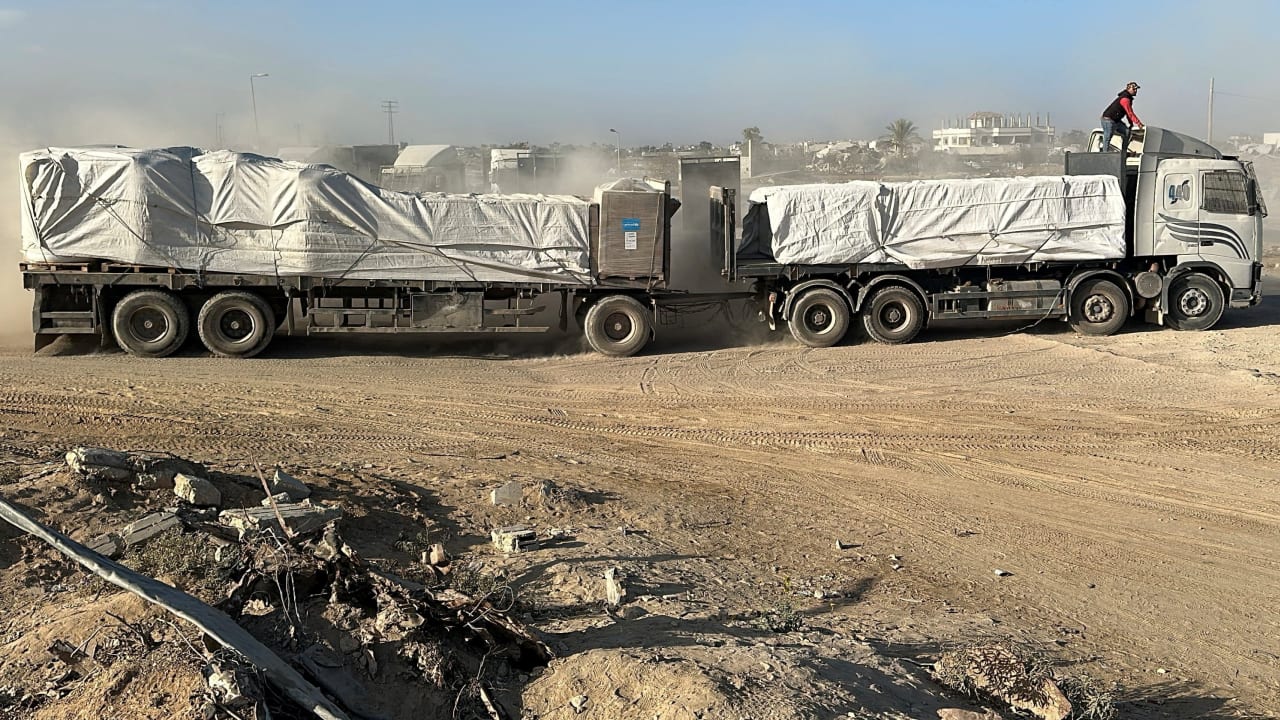
UNRWA was founded in 1949 by the UN General Assembly. Its mission was to provide relief to all refugees resulting from the 1948 Arab Israeli conflict. In 1952 Israel assumed responsibility for Jewish refugees, leaving UNRWA responsible only for the Arabs who were displaced by that conflict, both inside the territory of the former Mandate Palestine (in the West Bank and Gaza), and outside the Mandate's borders (in Jordan, Lebanon and Syria).
It is worth recalling the background to the "Palestinian refugee problem." In 1947 the General Assembly voted to partition Mandate Palestine into two states, a Jewish state and an Arab state, with Jerusalem and Bethlehem remaining under international control. The Jewish leadership accepted the partition plan, the Arab leadership, backed by all the Arab states, rejected it, and launched a war to drive the Jews out. The Arab armies were defeated, and about 700,000 Arabs became refugees. Some of these were expelled by the Israelis, some fled on the advice of their leaders, and others fled simply to escape the fighting.
The creation of a specialised agency to provide relief to these refugees made some sense in 1949. But the creation of the UN High Commissioner for Refugees (UNHCR) in 1950 rendered UNRWA redundant, and its functions should have been taken over by the UNHCR. This was not done, for entirely political reasons. UNRWA continued to operate at the insistence of what was by then a permanent majority at the UN hostile to Israel, consisting of an opportunistic alliance of the Soviet bloc and the Muslim world. The Palestinian refugees and their offspring were to be held, in effect as hostages, in perpetuity, as a weapon to be used against Israel, and UNRWA was to be their keeper.
Another long-forgotten fact is that UNRWA's charter defines a Palestinian as any person of Arab descent who had been living in Mandate Palestine for two years before the 1948 war, as well as all their male-line descendants. This means that a large number of people who migrated to Mandate Palestine from Transjordan, Egypt and other Arab countries, attracted by the economic opportunities provided by Jewish investment and British administration, were classed as Palestinians even though they had no actual Palestinian ancestry. Their descendants are still classed as Palestinian refugees.
Now, 76 years after the creation of UNRWA, nearly all of the original 700,000 refugees are dead. Mahmoud Abbas, the self-styled and unelected president of the "State of Palestine," who was born in Safed in 1935 and is now 90, is among the last of that generation.
Nearly all of those now officially classed as Palestinian refugees are the children, grandchildren and great-grandchildren of the 1949 refugees.
These descendants now number more than 5 million, almost none of whom have ever set foot in what is now Israel. Of these, 1.2 million live in Gaza and 770,000 live in the West Bank. Another 2.1 million live in Jordan, 530,000 in Syria and 450,000 in Lebanon (many of those in Syria fled to Jordan or Lebanon during the Syrian civil war).
It needs to be stressed how unique this situation is. No other refugee population in the world contains almost no actual refugees: that is, people who have fled or been forced from their homes. Nearly all of the official Palestinian refugees live where they were born, and where in most cases their parents were born. The decision to continue to class them, even to the fourth generation, as refugees was and remains a political choice made by the majority bloc at the UN.
What was the alternative? It was obvious by the mid 1950s that Israel was not going to allow the Arabs who left its territory in 1949 to return, and the 1956 Suez Crisis and 1967 war made it clear that Israel could not be coerced into doing so. At that point efforts to resettle the refugees should have begun. The obvious place to resettle them was and still is Jordan, which was originally the eastern half of Mandate Palestine and which has a population of majority Palestinian descent. Jordan is an artificial creation ruled by a dynasty imported from the Hejaz and imposed by the British. It could very easily have been redesignated as Palestine, and still could be.
Let us take the most obvious analogy from the same period of history. At the end of World War II some 12 to 15 million Germans were expelled from their homes in eastern Germany, Poland and Czechoslovakia. Today their descendants have been successfully integrated into German society. Although many retain their cultural identity as Pomeranians or Sudetenlanders, there is no agitation whatever to reverse the postwar territorial settlement.
It will be argued that the resettlement of the German refugees was possible only because there was still a German state for them to be resettled in: they were only being resettled from one part of Germany to another. But this ignores the fact that Germany only became a united country in 1871, and that in 1945 it was a much less homogenous country than it is today. There were wide differences between, for example, East Prussians and Bavarians. They spoke different dialects, dressed differently and (most importantly) went to different churches. For a Protestant East Prussian refugee in 1945, Catholic Bavaria was in many ways a foreign country.
By contrast, despite recent efforts to create a separate Palestinian cultural identity ("Palestine music", "Palestinian food"), there is very little difference between a Palestinian born in Jaffa or Nablus and a Jordanian born in Amman. They are mostly Sunni Muslims and they speak the same Shami or Levantine dialect of Arabic (as do most Lebanese and Syrians). If the Palestinian refugees had been resettled in Jordan in the 1950s or 1960s, the "Palestinian question" in its current form would not exist. Today, after decades of nationalist propaganda (inculcated in UNRWA schools), this would be much more difficult, but not impossible.
(In fact, as everyone familiar with the issue knows, most Palestinians, wherever they live, would very happily be resettled, provided they could be resettled in North America or Western Europe. In the current political climate, after over 50 years of Palestinian terrorism, that's not very likely, although several hundred thousand Palestinians have emigrated from both Gaza and the West Bank over the past 20 years, mainly to Western Europe or Canada. Israel has quietly facilitated this exodus.)
Today UNRWA has more than 30,000 employees, nearly all of them Palestinians, to manage these 5 million official refugees. (By contrast, the UNHCR, which is responsible for the welfare of more than 20 million real refugees, has 18,000 employees.) While this is represented as "empowering refugees," what it means in practice is that UNRWA has come under the control of the Palestinian political factions to whom these employees owe their first loyalty: primarily Fatah in the West Bank and Hamas in Gaza.
UNRWA provides a variety of social services to the officially designated Palestinian refugees, most of whom live in what are usually described as refugee camps but are in fact sizeable towns. This arrangement relieves Jordan, Lebanon and Syria, as well as the Palestinian Authority, of the need to provide services to these communities. It also serves to prevent the Palestinians from integrating into the societies of their host countries, and freezes them into the status of permanent, hereditary refugees, which suits the political agenda of the anti-Israel majority at the UN.
Most notably, UNRWA operates school systems in all the Palestinian localities. Before the current conflict, these schools served about 500,000 students. They are staffed entirely by Palestinians, most of whom are members or supporters of the various Palestinian political factions such as Fatah and Hamas. This is most obviously true in Gaza, where UNRWA provides schools for the large majority of the territory's students, and where Hamas has had complete control of the system since its seizure of power in 2007. It has been claimed that all of the perpetrators of the 7 October attacks on Israel were graduates of UNRWA schools. That cannot be proved, but it is likely that the great majority were.
What is undeniably true is that UNRWA schools have inculcated into several generations of Palestinian youth a visceral hatred of Israelis, Zionists and Jews. They have drawn no distinction between these three categories, which is why the Hamas attackers cheerfully murdered Israeli peace activists such as Vivian Silver. Someone also taught these young Palestinians that the gleeful murder, torture and rape of Israeli Jews is an approved form of "armed struggle" against the Zionist occupiers. If it wasn't UNRWA schools, who was it?
UNRWA's Palestinian employees also get to spend most of UNRWA's $US1.1 billion annual budget. It is a sad fact that all foreign aid programmes are riddled with corruption and embezzlement. In programmes which transfer large amounts of money from rich donors to very poor recipients, this is understandable. In the case of UNRWA, however, the principal motive for diversion of aid money is not survival, or even personal enrichment (although as the opulent mansions of the Fatah and Hamas leadership testify, that is certainly a factor). The motive is mainly military and political.
Both Fatah and Hamas have stolen huge amounts of foreign aid over recent decades, and much of that money has passed through the hands of UNRWA officials before it has been used to buy weapons, build missile sites, dig tunnels and spread antisemitic propaganda. UN officials, most of them supporters of the Palestinian cause, have made no effort to police this, and the donor countries, particularly in Europe, have not been much better. No-one wants to be called an Islamophobe or (even worse) a Zionist for trying to prevent the theft of taxpayer money to fund warfare against Israel.
It should be noted in passing that the great majority of UNRWA's funding comes from Western countries. Before the current conflict, the largest donors were the United States, the European Union, Germany, Britain and Sweden. The EU and its member states together provided over 40% of UNRWA's funds, while the United States provided 29%. The only Arab states to make significant contributions were Saudi Arabia, Kuwait and Qatar, although between them they gave less than Sweden. China, India and Russia gave only token amounts, Iran gave nothing. Australia gave $20 million a year.
What this means in effect is that Western taxpayers, including Australia's, have been forking out more than a billion dollars a year to keep 5 million Palestinians penned up in refugee camps in perpetuity, to be used as a weapon in the campaign of the anti-Israel (and anti-Western) majority bloc at the UN to destroy Israel and either kill or drive into exile the 7 million Jews who live there. And all this to create another poor, corrupt, despotic Arab state, run either by the gangsters of Fatah or the religious fanatics of Hamas.
The 7 October attack on Israel and the accompanying atrocities have brought all these matters to a head. Hamas of course knew that the attack would provoke an immediate and massive Israeli response, but they seem to have underestimated the depth of the anger and revulsion that the behaviour of their "fighters" would provoke, not only in Israel but in most of the Western world. They appear not to have anticipated that the attack would force Western governments to acknowledge what they knew all along – that UNRWA has long ago been captured by the Palestinian factions, and that Hamas has been funding its sophisticated military infrastructure in Gaza using Western taxpayer money funnelled to them by UNRWA.
Israel will probably also insist that UNRWA be expelled from Gaza – certainly its control of the education system must end. More broadly, the governments of the Western world – who are paying UNRWA's bills – must now accept that its continued existence is a serious obstacle to any long-term settlement of the Israel-Palestine conflict. It should be disbanded and its functions transferred to agencies not under Palestinian control. It is very unlikely that the anti-Israel majority at the UN will agree to this, but if the Western governments permanently cut off UNRWA's funding, and direct their humanitarian aid to the Palestinians elsewhere, its ability to do further harm will be greatly reduced.
How then have I been inoculated against the biases I criticise my fellow commentators in this thread for showing? I believe the answer, paradoxically, is my membership of the ALP, and more particularly the ALP Right. Since my political affiliation is formal and known in ALP circles, I have to guard especially carefully against partisanship. And since I support a faction dominated by hard-boiled pragmatists and generally hostile to the views of the Australian Greens and the inner urban cosmopolitan elite that forms their voting base, I am better equipped to avoid the trap of that elite groupthink into which many others have fallen and which i regularly see at federal and state election time.)