• Security incident: ISF was recently accessed by intruders. Please change your password, and change it anywhere else you used it. Read more

Cont: The Trials of Amanda Knox and Raffaele Sollecito: Part 32

It's not my intent to imply that an unlawful act (violation of procedure) is necessarily malicious. I believe that many such acts are not intended as malicious, even when done intentionally.
I completely agree.

However, it is the responsibility of the state (Italy, in this case) to be sure that the police, prosecutors, and judges are trained, and this training must achieve a high standard of compliance with procedural law, otherwise, miscarriages of justice are likely.
This raises an interesting question. Were these officials properly trained and then just ignored their training, was their training so utterly deficient that such a gross miscarriage of justice as occurred in this case was bound to happen eventually, or was it something in between these two extremes. I strongly suspect that it was in between, with the police likely tending toward poor training, and the judiciary [ETA: likely] tending toward failing to follow what they'd been trained the law was.

The assignment of blame for Knox being denied a lawyer is not necessarily relevant, because, to my knowledge, there is no criminal law in Italy for that violation of procedural law. The remedy for the denial of a lawyer is to throw out (court declares inadmissible) the alleged evidence (incriminating statements) gathered when there was no presence of the lawyer. Obviously, both the police and Mignini were responsible for Knox being denied a lawyer during the interrogations and the period immediately after them. Whether the police denied Knox a lawyer on Mignini's instructions is unknown to the public; of course, he was the supervisor of the police team for the investigation.
That's what I was getting at, although I probably should have tried to make my point clearer. You asked what the implications of police officers' being able to assert incompetence as a defense to their illegal activities; what I was attempting to illustrate is that, often, there would be few additional implications, as there is no criminal penalty for the illegal activity.

At least in US law, it is assumed that the person accused knows the law, unless there is some good reason otherwise. Thus, if one is accused of trespassing on US government property, if there were no signs and perhaps fences in relevant places to warn someone, an accusation of trespassing would very likely be dismissed by a court. If speed limit signs were not posted in relevant places, then your example could be a good one.
Your example actually isn't on point, and, in hindsight, mine may not be, either. You're talking about a situation where a person doesn't know he or she is trespassing, rather than a situation where he or she doesn't know trespassing is illegal.

I was thinking of a situation in which a local ordinance is passed setting an unreasonably low speed limit along a certain stretch of road, and said speed limit is then either not posted or very poorly posted (e.g., sign mostly concealed behind heavy underbrush). So, yes, technically, the speeder would be ignorant of the law (the speed limit in that area). However, anyone with a valid drivers license is presumed to know that the speed limit has to be obeyed. So, again in hindsight, I'd say this would be more a case of knowing the law but being unaware one was breaking it, rather than not knowing the law.

Cases where ignorance of the law is allowed as a defense for ordinary people, in certain circumstances, include:
  • Advice of counsel (your attorney gave you the wrong information)
  • Advice from the government (an agency gave you the wrong information)
  • The government gave everyone the wrong information (e.g., official hunting regulations list an incorrect bag limit)
In other words, if you can show that you either made a good-faith attempt to learn and comply with the law, or you couldn't reasonably have been expected to have known the law, then you should be okay.

There was a case I remember quite a while ago (about 40 years, I think), where a man in Ohio was criminally charged in the death of his son in a car accident, because the boy wasn't in a car seat, which was required by a recently passed state law. The man's defense was that he didn't know about the law because he was illiterate and didn't own a TV. He was acquitted, but IDK whether that's because the jury actually bought his argument, or they just felt sorry for him.

However, for the Knox case, the alleged criminal violations under Italian law would have included the use of threats (the alleged threats of prison and not being allowed to see her mother) and violence (the alleged hits on her head) to obtain statements, filing a false official document (possibly based on the truncated wording quoting Knox's text message to Lumumba that Mignini used in the arrest document), and calunnia (falsely accusing someone, known to be innocent, of a crime). I'm basing these charges on the Boninsegna MR (as I recall it) - note that in order to charge Knox with calunnia against the police and Mignini, an Italian prosecutor needed to identify in Knox's testimony before the Massei court the crimes that she was implicitly accusing the police and Mignini of committing.
IANAL, but I think even a zealous prosecutor would have had trouble making any criminal charges stick, even if one of the police officers or the interpreter had suddenly gotten a guilty conscience and corroborated Amanda's account of what happened.

If there's a question as to why the police knew Knox to be innocent, that is the kernel of the matter. Knox was known to be innocent by the police and Mignini during the interrogation because she had not been finally proven guilty by an Italian court. That's based on the Italian Constitution and Italian procedural law. Those thinking that the police and Mignini, because they may sincerely have strongly believed Knox to be guilty could not have committed calunnia against (that is, framed) Knox simply don't accept or don't understand this principle of the presumption of innocence. If her statements during the interrogation were coerced - in violation of CPP Article 188 - then her statements cannot be used because they were gathered contrary to law (CPP Article 191). This would mean that the arrest document was false in that respect as well, another instance of the criminal act of filing a false official document as well as an act of calunnia.
I wouldn't say she was known to be innocent; I believe that ought to refer to factual innocence. If mere legal innocence opened one up to a potential charge of calunnia, very few people would make accusations, even upon very strong evidence, for fear of being charged if the accused were to be acquitted. I will certainly say that they had no reasonable basis upon which to accuse her.

I am, however, actually willing to give the police and Mignini the benefit of the doubt and say that they are probably not to be to be blamed for the fact that Amanda's failure to show grief in the way that they, as Italians, expected that she ought to have, aroused their suspicions.

Of course, that in no way excuses Mignini's idiotic theories ("Only a woman would cover the body"), the incompetent investigation, and the abusive and criminal interrogations of Amanda and Raffaele.
 
Last edited:
None of this abnegates the fact there WAS a sadistic cruel murder, at Halloween/All Souls bank holiday,
When the murder happened is irrelevant.
wherein the perps went back afterwards to clean up,
No evidence of a clean-up.
pose the body and create a mise-en-scène in an elaborate act of deception,
No evidence of posing the body.
complete with broken window, strewn about clothing
As a result of Guede breaking into the cottage.
and the body undressed and set in an obscene position to make it look like a rape.
It looked like a rape because Guede did sexually assault her.
You might call this clowning about and a prank
No, I said Raffaele was clowning around when his FB picture was taken, and Amanda pulled a prank back at UW. I never called Guede's sexual assault and murder a prank.
and I dare say, whilst the pair were high on drugs it seemed like a great laugh.
High on pot, not "drugs".
The pages of the last couple of weeks torn out of her diary to hide the planning and fantasies of this sick pair.
No evidence of this.
Mez was bullied, tortured by her tormentors:
Clearly Guede bullied her, but there's no evidence he tortured her.
more than thirteen additional knife point jabs and bruising around the neck indicating strangulation and an extremely painful breaking of her hyoid bone. This was cruel calculated sadism not a chance burglary.
Well, it started out as a burglary until Meredith came home and surprised him. If you wish to accuse him of calculated sadism, then so be it, though I'm not sure there's evidence to support your claim
Phones switched off for the duration.
One switched off for the evening for various reasons, none of which had to do with Guede murdering Meredith.
Committed by persons with a thrill-seeking need for domination and lesson teaching.
Committed by A person, and while he's never explained his motivation, I suspect it was a crime of opportunity by someone motivated by a sexual urge.
 
That was the nature of RS' thrill kill fantasy. Wanted 'extreme experiences'.

You know what else are "extreme experiences"? Sky diving, hang gliding, bungee jumping, race car driving, mountain climbing, etc. Yet your mind goes to it being "RS's thrill kill fantasy". What does that tell us?
Objectifying the victim means they can do it without seeing her as a person.
So, they saw her as a vampire? Then why didn't they force her to dress up in her vampire costume and really objectify her? Utter rubbish.
Knox had a history of hazing her colleagues. Staged burglaries for a laugh.
And there's a two-fer: both hyperbole and mischaracterization.

Hazing: "Any activity expected of someone joining a group (or to maintain full status in a group) that humiliates, degrades, or risks emotional and/or physical harm, regardless of the person's willingness to participate."

What group was her roommate joining? How was the prank humiliating, degrading, or risking her emotional and/or physical harm? A momentary fright after which she was informed it was just a prank is hardly "emotional harm".

ONE college prank pulled by her and and some other roommates is hardly a "history of hazing".
Confronted frightened housemate wearing a sinister ski mask.
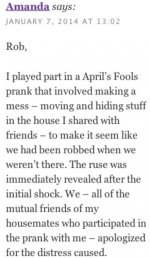
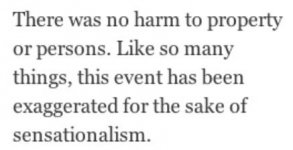
"Sinister ski mask"? I'm asking for a quote and citation...not that you'll provide it. This is what Knox says happened:

prankone.JPG
pranktwo.JPG


Terrified neighbours with an out of control party.
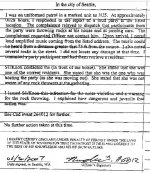
Sigh. You've been reading the DM tabloid nonsense again. THIS is Off. Bender's report. I see no evidence of "terrified neigbors" or an "out of control party". I see pissed off neighbors.
knox noise ticket.JPG

Wrote short stories in which 'chicks' were raped.
LOL. This may work on those who have never read "Baby Brother" but not on those who have read it. It's a story about the disgust a brother feels for his younger brother who he learns drugged and likely raped a girl at a party.
And it was one story, not plural.

This constant blatant exaggeration and mischaracterizing is more than annoying. It's revealing.
 
i agree. this was obviously a common practice to evade the law requiring counsel. We were just interviewing as a witness so we didn't have to record the interrogation, or have legal counsel present. I suspect it was not the first time Mignini had used the 'I'm just hear to record your statement' lie as a way to avoid the presence of a defence lawyer.

It was particularly invidious given the long coercive interrogation throughout the night, carried out in a foreign language, of a foreign national without notifying the embassy.
It's amazing how they were only 'witnesses' on Nov. 5 so weren't recorded, yet they were recorded in the questura waiting room on Nov. 4.

Mignini' excuses included
1. They weren't suspects, just witnesses informed of the facts.
2. They had to rush out and arrest Lumumba (AFTER the interrogation).
3. They didn't have the money due to budget restrictions.
 
What ◊◊◊◊◊◊◊◊◊. Amanda was never involved in a hazing. Amanda, along with a couple of roommates, played a prank on another roommate. Playing pranks on one another in college is about as common as smoking pot, and I would remind you, pranks are intended to make people laugh. She co-hosted a party that got too loud. She wrote ONE short story, and rape was hardly mentioned. The focus of the story was one brother holding the other accountable because he had raped someone. It was a positive moral story.

Rather than writing this crap that serves no purpose,
why don't you answer some of the questions you've been avoiding, such as;
  • How did Filomena know Meredith never locked her door?
  • Explain how you can claim "they were technically not 'exonerated'"
  • What is your evidence that Amelie was downloaded in the end of October?
That's a rhetorical question, innit?
 
Profiling is mostly mythology to begin with. The expert "profiler," usually FBI, who shows up at the police station, looks through the reports, and intuits, based on the angle of the stab wounds and the phase of the moon and the use of the phrase "strange lotions" in the taunting note sent to the newspaper, that the serial killer must be 29 years old, single, used to play a trumpet in a high school orchestra, and collects vintage Happy Meal toys—and turns out to be exactly right in every detail—is as much a figment of TV show runners' imaginations as DNA test results that come back in ten minutes. Most real profiling is based on statistics, for instance most bank robbers or kidnappers are within a certain age range.

And more important, profiling only works to the limited extent it does, if you have the facts and the statistical relationships correct. Someone who interprets a single noise complaint as "antisocial" or a Halloween costume photo as indicating "transgressive personality" isn't profiling, they're making up excuses. That's the potential fraud, the pretense of profiling without actually doing anything resembling that. (Note that I conditioned all that on whether Mignini himself ever claimed to actually be profiling in the manner Vixen claims he did.) Like claiming a car can self-drive on public streets when it actually can't.

I'm not sure whether either of those example is actual fraud in any legal or dictionary sense. As I've been telling Vixen, most of the discussion in this thread (your own contributions excepted) is now about history. With the exception of a few remaining issues related to the ECHR that no one would care the slightest bit about if it weren't for the murder case, "current events" have gone by the board. Narratives of history don't run on nuanced details, but on broad sweeps. Did Nero fiddle while Rome burned? Almost certainly not. Who cares? The same way Nencini didn't care about the actual evidence or truth about AK and RS, history won't care exactly why he's the villain.
I agree with your position that most of what is called "profiling" (fake profiling) is nonsense. For the Knox - Sollecito case, the "profiling" by the PGP and their allies is absurd.

In my post, I left out the issue of profiling, because I thought that the alleged or fake "profiling" in this case has been more of an effort to justify the "conclusion" or "suspicion" of the guilt of Knox and Sollecito that had been formed before any attempt at even fake "profiling" began. I am not sure that Mignini and the police engaged in profiling or fake profiling to any extent before they recognized how simple the "solution" of the case became if the rape/murder could be attributed to an "insider" - a resident of the cottage present in Perugia at the relevant time. Mignini's intuitive evidence-free hunches coupled with his interest in Satanic ritual murders and Giobbi's and Napoleoni's negative impressions of Knox and Sollecito were additional motivations. Once Mignini and the police decided that insiders Knox and Sollecito were "good", "convenient," and "vulnerable" suspects, the task was to "find" evidence incriminating them to the extent that an arrest could be justified at an arrest hearing. This was accomplished during the 5 - 6 November 2007 coercive interrogations. The character assassination or fake "profiling" began after the arrest.
 
Last edited:
This post highlights the numerous falsehoods Vixen has told in her post. If Amanda and Raffaele were so depraved and evil that they would commit a brutal murder, why is it necessary to resort to lying to support this argument? If the case against Amanda and Raffaele was such a slam dunk, why is it necessary to resort to arguments such Raffaele being influenced by a manga comic in an unopened wrapper? Why repeat the same lies over and over again? Why has vixen constantly refused to answer why is it necessary to resort to lying if the case against Amanda and Raffaele was so solid?

Unopened, claim you.

.
 
The above has zero to do with Myriad's post which you completely mischaracterized.


Yet you bring it up anyway.

This knowledge comes from your years of living in Italy's old towns and overhearing Italians whispering about it?
All these mafia and masonic "whispers" aren't coming so much from Italy as from you and TJMK.

If Mignini claimed Knox drank Meredith's blood and sacrificed a goat to Satan, you'd back him up.

You mean the scene in one of the comics in the UNOPENED 1960's manga collector's set given to him as a gift by his friend, Gianluigi Ceraso?

I've seen worse on TV in the recent Interview with the Vampire series.


I see this claim a lot by the PGP. Like most of your claims, it's not based on anything but your own need to believe it.


Of course it was. The police who retrieved RS's manga collection were shocked by their content.

Your making light of the murder is absolutely par for the course.


.


.
 
Last edited:
Profiling is sometimes correct and sometimes not. Anything subjective is never going to be accurate all the time.
AFAIK, the only professional profiler involved in the case is John Douglass who formed and lead the FBI profiling (Behavioral Science) unit. His opinion is that neither Knox nor Sollecito fit the profile of killers but Guede does.
 
Profiling is mostly mythology to begin with. The expert "profiler," usually FBI, who shows up at the police station, looks through the reports, and intuits, based on the angle of the stab wounds and the phase of the moon and the use of the phrase "strange lotions" in the taunting note sent to the newspaper, that the serial killer must be 29 years old, single, used to play a trumpet in a high school orchestra, and collects vintage Happy Meal toys—and turns out to be exactly right in every detail—is as much a figment of TV show runners' imaginations as DNA test results that come back in ten minutes. Most real profiling is based on statistics, for instance most bank robbers or kidnappers are within a certain age range.

And more important, profiling only works to the limited extent it does, if you have the facts and the statistical relationships correct. Someone who interprets a single noise complaint as "antisocial" or a Halloween costume photo as indicating "transgressive personality" isn't profiling, they're making up excuses. That's the potential fraud, the pretense of profiling without actually doing anything resembling that. (Note that I conditioned all that on whether Mignini himself ever claimed to actually be profiling in the manner Vixen claims he did.) Like claiming a car can self-drive on public streets when it actually can't.

I'm not sure whether either of those example is actual fraud in any legal or dictionary sense. As I've been telling Vixen, most of the discussion in this thread (your own contributions excepted) is now about history. With the exception of a few remaining issues related to the ECHR that no one would care the slightest bit about if it weren't for the murder case, "current events" have gone by the board. Narratives of history don't run on nuanced details, but on broad sweeps. Did Nero fiddle while Rome burned? Almost certainly not. Who cares? The same way Nencini didn't care about the actual evidence or truth about AK and RS, history won't care exactly why he's the villain.


I see. So Bryan Kohberger's history of interest in serial killers and studying criminology is completely irrelevant according to your theory.

I find it weird that anyone would believe a policeman or a prosecutor, or even a judge, according to some criminals, are responsible for the perp being found guilty after a lengthy and fair trial. Ten different judges reviewed the case before it reached Massei. The six lay jurors are chosen randomly for each case. Mignini was joined by Commodi, another prosecutor a few months in, yet somehow you have a weird belief he single handedly managed to prove the case to two merits courts, even though it was Crini who took over for the second one.


Amazing!


.
 
Last edited:
The above has zero to do with Myriad's post which you completely mischaracterized.


Yet you bring it up anyway.

This knowledge comes from your years of living in Italy's old towns and overhearing Italians whispering about it?
All these mafia and masonic "whispers" aren't coming so much from Italy as from you and TJMK.

If Mignini claimed Knox drank Meredith's blood and sacrificed a goat to Satan, you'd back him up.

You mean the scene in one of the comics in the UNOPENED 1960's manga collector's set given to him as a gift by his friend, Gianluigi Ceraso?

I've seen worse on TV in the recent Interview with the Vampire series.


I see this claim a lot by the PGP. Like most of your claims, it's not based on anything but your own need to believe it.


Another one of your made up claims?


.
 
Profiling is sometimes correct and sometimes not. Anything subjective is never going to be accurate all the time.
AFAIK, the only professional profiler involved in the case is John Douglass who formed and lead the FBI profiling (Behavioral Science) unit. His opinion is that neither Knox nor Sollecito fit the profile of killers but Guede does.


Luckily we have criminal courts of law who decide the issue and not bigots.


.
 
I see. So Bryan Kohberger's history of interest in serial killers and studying criminology is completely irrelevant according to your theory.

I find it weird that anyone would believe a policeman or a prosecutor, or even a judge, according to some criminals, are responsible for the perp being found guilty after a lengthy and fair trial. Ten different judges reviewed the case before it reached Massei. The six lay jurors are chosen randomly for each case. Mignini was joined by Commodi, another prosecutor a few months in, yet somehow you have a weird belief he single handedly managed to prove the case to two merits courts, even though it was Crini who took over for the second one.

Amazing!

Yeah, it is amazing how half the Italian criminal justice system was willing to bend procedure, propriety, and logic into shapes that not even M.C. Escher could draw, just to help Giuliano "Filet" Mignini cover his filet. Fortunately they were checked by a higher court that actually cared about inconvenient details like cause and effect.

Poor deluded Filet. No witches to torture in his dungeons any more. Satan got away from him again. Vampires party in Perugia.
 
Of course it was. The police who retrieved RS's manga collection were shocked by their content.
Only by the sealed ones Chiacchiera opened and that RS had not read. But maybe Chiacchiera is also bent or paid off? Maybe the mafia. Masons, or Trump got to him! Immediately following the quote and cited testimony of Chiacchiera above was this:
PRESIDENT - the defense attorney's question was perhaps also aimed at this. You said earlier: "some comics caught my attention" for the characteristics that you highlighted earlier. You quantified these comics as three or four, I think I understood. Were these the only comics that caught your attention?

WITNESS - yes.

LAWYER - and were there others of another type?

PRESIDENT - that's it. I think that was the question he was aiming at.

WITNESS - It's written in the minutes.
So the only ones that "horrified" hims were the ones that HE OPENED and that RS had not read.
Your making light of the murder is absolutely par for the course.
And your making false claims and mischaracterizing what is said is absolutely par for the course.
 
Luckily we have criminal courts of law who decide the issue and not bigots.
Yes, we do. Which has absolutely nothing to do with my comment.

"bigots"? Are you really claiming that Douglas stating they don't fit the profile of killers is because he's a bigot? Was Guede confirmed guilty because the courts were bigoted?
Is anyone who believes Guede alone killed Kercher a bigot?
Are you a bigot for believing Guede was involved in the murder?

You've made some really gobsmacking claims, but this one is right up there in the desperation department.
 
1. I completely agree.


2. This raises an interesting question. Were these officials properly trained and then just ignored their training, was their training so utterly deficient that such a gross miscarriage of justice as occurred in this case was bound to happen eventually, or was it something in between these two extremes. I strongly suspect that it was in between, with the police likely tending toward poor training, and the judiciary [ETA: likely] tending toward failing to follow what they'd been trained the law was.


3. That's what I was getting at, although I probably should have tried to make my point clearer. You asked what the implications of police officers' being able to assert incompetence as a defense to their illegal activities; what I was attempting to illustrate is that, often, there would be few additional implications, as there is no criminal penalty for the illegal activity.


4. Your example actually isn't on point, and, in hindsight, mine may not be, either. You're talking about a situation where a person doesn't know he or she is trespassing, rather than a situation where he or she doesn't know trespassing is illegal.

I was thinking of a situation in which a local ordinance is passed setting an unreasonably low speed limit along a certain stretch of road, and said speed limit is then either not posted or very poorly posted (e.g., sign mostly concealed behind heavy underbrush). So, yes, technically, the speeder would be ignorant of the law (the speed limit in that area). However, anyone with a valid drivers license is presumed to know that the speed limit has to be obeyed. So, again in hindsight, I'd say this would be more a case of knowing the law but being unaware one was breaking it, rather than not knowing the law.

Cases where ignorance of the law is allowed as a defense for ordinary people, in certain circumstances, include:
  • Advice of counsel (your attorney gave you the wrong information)
  • Advice from the government (an agency gave you the wrong information)
  • The government gave everyone the wrong information (e.g., official hunting regulations list an incorrect bag limit)
In other words, if you can show that you either made a good-faith attempt to learn and comply with the law, or you couldn't reasonably have been expected to have known the law, then you should be okay.

There was a case I remember quite a while ago (about 40 years, I think), where a man in Ohio was criminally charged in the death of his son in a car accident, because the boy wasn't in a car seat, which was required by a recently passed state law. The man's defense was that he didn't know about the law because he was illiterate and didn't own a TV. He was acquitted, but IDK whether that's because the jury actually bought his argument, or they just felt sorry for him.


5. IANAL, but I think even a zealous prosecutor would have had trouble making any criminal charges stick, even if one of the police officers or the interpreter had suddenly gotten a guilty conscience and corroborated Amanda's account of what happened.


6. I wouldn't say she was known to be innocent; I believe that ought to refer to factual innocence. If mere legal innocence opened one up to a potential charge of calunnia, very few people would make accusations, even upon very strong evidence, for fear of being charged if the accused were to be acquitted. I will certainly say that they had no reasonable basis upon which to accuse her.

I am, however, actually willing to give the police and Mignini the benefit of the doubt and say that they are probably not to be to be blamed for the fact that Amanda's failure to show grief in the way that they, as Italians, expected that she ought to have, aroused their suspicions.

Of course, that in no way excuses Mignini's idiotic theories ("Only a woman would cover the body"), the incompetent investigation, and the abusive and criminal interrogations of Amanda and Raffaele.
1. We need to be careful and define the meaning of "malicious" in this context. One US legal definition is:

A malicious act is an intentional, wrongful act performed against another without legal justification or excuse.
Source: https://definitions.uslegal.com/m/malicious/
If police and/or a prosecutor engage in coercing or psychologically manipulating an incriminating statement from a person who must, under law, be presumed innocent, I believe that qualifies as a malicous act. Italian procedural law (CPP Article 188) states specifically that "methods that may influence the freedom of self-determination or alter the capacity to recall and evaluate facts shall not be used" to gather evidence. Obviously the coercion and psychological manipulation as conducted in Knox's 5 - 6 November 2007 interrogation falls under this prohibition. Another Italian procedural law, CPP Article 191, states that "evidence gathered in violation of the prohibitions set by law shall not be used". So I firmly believe that the actions of the police and prosecutor during Knox's interrogation were malicious. There is no valid argument against that belief. That is why I firmly believe that the police and prosecutor were "framing" Knox and Sollecito.

2. I disagree with your statements regarding the level of training of the police and prosecutor. Under Italian law, the questions and answers exchanged in any questioning by police or prosecutor of a witness, a suspect, or an accused are to be documented in writing (CPP Articles 357 and 373); electronic recording is allowed but does not eliminate the requirement of written documentation. The same police officers who carefully documented in writing all the witness statements before the 5 - 6 November interrogation failed to do so for the 5 - 6 November interrogation.

3. I was not clear enough in my statements. For some procedural violations, there is no criminal penalty; instead, there is a remedy such as the exclusion of unlawfully obtained evidence from the trial. However, the method used by the police or prosecutor in carrying out the procedural law violation sometimes involves an alleged criminal activity - an alleged violation of criminal law. This must be the case for some of the actions of police and prosecutor during Knox's 5 - 6 November interrogation, if one accepts her version of the events as true. Otherwise, Mignini and another Italian prosecutor (from Florence) would not have been able to charge Knox with calunnia against the police and Mignini based on her testimony in the Massei trial.

Furthermore, the superior officers of the police or the High Council of the Judiciary could hold individual police or prosecutors (respectively) responsible for misconduct; the consequence might be only a delay in promotion or a censure. The High Council of the Judiciary censured Mignini for a violation of procedural law: the denial of a lawyer for Sollecito during and following the 5 - 6 November interrogation.
4. I think we are dealing in this part with distinctions with little or no difference.

5. If one or more of the police had stated that one of the officers had hit Knox, then there would certainly be a criminal case brought against that named officer, if Italian procedural law were followed. It is important to recognize that the ECHR found in its final judgment Knox v. Italy a violation of Convention Article 3 (procedural limb) against Italy for not conducting an impartial, independent, and effective investigation of her allegations of mistreatment by the police during the 5 - 6 November interrogation.

6. There's a misunderstanding. Knox and Sollecito were, as are all witnesses, suspects, and accused, to be presumed to be innocent in accordance with the Italian Constitution and Italian procedural law. That means they were entitled to certain defense rights; those rights were violated during the 5 - 6 November interrogations. Fabrication of evidence against them is covered by the crime of calunnia.

I believe you are correct that if a person A accuses another person B of a crime, even by implication, before the police, a prosecutor, or a judge - even during a trial, and person B is finally acquitted or the case against person B is otherwise dismissed, then person A possibly could be charged with calunnia (CP Article 368). There would also be a possible civil action for calunnia by B against A seeking a monetary award.

Of further interest, there is also an Italian crime of autocalunnia (CP Article 369). If A makes a false confession but is acquitted or otherwise dismissed, then a prosecutor can charge A with autocalunnia.

The elements of the crime of calunnia are: 1. A knows that B is innocent (the calunnia law wording does not distinguish legal innocence from factual innocence), 2. A accuses B of a crime before the police, a prosecutor, or a judge, or 3. A creates false evidence ("simulates the traces") of a crime implicating B.

Here's a Google translation of the text of CP Article 368, Calunnia:

Art. 368.
Calumny. [Malicious false accusation of a crime to the authorities]

Anyone who, by means of a report, complaint, request or petition, even if anonymous or under a false name, addressed to the judicial authority or to another authority that has the obligation to report it to that authority or to the International Criminal Court, accuses someone of a crime whom he knows to be innocent, or simulates the traces of a crime against him, is punished with imprisonment from two to six years (1).
The penalty is increased if someone is accused of a crime for which the law establishes a maximum penalty of imprisonment of more than ten years, or another more serious penalty.
The imprisonment is from four to twelve years, if the act results in a sentence of imprisonment of more than five years; it is from six to twenty years, if the act results in a sentence of life imprisonment; and the penalty of life imprisonment is applied, if the act results in a sentence of death (2).

Notes: (1) The International Criminal Court was added to the text in 2012. (2) Italy abolished the death penalty in 1944 [the Fascist regime collapsed 25 July 1943, following the Allied invasion; the Fascist era CP was changed to eliminate the death penalty by the new government of the Kingdom of Italy; Italy became a republic in 1946; the Republican Constitution was adopted in 1948].

Sources:
 
Last edited:
Yeah, it is amazing how half the Italian criminal justice system was willing to bend procedure, propriety, and logic into shapes that not even M.C. Escher could draw, just to help Giuliano "Filet" Mignini cover his filet. Fortunately they were checked by a higher court that actually cared about inconvenient details like cause and effect.

Poor deluded Filet. No witches to torture in his dungeons any more. Satan got away from him again. Vampires party in Perugia.


This brings to mind the jury of the OJ Simpson case. It so firmly 'believed' in its prejudiced minds that OJ was the victim of a witch hunt, it refused to look at the objective evidence, circumstantial, direct & indirect, forensic, witness testimony, as it had been instructed and as was its duty. I was watching the Netflix doc about this and a person who had been on the jury explained this mindset. It entrenched itself into an irrational and unreasonable view of a witch hunt somewhere out there; in other words, it was prejudiced and bigoted. OJ Simpson's supporters threatened to riot if he was found guilty. OK, fair enough, members of public can hold whatever belief they want. Unlike members of a jury it has no civil or statutory duty to look at the facts presented during the hearing and only those facts, putting aside ideologies and politics. It could be argued it was swayed - understandably - by history and the still-living memory of the Rodney King police beating and subsequent LA rioting and looting, but that doesn't absolve it of the duty to be impartial, reasonable and fair. It was not fair to OJ's victims, Nicole and Ron, who died a horrible savage and cruel death.

Likewise, in the AK/RS case the jury found the pair guilty based on the evidence presented and nothing more. The idea it was a witch hunt - as AK supporters claim - is nothing more than rationalising an unreasonable belief the pair were witch hunted by the evil Dr. Mignini, waiting in the shadows like a predator sniffing out likely prey. "Witch hunt" is the only explanation they can come up with as evidence is not on their side.

Whilst OJ's supporters rejoiced when Schenk got him off on a technicality, it doesn't change the truth of the matter. He did it. In the AK/RS case, getting off the prison sentence hasn't changed the facts and truth of the matter. In fact, the Motivational Report states clearly their presence at the cottage during the murder. Even if, as Bill Williams likes to claim, they were there but not involved, what kind of a person fails to fetch help for her 'friend' who, by her own words, "Of course she ◊◊◊◊◊◊◊ suffered, she had her throat slit!" and then tries to get an innocent man to take the blame? What kind of a person is it you are championing?


.

.
.
 
Last edited:

ISF - Join now!

Every member here is approved by hand. No bots, no spam, just people who care about evidence and honest debate.

Membership is free!

Create your free account

Back
Top Bottom