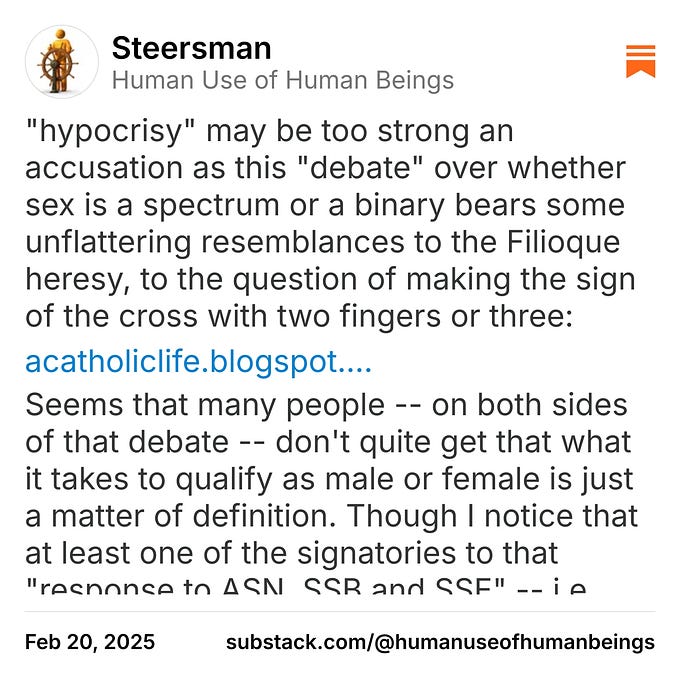
The nice thing for me is that the so-called "strict biological definition" isn't the relevant definition most of the time and can be safely ignored. It's not worth my brain space to argue about it. Legal definitions are more important in human society.
Generally so, although the problems generally multiply like mushrooms or the heads on a hydra when those definitions conflict -- as they do in both Trump's EO and in that "Defining Male and Female Act" -- with the biological ones.

en.wikipedia.org
The UK's Gender Recognition Act being a rather sad case in point -- a tragicomedy in three Acts. Clowns to the Left of us, Jokers to the Right ...
This one is a proposal that I came across. I don't think it's a law yet:
It does get a bit complicated when they attempt to define the word "gender" but the definition of "sex" seems straightforward enough.
I had linked to that in an earlier and quite recent post; you may wish to take a gander at it, particularly since it is of some relevance to your "straightforward enough":
Offhand, it seems the best solution is for the NCAA, and similar organizations, to simply specify that "edge cases" will be dealt with by "proximity" to the "ideal" definition. I don't think it's up to Trump's EO to fully define "male" and "female", and their exceptions; that seems the bailiwick of those implementing the policies. And there seems to have been a bill in the House of Representatives that would have picked up the slack, although it may exhibit the same deficiencies:
But while Trump's EO and that House Bill go some distance in curtailing various "trans-gressions" against women in general, not to mention endorsing, more or less accurately, the standard biological definitions for the sexes, I still think the discrepancies between those two will likely cause problems down the road -- not least in the contradictions between the legal and biological definitions. Will we have one set of definitions for the kids in their biology classes and another set for their legal and social studies classes? From contradictions, anything follows:
"deficiencies", "discrepancies", and "contradictions" doesn't begin to describe the problems with that Bill.
For one thing: "To establish a clear and consistent biological definition of male and female." It is most certainly NOT the biological definition for those categories. Starting off on the wrong foot before they're even out of the gate. They might have had a point if they defined new categories, say "human$male" and "human$female" -- entirely different kettles of fish from the biological definitions.
For another: "Every individual is either male or female." Horse feathers, great steaming piles of them. By the standard biological definitions -- which that Bill presumes to endorse or subscribe to -- some third of us, at any one time, are neither male nor female, are sexless. (In Seattle or not ...)
For another: "Physical differences between males and females are enduring, and the two sexes are not fungible (i.e., mutually interchangeable)." Which differences? Some differences are "enduring" and some aren't -- breasts and vaginas for examples. Rather amused to note that lesbian -- homogenitalia-ist -- Arielle Scarcella has a YouTube video up arguing that "neovaginas are different" -- I guess she would know ... As for "mutually interchangeable", I guess that would depend on the purpose one has in mind -- any port in a storm for example. Relative to which see this Los Angeles Times article on transwoman Lynn Conway, definitely a case of one smart cookie:
Finally, though there are many other problems with that Bill: "gender “(A) means “(i) males, females, or the natural differences between males and females, unless such term is otherwise specified or used alone (rather than with or as an adjective modifying other words); and “(ii) a synonym for sex;" There are a great many solid reasons to stipulate -- even if the concept may not yet be ready for prime time, that it is something that "leaked" out of some lab or ivory tower before it's time -- that "gender" refers to or denotes a range of sexually dimorphic properties -- behaviour, roles, expressions, stereotypes, etc.


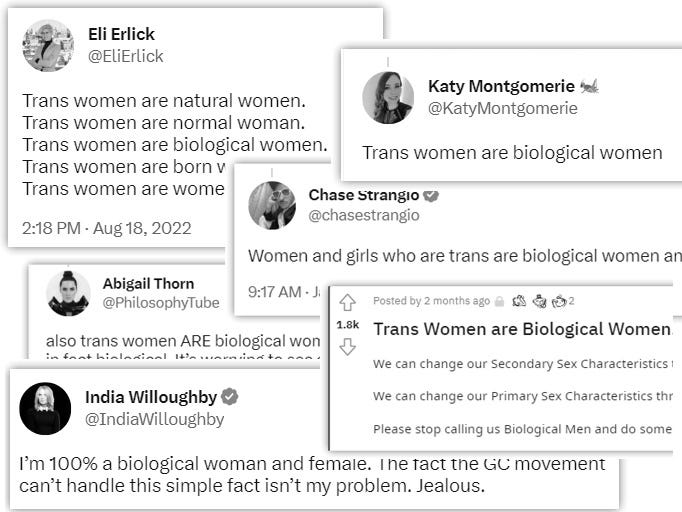
 ", of your membership cards in those categories. If it's just a matter of identity then why can't others do the same thing, modify the biological definitions to comport with their delusions and desires? Like Ms. Tickle with "her" brand-spanking new neovagina?