• Quick note - the problem with Youtube videos not embedding on the forum appears to have been fixed, thanks to ZiprHead. If you do still see problems let me know.

Cont: Luton Airport Car Park Fire IV

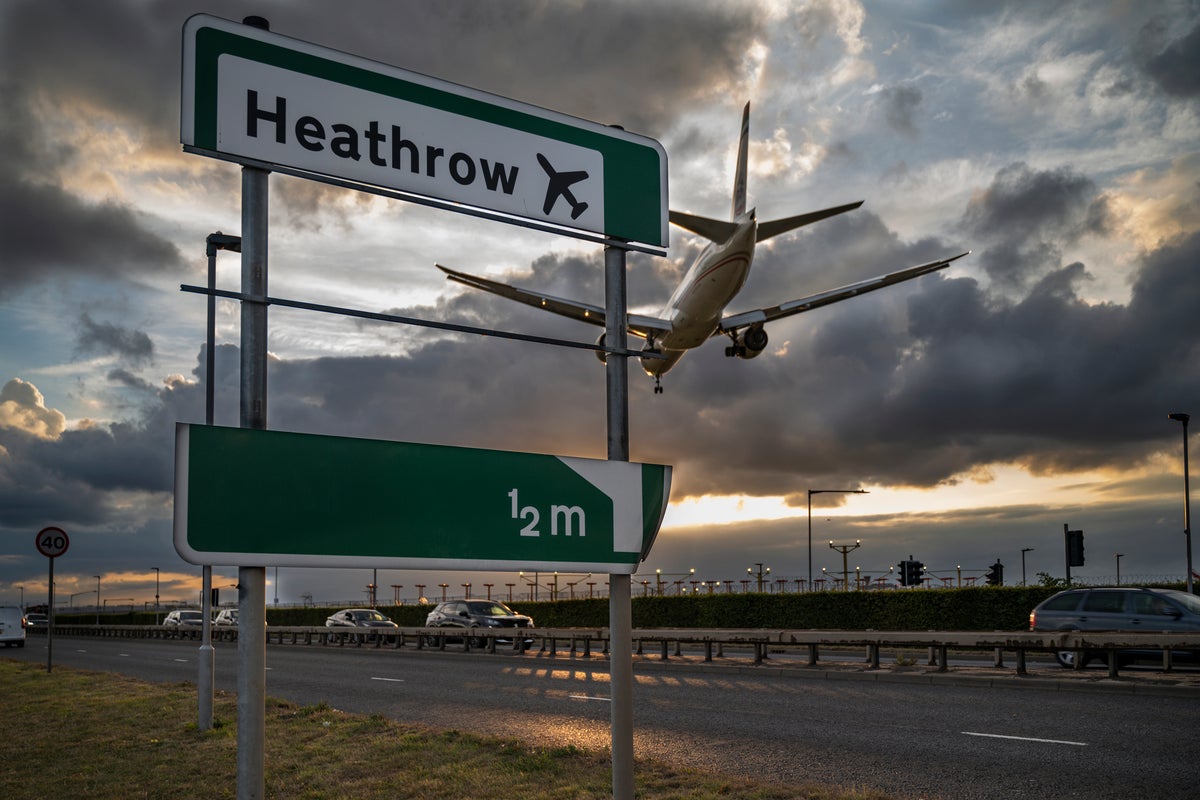
Car burns itself to a crisp in a tunnel at Heathrow airport. Guess what it was. A diesel Land Rover, again.


Of course, Geoff Buys Cars immediately put out a video claiming it was an EV.

At least the tanker full of petroleum fuel currently causing mayhem and environmental disaster near Hull was carrying jet fuel, so the dino-juice enthusiasts can probably weasel out of any responsibility for that.
 
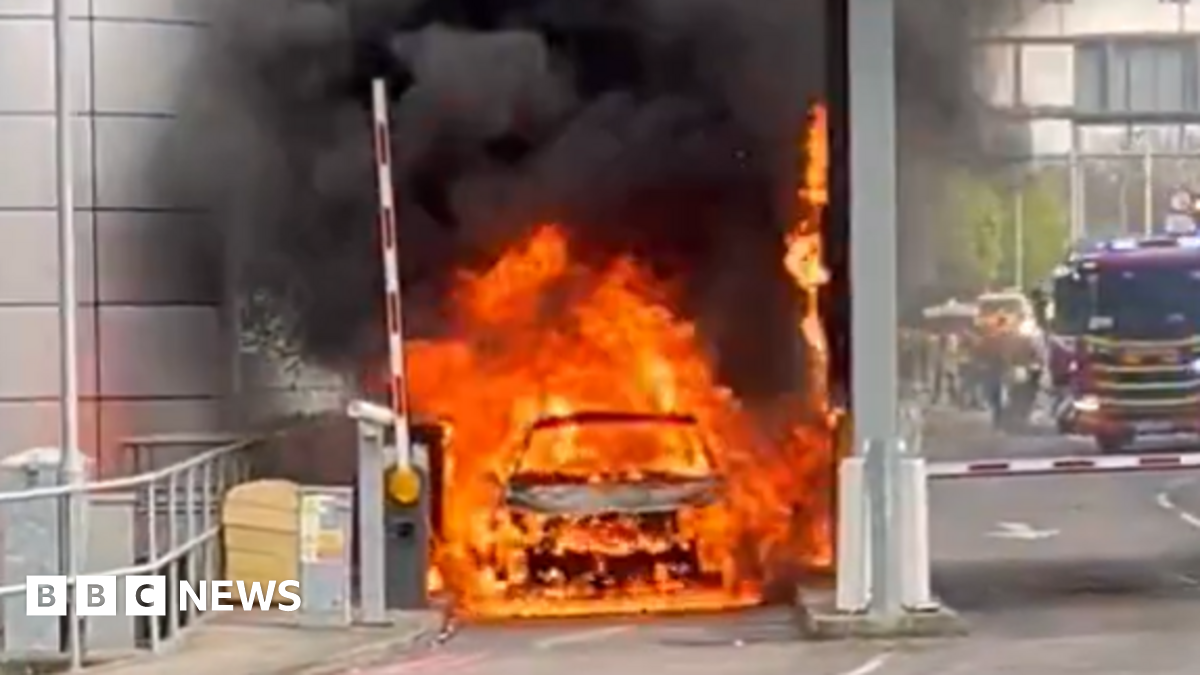
Here we go again. Gatwick airport this time, and the car was at the exit barrier to the car park. It looks as if its position prevented other cars from catching fire so the entire thing has not ignited.


Pictures from the early stages of the conflagration show that it's a VW Tiguan, probably a diesel. It could be some sort of hybrid of course, and indeed hybrids catch fire even more often than pure ICE cars so that's probably a fair bet. But it's not the battery that causes it, and what was burning in that video is 50 litres of liquid fuel, not a battery

1744585847281.jpeg

So far as I can tell Geoff Buys Cars hasn't seen it yet, but there are several possibilities. He might insist that it was an EV regardless. Or he might agree that it was a hybrid but then decide that that counts as an EV for the purposes of his little games. Or he might do what he did with the Luton fire and declare that it doesn't matter, the fact that about a dozen people on Twitter immediately assumed it must be an EV proves that EVs are dead and nobody will buy one because if the universal fear of fire.

Meanwhile there are 1.43 million pure EVs on the road in Britain, that is, every 23rd car you meet on average will be an EV.
 
I stand corrected. The burning car is a petrol PHEV with a 19.7 kwh battery located at the back of the car. That battery might let the car go about 30 miles on a good day. It's absolutely clear from an earlier picture from the sequence above that the fire started under the front of the car, with the first flames visible just inside the right front wheel. At that point there is a lot of smoke coming from under the bonnet, but the rear of the car is undamaged. The battery was certainly not the source of the fire. This is a classic ICE fire, probably caused by a fault in the 12v system.

It was a very new car, a 25 number plate, so really no more than six weeks old. The Autotrader entry says it only had 3,000 miles on the clock, though that actually seems a lot for such a new car.

1744651507125.jpeg


It should really be no surprise that it's a hybrid, as the combustion records of hybrids are absolutely shocking.

1744651682011.jpeg


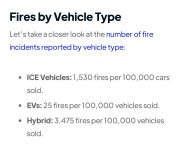
According to these data, a hybrid is over twice as likely to catch fire as a pure ICE car, and amost 140 times as likely to catch fire as a pure EV. It also confirms the figure of 60x for the likelihood of a an ICE fire relative to an EV. I've seen multipliers of up to 80x from different sources.

It's obviously not the batteries that are causing this rate of fires in hybrids, and it obviously wasn't the battery that caused this one to go on fire. So why are hybrids twice as combustible as pure ICE? My amateur guess is that it's down to complexity. A pure EV is a very simple machine, compared to anything with an engine in it. There isn't so much scope for things to short-circuit, and when they do, there isn't the oil and the hot exhaust and so on to make the whole thing more likely to catch. In contrast the hybrid is more complex than the ICE, with two drive trains and gizmos for switching from one to the other. And of course it still has the oil and the hot exhaust and so on.

The issue is, as we saw from Vixen earlier in the thread, that the presence of a battery is used to hype this up into "OMG it had a battery it was an EV it was an EV fire! Told you so!" by a bunch of people. It's all over Twitter and various news web sites. Try telling these people about the respective rates of fires in the two types of vehicle and they simply don't listen.

This is going to go on, and probably get worse, until the monumentally stupid idea that is the PHEV finally meets its well-deserved death. On the one hand I'm sad to see such a new and apparently very nice car burned to a crisp. But on the other hand, one fewer PHEV on the road, whoopee.
 
Here we go again.


Here's a video of it that shows the number plate.


It's a Merc E-class, nine years old, diesel. No sort of hybrid.

View attachment 60757

Maybe one day one of these will turn out to be an EV. You'd think eventually, the odds would favour it. Maybe.


Clearly Rishi Sunak hacked the DVLA database.
 
It's taken a while for me to find the source of the PHEVs are bad claim, but everyone seems to be referring back to this one claim by an insurance company.


They appear to have estimated the number of PHEV fires from a published list of recalls.

Their estimate does not seem to have any connection with reality.

Their link to a data source is for the number of electric vehicles sold. (Nothing to do with fires).
 
I'm pretty sure I saw different figures for that, but since I didn't bookmark it I can't find it again. If you're right we definitely need better data. But it's a statistic I've seen crop up again and again in different contexts, and before that article was published.
 
I'm pretty sure I saw different figures for that, but since I didn't bookmark it I can't find it again. If you're right we definitely need better data. But it's a statistic I've seen crop up again and again in different contexts, and before that article was published.
If you can find a different source, I'd certainly like to read it.

All I could find was other articles pointing to the insurance company.
 
If I come across it again, I'll post it. The stats that show that pure EVs catch fire between 20 and 80 times less frequently than ICE seem to be pretty solid though - the range of figures reflects the different studies that have been done. I did see another confounder mentioned on a YouTube video though - that a significant proportion of ICE fires are deliberate arson with the intent of covering up a crime. (Then I suppose there's the deliberate arson of Teslas...)

I could see the logic that hybrids might be more inclined to catch fire than EVs though, with both power trains and even more complicated electronics.
 
If I come across it again, I'll post it. The stats that show that pure EVs catch fire between 20 and 80 times less frequently than ICE seem to be pretty solid though - the range of figures reflects the different studies that have been done. I did see another confounder mentioned on a YouTube video though - that a significant proportion of ICE fires are deliberate arson with the intent of covering up a crime. (Then I suppose there's the deliberate arson of Teslas...)

I could see the logic that hybrids might be more inclined to catch fire than EVs though, with both power trains and even more complicated electronics.

The confounding problem is real and not easily dealt with, I can see example of that in the various academic data about vehicle fires.

It's difficult to find out if vehicles caused a fire or were destroyed by a fire external to the vehicle, in house fires for example.
Similarly vehicles that spontaneously explode while driving vs. vehicles that catch fire after being destroyed in a collision.

(One example I bumped into, was a battery that caught fire at a wrecker's yard, while it was being disassembled!)

The biggest problem that I've seen is places that lump skateboards, hoverboards, monowheels, e-scooters and electric bikes all into the 'electric vehicle' category. I believe that the UK has recently made a mandatory change to reporting requirements to prevent that.

There is a theory that PHEVs can catch fire because the engine heats up the battery.

I've not personally seen a PHEV where the battery and engine are co-located, nor a PHEV with the exhaust routed through the battery case, but, if those things exist, I can certainly see the problem.

My concern with the PHEV bad stat, is that it quotes a number of 3,474 fires in hybrid vehicles per 100,000 vehicles sold, yet other research groups have only been able to find approximately 500 hybrid vehicle fires in total.

It really just looks like a methodology error to me.
 
I do recall some statements a couple of years ago that hybrids were intermediate in fire risk between ICE and EVs. I have no idea what that was based on though. Another confounder is that both EVs and hybrids are relatively recent introductions and there aren't many really old cars with these drivetrains around, whereas there are a lot of old ICE bangers in circulation. But having said that, none of the headline fires we've been seeing have been in particularly old ICE cars.

Cheap e-scooters bought from AliExpress have been a known problem for some time, but everything was "an EV fire", as you say. I believe hybrid batteries don't have the same battery management and safety systems there are in EVs, but having said that, the (few) hybrid fires I've seen haven't started in the traction battery anyway. (I don't think hammering a 20 kwh battery by running it from 100% to low every day and charging it from low to 100% every night is a particularly good way to treat any battery, but I don't think it increases the fire risk.)
 

Back
Top Bottom