The Truth about RFK Jr

Why does this not surprise me?

Pro-RFK Jr. letter to the Senate includes names of doctors whose licenses were revoked or suspended

The letter was meant to lend credibility to Kennedy’s nomination.

A letter submitted to the U.S. Senate that states it was sent by physicians in support of Robert F. Kennedy Jr.’s nomination as secretary of Health and Human Services includes the names of doctors who have had their licenses revoked, suspended or faced other discipline, The Associated Press has found.
The AP found that in addition to the physicians who had faced disciplinary action, many of the nearly 800 signers are not doctors. The letter with the names of those who signed was provided to the AP by Sen. Ron Johnson’s office after he entered it into the Congressional Record on Wednesday during the first of Kennedy’s two confirmation hearings.

Among those who signed it were a self-described journalist, a certified public accountant, a firefighter/paramedic, a certified health coach and someone who said they had a bachelor’s degree “with an emphasis on Jungian Psychology.” The signers include at least 75 nurses, as well as physician’s assistants. More than 90 did not include any credentials at all.

Over 20 were chiropractors, representing an industry that has funded Kennedy’s work. An AP investigation found that donations from a chiropractic group represented one-sixth of the revenues collected by Kennedy’s anti-vaccine nonprofit in 2019.

The letter was organized and submitted by MAHA Action, which is run by Del Bigtree, who worked for Kennedy’s presidential campaign and is a longtime anti-vaccine activist. The Washington Post reported Wednesday that Kennedy transferred the trademark for the “MAHA” slogan to an limited liability company run by Bigtree. Kennedy reported that he received $100,000 in income from licensing the slogan and said in his financial disclosures that he had transferred the trademark for “no compensation.”

Ron Johnson has got to be one of the stupidest people in Congress.

 
If only his insanity were limited to the COVID pandemic ...
Oh, "insanity"? Wow, okay. So all those scientists, including the ones from Harvard, Oxford, Stanford, Yale, etc.--they're all peddling "insanity"? Yeah, you bet. I mean, really? "Insanity"?

Are you one of those people who still masks in public?

BTW, how many prescriptions drugs have been granted immunity from liability? Hey?

Mojo:
That's why the anti-vaxxers' complaints about a lack of placebo-controlled trials are bogus.
This is one of the silliest arguments I've ever seen on a public board. For one thing, you left out the key components of randomized and double-blinded. Even just randomized placebo-controlled trials allow researchers to compare the effects of the drug against the placebo effect, which provides a reliable measure of the drug's true efficacy. However, a randomized controlled test does not necessarily have to involve a placebo, but the absence of a placebo can lead to problems in determining the drug's effectiveness. Dr. D. L. Steiner in "Placebo-controlled Trials: When Are They Needed?" on the NIH website:

Randomized controlled trials require that patients be assigned to either receive the medication under investigation or to a control condition. It is not necessary that the control arm of the trial involve a placebo; it may consist of a different drug or conventional treatment. However, this can lead to serious problems in interpretation if the trial concludes that there is no statistically significant difference between the groups.

In studies where a placebo arm was not used, it is extremely difficult to determine if this lack of a difference was due to equal effectiveness of the treatments, or was the result of a Type II error; i.e., erroneously concluding that there was no difference when one, in fact, existed. (LINK)


I notice that none of the Big Pharma apologists/RFK Jr. critics here are substantively addressing the evidence that serious side effects from the COVID vaccine were markedly under-reported, and that even the VAERS data indicate a higher risk of side effects than our Big Pharma-bought news outlets have shared with the American people.

Think about it this way: Suppose you were 1 of 100 people in a room and a government rep told you that Vaccine X had a serious-side-effect rate of "only" 2%. Now, 2% of 100 is 2, so that means that 2 of you in the room would suffer serious side effects if you got the vaccine. How many people in that room do you think would decline the vaccine?

To be considered credibly safe, a vaccine should have a serious adverse reaction rate of no more than 0.001, which means that 1 out of every 1,000 people will suffer serious side effects. Ideally, the rate should be 0.0001, or 1 in 10,000.

The bottom line is that if you refuse to acknowledge the evidence that some vaccines are not as safe as advertised, then your criticism of RFK Jr. is invalid. He does not oppose vaccination in principle. His point is that some vaccines are far riskier than we've been led to believe, and that this risk should be admitted and addressed.
 
Last edited:
Think about it this way: Suppose you were 1 of 100 people in a room and a government rep told you that Vaccine X had a serious-side-effect rate of "only" 2%. Now, 2% of 100 is 2, so that means that 2 of you in the room would suffer serious side effects if you got the vaccine. How many people in that room do you think would decline the vaccine?
Where is this 2% figure coming from?

When you say "serious-side-effect" what do you mean?
 
This is one of the silliest arguments I've ever seen on a public board. For one thing, you left out the key components of randomized and double-blinded. Even just randomized placebo-controlled trials allow researchers to compare the effects of the drug against the placebo effect, which provides a reliable measure of the drug's true efficacy.
However, a randomized controlled test does not necessarily have to involve a placebo, but the absence of a placebo can lead to problems in determining the drug's effectiveness. Dr. D. L. Steiner in "Placebo-controlled Trials: When Are They Needed?" on the NIH website:

Randomized controlled trials require that patients be assigned to either receive the medication under investigation or to a control condition. It is not necessary that the control arm of the trial involve a placebo; it may consist of a different drug or conventional treatment. However, this can lead to serious problems in interpretation if the trial concludes that there is no statistically significant difference between the groups.

In studies where a placebo arm was not used, it is extremely difficult to determine if this lack of a difference was due to equal effectiveness of the treatments, or was the result of a Type II error; i.e., erroneously concluding that there was no difference when one, in fact, existed. (LINK)
This is silly. There are extremely good ethical reasons why you don't use a placebo in certain situations such as vaccines.

Think about it.

Please, just use your goddammmned brain!

If you can use a vaccine to prevent measles, and it works well. Then what do you do if you invent another vaccine to prevent measles?

Do you:

a) Use the new vaccine in a controlled study against the old vaccine?
b) Use the new vaccine in a controlled study against nothing at all?

People like RFK are trying to do a sleight of hand in which they get people to think that the failure to do (b) means that the drugs are not properly tested.

Are you so gullible that you fall for his garbage?

Do you really believe that he has no conflicts of interest?
 
Oh, "insanity"? Wow, okay. So all those scientists, including the ones from Harvard, Oxford, Stanford, Yale, etc.--they're all peddling "insanity"? Yeah, you bet. I mean, really? "Insanity"?

Are you one of those people who still masks in public?

BTW, how many prescriptions drugs have been granted immunity from liability? Hey?


This is one of the silliest arguments I've ever seen on a public board. For one thing, you left out the key components of randomized and double-blinded. Even just randomized placebo-controlled trials allow researchers to compare the effects of the drug against the placebo effect, which provides a reliable measure of the drug's true efficacy. However, a randomized controlled test does not necessarily have to involve a placebo, but the absence of a placebo can lead to problems in determining the drug's effectiveness. Dr. D. L. Steiner in "Placebo-controlled Trials: When Are They Needed?" on the NIH website:

Randomized controlled trials require that patients be assigned to either receive the medication under investigation or to a control condition. It is not necessary that the control arm of the trial involve a placebo; it may consist of a different drug or conventional treatment. However, this can lead to serious problems in interpretation if the trial concludes that there is no statistically significant difference between the groups.

In studies where a placebo arm was not used, it is extremely difficult to determine if this lack of a difference was due to equal effectiveness of the treatments, or was the result of a Type II error; i.e., erroneously concluding that there was no difference when one, in fact, existed. (LINK)


I notice that none of the Big Pharma apologists/RFK Jr. critics here are substantively addressing the evidence that serious side effects from the COVID vaccine were markedly under-reported, and that even the VAERS data indicate a higher risk of side effects than our Big Pharma-bought news outlets have shared with the American people.

Think about it this way: Suppose you were 1 of 100 people in a room and a government rep told you that Vaccine X had a serious-side-effect rate of "only" 2%. Now, 2% of 100 is 2, so that means that 2 of you in the room would suffer serious side effects if you got the vaccine. How many people in that room do you think would decline the vaccine?

To be considered credibly safe, a vaccine should have a serious adverse reaction rate of no more than 0.001, which means that 1 out of every 1,000 people will suffer serious side effects. Ideally, the rate should be 0.0001, or 1 in 10,000.

The bottom line is that if you refuse to acknowledge the evidence that some vaccines are not as safe as advertised, then your criticism of RFK Jr. is invalid. He does not oppose vaccination in principle. His point is that some vaccines are far riskier than we've been led to believe, and that this risk should be admitted and addressed.
You can pull figures out of *** all you want. But it doesn't make them true. Acceptable adverse effect rates for vaccines depend on the consequences of the infection. I think most people would take an adverse event rate of 5% for post exposure prophylaxis of rabies (rabies has a 100% rate of causing an unpleasant death), and PEP (post exposure prophylaxis) is 100% effective. Unlike usual medicines vaccines have population benefits, ring vaccination in smallpox outbreaks stop smallpox spreading and killing unvaccinated people. The oral polio vaccine had a small rate of causing paralysis, as polio rates fell that small risk became greater than the risk from polio so the immunisation shifted to the injection.

You seem to believe there are no trials on vaccines, no post licensing surveillance, that is just not true. RCT are required for US licensing, but they are not always the best technique for research. Prospective cohort studies are consistently better at studying real world effects than RCT.

You go with the myth that since covid mortality is low in children and young adults that they should have been allowed even encouraged to become infected (GB declaration) yet death is not the only consequence of covid infection. Long Covid; MIS (multisysytem inflammatory syndrome) are both vaccine preventable complications of COVID infection. At the end of the day (or years) the question is are you more likely to be alive and healthy if vaccinated or not. The answer is constantly that Covid vaccines reduce the risk of death and illness in particular long covid, even in children. See below if interested in some references.

Vaccine Effectiveness Against Long COVID in Children​

The vaccination rate was 67% in the cohort of 1 037 936 children. The incidence of probable long COVID was 4.5% among patients with COVID-19, whereas diagnosed long COVID was 0.8%. Adjusted vaccine effectiveness within 12 months was 35.4% (95 CI 24.5–44.7) against probable long COVID and 41.7% (15.0–60.0) against diagnosed long COVID. VE was higher for adolescents (50.3% [36.6–61.0]) than children aged 5 to 11 (23.8% [4.9–39.0]).
Over a million children followed up 2/3 vaccinated. Long covid diagnosis was 1% in unvaccinated and reduced by half or a third by vaccination.

In UK follow up of 5 million vaccinated children
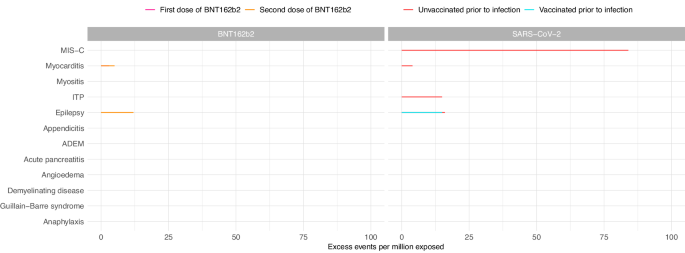
The risk-benefit profile of COVID-19 vaccination in children remains uncertain. A self-controlled case-series study was conducted using linked data of 5.1 million children in England to compare risks of hospitalisation from vaccine safety outcomes after COVID-19 vaccination and infection. In 5-11-year-olds, we found no increased risks of adverse events 1–42 days following vaccination with BNT162b2, mRNA-1273 or ChAdOX1. In 12-17-year-olds, we estimated 3 (95%CI 0–5) and 5 (95%CI 3–6) additional cases of myocarditis per million following a first and second dose with BNT162b2, respectively. An additional 12 (95%CI 0–23) hospitalisations with epilepsy and 4 (95%CI 0–6) with demyelinating disease (in females only, mainly optic neuritis) were estimated per million following a second dose with BNT162b2. SARS-CoV-2 infection was associated with increased risks of hospitalisation from seven outcomes including multisystem inflammatory syndrome and myocarditis, but these risks were largely absent in those vaccinated prior to infection. We report a favourable safety profile of COVID-19 vaccination in under-18s.

This study following up over a thousand children infected with Covid shows significant rates of long covid and protection by vaccine.

This study looked at over 600,000 people with long covid and showed a vaccine protective effect.
Oyungerel Byambasuren, Paulina Stehlik, Justin Clark, Kylie Alcorn, Paul Glasziou - Effect of covid-19 vaccination on long covid: systematic review: BMJ Medicine 2023;2:e000385.

This study followed up 99 million people vaccinated against covid looking for adverse events (and they found some and you can look at the rates). https://doi.org/10.1016/j.vaccine.2024.01.100

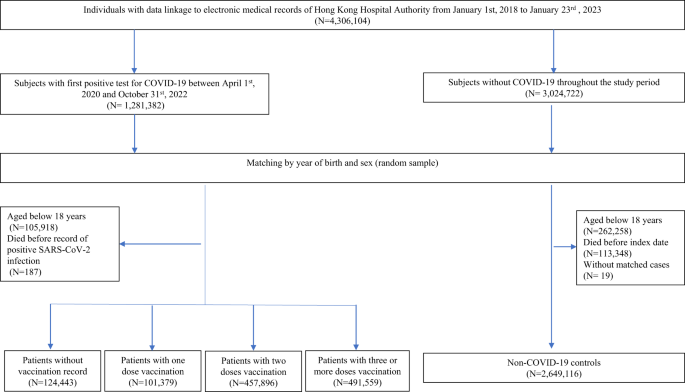
Following up over a million people with covid infection of whom about 1/8 were unvaccinated and half were fully vaccinated (three doses) you were last likely to be alive and healthy if you weren't vaccinated.
 
Oh, "insanity"? Wow, okay. So all those scientists, including the ones from Harvard, Oxford, Stanford, Yale, etc.--they're all peddling "insanity"? Yeah, you bet. I mean, really? "Insanity"?

Are you one of those people who still masks in public?

BTW, how many prescriptions drugs have been granted immunity from liability? Hey?


This is one of the silliest arguments I've ever seen on a public board. For one thing, you left out the key components of randomized and double-blinded. Even just randomized placebo-controlled trials allow researchers to compare the effects of the drug against the placebo effect, which provides a reliable measure of the drug's true efficacy. However, a randomized controlled test does not necessarily have to involve a placebo, but the absence of a placebo can lead to problems in determining the drug's effectiveness. Dr. D. L. Steiner in "Placebo-controlled Trials: When Are They Needed?" on the NIH website:

Randomized controlled trials require that patients be assigned to either receive the medication under investigation or to a control condition. It is not necessary that the control arm of the trial involve a placebo; it may consist of a different drug or conventional treatment. However, this can lead to serious problems in interpretation if the trial concludes that there is no statistically significant difference between the groups.

In studies where a placebo arm was not used, it is extremely difficult to determine if this lack of a difference was due to equal effectiveness of the treatments, or was the result of a Type II error; i.e., erroneously concluding that there was no difference when one, in fact, existed. (LINK)


I notice that none of the Big Pharma apologists/RFK Jr. critics here are substantively addressing the evidence that serious side effects from the COVID vaccine were markedly under-reported, and that even the VAERS data indicate a higher risk of side effects than our Big Pharma-bought news outlets have shared with the American people.

Think about it this way: Suppose you were 1 of 100 people in a room and a government rep told you that Vaccine X had a serious-side-effect rate of "only" 2%. Now, 2% of 100 is 2, so that means that 2 of you in the room would suffer serious side effects if you got the vaccine. How many people in that room do you think would decline the vaccine?

To be considered credibly safe, a vaccine should have a serious adverse reaction rate of no more than 0.001, which means that 1 out of every 1,000 people will suffer serious side effects. Ideally, the rate should be 0.0001, or 1 in 10,000.

The bottom line is that if you refuse to acknowledge the evidence that some vaccines are not as safe as advertised, then your criticism of RFK Jr. is invalid. He does not oppose vaccination in principle. His point is that some vaccines are far riskier than we've been led to believe, and that this risk should be admitted and addressed.

You are simping for a deranged conspiracy theorist who doesn’t believe in germ theory,

You are actively advocating for children to die.
 
Oh, "insanity"? Wow, okay. So all those scientists, including the ones from Harvard, Oxford, Stanford, Yale, etc.--they're all peddling "insanity"? Yeah, you bet. I mean, really? "Insanity"?

Are you one of those people who still masks in public?

BTW, how many prescriptions drugs have been granted immunity from liability? Hey?


This is one of the silliest arguments I've ever seen on a public board. For one thing, you left out the key components of randomized and double-blinded. Even just randomized placebo-controlled trials allow researchers to compare the effects of the drug against the placebo effect, which provides a reliable measure of the drug's true efficacy. However, a randomized controlled test does not necessarily have to involve a placebo, but the absence of a placebo can lead to problems in determining the drug's effectiveness. Dr. D. L. Steiner in "Placebo-controlled Trials: When Are They Needed?" on the NIH website:

Randomized controlled trials require that patients be assigned to either receive the medication under investigation or to a control condition. It is not necessary that the control arm of the trial involve a placebo; it may consist of a different drug or conventional treatment. However, this can lead to serious problems in interpretation if the trial concludes that there is no statistically significant difference between the groups.

In studies where a placebo arm was not used, it is extremely difficult to determine if this lack of a difference was due to equal effectiveness of the treatments, or was the result of a Type II error; i.e., erroneously concluding that there was no difference when one, in fact, existed. (LINK)


I notice that none of the Big Pharma apologists/RFK Jr. critics here are substantively addressing the evidence that serious side effects from the COVID vaccine were markedly under-reported, and that even the VAERS data indicate a higher risk of side effects than our Big Pharma-bought news outlets have shared with the American people.

Think about it this way: Suppose you were 1 of 100 people in a room and a government rep told you that Vaccine X had a serious-side-effect rate of "only" 2%. Now, 2% of 100 is 2, so that means that 2 of you in the room would suffer serious side effects if you got the vaccine. How many people in that room do you think would decline the vaccine?

To be considered credibly safe, a vaccine should have a serious adverse reaction rate of no more than 0.001, which means that 1 out of every 1,000 people will suffer serious side effects. Ideally, the rate should be 0.0001, or 1 in 10,000.

The bottom line is that if you refuse to acknowledge the evidence that some vaccines are not as safe as advertised, then your criticism of RFK Jr. is invalid. He does not oppose vaccination in principle. His point is that some vaccines are far riskier than we've been led to believe, and that this risk should be admitted and addressed.
Bubba adjacent?
 
You are simping for a deranged conspiracy theorist who doesn’t believe in germ theory,

You are actively advocating for children to die.
That poster is arguing the same tired apologetics reminicent of the COVID threads in the CT subforum and their posts here really belong there.

Junior's crockpot take on germ theory alone disqualify him, much less his takes on HIV and vaccines.
 
That poster is arguing the same tired apologetics reminicent of the COVID threads in the CT subforum and their posts here really belong there.

Junior's crockpot take on germ theory alone disqualify him, much less his takes on HIV and vaccines.

I think there’s going to be an ongoing dilemma on this forum in how to determine if threads belong in the Politics or Conspiracy Theories subforums because the U.S. government has been taken over by conspiracy theorists.
 
I think there’s going to be an ongoing dilemma on this forum in how to determine if threads belong in the Politics or Conspiracy Theories subforums because the U.S. government has been taken over by conspiracy theorists.
Perhaps they could just be merged for the next four years.
 
Cool. Are you going to compare that list with a list of the scientists who did not reject shutting down businesses, mandatory masking, closing elementary schools and universal vaccination?

Can you at least guess which list is longer?
We could do the equivalent of Project Steve.

I mean, seriously, he thinks that list is impressive?

I could create a longer list by just querying the pediatricians in the local county.

Seriously, mikegriffith, is there an actual creationist playbook that you are following, or are you just too naive to not realize that is all you are doing?
 
Last edited:
We could do the equivalent of Project Steve.

I mean, seriously, he thinks that list is impressive?

I could create a longer list by just querying the pediatricians in the local county.

Seriously, mikegriffith, is there an actual creationist playbook that you are following, or are you just too naive to not realize that is all you are doing?
CT dopes from Climate change to Evolution deniers pimp these list all the time, not acknowledging, or caring really, that the lists in the opposite are far longer, and more fact-based.
 
We could do the equivalent of Project Steve.

I mean, seriously, he thinks that list is impressive?

I could create a longer list by just querying the pediatricians in the local county.

Seriously, mikegriffith, is there an actual creationist playbook that you are following, or are you just too naive to not realize that is all you are doing?
If you follow the link on MG's posts to his "Home Page," you'll understand why he's following the creationist playbook- he is a creationist, with all the factual ignorance and failures in basic logic that that implies.
 
If you follow the link on MG's posts to his "Home Page," you'll understand why he's following the creationist playbook- he is a creationist, with all the factual ignorance and failures in basic logic that that implies.
Picked his underlying thesis some time ago. I've met these people many times before.
 
CT dopes from Climate change to Evolution deniers pimp these list all the time, not acknowledging, or caring really, that the lists in the opposite are far longer, and more fact-based.
This leads to a practice that I call "The Usual Suspects."

When the local newspaper in Ogden, UT, wants to do a piece on anti-vaxxers, for example, they contact Shari Tenpenny from Ohio as their anti-vaxxer, and for the "pro-vax" side, they call the local pediatrician.

Because they can't actually find a local anti-vax doctor, so they have to go to one of the Usual Supects.
 
Feb 2 (Reuters) - A U.S. Senate committee will vote Tuesday on whether to advance President Donald Trump's nomination of Robert F. Kennedy Jr. to lead the Department of Health and Human Services, the committee announced Sunday.
In contentious confirmation hearings before the Senate Finance Committee last week, Senate Democrats accused Kennedy of being financially vested in the anti-vaccine movement and peddling conspiracy theories to sow doubt about lifesaving medicines -- assertions Kennedy rejected.
 

Back
Top Bottom