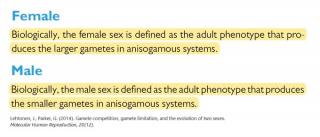
First, my apologies to many of the regulars for repeating a good bit of what I've said in other threads (& a good bit of what's been said in this thread). I was a research biologist for close to 30 years (about 23 years of that post PhD), and then transitioned to clinical genetics a bit over 5 years ago. My research foci in academia were centered around (eutherian) mammalian genetics and included evolution/comparative biology, epigenetics and developmental/ reproductive biology. During grad school I got interested in comparative mechanisms of sex determination in amniote (mammals, birds, reptiles) vertebrates and did a mock thesis proposal on this topic. I've periodically revisited the literature on that topic.
When I ran my own lab, research involved genes whose expression varies depending on whether they are transmitted via maternally vs paternally as well as a number of areas that involved differential phenotypic effects in males vs females. I went to many local, national and international meetings (including those focused on developmental and reproductive biology in mammals), went to and gave many seminars, and taught (among other things) developmental biology to grad students.
The point of that background is that over that time, I've been involved in many conversations with thousands of biologists and/or students where sex was an important variable and/or directly the subject of the topic. We used - either implicitly or explicitly - what a
recent review by the society of endocrinologists (that unfortunately cowtowed to the recent gender ideology a bit) called the "classic" definition - namely which gamete type the individual/body in question was functionally organized around producing/delivering (which includes pre- & post-fertile individuals). Over all that time and all those interactions, I never heard any discussions about how we should define the sexes, that the definition we were using was wanting and/or confusion about what we meant by female and male.
That is, of course, until recently. I first noted some folks on "sci-twitter" (people who had mutual connections with scientists I knew or institutions where I'd been) claiming that sex was a spectrum/ not a binary in during downtime in the first year of the pandemic (the biologists involved were mostly not repro/devo/evo types). I initially engaged a bit (had some interactions with Emma Hilton) and was told that stating that sex is binary is seen as a "transphobic dogwhistle". Those social media arguments and most of the recent papers referenced explicitly appeal to social justice/inclusivity in their critiques (i.e. rather than functional issue with the definition).
<snipped to address separately in another post>
As others have noted, there may differences between clades/phylogenetic groups in applying in those terms, particularly at different life stages. For example, it doesn't make much sense to label an embryo as male/female in species with environmental sex-determination (at least before that determinant is in place/the primordial germ cells are specified). And of course there are vertebrates that can change sex as well as those that can reproduce asexually. However, no eutherian mammal can change sex, parthenogenesis is precluded due to differential marking of genes in oogenesis vs spermatogenesis, and there are no species with a class of functional hermaphrodites.
While there are some core
conserved players in sex determination pathway within vertebrates (with some modifications in eutherians) there is significant variation and it's unclear (to me at least) whether sex in non-vertebrate groups is homologous - reviews
1 &
2
Please note that people with disorders of sexual development (DSDs) do not indicate additional sexes or that ‘sex is a spectrum’. It's some serious cherry-picking to apply the 'defects are exceptions' criterion to sex and not other characteristics or species. Humans have 46 chromosomes, 5 digits per limb, like other primates are visually oriented, have a well-developed pre-frontal cortex, etc. However, there are pathogenic mutations (or accidents) that can alter any of these (or virtually any) characteristics in an individual. And I suspect if I was reporting on white-footed mice with indeterminate gonads who lived near a superfund site, no one would be calling sex a spectrum in that species.
Individual eutherian mammals develop along one of the two reproductive pathways. Those pathways get disrupted in some cases (via deleterious mutation in key genes or other insult that results in altered gene expression), but with modern methods, I'm not aware of any cases that defy classification (i.e. in which we can't tell whether the individual would have developed to produce oocytes vs sperm). But - if there were such cases - these individuals would be incapable of reproduction and therefore not relevant to the definition of a reproductive method and its relevant classes. Put another way, to disprove the sex binary, you'd have to show that there is a class of individuals who reproduce without producing one of the two established gamete types.
I point all this out because the internet is now rampant with (what seem to be) politically motivated arguments about defining sex. I am concerned this phenomenon is contributing to erosion of public trust in science. As someone who is left-leaning on most issues, I'm also dismayed to see that much of the mis-information is coming from that side, and I suspect this will have negative ramifications. For example, it's harder to convince people of the effects of climate change and our impacts on the environment when you also can't define a woman or claim that Rachel Levine is the " first female four-star Admiral of the U.S. Public Health Service" (United States).