• Quick note - the problem with Youtube videos not embedding on the forum appears to have been fixed, thanks to ZiprHead. If you do still see problems let me know.

Does Attorney General Gonzalez need a lawyer?

Joined
Mar 27, 2005
Messages
1,506
build-better-bush.jpg


From today's U.S. Senate Judiciary Committee hearing on Wartime Executive Power and the National Security Agency's Surveillance Authority:


FEINSTEIN: All right, but you sidestepped FISA, using the plenary authority as commander in chief. The problem there, as I see it, is that Article 1 Section 8 gives the Congress the authority to make the regulations for the military. NSA is part of DOD; therefore the Congress has the right to make those regulations.

GONZALES: I think that the clause you're referring to is the clause in Section 8 of Article 1 which clearly gives to the Congress the authority and power to make rules regarding the government and regulation of our armed forces.

And then the question is, well -- electronic surveillance -- is that part of the government and regulation of our armed forces?

There are many scholars who believe that, there, we are only talking about, sort of, the internal administration of our military, like courts-martial, like selective service.

And so, I think there would be a question, a good debate and discussion about whether or not -- what does that clause mean and does it give to the Congress, under the Constitution, the authority to impose regulations regarding electronic surveillance?

I'm not saying that it doesn't. I'm just saying that I think that's obviously a question that would have to be resolved.


http://www.washingtonpost.com/wp-dyn/content/article/2006/02/06/AR2006020600931.html
Ummmm........ yeah.


Another point I was glad to hear raised:


GRAHAM: But it's clear to me that the Congress has the authority to regulate the military, to fund the military. And the Uniform Code of Military Justice is a statutory scheme providing guidance, regulation and punishment to the military that the Congress passes.

GONZALES: I think most scholars would say that would fall under the clause in Section 8 of Article I giving the Congress the authority to pass rules regarding government and regulation of the armed forces.

GRAHAM: And I would agree with those scholars.

And the point I'm trying to say is that we can tell our military, "Don't you do this to a detainee." And you, as commander in chief, can tell the military, "We've got to win the war, we've got to protect ourselves."

Now, what I'm trying to say is that I'm worried about the person in the middle here. Because if we had adopted the reasoning of the Bybee memo -- that's repudiated, appropriately -- the point I was trying to make at your confirmation hearing is that the legal reasoning used in determining what torture would be under the Convention of Torture or the torture statute not only was strained that made me feel uncomfortable, it violated an existing body of law that was already on the books called the Uniform Code of Military Justice.

If a military member had engaged in the conduct outlined by the Bybee memo, they could have been prosecuted for abusing a detainee because it's a crime in the military, Mr. Attorney General, for a guard to slap a prisoner, much less have something short of major organ failure.

This is really a big deal for the people fighting the war. And if you take your inherent authority argument too far, then I am really concerned that there is no check and balance.

GRAHAM: And when the nation's at war, I would argue, Mr. Attorney General, you need checks and balances more than ever, because within the law we put a whole group of people in jail who just looked like the enemy.

GONZALES: Senator, if I could just respond. I'm not -- maybe I haven't been as precise with my words as I might have been.

I don't think I've talked about inherent exclusive authority. I talked inherent authority under the Constitution and the commander in chief.

Congress, of course, and I've said in response to other questions, they have a constitutional role to play also during a time of war.

GRAHAM: We coexist.

Now, can I get to the FISA statute in two minutes here? And I hope we do have another round, because this is very important. And I'm not here to accuse anyone of breaking the law. I want to create law that will help people fight the war know what they can and can't do.

The FISA statute -- if you look at the legislative language, they made a conscious decision back in 1978 to resolve this two-lane debate. There's two lanes you can go down as commander in chief. You can act with the Congress and you can have inherent authority as commander in chief.

The FISA statute said, basically, "This is the exclusive means to conduct foreign surveillance where American citizens are involved." And the Congress, seems to me, gave you a one-lane highway, not a two- lane highway. They took the inherent authority argument, they thought about it, they debated it, and they passed a statute -- if you look at the legislative language -- saying, "This shall be the exclusive means." And it's different than 1401.

So I guess what I'm saying, Mr. Attorney General, if I buy your argument about FISA, I can't think of a reason you wouldn't have the ability if you chose to to set aside the statute on torture if you believed it impeded the war effort.

GONZALES: Well, Senator, whether or not we set aside a statute, of course...

GRAHAM: But inherent authority sets aside the statute.

GONZALES: That's what we're talking about here. We don't need to get to that tough question.

GRAHAM: If you don't buy the force resolution argument, if we somehow magically took that off the table, that's all your left with is the inherent authority. And Congress could tomorrow change that resolution, and that's dangerous for the country if we get in a political fight over that.

All I'm saying is that the inherent authority argument, in its application, to me, seems to have no boundaries when it comes to executive decisions in a time of war. It deals the Congress out, it deals the courts out.

And, Mr. Attorney General, there is a better way. And on our next round of questioning we will talk about that better way.

GONZALES: Can I simply make one quick response?

SPECTER: You may respond, Attorney General.

GONZALES: Well, the fact that the president, again, may have inherent authority doesn't mean that Congress has no authority in a particular area. And when we look at the words of the Constitution, and there are clear grants of authority to the Congress in a time of war.

And so if we're talking about competing constitutional interests, that's when you get into, sort of, the third part of the Jackson analysis.

GRAHAM: That's where we're at right now.

GONZALES: I don't believe that's where we're at right now.

GRAHAM: That's where you're at with me.

For comic relief:


SCHUMER: Last week in the hearing before the Intelligence Committee, General Hayden refused to state publicly how many wiretaps have been authorized under this NSA program since 2001. Are you willing to answer that question, how many have been authorized?

GONZALES: I cannot. No, sir. I am not at liberty to do that.

I believe -- and, of course, I have not been to all the briefings to the congressional leaders and the leaders of the Intel Committee -- I believe that that number has been shared, however, with members of Congress.

SCHUMER: You mean the chair of the Intelligence Committee or something?

It's not a classified number, is it?

GONZALES: I believe it is a classified number -- yes, sir.

SCHUMER: But here's the issue. FISA is also important to our national security. And you've praised the program, right?

GONZALES: I couldn't agree more with you, Senator.

SCHUMER: OK.

GONZALES: It's very important.

SCHUMER: Now FISA makes public every year the number of applications. In 2004, there were 1,758 applications. Why can't we know how many under this program? Why should one be any more classified than the other?

GONZALES: I don't know whether or not I have a good answer for you, Senator.

SCHUMER: I don't think you do.

(LAUGHTER)

I oughta have a pretty clean garage by the time C-Span radio is through broadcasting this.
 
They wouldn't swear Gonzales in though. Some nonsense about him being honest and all, they didn't want to offend him.

-please-
 
They wouldn't swear Gonzales in though. Some nonsense about him being honest and all, they didn't want to offend him.

-please-
Lying to Congess is a crime whether you're sworn or not. And yet another BushCo criminal will probably walk free and continue to wield power.
 
Lying to Congess is a crime whether you're sworn or not. And yet another BushCo criminal will probably walk free and continue to wield power.
Yes, the Constitution clearly gives Congress the power to interpret it. Otherwise, it would have a separation of powers... oh wait...:rolleyes:

This is political grandstanding by Congress. Congress doesn't like to be told the cold hard truth - that some powers are granted to the POTUS and Congress has no authority to butt in. Waging a war is one of those times, POTUS is Commander-in-Chief, not 600+ members of Congress.
 
Yes, the Constitution clearly gives Congress the power to interpret it. Otherwise, it would have a separation of powers... oh wait...:rolleyes:

This is political grandstanding by Congress. Congress doesn't like to be told the cold hard truth - that some powers are granted to the POTUS and Congress has no authority to butt in. Waging a war is one of those times, POTUS is Commander-in-Chief, not 600+ members of Congress.
A few questions:

According to the constitution, who declares war? When did this last occur?

Where in the constitution does it say that POTUS can violate the law? Please be explicit.
 
According to the constitution, who declares war?

Congress is granted that power in Article I; Section 8:

The Congress shall have power...To declare war, grant letters of marque and reprisal, and make rules concerning captures on land and water;

When did this last occur?

Congress last invoked its power to declare war on October 2, 2002 - when it passed their Joint Resolution to Authorize the Use of United States Armed Forces Against Iraq.


Where in the constitution does it say that POTUS can violate the law? Please be explicit.

It does not. The Constitution does, however, invest the President with powers that cannot be modified by statute. If Congress passed a law requiring the President to attack Kandahar at 3:00 PM using the 4ID attacking from the north, that would be a clear infringement on his powers as Commander-in-Chief. The power of Congress would be just as restricted if it tried to pass a law that forbid the President from attacking Kandahar during the course of his execution of powers as CINC under the AUMF.
 
Yes, the Constitution clearly gives Congress the power to interpret it. Otherwise, it would have a separation of powers... oh wait...:rolleyes:

This is political grandstanding by Congress. Congress doesn't like to be told the cold hard truth - that some powers are granted to the POTUS and Congress has no authority to butt in. Waging a war is one of those times, POTUS is Commander-in-Chief, not 600+ members of Congress.
The Constitution might say that Congress cannot pass laws limiting the inherent authority of the President, but it also says that the President must obey laws passed by Congress. If there is a conflict between these two sections, then the Judicial branch resolves by either ruling in favor of or against the Constitutionality of the law in question.

At no point does the President have the authority to ignore the law or make up his own laws. He can work within the law, work to have the law changed, or challenge the law in court. Bush did none of these things.

Of course, the Bush administration doesn’t want to use the Constitutional argument, since you can’t really use it unless you admit you were violating the law as it was written. They are instead going with the extremely shaky FISA/AUMF legal combo, arguing that two laws that seem to contradict each other make the program legal when you put them together.
 
The Constitution does, however, invest the President with powers that cannot be modified by statute. If Congress passed a law requiring the President to attack Kandahar at 3:00 PM using the 4ID attacking from the north, that would be a clear infringement on his powers as Commander-in-Chief. The power of Congress would be just as restricted if it tried to pass a law that forbid the President from attacking Kandahar during the course of his execution of powers as CINC under the AUMF.

Bad example. Congress explicitly has powers both to "make Rules for the Government and Regulation of the land and naval Forces." A Regulation that the President cannot attack Kandahar would be every bit as valid as a Regulation that the army may not use poison gas or that soldiers may not wear mustaches.
 
Of course, the Bush administration doesn’t want to use the Constitutional argument, since you can’t really use it unless you admit you were violating the law as it was written. They are instead going with the extremely shaky FISA/AUMF legal combo, arguing that two laws that seem to contradict each other make the program legal when you put them together.

It was claimed on Air America last night (the Majority Report without Janeane G) that the Bush administration asked for and receieved significant amendments to the FISA law after 9/11, including the caveat about the 72 grace period to get a warrant. It was reported that Bush PRAISED congress for their actions at the time, and claimed that they had just made FISA sufficient for us to hunt out terrorists.

So the question is, if the FISA law was so contradictory, why didn't they just ask congress to clear up the contradictory parts while they were doing these amendments? In the post 9/11 environment, congress was very happy to acceed a lot to the president. However, the Pres didn't seem to be too concerned about FISA at that point, and acted as if it were all well and good. And then they started by-passing it.

It sounds very much like this whole defense is very post-hoc, and had nothing to do with why they started it. None of this seemed to be at all on their radar UNTIL THEY GOT CAUGHT. All of a sudden, excuses come from everywhere.

Lastly, when you step back, the multiple defense lines just reak of throwing shirt at the wall and hoping something sticks. When it first broke, there all kinds of excuses coming out, most of them nonsense ("FISA takes too long" - um, you can get it retroactively). Even the claim that it is only being used on terrorist suspects is looking to be false, as reported in the Post last weekend, thousands of calls have been tapped, with the number of terrorist leads that result on the order of dozens. A generous interpretation of the claim is that 90% of the calls being tapped are for citizens without even a hint of suspicion.
 
Hearing more about AG not being placed under oath. Why did they do that? There is only one possible explanation for that, and I can’t imagine any senator who would like it.
 
Hearing more about AG not being placed under oath. Why did they do that? There is only one possible explanation for that, and I can’t imagine any senator who would like it.

I'll link the transcripts again.


SPECTER: We have told the attorney general we would require his presence all day. We will have 10-minute rounds, which is double what is the practice of this committee. And, as I've announced in advance, we will have multiple rounds.

There has been some question about swearing in the attorney general and I discussed that with the attorney general. He said he would be willing to be sworn.

After reflecting on the matter, I think it is unwarranted because the law provides ample punishment for a false official statement or a false statement to Congress under the provisions of 18 United States Code 1001 and 18 United States Code Section 1505.

The penalties are equivalent to those under the perjury laws.

There has been a question raised as to the legal memoranda within the department. And at this time and on this showing, it is my judgment that that issue ought to be reserved to another day. I'm sure it will come up in the course of questioning.

The attorney general will have an opportunity to amplify on the administration's position. But there is a fairly well-settled doctrine that internal memoranda within the Department of Justice are not subject to disclosure because of the concern that it would have a chilling effect; that if lawyers are concerned that what they write may later be subjected to review by others, they'll be less than candid in their positions.

SPECTER: This committee has faced those issues in recent times with requests for internal memoranda of Chief Justice Roberts. And they were not produced. And they were more relevant there than here because of the issue of finding some ideas as to how Chief Justice Roberts would function on the court if confirmed.

Here we have legal issues and lawyers on this committee and other lawyers who are as capable as the Department of Justice in interpreting the law.

One other issue has arisen, and that is the issue of showing a video. And I think that would not be in order.

The transcripts of what the president said and the transcripts of what you, Mr. Attorney General, said earlier in a discussion with Senator Feingold are of record -- this is not a Sunday morning talk show -- and the transcripts contain the full statement as to legal import and legal effect. And I'm sure that those statements by the president, those statements by you, will receive considerable attention by this committee.

That's longer than I usually talk, but this is a very big subject.

FEINGOLD: Mr. Chairman?

SPECTER: This is the first of a series of hearings -- at least two more -- because of the very profound and very deep questions which we have here, beyond statutory interpretation and the constitutional implications of the president's Article 2 powers.

And this is all in the context of the United States being under a continuing threat from terrorism.

But the beauty of our system is the separation of powers, the ability of the Congress to call upon the administration for responses, the response of the attorney general in being willing to come here today, and then the Supreme Court to resolve any conflicts.

SPECTER: I'd like to yield now to...

FEINGOLD: Mr. Chairman, could I just ask a quick clarification?

SPECTER: Senator Feingold?

FEINGOLD: Heard your judgment about whether the witness should be sworn. What would be the distinction between this occasion and the confirmation hearing where he was sworn?

SPECTER: The distinction is that it is the practice to swear nominees for attorney general or nominees for the Supreme Court, or nominees for other Cabinet positions, but the attorneys general have appeared here on many occasions in the 25 years that I have been here and their might be a showing, Senator Feingold, to warrant swearing.

FEINGOLD: Mr. Chairman, I'd just say that the reason that anyone would want him sworn has to do with the fact that certain statements were made under oath at the confirmation hearing. So it seems to me logical that, since we're going to be asking about similar things, that he should be sworn in this occasion, as well.

LEAHY: And, Mr. Chairman, if I might on that point -- if I might on that point, of course, the attorney general was sworn in on another occasion other than his confirmation, when he and Director Mueller appeared before this committee for oversight.

And I had asked the chairman, as he knows, earlier that he should be sworn on this. And I made that request right after the press had pointed out where an answer to Senator Feingold appeared not to have been truthful. And I felt that that is an issue that's going to be brought up during this hearing, and we should go into it.

LEAHY: I also recall the chairman and other Republicans insisting that former Attorney General Reno be sworn, which she came up here on occasions other than her confirmation.

I think, especially because of the article about the questions of the senator from Wisconsin, Senator Feingold, I believe he should have been sworn. That is, obviously, the prerogative of the chairman.

But I would state again, and state strongly for the record, what I've told the chairman privately. I think in this instance, similar to what you did in April with Attorney General Gonzales and Director Mueller, both of whom were sworn, and as the chairman did on -- insisted with then-Attorney General Reno, I believe he should be sworn.

SPECTER: Well, Senator Leahy and I have not disagreed on very much in the more than a year since we've worked together as the ranking and chairman, and I think it's strengthened the committee.

And I did receive your request. And I went back and I dug out the transcript and reviewed Senator Feingold's vigorous cross- examination of the attorney general at the confirmation hearings.

And I know the issues as to torture, which Senator Feingold raised, and the issues which Senator Feingold raised as to searches without warrants.

And I have reviewed the provisions of 18 USC 1001 in the case involving Admiral Poindexter, who was convicted under that provision; and have reviewed the provisions of 18 United States Code 1505, where Oliver North was convicted. And there are penalties provided there commensurate with perjury.

And it is my judgment that it is unnecessary to swear the witness.

LEAHY: But, Mr. Chairman, may I ask, if the witness has no objection to being sworn, why not just do it and then not have this question raised here? I realize only the chairman can do the swearing in.

LEAHY: Otherwise, I'd offer to give him the oath myself, insofar as he said he was willing to be sworn in. But if he's willing to be, why not just do it?

SESSIONS (?): Mr. Chairman...

SPECTER: Well, the answer to why I'm not going to do it is that I've examined all the facts and I've examined the law and I have asked the attorney general whether he would object or mind and he said he wouldn't. And I have put that on the record.

But the reason I'm not going to swear him in is not up to him. Attorney General Gonzales is not the chairman; I am. And I'm going to make the ruling.

(CROSSTALK)

LEAHY: I would point out that he's been here before this committee three times. The other two times he was sworn. It seems unusual not to swear him in this time.

FEINGOLD (?): Chairman, I move the witness be sworn.

SPECTER: The chairman has ruled. If there is an appeal from the ruling of the chair, I have a pretty good idea how it's going to come out.

FEINGOLD (?): Mr. Chairman, I appeal the ruling of the chair.

SPECTER: All in favor of the ruling of the chair, say "aye."

(UNKNOWN): Roll call.

SPECTER: Opposed?

FEINGOLD (?): Ask for a roll call vote.

SPECTER: The clerk will call the roll.

I'll call the roll.

(LAUGHTER)

SESSIONS: Out of the question.

(LAUGHTER)

SPECTER: Senator Hatch?

HATCH: No.

SPECTER: Senator Grassley?

GRASSLEY: No.

SPECTER: Senator Kyl?

KYL: Mr. Chairman, is the question to uphold or to reject the ruling?

SPECTER: The question is to uphold the ruling of the chair, so we're looking for ayes, Senator.

(LAUGHTER)

LEAHY: But we're very happy with the noes that have started on the Republican side, they being the better position.

HATCH (?): I'm glad somebody clarified that.

SPECTER: So the question is, "Should the ruling of the chair be upheld that Attorney General Gonzales not be sworn?"

(CROSSTALK)

SPECTER: By proxy for Senator Brownback, aye.

Senator Coburn?

(CROSSTALK)

SPECTER: We've got enough votes already.

Senator Leahy?

LEAHY: Emphatically, no.

(CROSSTALK)

SPECTER: Aye.

The ayes have it.

FEINGOLD: Mr. Chairman, I request to see the proxies given by the Republican senators.

SPECTER: Would you repeat that, Senator Feingold?

FEINGOLD: I request to see the proxies given by the Republican senators.

SPECTER: The practice is to rely upon the staffers. But without counting that vote -- well, we can rephrase the question if there's any serious challenge of the proxies.

This is really not a very good way to begin this hearing.

SPECTER: But I've found that patience is a good practice here.

SESSIONS: Mr. Chairman (OFF-MIKE) very disappointed that we went through this process.

This attorney general, in my view, is a man of integrity. And having read the questions, as you have, that Senator Feingold put forward, and his answers, I believe he'll have a perfect answer to those questions when they come up at this hearing.

And I do not believe they're going to show he perjured himself in any way or was inaccurate in what he said.

And I remember having a conversation with General Myers and Secretary of Defense Rumsfeld, and one of the saddest days in their career was having to come in here and stand before a Senate committee and raise their hand as if they are not trustworthy in matters relating to the defense of this country.

And I think it's not necessary that a duly confirmed Cabinet member have to routinely stand up and just give an oath when they are, in effect, under oath and subject to prosecution if they don't tell the truth.

I think it's just a question of propriety and good taste and due respect from one branch to the other.

And that's why I would support the chair.

LEAHY: Mr. Chairman, I don't...

SPECTER: Let's not engage in protracted debate on this subject. We're not going to swear this witness, and we have the votes to stop it.

Senator Leahy?

LEAHY: Mr. Chairman, I have stated my position why I believe he should be sworn in. But I understand that you have the majority of votes.
 
Am I missing something. I count 3 No's and only 2 Aye's, so why did the Aye's have it?
 
Congress last invoked its power to declare war on October 2, 2002 - when it passed their Joint Resolution to Authorize the Use of United States Armed Forces Against Iraq.

The word “war” appears 4 times in the preamble:
Once in reference to Iraq’s invasion of Kuwait
Three times in reference to “the war on terrorism”

The word war appears 5 times in the body and each time it is part of the phrase “WAR POWERS RESOLUTION”.

No where in the resolution is war declared on Iraq.

LLH
 
It sounds very much like this whole defense is very post-hoc, and had nothing to do with why they started it. None of this seemed to be at all on their radar UNTIL THEY GOT CAUGHT. All of a sudden, excuses come from everywhere.
And consider these words, uttered by George W. Bush in 2004:

Secondly, there are such things as roving wiretaps. Now, by the way, any time you hear the United States government talking about wiretap, it requires-a wiretap requires a court order. Nothing has changed, by the way. When we're talking about chasing down terrorists, we're talking about getting a court order before we do so. It's important for our fellow citizens to understand, when you think Patriot Act, constitutional guarantees are in place when it comes to doing what is necessary to protect our homeland, because we value the Constitution.
 
Yes, the Constitution clearly gives Congress the power to interpret it. Otherwise, it would have a separation of powers... oh wait...:rolleyes:

This is political grandstanding by Congress. Congress doesn't like to be told the cold hard truth - that some powers are granted to the POTUS and Congress has no authority to butt in. Waging a war is one of those times, POTUS is Commander-in-Chief, not 600+ members of Congress.

Yes, at last, an endless, "unwinnable" (in Bush's own words) war, to justify what it is the right has always wanted!

ABSOLUTE POWER!!!!!

(Villainous laugh)
 
The word “war” appears 4 times in the preamble:
Once in reference to Iraq’s invasion of Kuwait
Three times in reference to “the war on terrorism”

The word war appears 5 times in the body and each time it is part of the phrase “WAR POWERS RESOLUTION”.

No where in the resolution is war declared on Iraq.

LLH
Here's what a declaration of war looks like...
December 8, 1941

JOINT RESOLUTION Declaring that a state of war exists between the Imperial Government of Japan and the Government and the people of the United States and making provisions to prosecute the same.

Whereas the Imperial Government of Japan has committed unprovoked acts of war against the Government and the people of the United States of America: Therefore be it Resolved by the Senate and House of Representatives of the United States of America in Congress assembled, That the state of war between the United States and the Imperial Government of Japan which has thus been thrust upon the United States is hereby formally declared; and the President is hereby authorized and directed to employ the entire naval and military forces of the United States and the resources of the Government to carry on war against the Imperial Government of Japan; and, to bring the conflict to a successful termination, all of the resources of the country are hereby pledged by the Congress of the United States.

Approved, December 8, 1941, 4:10 p.m. E.S.T.
 
Am I missing something. I count 3 No's and only 2 Aye's, so why did the Aye's have it?
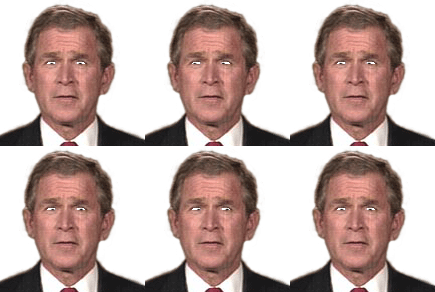
bush-eyes.gif


The subtleties of party line voting...

The actual question being voted on was: "Should the ruling of the chair be upheld that Attorney General Gonzales not be sworn?"

Two Republicans, (who hold a majority on the committee) Orrin Hatch and Charles Grassley, apparently weren't listening and voted "no" when they meant "yes". Because everyone knew it was a party line vote, making sense of this was unnecessary.

The chairman, Republican Arlen Specter, voted "aye" twice in support of his own ruling from the chair (to not swear in the Attorney General).

Those were the two "ayes".

The ranking Democrat on the committee, Patrick Leahy, voted once. That was the third no. But the only real one.

Funny how Specter invoked this:


And I have reviewed the provisions of 18 USC 1001 in the case involving Admiral Poindexter, who was convicted under that provision; and have reviewed the provisions of 18 United States Code 1505, where Oliver North was convicted. And there are penalties provided there commensurate with perjury.

And it is my judgment that it is unnecessary to swear the witness.

Was Spector concerned that Attorney General Gonzalez was about to say something that could get him into trouble for lying?
 

Back
Top Bottom