Cont: Why James Webb Telescope rewrites/doesn't the laws of Physics/Redshifts (2)

Status
Not open for further replies.
Yes. It would be stunningly dishonest to compare the relatively recent volume of the "local" universe to the long-ago volume of the observable universe at recombination, when the scale factor at recombination was a tiny fraction of what it was when light we observe today was emitted from within the so-called local universe.

Mike Helland is complaining that I am not so stunningly dishonest as to do that.

You're being absurd.

We can only make measurements along our past line cone:
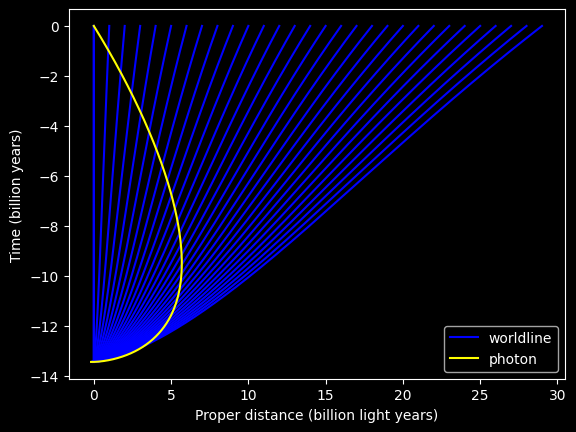
lcdmworldlines.png


It only goes back so far until you hit a big bang. If you think that's misleading, then you're just desperate to avoid looking the facts in the face.

You're talking about where the things are at t=0, the top of that graph, and then cubing it. Does the angle at which we observe a supernova matter? Of course it doesn't. You're comparing light travel time distances to volumes. Take a billion of something and cube it. Oooooo. Big number. Wow.

We don't have empirical measurements of anything being 18 billion light years away. That's where it is in theory due to the expansion of space that occurred as its light traveled here.
 
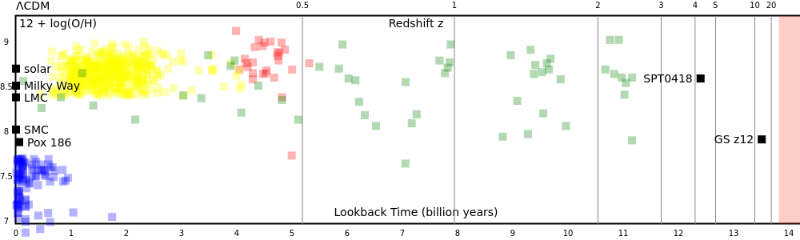
So at z = 4, it's pretty obvious that there is no correlation between metallicity and distance, or mass and distance. Higher or lower metallicity than solar and higher or lower mass than the Milky Way is possible.

You certainly cannot determine trends from looking at just two galaxies, it's an absurd argument. And it's false. There is clear evidence for a decline in metallicity with redshift.

https://arxiv.org/abs/2304.08516
https://arxiv.org/abs/2301.12825

There is also a decline in the number density at a given stellar mass.

https://ui.adsabs.harvard.edu/abs/2013ApJ...777...18M/abstract
https://arxiv.org/abs/2301.00027
https://www.aanda.org/articles/aa/abs/2015/03/aa24750-14/aa24750-14.html

You've compared this massive redshift 4 galaxy only to the Milky Way (which is 6x10^10 in stellar mass), but modern galaxies span from 10^7 dwarfs to 10^12 giant elliptical galaxies.

If we extrapolate that out to z > 10, the first galaxies we notice at that range will be smaller and less dusty than the general population there.

And yet at redshift 4, or even 1 these dusty galaxies are not enough to reverse the decline in stellar mass and metallicity. These are not typically galaxies. Selection does not explain the decrease in metallicity, and one shouldn't invent a population which may not exist.

It seems like from z=0 to z=11 a difference of 200x is quite unremarkable.

You're assuming that it will end up only as massive in the Milky Way when there are much more massive galaxies. My point was that these objects look nothing like a mature universe.

This galaxy is even farther:

Doesn't differ from what I said previously. This galaxy is still metal poor over all, and it is a tiny dwarf by modern standards.
 
You certainly cannot determine trends from looking at just two galaxies, it's an absurd argument.

Two galaxies, at the same redshift, 12 billion years ago. One is larger than the Milky way with more metal. One is smaller than the Milky Way with less metal.

One is easy to see. We see many others like it.

One is barely detectable, seen by the off-chance of being behind a gravitational lens.

The claim seems to be, this extremely rare exception to our expectation can be justifiably ignored. If it doesn't fit the model, it's bad data.

I think it's a remarkable coincidence this is an extremely rare galaxy that just happen to sit behind a gravitational lens.

Skepticism is obviously justified.


Does the current standard model of cosmology make quantifiable predictions about the metallicity with redshift?

What are they?

Specifically, what is the expected metallicity (Z) at redshift z=4?

Assuming at z=0 that Z=1.

What does the model predict for z=4?


Your cited paper "Mass-Metallicity Star-Formation Relations at z = 4 − 10", page 19, Figure 16. Can we say that at z<4, there is no particular trend? Metallicity starts to dip at what looks like z>6?

Do we agree that from z=0 to z=4 there is no correlation between distance and metallicity?

ETA, this is the conclusion of your reference:

Due to the limited sample size and associated metallicity errors, particularly at z > 8, it is challenging to make definitive conclusions from the current study. Further statistical investigations of metallicity are crucial to confirm the suggested lack of evolution in the SFR-MZ relation up to z ∼ 8, followed by a decrease at higher redshifts. These findings need to be rigorously compared with theoretical studies to better understand the underlying physics that govern early galaxy evolution.

So we're saying the universe from z=0 to z=8 is roughly the same. It's z>8 where evolution is observed.


Doesn't differ from what I said previously. This galaxy is still metal poor over all, and it is a tiny dwarf by modern standards.

What Z value should I be using for GS-z12 then?
 
Last edited:
This looks interesting:
Ilie, C., Paulin, J., and Freese, K., “Supermassive Dark Star candidates seen by JWST”, Proceedings of the National Academy of Science, vol. 120, no. 30, 2023. doi:10.1073/pnas.2305762120.​

Ilie et.al. said:
We describe below our method to look for Dark Star candidates in JWST data....

We have found three candidates that match both criteria. Specifically, of the four spectroscopically confirmed Lyman break objects: JADES-GS-z13-0 , JADES-GS-z12-0 , JADES-GS-z12-0 , and JADES-GS-z10-0 [25, 26], all are consistent with possibly being point objects, and three have photometry that can be modeled by SMDS spectra (with the exception of JADES-GS-z10-0 ).


They are suggesting three of the four spectroscopically confirmed Lyman break objects might be dark stars rather than galaxies.

(Dark stars are "made of hydrogen and helium but powered by Dark Matter heating." Back in 2010, two of the paper's authors suggested dark stars might have been common in the early universe and would likely be detectable by JWST.)

What Z value should I be using for GS-z12 then?

Ilie et.al. said:
We note here the spectra for those four objects, obtained in [26], do not yet confidently identify any spectral lines, as they are too noisy (S/N∼ 2).


Reference [26] is
E. Curtis-Lake et.al., Spectroscopic confirmation of four metal-poor galaxies at z=10.3-13.2, arXiv e-prints, arXiv:2212.04568 (2022), arXiv:2212.04568 [astro-ph.GA].​
whose abstract says
Curtis-Lake et.al. said:
The spectra reveal that these primeval galaxies are metal poor, have masses between of order [sic] ~107-108 solar masses, and young ages.
 
Spectroscopic confirmation of four metal-poor galaxies at z=10.3-13.2

What does metal-poor mean?

Z < 1?
Z < 0.1?

What value should we be using for Z (uppercase, as in metallicity, not lower case as in redshift).

Can we decide on when the "early universe" starts?

Are we going to say z ≥ 10 is the early universe?


My point of view is that the mass-distance, star-formation-rate-distance, metallicity-distance relationships that were predicted in 30 years ago have nothing to do with what we are seeing, but we prefer to keep that picture around anyways.

We really need to know two things. What does the standard model of cosmology quantitatively predict, and what does the current data say?

Specifically, we need at least three of these, one for metallicity, one for SFR, and one for mass.

tz-metallicity.png


These should include the predictions of the current standard model of cosmology, and the measurements we've made.

Basically, I'm skeptical you'll see anything more significant than something like this:

FdMXx.png


At this point, I would guess cosmologists would hazard to make any real predictions because they known the data won't actually corroborate them.

1. there are no problems in cosmology
2. if there are, they aren't a big deal
3. if they are, it's a galaxy formation problem
4. if it isn't, supermassive dark stars
5. also, see number 1

Whatever the responses to this post are, I can predict with near perfect certainty that they won't include the standard model's predictions for mass, metallicity, and SFR over the history of the universe. Prove me wrong.
 
You've compared this massive redshift 4 galaxy only to the Milky Way (which is 6x10^10 in stellar mass), but modern galaxies span from 10^7 dwarfs to 10^12 giant elliptical galaxies.

According to this:

https://www.worldatlas.com/space/the-ten-largest-galaxies-in-the-universe.html

Andromeda, at about 1.5 trillion stars, is the 10th largest galaxy observed in the universe.

Now, I'm pretty sure that source isn't accurate. But, realistically, how many galaxies have been measured to have > 1 trillion stars? Surely more than 10. Is it 20? Is it 1000?
 
One way to answer that question is to read the paper whose title Mike Helland quoted.

But I am not surprised to learn that reading the paper I cited is beyond Mike Helland's abilities.

The paper says this:

Nearby metal-poor galaxies (Z/Z ≲ 0.1)​

So < 0.1

Which it compares to nearby galaxies with the same metallicity. So. Whoopdee do.

There are metal poor galaxies everywhere.

How about actual predictions from the standard model of cosmology as to what we should find where? Or did cosmologists get out of the business a couple decades ago?

The thing is, which has been explained to me, and I get, is that, unlike say redshift-distance, there are a lot more factors than just mass-distance, or metallicity-distance. No matter what, whether there is a relationship or a null relationship, it's not going to be some pretty line. It's gonna be extremely scattered

Even though there isn't anything that's quantitative and simple/direct, we still persist in the 20th century view, back when the comparatively limited data we had for the most supported a clearer relationship.

Andromeda is, allegedly, the 10th largest galaxy ever observed. If it was out at z=4, and not behind a gravitational lens, would we even see it?
 
The paper says this:

Nearby metal-poor galaxies (Z/Z ≲ 0.1)​

So < 0.1

Which it compares to nearby galaxies with the same metallicity. So. Whoopdee do.

There are metal poor galaxies everywhere.

How about actual predictions from the standard model of cosmology as to what we should find where? Or did cosmologists get out of the business a couple decades ago?

The thing is, which has been explained to me, and I get, is that, unlike say redshift-distance, there are a lot more factors than just mass-distance, or metallicity-distance. No matter what, whether there is a relationship or a null relationship, it's not going to be some pretty line. It's gonna be extremely scattered

Even though there isn't anything that's quantitative and simple/direct, we still persist in the 20th century view, back when the comparatively limited data we had for the most supported a clearer relationship.

Andromeda is, allegedly, the 10th largest galaxy ever observed. If it was out at z=4, and not behind a gravitational lens, would we even see it?

Help me understand: You are so confident in the current galaxy formation models that any anomalous observation must call into question the theory of an expanding universe. Is that correct?
 
This looks interesting:
Ilie, C., Paulin, J., and Freese, K., “Supermassive Dark Star candidates seen by JWST”, Proceedings of the National Academy of Science, vol. 120, no. 30, 2023. doi:10.1073/pnas.2305762120.​

That paper is from April.

https://arxiv.org/abs/2304.01173

It's been brought up here before, actually.

This paper is from Nov:

https://arxiv.org/pdf/2311.09908.pdf

It doesn't address the supermassive dark star hypothesis, but I think it safely rules it out.

The robustness of the line detection is also confirmed by the visual inspection of the 2-d spectrum, in which the line is observed on three pixels in the spatial direction along the slit. Based on these various lines of evidence, we interpret this line as C iii], making it the most distant metal line detection to date.

We measure a high EW(C iii]) = 30 ± 7 Å. Similarly high EW(C iii]) have been found in some local metal-poor dwarf galaxies, such as Pox 186 (M⋆ ≈ 105 M⊙; Kunth et al. 1981; Kumari et al. 2023), considered a local analogue of high-redshift star-forming galaxies, as well as in more massive galaxies at intermediate redshifts (2 < z < 4; Le Fèvre et al. 2019) and at 7 < z < 9 (Stark et al. 2017).

I looked up the Pox 186:

https://en.wikipedia.org/wiki/POX_186

The galaxy is considered very small and distorted compared to most older galaxies, such as our own Milky Way Galaxy. It is currently believed to have first begun forming when two enormous clouds of gas and stars crashed into each other less than 100 million years ago, sparking new stars to form. Some people believe this may be direct evidence of a new theory, speculating that later-forming galaxies in our universe are smaller than galaxies that have been around for billions of years.

So, GS-z12 is analogous in size and metallicity of a z=0.0039 startup.

GS-z12 has a comovingdistance of 33.5 Gly, and a luminosity distance of 456 Gly in LCDM, H0=67.5.

Also, in LCDM, it should have an angular diameter distance of 2.5 Gly, which is the same as a z=0.23 galaxy.

Do galaxies of the same mass as GS-z12 at z=0.23 have the same angular diameter?

Not even close. That's why GS-z12 is believed to extremely compact.

In my model, that's dL = 490 Gly. So my model should predict a somewhat higher mass. And since there is no angular diameter turnaround in my model, it shouldn't be expected to be the same size no the sky as a similarly sized z=0.23 galaxy, meaning it's not compact. Meaning it's pretty normal for a young galaxy (like the one at z=0.0039) that isn't obscured by dust.
 
Help me understand: You are so confident in the current galaxy formation models that any anomalous observation must call into question the theory of an expanding universe. Is that correct?

No.

Let me show you something.

https://old.reddit.com/r/BigBangSkeptics/?count=75&after=t3_2u07na

I noticed lot of articles saying the same thing, so I just made a subreddit to put links.

Pick a link, check it out. Here's one, 4th from the bottom, posted 9 years ago:

https://lighthouse.mq.edu.au/media-releases/granny-galaxies-discovered-in-the-early-universe

"Scientists have known about large numbers of young galaxies in the early universe actively forming new stars,” says co-author Dr Lee Spitler. “The ones we've found have already gone through this phase: they have actually taken an early retirement from star-formation, when the universe was only 12% of its current age. Because they grew up so quickly, it’s likely they underwent an explosive period of new star formation – a brief, so called starburst phase – then retired.”

...

“Fifteen years ago they were predicted not to even exist within the cosmological model favoured at the time. In 2004 I wrote a paper on the discovery of such galaxies existing only three billion years after the Big Bang. Now, with improved technology we are pushing back to only 1.6 billion years, which is truly exciting."

The finding raises new questions about how these galaxies formed so rapidly and why they stopped forming stars so early.

Those aren't new questions though.

They go back at least to the early 2000's. It's always the same thing.

"Guess we're gonna have to rethink how galaxies form."

Same excuse. I'm not confident in them, but there's also a limit to my gullibility. How are you going to cram a galaxy developing in just over 1 galactic year? And how does that really fix the problems?

A specific timeline of galactic sizes are necessary for LCDM to avoid falsification by the angular size test. You mess with the theory of galaxy formation too much, you break something on the other end.

And let's be real here. Is there really such a thing as "the theory of galaxy formation?" Does it have equations?

It seems to me it's more of a conjecture, that things build through mergers. Where the rubber meets the road, it's a simulation of gravity and whatever exotic elements (dark matter, inflation field) the cosmologists feel necessary.

Am I confident in that? No. I'm a bit skeptical of that, to be honest.
 
This paper is from Nov:

https://arxiv.org/pdf/2311.09908.pdf

It doesn't address the supermassive dark star hypothesis, but I think it safely rules it out.
Mike Helland expresses an opinion. The value of that opinion can be estimated by considering the value of other opinions he has expressed in this thread and its predecessor.

The robustness of the line detection is also confirmed by the visual inspection of the 2-d spectrum, in which the line is observed on three pixels in the spatial direction along the slit. Based on these various lines of evidence, we interpret this line as C iii], making it the most distant metal line detection to date.

We measure a high EW(C iii]) = 30 ± 7 Å. Similarly high EW(C iii]) have been found in some local metal-poor dwarf galaxies, such as Pox 186 (M⋆ ≈ 105 M⊙; Kunth et al. 1981; Kumari et al. 2023), considered a local analogue of high-redshift star-forming galaxies, as well as in more massive galaxies at intermediate redshifts (2 < z < 4; Le Fèvre et al. 2019) and at 7 < z < 9 (Stark et al. 2017).
It looks as though Mike Helland failed to notice that the paper goes on to note important differences between Pox 186 and GS-z12:
Eugenio et.al. said:
A local galaxy with properties analogue to GS-z12, F. D’Eugenio et al.: High C/O in GS-z12 i.e. with a high-EW C iii] emission, is the low-mass, metal-poor star-forming dwarf galaxy Pox 186 (Kumari et al. 2023). GS-z12 and Pox 186 have similar size of ≈100 pc, yet, they have different masses (by two orders of magnitude) and markedly different C/O abundances.

I looked up the Pox 186:

https://en.wikipedia.org/wiki/POX_186

The galaxy is considered very small and distorted compared to most older galaxies, such as our own Milky Way Galaxy. It is currently believed to have first begun forming when two enormous clouds of gas and stars crashed into each other less than 100 million years ago, sparking new stars to form. Some people believe this may be direct evidence of a new theory, speculating that later-forming galaxies in our universe are smaller than galaxies that have been around for billions of years.

So, GS-z12 is analogous in size and metallicity of a z=0.0039 startup.
Despite their similar size, they differ in mass by two orders of magnitude.

All of the cited papers agree that GS-z12 has low metallicity. To find a galaxy with similarly low metallicity in our local universe, you'd want to find an unusually young galaxy such as Pox 186.

At any rate, that is what mainstream cosmology would predict, and the cited papers provide evidence in support of that prediction.

Helland physics, on the other hand, says there should not be any significant difference between the distribution of metallicities seen in galaxies of our local universe when compared to the distribution of metallicities seen in galaxies at extremely high redshifts.

All of the recently cited papers present evidence that Helland physics is wrong about that.

The real mystery here is why Mike Helland thinks the cited papers support Helland physics instead of providing evidence against Helland physics.
 
At any rate, that is what mainstream cosmology would predict, and the cited papers provide evidence in support of that prediction.

Are those predictions quantitative or more just a "in general one should find things going to zero toward the big bang"?


Helland physics, on the other hand, says there should not be any significant difference between the distribution of metallicities seen in galaxies of our local universe when compared to the distribution of metallicities seen in galaxies at extremely high redshifts.

Is it a question of what's there or what is seen?

By "at extremely high redshifts", I assume you mean the edge of our current where our current data reaches, z>10.

Suppose we had the power to move Andromeda around the universe. And we start pushing it farther and farther away from the Milky Way.

JWST has revealed to us galaxies that are hidden from HST. Presumably we would push Andromeda until it became invisible to HST. Even JWST if there's no gravitational lens to help it out.

What does LCDM predict that distance would be?
 
Last edited:
The real mystery here is why Mike Helland thinks the cited papers support Helland physics instead of providing evidence against Helland physics.


At least part of that mystery is explained by Mike Helland's misreading and/or misreporting of his sources.

I have already commented upon some misleading aspects of this picture:
[qimg]https://raw.githubusercontent.com/mikehelland/hubbles-law/master/img/tz-local.png[/qimg]


My remarks concerning that picture referred to its yellow-shaded area. Shortly after those remarks, Mike Helland confused the issue by posting a second picture in which the yellow shading was extended to cover a larger area of the picture:


That picture might lead someone to believe the metallicities shown in that picture come from references [1], [2], and [3].

But the near-solar metallicity shown for GS-z12 is incorrect. Reference [2] repeatedly says things such as "GS-z12 stands out as a metal-poor system" and "These values place GS-z12 clearly outside the rising enrichment sequence of local and lower redshift galaxies, and closer to...extremely metal-poor stars in the Milky Way halo" and "GS-z12 has...a sub-solar metallicity of 12 + log (O/H) = 7.9 dex". (Mike Helland might have been confused by the super-solar ratio of carbon to oxygen, or by the many other ratios discussed within reference [2].)

Although reference [1] discusses 850.1 and 850.2, I see no discussion of their metallicity within that paper beyond a couple of references to low metallicity. So I suspect the metallicity shown for 850.1 in Mike Helland's second picture is unsupported or incorrect as well.

Reference [3] does report the low metallicity shown for LLS1723 in Mike Helland's picture.
 
But the near-solar metallicity shown for GS-z12 is incorrect. Reference [2] repeatedly says things such as "GS-z12 stands out as a metal-poor system" and "These values place GS-z12 clearly outside the rising enrichment sequence of local and lower redshift galaxies, and closer to...extremely metal-poor stars in the Milky Way halo" and "GS-z12 has...a sub-solar metallicity of 12 + log (O/H) = 7.9 dex". (Mike Helland might have been confused by the super-solar ratio of carbon to oxygen, or by the many other ratios discussed within reference [2].)

I confuse easily.

In any case, if it was a supermassive dark star, it wouldn't have any of those things. Just hydrogen and helium and dark matter.

Although reference [1] discusses 850.1 and 850.2, I see no discussion of their metallicity within that paper beyond a couple of references to low metallicity. So I suspect the metallicity shown for 850.1 in Mike Helland's second picture is unsupported or incorrect as well.

It's referred to as dust rich and highly dust obscured. Dust isn't made of just hydrogen or helium either.

Reference [3] does report the low metallicity shown for LLS1723 in Mike Helland's picture.

Got one!
 
Some what scathing review of contemporary cosmology:

https://www.science20.com/martin_lopez_corredoira/herds_and_shepherds_in_cosmology-256895

Why, then, is there so much noise and commotion surrounding Hubble tension? There are tens of tensions and problems in the standard model that are more challenging than this, but the cosmological herds are currently obsessed with solving the Hubble tension as the key problem in cosmology.

It mimics many of the points that have been made over the last 15 years:

https://www.americanscientist.org/article/modern-cosmology-science-or-folktale

But López-Corredoira really turns it up, calls out the "herds and shepherds" of a sociological phenomenon.
 
But López-Corredoira really turns it up, calls out the "herds and shepherds" of a sociological phenomenon.


Martín López Corredoira thinks of himself as a social cosmologist. That's been his shtick for at least 20 years.

2003: What do astrophysics and the world's oldest profession have in common?
All the circumstances above described may lead one to conclude, that the actual ‘product’ from the branch of science known as astrophysics has become prostituted in many senses. According to the dictionary, one of the meanings of ‘prostitution’ is the use of talent or ability in a base and unworthy way, usually for money. This is what astrophysics and world's oldest profession have in common.

2013: Non-standard Models and the Sociology of Cosmology
Cosmologists do not usually work within the framework of alternative cosmologies because they feel that these are not at present as competitive as the standard model. Certainly, they are not so developed, and they are not so developed because cosmologists do not work on them. It is a vicious circle. The fact that most cosmologists do not pay them any attention and only dedicate their research time to the standard model is to a great extent due to a sociological phenomenon (the “snowball effect” or “group-think”).

2022: Alternative ideas in cosmology
None of the alternative cosmological models is as competitive as the standard ΛCDM model, because they are not so developed and there are many observations pending to be explained with these models.
That third paper, written with a co-author, is by far the most serious of the three. When discussing Melia's ideas, for example, the paper correctly observes that Melia's "interpretation of general relativity is not supported by other specialists in gravitation" and gives a citation.


Because I myself have observed within this thread (or its predecessor) that some of Melia's errors derive from his misunderstanding of the local flatness theorem, I will cite another paper that identifies mistakes made by Melia:
Do Young Kim, Anthony N. Lasenby, Michael P. Hobson. Friedmann-Robertson-Walker models do not require zero active mass. Monthly Notices of the Royal Astronomical Society: Letters 460:1, 21 July 2016.​
 
Martín López Corredoira thinks of himself as a social cosmologist. That's been his shtick for at least 20 years.

Here are his scientific publications:

https://lopez-corredoira.com/ciencia_en.html

His point is that the shepherds point the way to go, and anyone that questions it gets smeared out of existence.

That's certainly the role you played here.

I bet there's plenty of people reading this that are skeptical of the big bang or the expanding universe. You've poisoned the well sufficiently that it'd be a reputation suicide to take any position except the expansion of the universe as absolute truth.
 
Here are his scientific publications:

https://lopez-corredoira.com/ciencia_en.html

His point is that the shepherds point the way to go, and anyone that questions it gets smeared out of existence.

That's certainly the role you played here.

I bet there's plenty of people reading this that are skeptical of the big bang or the expanding universe. You've poisoned the well sufficiently that it'd be a reputation suicide to take any position except the expansion of the universe as absolute truth.

Well maybe half a dozen or so, on this insignificant online discussion site. None of whom appear to agree with your position. Perhaps your inflated ego increases the significance of this discussion to something that actually matters in the scientific world. Could you remind us of the dispositions of "all" the papers you have submitted to actual reputable scientific journals?
 
Some what scathing review of contemporary cosmology:

https://www.science20.com/martin_lopez_corredoira/herds_and_shepherds_in_cosmology-256895

Why, then, is there so much noise and commotion surrounding Hubble tension? There are tens of tensions and problems in the standard model that are more challenging than this, but the cosmological herds are currently obsessed with solving the Hubble tension as the key problem in cosmology.

Indeed, much of that essay is devoted to arguing that the Hubble tension is overstated.

(I guess Mike Helland didn't notice that Martín López Corredoira was dismissing the importance of one of Mike Helland's favorite arguments.)

Corredoira is certainly an accomplished scientist:


The most recent publication in that list argues the magnitude and importance of the so-called Hubble tension have been exaggerated due to systematic underestimation of the statistical error bars in measurements and methods. He concludes:
Hence, the tension of 4.4𝜎, estimated between the local Cepheid–supernova distance ladder and cosmic microwave background (CMB) data, is indeed a 2.1𝜎 tension in equivalent terms of a normal distribution, with an associated 𝑃(> 𝑥eq.) = 0.036 (1 in 28). This is not large but it can occur as a random statistical fluctuation.


In other words, Martín López Corredoira thinks the Hubble tension is nowhere near as big a problem for mainstream cosmology as Mike Helland believes it to be.

His point is that the shepherds point the way to go, and anyone that questions it gets smeared out of existence.

That's certainly the role you played here.

I bet there's plenty of people reading this that are skeptical of the big bang or the expanding universe. You've poisoned the well sufficiently that it'd be a reputation suicide to take any position except the expansion of the universe as absolute truth.


Skepticism is fine.

My role in this thread and its predecessor has been to point out that many of the arguments put forward by Mike Helland are downright stupid. For example: All credible estimates of the Hubble constant say its value is somewhere between 65 and 75 km/s/Mpc. Mike Helland interprets that uncertainty to mean the value of the Hubble constant is actually zero. That is a profoundly stupid argument.

Just yesterday, Mike Helland directed our attention to an essay that argues the statistical significance of the Hubble tension has been overestimated. He even quoted a few sentences that say the Hubble tension is not so much of a problem for mainstream cosmology as people like Mike Helland make it out to be.

But Mike Helland completely missed that author's point.

When Mike Helland says I've "poisoned the well sufficiently that it'd be a reputation suicide to take any position except the expansion of the universe as absolute truth", he is being ridiculous. Yes, I have pointed out that many of Mike Helland's arguments are stupid. Mike Helland might think my criticisms have affected his reputation among readers of this thread, and I concede the possibility. On the other hand, my criticisms of Mike Helland's arguments have not affected the reputation of anyone who is doing reputable science.
 
Status
Not open for further replies.

Back
Top Bottom