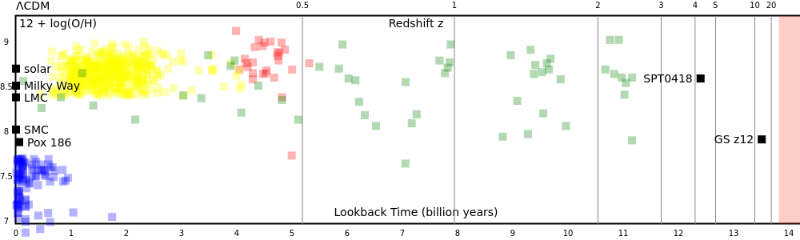
You might try reading back through the thread to find the discussion of said problems. Discussions in which you were an active participant. Discussions in which you will find no one claiming that problems in current cosmology do not exist.
Sure. You will find some admitting the Hubble tension is problem, always with the obligatory disclaimer that it's not a big deal.
First of all, that has nothing to do with galaxy formation.
Secondly, you will be told it's some type of problem with our measurements of local, nearby galaxies.
Do you believe that? Do you know what that means?
Do you have the image in mind that there is some small sliver at data for "nearby" galaxies, that doesn't match up with our model?
Seriously, think about it. What does the problem look like in your head?
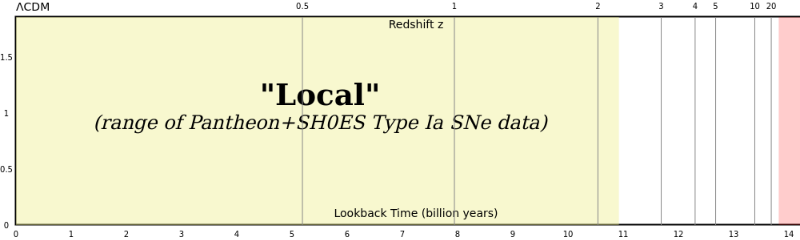
This is the part of the universe that the "local" data actually covers:
Does that reflect what you were imagining?
The data in that range tells us the universe is currently expanding at 73 km/s/Mpc, and the universe is 12.8 billion years old.
This is considered wrong. The data says this is what it is. There are no cosmologists that consider this to be possible.
It has to be closer to 67.5 km/s/Mpc, and the universe has to be 13.8 billion years old. Even when discussing galaxies that clearly fall in the range of the "local" data, where 67.5 is an objectively poor fit to the data... that's the value used.
It is in no way conceivable in their minds that light from 370,000 years after the big bang cannot be telling us anything but the right answer (unless the value has changed sometime between 13.75 billion years ago and 11 billion years ago).
Part of this is that they've measured the ages of stars to be older than 12.8 billion years. Isn't it conceivable that our ability to measure the age of a star isn't as precise or accurate as we thought? Is that such an exact science, never having actually visited more than one star, that our belief in the beginning of reality as we know must hinge strictly on those measurements?
Some big bang skeptics are fond of pointing at the Methuselah star as evidence against the big bang. Because it's apparently the oldest star in our galaxy. Because it's so metal poor.
Well. This is how stupid I am. That doesn't make sense.
Why would the oldest star in the galaxy have the least amount of metal in it? If it's been burning for so long... wouldn't it have a ton of metal?
What if it's one of the youngest stars?
Again, I'm a moron. It probably has to do with where it's hiding it's metal weight, and us being certain about that too.
I just think it's a bit preposterous that "oh, the data! the evidence!" and where the rubber actually meets the road, the SNe data is simply pushed aside in favor of readings of tea leaves at the so called surface of last scattering.
And this really has zero connection to the theory of galaxy formation through mergers.