• Security incident: ISF was recently accessed by intruders. Please change your password, and change it anywhere else you used it. Read more

Merged Strict biological definitions of male/female

I've shown them dozens of times. You're either not paying attention or you simply refuse to look at what I've put on the table. ...

Steersman, it's you that isn't "paying attention". The world of science and the world of everyday communication don't use your obscure, convoluted system of definitions.

They both manage just fine, with no confusion at all. It's your proposed definitions that not only fail to shed light on the subject but actually cloud the issue. Worse than worthless - positively negative.
 
Why are you bringing this up when you know n=3 and they don't resemble each other overmuch?

Haven't got the foggiest idea what you're referring to ... show your work ...

ETA: I've skimmed through the Needham paper and have yet to find a purported relationship between polythetic classes and (discrete or continuous) spectra. Perhaps you had another paper in mind?

Don't think you're paying attention. OR you have your thumbs - to the elbows - on the scales.

75 references to polythetic categories, though Needham uses "polytypic" in the same sense. But you might try thinking about this passage I found on just a quick skim:

A class is ordinarily defined by reference to a set of properties which are both necessary and sufficient (by stipulation) for membership in the class. It is possible, however, to define a group K in terms of a set G of properties f; f,, . . . ,f, in a different manner.

Suppose we have an aggregation of individuals (we shall not as yet call them a class) such that:
  1. ) Each one possesses a large (but unspecified) number of the properties in G.
  2. ) Each f in G is possessed by large numbers of these individuals and
  3. ) No f in G is possessed by every individual in the aggregate.

By the terms of (3), no f is necessary for membership in this aggregate; and nothing has been said to warrant or rule out the possibility that some f in G is sufficient for membership in the aggregate.

Bit murky but I think it speaks rather clearly to numbering and ordering the sets of properties that determine category membership.
 
Steersman, it's you that isn't "paying attention". The world of science and the world of everyday communication don't use your obscure, convoluted system of definitions.

They both manage just fine, with no confusion at all. It's your proposed definitions that not only fail to shed light on the subject but actually cloud the issue. Worse than worthless - positively negative.

What a pile of horse feathers. You might try reading those articles by Needham & Regenmortel.
 
Haven't got the foggiest idea what you're referring to ... show your work...
Scroll back to your pie chart and count the categories.


75 references to polythetic categories, though Needham uses "polytypic" in the same sense.
Does Needham explain what—if anything—this has to do with spectra?

You seem to think that it really matters whether our defintion of sex results in either a polythetic category or a (discrete?) spectrum. Maybe you're right, but I've yet to see the argument as to why we should care, or why it's considered more virtuous to be either monothetic or non-spectral.

Sent from my Fathom FQ2 using Tapatalk
 
Last edited:
Scroll back to your pie chart and count the categories.

There were several other cases of 3. Including Hilton's.

Does Needham explain what—if anything—this has to do with spectra?

Think I've explained it with this quotation several times:

“If the n [the number (of category members)] is very large, it would be possible to arrange the members of K along a line in such a way that each individual resembles his nearest neighbors very closely and his furthest neighbors less closely.”

Note the "resembles" ...

You seem to think that it really matters whether our definition of sex results in either a polythetic category or a (discrete?) spectrum. Maybe you're right, but I've yet to see the argument as to why we should care, or why it's considered more virtuous to be either monothetic or non-spectral.

Good question, kind of the $64,000 one. Though the controversy is between polythetic and spectral, on the one hand, and monothetic and non-spectral on the other.

But as I've said - more or less right out of the chute ... - that Hilton's summation of the ad-hoc, folk-biology "definition" turns out to be a polythetic category - a spectrum of three - is not, in itself, all that fatal. But it is ironic, if not hypocritical of them to then be throwing stones at Nature, SA, & Ainsworth for peddling definitions for the sexes that are more explicit spectrums.

But more to your point, Needham at least goes into some depth on why and where each type might be preferable:

A consequence of a polytypic definition of classes is that 'there will always be the possibility of borderline cases. . . . Indeed, it is an essential aspect of polytypic classes'

The greater the number of criteria, the more difficult it tends to be to determine if any entity qualifies for membership or not - current disputes over CAIS people being cases in point.

Many sources have emphasized a similar aspect differentiating between intensional and extensional definitions: the fewer the number of sufficient conditions, any one of which is necessary for category membership, the greater the number of members encompassed by the category definition. Of significant benefit when we're trying to compare "accidental properties" of probably millions of different anisogamic species - possibilities of past or future abilities just muddies the waters.

More or less the principles of taxonomy that Needham goes into some depth on, quoting any number of credible researchers in that field - Mayr, Simpson, & Sokal in particular.

There's a certain economy that follows from having fewer and more precisely defined criteria for category membership. Some significant and crucially important principles in play that Hilton's "definitions" are riding roughshod over - which causes any number of problems and no end of "confusion".
 
Note the "resembles"
Note "very large," though.

Good question, kind of the $64,000 one. Though the controversy is between polythetic and spectral, on the one hand, and monothetic and non-spectral on the other.
I don't believe you've proven that polythetic categories are somehow equivalent to a spectrum. Is the class of mammals monothetic or polythetic, in your view? If the former, what are the necessary and sufficient criteria for inclusion? If the latter, in what sense are mammals a spectrum?

But as I've said - more or less right out of the chute ... - that Hilton's summation of the ad-hoc, folk-biology "definition" turns out to be a polythetic category - a spectrum of three - is not, in itself, all that fatal.
Your preferred approach also yields three categories (ref. pie chart) but neither approach can be graphed as a spectrum unless we come up with an ordinal measure which applies to all three categories for our x-axis.

ETA: I'd suggest "lifetime viable gametes produced," but that only works for your defintions, not the OP.

ETA2: I forgot to mention that "current disputes over CAIS people" don't help us differentiate between the two approaches on offer here. CAIS patients typically have structures associated with both sexes, so they cannot be readily sexed into either category using the structural approach. This discussion should probably be in the DSD thread, though.
 
Last edited:
Note "very large," though.

Immaterial. Three is sufficient: A > B > C.

I don't believe you've proven that polythetic categories are somehow equivalent to a spectrum.

Don't think you're looking closely enough. Look again at the binary representations for the members of Sally's family. Compare that to Needham's & Regenmortel's essays.

Is the class of mammals monothetic or polythetic, in your view? If the former, what are the necessary and sufficient criteria for inclusion?

Generally, all species are seen as monothetic categories, the single necessary & sufficient condition being able to interbreed:

In biology, a species is the basic unit of classification and a taxonomic rank of an organism, as well as a unit of biodiversity. A species is often defined as the largest group of organisms in which any two individuals of the appropriate sexes or mating types can produce fertile offspring, typically by sexual reproduction.

https://en.wikipedia.org/wiki/Species

Why it is something of a red herring to argue or even suggest that, for an example out of the blue ..., a spider missing a leg no longer qualifies as a spider. Actually having 8 legs is an accidental property, not an essential one, not one of the ones that determines category membership.

Your preferred approach also yields three categories (ref. pie chart) but neither approach can be graphed as a spectrum unless we come up with an ordinal measure which applies to all three categories for our x-axis.

You're barking up the wrong tree, you're still insisting on "an ordinal measure" which Needham's & Regenmortel's essays show to be entirely bogus. Being charitable ...

ETA: I'd suggest "lifetime viable gametes produced," but that only works for your definitions, not the OP.

Pray tell, how would you think to determine that? :rolleyes: Think you're seriously misinterpreting what I'm saying.

But, again, not my definitions. Those of Lehtonen require only the detection of gametes being produced - right now - as the ONLY necessary and sufficient condition for sex category membership. Not sometime in the distant past, or in the murky or ephemeral future. That is their strong point.

ETA2: I forgot to mention that "current disputes over CAIS people" don't help us differentiate between the two approaches on offer here. CAIS patients typically have structures associated with both sexes, so they cannot be readily sexed into either category using the structural approach. This discussion should probably be in the DSD thread, though.

You're missing my point - or are refusing to engage with it. By Lehtonen's definitions - the other "strict biological definition" on tap here though Hilton's is bit of a joke for any number of other reasons, CAIS and most intersex are sexless - neither male nor female because they're producing neither gamete. Easy, peasy. Once again, one of its strong points: single, clear, largely unambiguous necessary and sufficient condition for category membership.
 
Immaterial. Three is sufficient: A > B > C.
Bit odd to ignore what your own quote says, but okay, I suppose you might know better than the authority you're quoting.


You're barking up the wrong tree, you're still insisting on "an ordinal measure" which Needham's & Regenmortel's essays show to be entirely bogus.
I'm not seeing anything in that paper about what we need to produce a spectrum.

Generally, all species are seen as monothetic categories, the single necessary & sufficient condition being able to interbreed
No one asked about species, but I think you just accidentally proved that kids aren't human.
 
Last edited:
Bit odd to ignore what your own quote says, but okay, I suppose you might know better than the authority you're quoting.

Not ignoring it; I'm cutting to the chase. The "resemble" is transitive relationship that's going to be present whether you have 3 or 3 million sets of conditions for category membership in that spectrum.

Something you should have some familiarity with:

https://en.wikipedia.org/wiki/Transitive_relation

I'm not seeing anything in that paper about what we need to produce a spectrum.

Not quite sure how you can possibly misunderstand that quote of Needham's or my illustrations of Sally's family using one of Regenmortel's. Did you actually read that passage? Look at the graph?

Elucidate the specificities of your perplexities ... To coin a phrase.

No one asked about species.

Fair enough; I stand corrected.

But the definition for "mammals" specifies:

Mammals (from Latin mamma 'breast') are a group of vertebrate animals constituting the class Mammalia, characterized by the presence of mammary glands which in females produce milk for feeding (nursing) their young, a neocortex (a region of the brain), fur or hair, and three middle ear bones.
https://en.wikipedia.org/wiki/Mammal

"characterized" is often taxonomic-speak for "typical". That some human mammal is missing mammary glands does not exclude her from the category.

But, offhand, that looks like a monothetic category with some 5 necessary and sufficient conditions.

ETA:

... but I think you just accidentally proved that kids aren't human.

Generally, don't get their "human" membership cards until they hit 30 ... ;-)

Kinda think there are a couple of built-in assumptions, possibly covered by "mating types".
 
Last edited:
Not quite sure how you can possibly misunderstand that quote of Needham's or my illustrations of Sally's family using one of Regenmortel's.
Not sure how you can possibly think we can graph a spectrum without inherently ordinal values to put on the x-axis, nor how you can think that Needham or Regenmortel somehow imply this to be true.

But, offhand, that looks like a monothetic category with some 5 necessary and sufficient conditions.
Clearly the mammary glands are not necessary since we males are also mammals. I'd say the hair/fur is a bit iffy as well, since we won't stop calling cetaceans mammals even if they live their entire lives without hair from birth to death, nor are human patients with various congenital hypotrichoses non-mammalian.
 
Not sure how you can possibly think we can graph a spectrum without inherently ordinal values to put on the x-axis, nor how you can think that Needham or Regenmortel somehow imply this to be true.

You're stuck with your hand in a monkey trap by insisting - absent any evidence at all - that ordinal values are necessary or essential. I, Regenmortel, and Needham have all given clear examples of spectra based on finite sets of properties ordered in some arbitrary manner. Which you refuse to address.

Looking rather intellectually dishonest there mate. Being charitable. And civil ..

Clearly the mammary glands are not necessary since we males are also mammals.

:rolleyes: "In a few mammalian species, male lactation can occur. With humans, male lactation can occur only under specific circumstances. ...."

https://en.wikipedia.org/wiki/Mammary_gland

I'd say the hair/fur is a bit iffy as well, since we won't stop calling cetaceans mammals even if they live their entire lives without hair from birth to death, nor are human patients with various congenital hypertrichoses non-mammalian.

And "hair and fur" is again "typical". So maybe "mammals" is a polythetic category - maybe we could order them in some spectrum? .... :rolleyes:
 
Not sure how you can possibly think we can graph a spectrum without inherently ordinal values to put on the x-axis, nor how you can think that Needham or Regenmortel somehow imply this to be true.

Methinks that here's some evidence of others doing precisely that - "spectra without inherently ordinal values":


Figure 1. Spectrum of thyroid abnormalities by region. The bar chart showed the difference in incidence of
each sort of thyroid abnormalities between the coast and the inland via Chi-square tests (†: p < 0.05; ‡: p < 0.001).
TPO Ab: Thyroid peroxidase antibodies; Tg Ab: Thyroglobulin antibodies. Thyroid Ab: Thyroid peroxidase
antibodies or thyroglobulin antibodies. green square box: the coast; orange square box: the inland.

https://www.researchgate.net/public...odine-replete_regions_a_cross-sectional_study

And:

https://www.researchgate.net/public..._tertiary_care_haematology_institute_in_India

 
But the definition for "mammals" specifies:

https://en.wikipedia.org/wiki/Mammal

"characterized" is often taxonomic-speak for "typical". That some human mammal is missing mammary glands does not exclude her from the category.

So, being 'of the class that has mammary glands to suckle their young' entitles us to refer to all people as mammals? Yet being 'of the class that produces spermatazoa' is not sufficient for us to call young boys 'male'?
 
thum_77127632ac0eeaa9a4.png
Okay, so you think that when people say "sex is a spectrum" they literally mean "sex has more than two categories which can be plotted in any order" rather than "sex takes on values in between male and female." I don't think that is what they are claiming, but okay. If that really is what they are saying, your pie chart appears to bear them out. Since any pie chart can be converted into a bar chart, you must admit that reproductive classes are indeed a spectrum.

After all this going around about which definition to assign to "spectrum," we're left with the following:

1) Attempting to classify people using Steerman's interpretation of sex yields three categories, which could be plotted as a bar chart with categories in any order and is thus a "spectrum," for some values of the term.

2) Attempting to classify people using Hilton's interpretation of sex yields three categories, which could be plotted as a bar chart with categories in any order and is thus a "spectrum," for some values of the term.

3) One of these approaches is clearly better, because reasons having to do with spectra.

This is not a syllogism, I just like groups of three. Behold, another spectrum!
 
Last edited:
So, being 'of the class that has mammary glands to suckle their young' entitles us to refer to all people as mammals? Yet being 'of the class that produces spermatazoa' is not sufficient for us to call young boys 'male'?


Yes, you've reached into the very beating heart of the nonsense.
 
So, being 'of the class that has mammary glands to suckle their young' entitles us to refer to all people as mammals? Yet being 'of the class that produces spermatazoa' is not sufficient for us to call young boys 'male'?

Good question - seriously. Though the answer kind of hinges on the differences between monothetic and polythetic categories, the articles that I've provided on which you seem rather reluctant to give much thought or attention to - wonder why .... "Don't confuse me with facts, my mind is made up"? :rolleyes:

But briefly, particularly since your reluctance to look at those sources doesn't justify much in the way of effort, we have to start from some actual definitions; what you've provided is largely only your interpretations.

More particularly, we have to start from the definitions of mammals and males as categories:

Mammalia
noun plural

: the highest class of the subphylum Vertebrata comprising humans and all other animals that nourish their young with milk secreted by mammary glands, that have the skin usually more or less covered with hair, a mandible articulating directly with the squamosal, a chain of small ear bones, a brain with four optic lobes, a muscular diaphragm separating the heart and lungs from the abdominal cavity, only a left arch of the aorta, warm blood containing red blood cells without nuclei except in the fetus, and embryos developing both an amnion and an allantois, and that except in the monotremes reproduce viviparously.

https://www.merriam-webster.com/medical/Mammalia

But vertebrata are also species, the only necessary and sufficient condition being, basically, the possession of compatible karyotypes to enable interbreeding; you can be a member of the spider species while still missing a leg. In addition to which, the above definition clearly has several sets of necessary and sufficient conditions since it also includes monotremes (egg-laying). There are a whole bunch of more or less explicit sufficient conditions for category membership. "Mammalia" are intrinsically polythetic categories - family resemblances, like "Sally's family". One can be members of that category while not possessing all of the traits that are typical of the category.

Not so with "male" and "female"; the biological definitions for which explicitly state single necessary and sufficient conditions for category membership, i.e., having functional gonads of either of two types:


They are monothetic categories; try looking at and thinking about the fundamental differences:


You're trying to compare apples and planets, or apples and a heap of sulphur, or trying to suggest or argue that they're identical.

Entirely different kettles of fish, if not species from different genera or families. Refusing to address or face those fundamental differences suggests that you either have your head in the sand or you're not paying attention ... ;)
 
^

Huge smokescreen designed to obscure the issue duly noted. I was tempted to predict this kind of answer.

Now, answer the point please. The one about 'Of the class that ...'. It's a point that has been made many times here and one you've conspicuously squirmed away from.
 
^

Huge smokescreen designed to obscure the issue duly noted. I was tempted to predict this kind of answer.

Now, answer the point please. The one about 'Of the class that ...'. It's a point that has been made many times here and one you've conspicuously squirmed away from.

:rolleyes: Haven't the foggiest idea what you're getting at; doubt you do either ...

Though you might ask yourself whether you can be a member of a political party if you can't pay the membership dues ...
 
:rolleyes: Haven't the foggiest idea what you're getting at; doubt you do either ...

Though you might ask yourself whether you can be a member of a political party if you can't pay the membership dues ...

I could never 'pay the membership dues' by suckling young (as I'm male), but I'm still in the 'mammal club'. 'Of the class that ...' is the point you've misinterpreted from the outset.
 
Okay, so you think that when people say "sex is a spectrum" they literally mean "sex has more than two categories which can be plotted in any order" rather than "sex takes on values in between male and female." I don't think that is what they are claiming, but okay. If that really is what they are saying, your pie chart appears to bear them out. Since any pie chart can be converted into a bar chart, you must admit that reproductive classes are indeed a spectrum.

Haven't got the foggiest idea what "people" (which people?) mean when they say "sex is a spectrum" - most of them, like Novella and Shermer, just throw a a bunch of "stuff" at the wall and say, "behold, a spectrum!" :rolleyes:

For example see the former's kick at that kitty which uses this graphic to start the ball rolling:


https://sciencebasedmedicine.org/the-science-of-biological-sex/

I'm surprised that "science-based medicine" doesn't stick in his throat, but it should. In any case, he at least is using "male" and "female" as intermediate points on his "sex spectrum" with the end points drifting off into never-never-land. Idiots - being charitable.

Though I haven't the foggiest idea what're getting when you insist that I "must admit that reproductive classes are indeed a spectrum". Some reason to think you're not paying attention ... ;) since I've clearly said that the spectrum of three reproductive classes consists of 3 and only 3 members: male, female, and sexless:
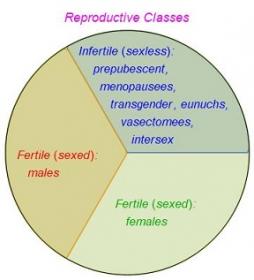


Of course I admit that "reproduction classes" is a spectrum, but I am most certainly not saying that each sex is a spectrum.

After all this going around about which definition to assign to "spectrum," we're left with the following:

1) Attempting to classify people using Steerman's interpretation of sex yields three categories, which could be plotted as a bar chart with categories in any order and is thus a "spectrum," for some values of the term.

2) Attempting to classify people using Hilton's interpretation of sex yields three categories, which could be plotted as a bar chart with categories in any order and is thus a "spectrum," for some values of the term.

3) One of these approaches is clearly better, because reasons having to do with spectra.

This is not a syllogism, I just like groups of three. Behold, another spectrum!

Again, it looks like you're not paying attention or you're intentionally trying to muddy the waters. Reproductive classes constitutes a spectrum of three - male, female, and sexless. But that is not saying that each sex is a spectrum; that is Hilton's argument, not mine.

It's not a case of either 1 or 2, but of 1 and not 2. That is, it's perfectly reasonable and justifiable to say that reproductive classes is a spectrum, but it is not justifiable to say that each sex is a spectrum.

Do pay attention there Double-Oh Seven ...

 

ISF - Join now!

Every member here is approved by hand. No bots, no spam, just people who care about evidence and honest debate.

Membership is free!

Create your free account

Back
Top Bottom