So, as I said, you're barking up the wrong tree if you are trying to analogize sex (either definition) to discrete spectra in mathematics or physics. Those fields use ordinal values when they are talking about spectra, but you are just assigning numbers arbitrarily to both sex (male/female/neither) and Sally's family.
It's immaterial how the numbers are assigned. All that's required is some way of ordering them all such that Z > Y > X > ... > A. If there are three or more then one has a spectrum.
Anyone can put values on anything, but that doesn't make it a spectrum in the sense that scientists generally use the term.
Allow me to demonstrate:
<nsip>
Behold, a spectrum!

Bravo!

But now maybe you can explain what qualifies them all to be members of the same category, what properties they have in common. Sally's family is a polythetic category because they share different subsets of 3 drawn from a set of 4 properties. And Hilton's definition is likewise a polythetic category because the members are characterized by different states of a reproductive ability.
Your example looks to be an arbitrary collection of objects. You can still put them in a spectrum of sorts, but it's not of much use. And that's the issue.
In threads about applying those definitions to human beings, yes.
And you've followed suit in this one by starting off with "strict biological definitions".
You are welcome to make a new thread for each of them.

One for all them will probably be sufficient. And I'll probably do so if you don't want to honestly address my criticisms of your OP. You boldly assert - absent evidence - that Hilton and Company are "essentially correct about what makes a mammal either female or male". And then object when I point out - with solid evidence - that they aren't.
I've asked this before but it's worth asking once again. What is a good practical example of a situation where we are trying to sort males from females and Parker's (supposed) approach yields significantly better results than Hilton's?
Think I've already answered that, several times I expect:
Originally Posted by d4m10n:
Can you come up with a situation (not involving sperm donation) where that 1/3 inference is problematic?
LoL. Apart from all the cases where the ability to actually produce sperm is an essential element - see the above re sequential hermaphrodites - there are no cases where producing them is an essential element, where "that 1/3 inference is problematic" ...
You explicitly exclude the cases where actual functionality is important, and then ask me for evidence in the other ones where it's not present or not an issue. Don't see how that qualifies as anything other than intellectually dishonest.
But to elaborate a bit, I gather that with clownfish there is only one breeding pair, the rest being either sexless (Lehtonen), or all male and female (Hilton). I'm sure no pro from Dover on the mathematics, but if, for example, one was modeling the population to determine the growth rate then the first assumption is likely to give much more accurate results than the second one.
I see that the article on sequential hermaphrodites has been modified to differentiate between functional and non-functional males and females, but that's a kludge at best:
https://en.wikipedia.org/w/index.ph...type=revision&diff=1091570144&oldid=890717544
Both protogynous and protandrous hermaphroditism allow the organism to switch between functional male and functional female.
So they should say that each newly hatched clownfish is a non-functional male and a non-functional female, that some will change into a functional male and a non-functional female, and that some will subsequently change into a non-functional male and a functional female.
What a joke, and a pile of unscientific claptrap. All to avoid saying "sexless" ...



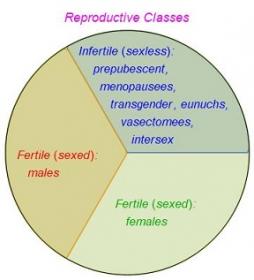
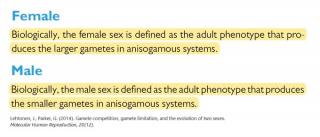


 I threw in an "or" there, just for you ...