We were wrong about how Super Massive Blackhole get bigger!

That said, I would also caution against taking CURRENT accretion rates to mean it always happened at that rate, starting from zero. E.g., if you take the current rate Earth is gathering dust and meteorites and use it to determine the age of the Earth, you'll get a VERY wrong result :p
 
Apparently yes. The logical conclusion is that the Universe is older than we thought. Which conflicts with the Big Bang theory. Which is based on observation of the CMB. So we have two observations that appear to be in conflict.

True. But basically everything that follows in your post is wrong. The big bang theory is on much firmer ground than our models of black hole formation, so Occam's razor indicates that the black hole formation models are more likely wrong.

But what if the CMB was not caused by a Big Bang? What if it is actually the remnants of events occurring over trillions of years that individually don't have much effect, but over a vast time frame built up to make the CMB we see today? Or what if it is actually caused some other effect that we are not aware of?

I don't think you understand how implausible that is. One of the things that is very hard for non-physicists to appreciate is the significance of the perfect black body profile of the CMB. There is nothing else in nature that even approaches such a perfect blackbody spectrum.

And when the encircling matter finally enters the black hole, what will it find? Imagine a black hole large enough that tidal forces are small and matter can exist in a 'normal' state. What would the event horizon look like to an observer inside? With all that stuff spinning around it you wouldn't be able to see the rest of the universe beyond, and any light beams you sent out to it would simply bend around back into the black hole.

Well, no. The event horizon doesn't look special. You can't see it, even when you fall through it.

First off, the minimum stable orbit is well outside the event horizon. There is no matter zipping around AT the event horizon. Second, the accretion disk is just that: a disk. Most of your field of view would be unobstructed. You would see the rest of the universe just fine. And even the accretion disk would have a distinctly NON-black body spectrum. Furthermore, your view would be very anisotropic. What you see when looking towards the singularity would not resemble what you see when you look away from it.

In contrast, the CMB is a perfect blackbody, it's quite uniform, and it's highly isotropic. These are NOT the features of what we would see from inside a black hole, no matter how massive.

ETA: a note about light "bending back". First, that makes it sound like you might see the light that you emitted outwards, and that's never the case. Second, whether it bends is actually dependent on what coordinate system you use. In Kruskal-Szekeres coordinates, for example, light stays on a straight path even inside the event horizon. In fact, light trajectories are identical whether inside or outside the event horizon in K-S coordinates.
 
Last edited:
I don't think you understand how implausible that is. One of the things that is very hard for non-physicists to appreciate is the significance of the perfect black body profile of the CMB. There is nothing else in nature that even approaches such a perfect blackbody spectrum.

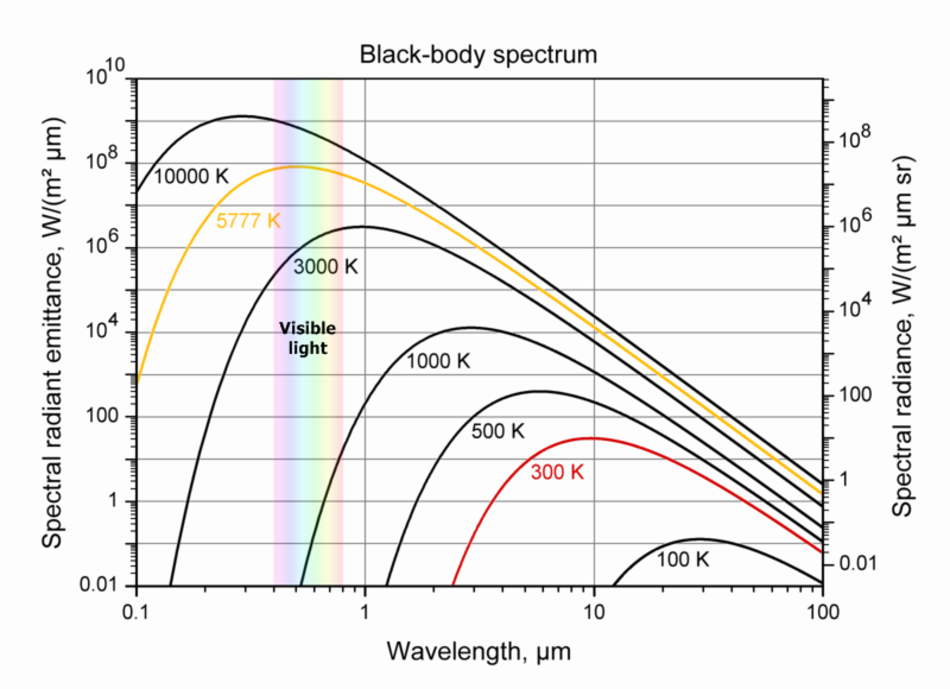
Here's black body spectra:

mainimage_BlackbodySpectrum_2.png


And here's the CMB:

nn0M1.png


There's also a couple problems with CMB, a cold spot, different temps in different hemispheres, models based on it predict the wrong value for Hubble's constant, and the axis of evil:

https://en.wikipedia.org/wiki/Axis_of_evil_(cosmology)

The "Axis of Evil" is a name given to an anomaly in astronomical observations of the cosmic microwave background (CMB). The anomaly appears to give the plane of the Solar System and hence the location of Earth a greater significance than might be expected by chance – a result which has been claimed to be evidence of a departure from the Copernican principle.
 
Last edited:
Here's black body spectra:
...
And here's the CMB:

Yeah, no. Those graphs are not comparable. They measure completely different things. The clue is in the fact that the axes aren't even the same. Neither the x nor the y axes for the two graphs match. The first graph is a measurement of the spectrum itself. The second graph is more complex, and relates to anisotropies in the temperature.

Here's a picture of the CMB spectrum which IS related to your first graph:

cmbspectrum1.gif


Note, though, that this is plotting spectral energy density versus frequency instead of versus wavelength, so the x direction is reversed relative to your first graph. Note also that this graph contains both the measured values and the theoretical curve of a perfect black body, and that they match within very small experimental errors. And finally, note that this is a one-parameter fit. The temperature is the ONLY variable needed to get a match. The shape is universal, and temperature determines both the peak position in X and the peak height in Y. There are damn few things in physics where you can get such incredible agreement with only a single parameter. And again, it's hard to understand how significant that shape is if you haven't studied thermodynamics, but it really, really matters, and basically nothing in nature aside from the big bang can produce that shape.

There's also a couple problems with CMB

And?

These "problems" all emerge when measuring the CMB at an incredibly sensitive scale. We don't have anything even remotely at that level of detail regarding the formation of ultra-massive black holes.

I'll give you a comparison that comes up on this forum: solar models. There are some aspects of stellar physics we don't understand in great detail regarding the dynamics of the sun's magnetic fields. But the basic model that the sun is powered by nuclear fusion in its core is rock solid. There is no real dispute about that. Why do we know that? Because everything we know about physics points to that, it explains all the most important features of the sun (ie, its power output), and no alternative works. Yet because we don't have every little i dotted and t crossed, some people think that the sun is powered by electricity instead of fusion.

The CMB is much the same. The gross features of the CMB are that it's a perfect black body, and that it's extremely (though not completely) uniform. The big bang theory explains these gross features. Nothing else does. Nothing else even comes close. What we're working on is how to explain the fine features, exactly how those small variations (and they are small) in temperature arise. And no doubt our theories will have to be refined in order to figure that out. But the gross features of the theory, which explain the gross features of the CMB, are almost certainly correct. You don't have to model the complete magnetic field of the sun to know that fusion in the core is powering it. And you don't need a complete theory of the CMB anisotropy to determine that it originates from an early stage of the universe when things were much hotter and denser. Nothing about black hole growth rates actually challenges that, because again, our data on black hole growth is VERY sparse compared to our data on the CMB.
 
Last edited:
Yeah, no. Those graphs are not comparable. They measure completely different things. The clue is in the fact that the axes aren't even the same. Neither the x nor the y axes for the two graphs match. The first graph is a measurement of the spectrum itself. The second graph is more complex, and relates to anisotropies in the temperature.

This might be a dumb question, but do perfect black bodies have anisotropies?

You said:

"the CMB is a perfect blackbody, it's quite uniform, and it's highly isotropic."

The latest measurements show it's not as uniform and isotropic as we thought.
 
If it's not a perfectly opaque solid and all at the exact same temperature, then it will not be isotropic. So unless the whole early universe was at exactly the same temperature, and it all went transparent at exactly the same moment, some anisotropy is actually exactly what you'd expect. And considering that going transparent was basically a matter of density (some of it indirectly), that condition boils down to: unless the early universe was perfectly uniform in density, yes, you'd expect anisotropy. And given that we did end up with stars and galaxies slightly later, yeah, it wasn't all uniform.
 
This might be a dumb question, but do perfect black bodies have anisotropies?

We have to be careful with our definition of anisotropy. A perfect black body will not have anisotropies in the sense that it will radiate equally in all directions (normalized by directional cross-section). This is a property of the source of the radiation.

But that's not the anisotropy we are measuring from the CMB. That anisotropy is measured at the observer, NOT at the source. Basically, in each direction that we look, we are seeing a different black body source. We are not looking at the same source from different directions. The anisotropy we observe indicates that these different black bodies are at slightly different temperatures. That's the anisotropy we see. Perfect black bodies do not all need to have the same temperature, so this anisotropy is not contradictory to the source being perfect black bodies.
 
Last edited:
light stays on a straight path even inside the event horizon. In fact, light trajectories are identical whether inside or outside the event horizon in K-S coordinates.
Of course. Light always travels in a straight line. And yet it never gets past the event horizon. So where does it go?

True. But basically everything that follows in your post is wrong. The big bang theory is on much firmer ground than our models of black hole formation, so Occam's razor indicates that the black hole formation models are more likely wrong.

Occam's razor
In the scientific method, parsimony is an epistemological, metaphysical or heuristic preference, not an irrefutable principle of logic or a scientific result. As a logical principle, Occam's razor would demand that scientists accept the simplest possible theoretical explanation for existing data. However, science has shown repeatedly that future data often support more complex theories than do existing data. Science prefers the simplest explanation that is consistent with the data available at a given time, but the simplest explanation may be ruled out as new data become available.


Did A Black Hole Give Birth To Our Universe?
if the entire Universe were compressed into a single point, what would happen? The answer is the same as it would be if you compressed any large-enough collection of mass or energy into a single point: it would form a black hole. What’s remarkable about Einstein’s theory of gravity is that if this collection of mass-and/or-energy isn’t charged (electrically) and isn’t rotating or spinning (i.e., without angular momentum), the total amount of mass is the only factor that determines how large the black hole is: what astrophysicists call its Schwarzschild radius.

Remarkably, the Schwarzschild radius of a black hole with the mass of all the matter in the observable Universe is almost exactly equal to the observed size of the visible Universe! That realization, on its own, seems like a remarkable coincidence, raising the question of whether our Universe might actually somehow be the interior of a black hole. But that’s only the beginning of the story; as we dive deeper, things get even more interesting...

This radiation — originally called the primeval fireball and now known as the cosmic microwave background — represented critical evidence that our Universe is expanding and cooling because it was hotter and denser in the past. The farther back we extrapolate, the smaller, more uniform, and more compact things were. Going all the way back, this picture of the hot Big Bang appears to approach a singularity, the same condition found at the central interiors of black holes...

Is it possible that what we perceive as cosmic inflation marks the creation of our Universe from an ultramassive black hole? Is it possible that dark energy is somehow connected to black holes, as well?

And does this mean that, as astrophysical black holes have formed within our Universe, that each one gives rise to its own “baby Universe” somewhere inside of it? These speculations have been around for many decades, but without a definitive or provable conclusion. Nevertheless, many models and ideas abound, and this line of thought continues to be compelling to many who research black holes...

There’s a lot to like about the idea that there’s a connection between black holes and the birth of Universes, from both physical and mathematical points of view. It’s plausible that there’s a connection between the birth of our Universe and the creation of an extremely massive black hole from a Universe that existed before our own; it’s plausible that every black hole that’s been created in our Universe has given rise to a new Universe within it.

What’s missing, unfortunately, is the key step of a uniquely identifiable signature that could tell us whether this is the case or not. That’s one of the most difficult steps for any theoretical physicist: to determine the imprint of a new idea on our observable Universe, distinguishing that new idea from our old, prevailing ones. Until we successfully take that step, work will likely continue on these ideas, but they will only remain speculative hypotheses. We don’t know whether our Universe was birthed by the creation of a black hole, but at this point, it’s a tantalizing possibility that we would be foolish to rule out.

 
Last edited:
I'd also add that we can't even actually check the isotropy in the definition of the black body, because that would involve looking at the same point from different angles. Which is a bit of a problem at intergalactic scales. We can't scoot over and see how it looks from 45 degrees to the left.

So, yeah, as Ziggurat was saying, the CMB anisotropy really isn't the same.
 

That, however is a VERY different theory than our universe being a black hole, which is what your message #39 seemed to be about. In fact, the one you quote above is that our universe was created by a white hole, which is the literal polar opposite of a black hole. The white hole may (or may not) have been CREATED by the collapse of a black hole, but it's not the same as BEING a black hole.

In effect, it's the same difference as between "Tom fell and made a hole in the ground" and "Tom IS a hole". (Note to mods: that's an indefinite article, not an attempt to bypass the censor;))
 
Of course. Light always travels in a straight line. And yet it never gets past the event horizon. So where does it go?

Look at the KS diagram. It hits the singularity.

But the singularity is not what you think it is. The singularity is not a point in space. In fact, the singularity is infinite in space (in one direction, anyways). Not everything will reach the singularity in the same place. The singularity is a boundary in time. Once you are inside the event horizon, the singularity is your future. That's why you can't escape it.


That writer doesn't know what he's talking about. I already described, at length, why you cannot use a Schwarzschild metric to describe the universe as a whole.
 
Depends on what you mean by that. If you mean direct-collapse supermassive blackholes, as far as I know, they're not ruled out by anything. They're just supposed to be rare. But then I'm not an expert.
 
That, however is a VERY different theory than our universe being a black hole
It is not unusual to have different theories describing the same thing.

Black hole cosmology
Accordingly, the Big Bang was a nonsingular Big Bounce at which the universe had a finite, minimum scale factor. Or, the Big Bang was a supermassive white hole that was the result of a supermassive black hole at the heart of a galaxy in our parent universe.

However...

... Any such model requires that the Hubble radius of the observable universe be equal to its Schwarzschild radius, that is, the product of its mass and the Schwarzschild proportionality constant. This is indeed known to be nearly the case; however, most cosmologists consider this close match a coincidence...


But it wouldn't be the first time that an observation dismissed as mere 'coincidence' eventually validated a rejected theory.

The cracks in cosmology: Why our Universe doesn’t add up
The standard model of our Universe may be showing some cracks. Several fundamental cosmological observations are contradicting each other. For instance, the Universe appears to be expanding 10 per cent faster than it should be, according to observations of the leftover heat from the Big Bang.

It’s perfectly possible that the contradictions will disappear as our estimates of cosmic parameters improve. But it’s also possible that the contradictions won’t go away and that our fundamental picture of the Universe is about to undergo a radical revision...

“The ‘standard model of cosmology’ is an admission of ignorance,” admits Prof Abraham Loeb of Harvard University.

“We label components whose nature we don’t know as ‘dark matter’ and ‘dark energy’. Since we don’t know what they are, it’s a very crude model that could easily be an oversimplification of reality”...

The standard model of cosmology is relatively simple, despite its multiple invisible components. But its simplicity may be blinding us to reality, which may be more complex. “Nature,” cautions Loeb, “is under no obligation to comply with the simplest version.”


HansMustermann said:
In effect, it's the same difference as between "Tom fell and made a hole in the ground" and "Tom IS a hole". (Note to mods: that's an indefinite article, not an attempt to bypass the censor;))
Well yes, when Tom falls into a (black) hole he is (part of) the hole from our perspective. But from Tom's perspective he is not the hole, he is inside a hole. Two ways of looking at the same thing.

The Big Bang may be a black hole inside another universe
Written by Tim Andersen, Ph.D., Principal Research Scientist at Georgia Tech.

The idea that we are living inside a black hole isn’t as crazy as it sounds. Black holes warp space and time to the point where space and time reverse roles. For anyone falling into a black hole, the radial dimension, towards the singularity, becomes time and the time dimension becomes like space...

This means that any matter falling in from the mother universe will disappear from that universe and emerge at the initial t=0 point of the daughter universe thoroughly scrambled.

Not only that, but what emerges at the Big Bang is not just the matter that was there at the black hole’s formation but all matter that ever fell into it. That is because time at the black hole’s singularity is essentially perpendicular to time in the mother universe outside...

You can have many interconnected universes this way, in which mothers give birth to daughters which give birth to more daughters, and so on ad infinitum. Thus, far from being only 13.8 Bya (Billion years ago), the whole interconnected cosmos can be infinitely old...

For an observer outside a black hole, called the far observer, the singularity is at a point in space. For the observer inside the event horizon, however, the sign of the r and t elements of the spacetime metric change places. Now, for the near observer, the singularity is at a point in time, some time in the future.
 
There's nothing wrong with having different hypotheses for the same thing, but you kinda have to make up your mind about which one you're talking about. If you post a link describing a white hole cosmology, in support of a post where you were talking about a black hole cosmology, it's... not very productive, to say the least.
 
To make it clear, though, while direct-collapse black holes do seem to exist, as I was saying, they're actually pretty rare. I mean, there's still billions of them in a universe this big, but it's still nowhere near enough of them for every galaxy to get one. So it can't be the ONLY explanation for supermassive black holes.
 

Back
Top Bottom