I don't think space is expanding.

Status
Not open for further replies.
With expanding energy fields of light, internal pressures of different magnitudes in different regions = explanation for the general redshift of light.

1. Expanding light has a lot of mass, but our devices can't register the expanding waves of the expanding light that are dark to us, which is the expanding thrust that all expanding nuclei of atoms circulate with one another.

2. We can study expanding light with the help of available photons.

3. Expanding photons are a very very very small part of the expanding light. They are like foam heads of waves of expanding light.

4. The wavy nature of the expanding light is projected by the available photons.

5. In the double gap test, send single photons and see where the waves of expanding light are transporting us.

6. For us, the dark waves of expanding lights interact with each other, accelerating each other's expansion out of space into existing space.

7. The denser the individual expanding densities of the waves of the expanding light, the greater the internal pressure of the expanding energy field formed by the expanding light and the more widely expanding the energy field will diffuse / expand outward into existing space.

8. In a large "empty" space between galaxy clusters, the expanding energy field of the expanding light field is not as large as within the galaxy cluster.

9. Due to lower internal pressure, the rate of expanding light does not accelerate away from its own galaxy cluster as quickly as the rate of expanding light accelerates within the forward galaxy clusters.

10. When the old expanding light finally projects inside or past another expanding galaxy, the new, more energetic and slightly faster expanding light accelerates the old expanding light to its own, thus extending the old expanding light, that is, generally redshifting.

11. The more expansive light that has passed through / past the galaxy cluster, the more elongated or generally redshifted the expanding light.

Expanding light vs. expanding space.

1. Space does not radiate information. You can't try to manipulate space to get information about it. In other words, expanding space is a completely religious concept. Expanding space is emperor naked.

2. Light can be studied scientifically. If and when the lights expand and interact with each other, we can change the trajectory of the expanding light with billions of years of expanding light by conducting a scientific experiment.

Why do cosmologists believe in the existence of expanding space trapped in a hat even though they cannot scientifically prove its existence?!?

Expanding space is a concept similar to the gods of antiquity.

🤔
 
What is the advantage of proposing the existence of space that is beyond our ability to detect? Given that we will never be able to confirm or refute that suggestion, what do we gain by considering it?

That's a great question.


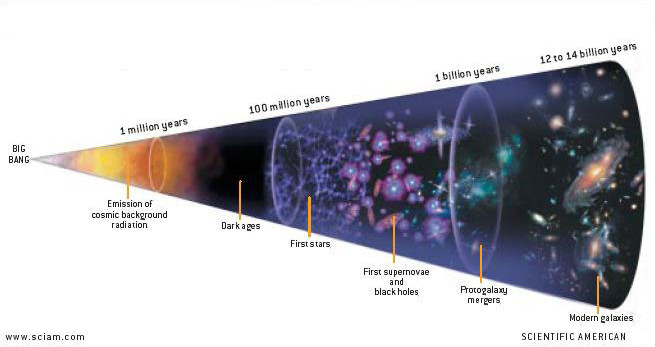
So, say here's the big bang, expanding from a single point:

expansion_classic.jpg


That's how it looked last century.

It said the univere was like 5 billion years old, but we thought stars were 20 billion years old.

That's a bug.

There was also:

https://en.wikipedia.org/wiki/Horizon_problem
https://en.wikipedia.org/wiki/Flatness_problem
https://en.wikipedia.org/wiki/Big_Bang#Magnetic_monopoles

So what did they do to fix it? Stars had to get younger, and the universe had to get older.

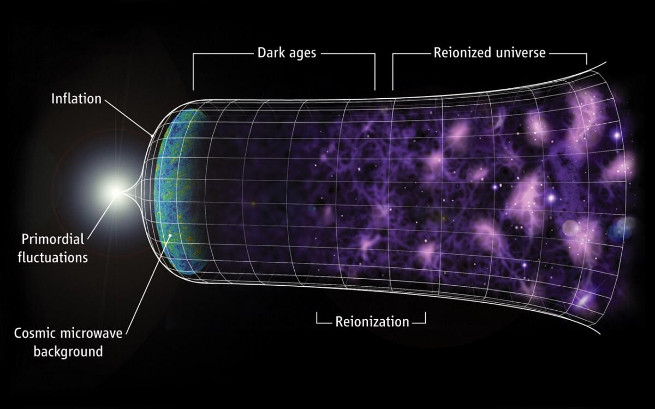
They came up with this cool trick, cram 1 trillion years of expansion into a single nanosecond. Inflation!

cosmicinflation.jpg


Why did this change happen?

To fix bugs in the big bang. It's a patch to fix the flaws. Nothing more.

Inflation means galaxies can be bigger and more mature faster than plain expansion.

But guess what, that's still not good enough.

There is a maximum theoretical size limit in the universe, which has has been busted by obseration:

https://en.wikipedia.org/wiki/List_of_largest_cosmic_structures

Hercules-Corona Borealis Great Wall (2014)[1] 9,700,000,000
Giant GRB Ring (2015)[5] 5,600,000,000[5]
Huge-LQG (2012-2013) 4,000,000,000[6][7][8]
U1.11 LQG (2011) 2,500,000,000
Clowes–Campusano LQG (1991) 2,000,000,000
Sloan Great Wall (2003) 1,380,000,000
South Pole Wall (2020) 1,370,000,000[9][10][11][12][13][14]
(Theoretical limit) 1,200,000,000

Further, this still goesn't give galaxies enough time to form:

http://www.sci-news.com/astronomy/most-distant-massive-rotating-disk-galaxy-08450.html
https://astronomy.com/news/2020/10/...found-in-the-web-of-a-supermassive-black-hole
https://skyandtelescope.org/astronomy-news/dead-ringer-milky-way-found-early-universe/
https://www.space.com/how-can-a-star-be-older-than-the-universe.html
https://medium.com/predict/hidden-a...ur-understanding-of-the-universe-4947007452b7
https://www.sciencedaily.com/releases/2016/08/160830131202.htm
https://www.sciencedaily.com/releases/2015/11/151118070758.htm
https://skyandtelescope.org/astronomy-news/dust-poor-early-galaxies-0624201523/#sthash.Vlkn6oBZ.dpuf
https://www.sciencedaily.com/releases/2015/09/150925085546.htm
https://www.caltech.edu/about/news/farthest-galaxy-detected-47761
https://www.sciencedaily.com/releases/2015/03/150302122925.htm
https://www.mq.edu.au/newsroom/2014/03/11/granny-galaxies-discovered-in-the-early-universe/

So we tried to fix the bug by given the universe super powers, and it still doesn't allow for what we actually observe.


Even in the standard model there are galaxies beyondn our Hubble volume which will never be observed.

https://en.wikipedia.org/wiki/Hubble_volume

And in the standard model the observable universe is fraction of the universe itself.

https://en.wikipedia.org/wiki/Observable_universe

The question is... do we see 90% of the universe? 50%?

Or less than 1%?


So, we lose dark energy, we lose inflation, we lose expansion, we lose age and size restrictions to the universe.

We lose our creation myth. That's a tough one.

So what do we gain?

A universe big enough and old enough to account for observations.

A universe filled with stuff we actually observe.

A universe that follows Coperniucan and cosmological principles.

Common sense.

And a new principle of physics, essentially a distance limit to inertia itself.
 
The frequency of light is a clock. The oscillation of the field is tied directly to oscillations in the source, and is a direct result of those oscillations. You cannot separate the two. If light is red shifted but not scattered, then the clocks are desynchronized.

Cool.

My theory has energy in it, which is directly linear to frequency, so cool.

In my theory, space doesn't expand, but time does.

The energy from a photon is discarded into space. Everything's conserved just fine.

Let's remember, that you said Sean Carroll is wrong about General Relativity and conserving energy, so it's not like I'm totally crazy and you're totally sane.
 
The energy from a photon is discarded into space. Everything's conserved just fine.

We aren't even talking about energy conservation here. The frequency is a clock. The timing has to match.

If I take a charged ball and shake it up and down, that will emit electromagnetic radiation. The frequency of the radiation must match the frequency of my shaking because that's what causes the radiation's frequency, and that forms a clock. Whatever happens to the energy of that radiation as it propagates outwards, the frequency is still tied directly to how fast I shook it up and down. You can't change that frequency without desynchronizing the clock of my shaking. Appealing to quantum mechanics won't get you out of this. It happens at the macroscopic, classical level too.

Let's remember, that you said Sean Carroll is wrong about General Relativity and conserving energy, so it's not like I'm totally crazy and you're totally sane.

I never said you were crazy, I said you were wrong.
 
The CMB is a real puzzle for anyone wanting some alternative cosmology. It’s actually quite hard for most people to understand why it’s so remarkable. The absolutely perfect blackbody shape of the CMB spectrum is something we can’t even produce artificially.

Background radiation arose when supermassive objects in the centers of galaxies were born. Each of them was born in its own 3 D "initial explosion." And they were born far apart.

Thus, there is no need for hokkus pokkus expanding space.


So, there was lot of 3 D "big bang" with out expanding space.

Expanding supermassive objects, expanding stars, expanding electrons, and expanding photons are created on the same principle without pulling forces


Entropy, of course, also on a small scale all the time.

Yes, there is no need for tensile forces because it is sufficient that the expanding condensations circulating zillions of expanding pushing force begin to expand much faster at the same time, explosively.

Immediately, a very high pressure is applied to the center / fulcrum of the system formed by the rapidly expanding densities.

See and wonder how easily that can be described with 3D animation.

https://youtu.be/QboDTgped1E

Then try to find a video that describes the expansion of expanding space using 3D animation.

You won’t find that because the expansion of expanding space cannot be described in words, nor visually.

Expanding supermassive objects emerged at about the same time completed far apart. Lot of 3 D "big bang" about same time. It was then that expanding light was released which is now perceived as background radiation.

Later, as the trajectories of these expanding supermassive objects met, expanding galaxies emerged from the inside out. That is, a lot of expanding stars from that dark expanding matter for us that protrudes from expanding supermassive objects.

And the principle is the same as in the way of expanding supermassive objects created without pulling forces.

That is, the expanding dark matter densities protruding from the expanding supermassive object met the expanding dark matter densities protruding from the other expanding supermassive object, their mutual interaction and the expansion of the zillions of separate expanding densities immediately intensified into an explosive one.

The expanding atomic nuclei continue to recycle, with all the other expanding atomic nuclei, the expanding pushing force in the form of zillions as separate expanding densities of dark energy which, by the same principle, give rise to new expanding electrons and new expanding photons.

🤔
 
So what do we gain?

A universe big enough and old enough to account for observations.

No, we do not. You are proposing radical changes to fundamental physical laws. You cannot specify what these changes actually are, and you cannot make any predictions for how they would affect things like galaxy formation times.

For example, what's your theory of gravity? We know Newtonian gravity is wrong. General Relativity is accurate to the extent that we can test it. Are you claiming it's wrong? If so, how does it need to be modified, or with what does it need to be replaced? You've got no idea. If you try to keep general relativity, then you cannot make the universe you're arguing for using GR. And if you don't have a replacement for it, you can't claim that you've gained anything.

Common sense.

Common sense doesn't have anything to do with this. We cannot directly experience anything on galactic, let alone cosmological scales. Why then would we have any intuition about such matters? Why would we have "common sense" about something that is not common to us at all?
 
Whatever happens to the energy of that radiation as it propagates outwards, the frequency is still tied directly to how fast I shook it up and down. You can't change that frequency without desynchronizing the clock of my shaking.

Ok.

And let's say that works great in our experiments.

But in the 1920's. we discovered the universe outside the Milky Way, and we discovered redshift.

Photons lose frequency at cosmological distances. That's an observed, undeniable fact.

We can salvage the constancy of the speed of light by inventing extra space for the photon to travel through, but 90 years later we can't figure out how much extra space to add.
 
Ok.

And let's say that works great in our experiments.

But in the 1920's. we discovered the universe outside the Milky Way, and we discovered redshift.

Photons lose frequency at cosmological distances. That's an observed, undeniable fact.

We can salvage the constancy of the speed of light by inventing extra space for the photon to travel through, but 90 years later we can't figure out how much extra space to add.

You still don't get it. It doesn't matter if the speed of light changes. Even if the speed of light is changing, the frequency can only change if the clocks desynchronize. That's true for any wave transmission. It's true for sound as well, and that's not a constant at all. There are multiple possible causes of desynchronization, but your cosmology is static, and so stationary clocks at different locations cannot desynchronize. Any cause of desynchronization requires a non-static situation, which is precisely what you're trying to avoid.
 
You are proposing radical changes to fundamental physical laws. You cannot specify what these changes actually are, and you cannot make any predictions for how they would affect things like galaxy formation times.

I can specify it, a photon's velocity is v = c - H * D, which you'll recognize as containing Hubble's Law.

This eliminates the need for an expanding universe, which eliminates time restrictions, which means galaxies that we observe 12 billion light years away didn't need to form within 1.8 billion years.


For example, what's your theory of gravity?

Given that this is about the photon, it would be a quantum theory of gravity with a graviton.


Common sense doesn't have anything to do with this. We cannot directly experience anything on galactic, let alone cosmological scales.

We can directly observe redshift.

I'm proposing we treat it as a feature of nature, and ditch dark energy.

That's common sense.
 
You still don't get it. It doesn't matter if the speed of light changes. Even if the speed of light is changing, the frequency can only change if the clocks desynchronize. That's true for any wave transmission. It's true for sound as well, and that's not a constant at all. There are multiple possible causes of desynchronization, but your cosmology is static, and so stationary clocks at different locations cannot desynchronize. Any cause of desynchronization requires a non-static situation, which is precisely what you're trying to avoid.

You're saying the expansion of space reduces frequency.

I'm saying it's time that expands, since frequency is inverse time, that accounts for the clock desync you're talking about.

If time increases but distance stays the same, that's deceleration of the traveler.
 
I can specify it, a photon's velocity is v = c - H * D, which you'll recognize as containing Hubble's Law.

No. You've specified one thing. What about everything else?

This eliminates the need for an expanding universe

General relativity doesn't really support steady state cosmologies. What's your theory for changing or replacing general relativity? You haven't specified. But you need a theory of gravity if you're trying to do cosmology.

Given that this is about the photon, it would be a quantum theory of gravity with a graviton.

Which you haven't specified the details of. For example, quantum electrodynamics turns into classical electrodynamics in the classical limit. Does your graviton theory turn into General Relativity in the classical limit? If so, then the cosmology should look like what general relativity predicts (which is the big bang), because the universe as a whole is going to be approaching the classical limit. And if not, then we're back to the question of what the hell you do have. And you have no answer to that.

We can directly observe redshift.

Yes, we can. So what? That's not the issue.

I'm proposing we treat it as a feature of nature

It doesn't matter if it's a "feature of nature". Whatever it is, it's still synonymous with clock desynchronization. And that means that the situation cannot be static. That's a logical requirement even if it's a "feature of nature", whatever that even means.

and ditch dark energy.

That's common sense.

Again, "common sense" isn't a useful guide to something as uncommon as cosmology.
 
You're saying the expansion of space reduces frequency.

Yes, it obviously would.

I'm saying it's time that expands

How does time expand? I don't mean what causes it to, because ultimately on some level things just are, but what's the mathematical description of this?

The expansion of space is a direct prediction of general relativity's Einstein field equation. This equation has been experimentally tested in many ways and found accurate. What do you have? If you're expanding time and not space, then you're making a prediction in conflict with general relativity. So you need to replace Einstein's field equation. What will you replace it with? And can your replacement match all the experimental results which Einstein's field equation matches?

You have no replacement, and you cannot correctly account for any of those multiple experimental verifications of general relativity. You want to replace GR because of difficulties in matching it to the most difficult problems, but you can't even replicate its successes in the easiest of problems. And you don't even recognize that this is a problem.
 
No. You've specified one thing. What about everything else?

Nothing changes where H * D is approximately 0/

General relativity doesn't really support steady state cosmologies.

FWIW, despite what the name might imply, space expands in steady state cosmology.

What's your theory for changing or replacing general relativity? You haven't specified.

GR needs to be superceded by a theory of quantum gravity anyways.

That's what work on string theory is about. But my theory creates redshifts without the force of gravity, so that's really a whole separate issue.

Does your graviton theory turn into General Relativity in the classical limit?

Gravitons aren't my theory.


Yes, we can. So what? That's not the issue.

The fact that we observe redshifts, which leads to stuff like dark energy is 100%


Again, "common sense" isn't a useful guide to something as uncommon as cosmology.

Well, cosmology could be right, and the universe could be 96% dark matter and dark energy.

I have my doubts.
 
I don't mean what causes it to, because ultimately on some level things just are, but what's the mathematical description of this?

v = c - H * D

The time of the journey increases as the velocity of the photon decreases.


If you're expanding time and not space, then you're making a prediction in conflict with general relativity.

Correct.

GR predicts too slow of redshift in the nearby universe, which causes us to think it's accelerating.

My equation plots a slightly different curve, which is consistent with the so-called Hubble tension.

graph_h74.png


So you need to replace Einstein's field equation. What will you replace it with? And can your replacement match all the experimental results which Einstein's field equation matches?

Or maybe GR should explain the observed Hubble tension.


[/QUOTE]
You have no replacement, and you cannot correctly account for any of those multiple experimental verifications of general relativity. You want to replace GR because of difficulties in matching it to the most difficult problems, but you can't even replicate its successes in the easiest of problems. And you don't even recognize that this is a problem.[/QUOTE]

That's the problem of quantum gravity.

Meanwhile, there are immediate problems in cosmology.
 
Common sense says the earth is flat and the sun goes round the earth.

Common sense has proved to be a very poor guide to the underlying nature of the universe. Most of modern physics is counterintuitive.

Well, when the theory of gravitation came about, common sense would choose that over Ptolemy's epicycles.

I'm not saying let's take the most naive view possible.

One that actually fits what we observe would be nice though.
 
v = c - H * D

The time of the journey increases as the velocity of the photon decreases.

That's a description of velocity changing, not time changing.

That's the problem of quantum gravity.

Meanwhile, there are immediate problems in cosmology.

Quantum gravity theories under consideration by most physicists reduce to general relativity in the classical limit, and so produce the same cosmologies as general relativity.

If you want something to replace general relativity, you can't just wave your hands and say "quantum gravity". That doesn't suffice. For example, how does quantum gravity produce your v = c - H*D?
 
Well, when the theory of gravitation came about, common sense would choose that over Ptolemy's epicycles.

I'm not saying let's take the most naive view possible.

One that actually fits what we observe would be nice though.

But your theory doesn't fit what we observe. It doesn't account for the precession of Mercury's perihelion. It doesn't account for gravitational time dilation. It doesn't account for measurements of frame dragging. It doesn't account for gravitational lensing. It doesn't account for gravitational wave measurements. There are so many observations that general relativity accounts for that you can't account for. And yet you want us to throw it overboard, with no actual replacement.

There is no common sense in that.
 
That's a description of velocity changing, not time changing.

Sure.

Imagine a runner doing the 50 meter dash.

They get time X.

Now imagine the finish line moving away from them. If they run at the same speed, they will get a time > X. That's expanding space.

Now imagine the finish line isn't moving, but the race track clock runs faster.

They will get time > X too.

The difference, mathematically, is that the rate of time increases more at the beginning and less at the end when only time increases. That's Hubble tension solved.


If you want something to replace general relativity, you can't just wave your hands and say "quantum gravity". That doesn't suffice. For example, how does quantum gravity produce your v = c - H*D?

Quantum gravity doesn't produce that formula.

That formula is proposed to be a new law of physics.

It clearly violates relativity.

An even bigger problem is that is violates inertia, a body in motion should remain in motion.

If that doesn't hold true for infinity, then that's a bigger problem than how this squares with relativity.

That just means physics needs innovation. Which we should assume is always true anyways.
 
But your theory doesn't fit what we observe. It doesn't account for the precession of Mercury's perihelion. It doesn't account for gravitational time dilation. It doesn't account for measurements of frame dragging. It doesn't account for gravitational lensing. It doesn't account for gravitational wave measurements. There are so many observations that general relativity accounts for that you can't account for. And yet you want us to throw it overboard, with no actual replacement.

There is no common sense in that.

My theory doesn't say anything about gravity.

v = c - H * D

There's no mass, no gravitation.

Hubble's Law as photon velocity fits cosmological observations independent of a theory of gravity.

Quantum gravity is a separate problem.
 
Status
Not open for further replies.

Back
Top Bottom