I don't think space is expanding.

Status
Not open for further replies.
So, you're right that I can't explain the CMB in any scientific way.

I still think that if there's energy that doesn't have a traditional source (such as photon's redshifting and depositing energy) then its source would have a "no body" spectrum, whatever that would be.

I also think the CMB anomalies and the fact that its temperature was most accurately predicted by a model that doesn't have a big bang show that the CMB is not the rock solid arbiter of truth that you do.

But, yes, my CMB explanation is not good.

That said, the standard model is in crisis mode, measurements don't agree, and the dark energy and dark matter situation gets more and more convoluted by the year.

I think the important aspect of my model is that it shows more redshift in the nearby unverse than the expanding model, which is perceived as acceleration in the expanding models.

And again, you haven't solved other fundamental problems with your theory, such as the fact that it would cause blurring. Thus it is already contradicted by observation.

Why blurring?

If increasing distance (expansion) doesn't blur the images, then increasing time (decelerating photons) shouldn't either.
 
Last edited:
As far as we know.

Exactly. You're replacing everything we actually know about photons with baseless speculation. Baseless speculation that in some places actually contradicts what we already know about photons.

As far as we know, photons don't work the way you think they need to work for your theory. Not only that, but if they did work that way, we wouldn't observe many things that we have in fact observed. Not only that, but even if they did work that way, your theory would still not work, because it also contradicts many other things that we have observed.

Basically your theory requires replacing everything we actually see happening around us with a bunch of stuff that you made up and that we don't see happening at all.
 
Why blurring?

If increasing distance (expansion) doesn't blur the images, then increasing time (decelerating photons) shouldn't either.
The photon scattering you proposed would create blurring. We don't see blurring, so we know that your scattering proposal is wrong and should be discarded. If your theory depends on photon scattering, then the entire theory is wrong and should be discarded.

This is separate from your proposal that photons decelerate, which has its own problems, and is also fatal to any theory that depends on it.

"What if Tired Light?"

"Won't work because of X."

"What if instead of X, Y?"

"Y doesn't work either, and also doesn't make Tired Light work."

"What about Z?"

"Z also doesn't work, doesn't fix Y, and doesn't make Tired Light work."

"... As far as we know."
 
Exactly. You're replacing everything we actually know about photons with baseless speculation. Baseless speculation that in some places actually contradicts what we already know about photons.

As far as we know, photons don't work the way you think they need to work for your theory. Not only that, but if they did work that way, we wouldn't observe many things that we have in fact observed. Not only that, but even if they did work that way, your theory would still not work, because it also contradicts many other things that we have observed.

Basically your theory requires replacing everything we actually see happening around us with a bunch of stuff that you made up and that we don't see happening at all.

Can you give some examples?

We observe redshift. That's a fact. Intergalactic photons arrive with reduced energy.

We didn't expect that, so we put expanding space in front of its way, and then Pearl Harbor happened, and Edwin Hubble got assigned to work in a wind tunnel, and later on, we picked up the expanding idea after the war, not realizing it wasn't really the best idea.

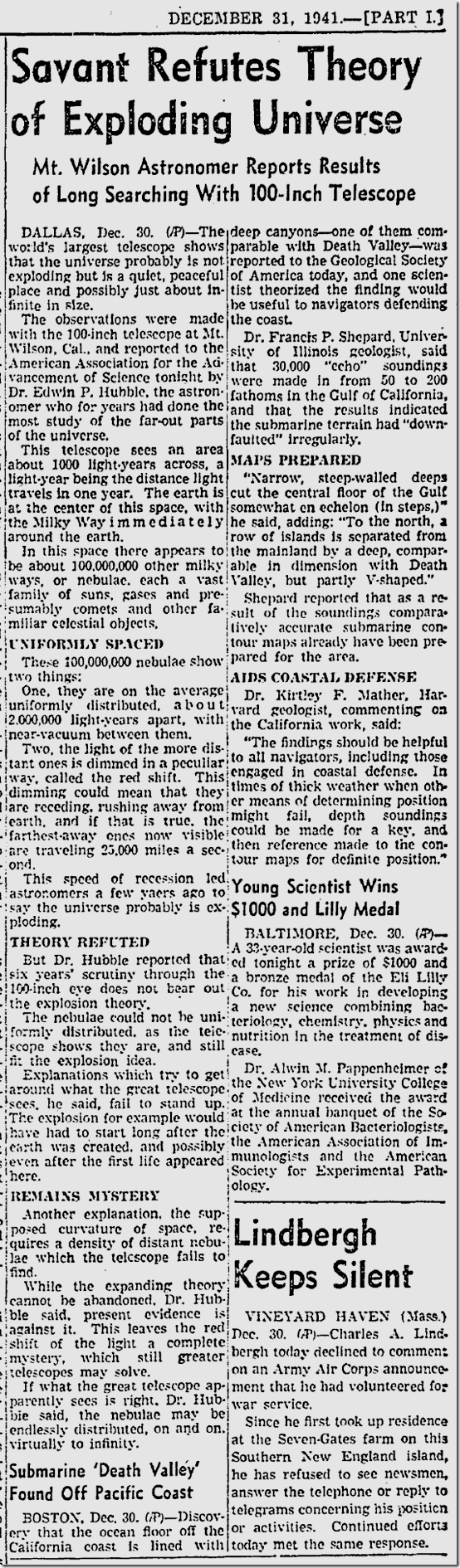
It was announced in a newspaper article in December 1941 that Hubble refuted the expansion of the universe.

paper1941.png


If space is expanding at v = HD, and at some point HD = c, then that means at that point in space, there will be photons trapped for eternity in space expanding faster than the speed of light.

Light that's infinite in a finite universe, is like putting a nuclear reacting in a datsun.
 
Then it would be demonstrated by supporting their claims.

By the way they support their claims. Debunkers are often jerks in the way they support their claims. Treating a crackpot as a "chew toy" to be poked for your amusement is a jerk thing to do, even if your debunking itself is a valuable service to the community.
 
The photon scattering you proposed would create blurring.

I'm not proposing a scattering.

That's Zwicky's Tired Light model.

In my model the photon redshifts because that's what photons do.

Just like matter curving space, photons redshift at H*D.

This is separate from your proposal that photons decelerate, which has its own problems, and is also fatal to any theory that depends on it.

But my theory doesn't depend on the photon interacting with anything.

It's different from Zwicky's Tired Light theory and other tired light theories that way.

I can show that mathematically.

In Zwicky's Tired Light theory photons travel at c. This produces the blue line on the graph, while my theory produces the green lines. Expanding models on the gray lines.

graph_white_hypothesis1.png
 
By the way they support their claims. Debunkers are often jerks in the way they support their claims. Treating a crackpot as a "chew toy" to be poked for your amusement is a jerk thing to do, even if your debunking itself is a valuable service to the community.

Chew toy is pretty apt, because I think some of see themselves as guard dogs for the flock.

Like, they revere the actual physicists, the shepards, so they go online and do some gatekeeping to gain favor of their idols, keeping the flock in check and flexing their knowledge.

If being a crackpot is my hobby, than I suppose it takes the opposite type to balance out nature.
 
I also think the CMB anomalies and the fact that its temperature was most accurately predicted by a model that doesn't have a big bang show that the CMB is not the rock solid arbiter of truth that you do.

You fundamentally misunderstand both Eddington's prediction and the early big bang prediction. Eddington didn't predict a CMB, because he didn't even know it existed. The temperature he predicted was a temperature that he though an object in space would equilibrate to by being heated by starlight. Starlight doesn't have a CMB spectrum. Not only is it not blackbody, the temperature profile of starlight is in the thousands of degrees, not single digits. And the amount of starlight he was using for that calculation is what we get here on earth (excluding the sun), which is inside a galaxy. In intergalactic space, which is most of the universe, the amount of starlight is significantly less, and the temperature one would calculate using Eddington's method would be much lower.

So no, Eddington didn't accurately predict the CMB temperature, at all.

As for what the Big Bang theory says about the temperature, again, that's something which changes as the universe ages. Unlike the blackbody spectrum profile, the temperature is not a fundamental aspect of the theory. It's measurement-dependent, and the fact that early measurements about the age and expansion rate of the universe weren't terribly accurate is no indictment of the theory, but merely a result of measurement limitations.

But, yes, my CMB explanation is not good.

I'm glad you can recognize that.

Why blurring?

Because scattering is the only mechanism which can make light lose energy the way you want it to, and scattering will cause blurring.

If increasing distance (expansion) doesn't blur the images, then increasing time (decelerating photons) shouldn't either.

No. Expansion will desync clocks. Your model won't. So your model cannot change frequency without scattering. Expansion can change frequencies, because (as mentioned) clocks desync.
 
Because scattering is the only mechanism which can make light lose energy the way you want it to, and scattering will cause blurring.


That's a different theory.

What you're saying is redshifts need be caused by something.

Expansion could be that cause. Tired light tries to find another cause.

Edwin Hubble suggested there is no cause, photons redshifting is a fundamental law of nature.

"If red-shifts are the familiar velocity-shifts, systematic variations do exist in the observable region, and they suggest an expanding universe that is finite, small, and young. On the other hand, if red-shifts are evidence of some unknown principle of nature, which does not involve actual motion, then variations are not appreciable in our sample, and the observable region is an insignificant fraction of the universe as a whole. Thus, in a certain sense, we again face a choice between a small finite universe and a universe indefinitely large plus a new principle of nature."
-- Edwin Hubble

I understand what you're trying to say.

Redshifts can only happen by some known principle, and those lead to blurring.

Do you understand what Hubble is saying? That this isn't an effect of a known cause?

Either redshifts are fundamental, or something like dark energy in fundamental.

Redshifts are actually observed.
 
I understand what you're trying to say.

Redshifts can only happen by some known principle, and those lead to blurring.

No, you do not understand what I'm saying. I'm saying that any possible mechanism which produces redshift must either scatter photons or desync clocks. It doesn't matter whether or not I know what's scattering or desyncing, it is impossible to redshift without at least one of those.

Your theory has neither. It is, therefore, impossible.
 
No, you do not understand what I'm saying. I'm saying that any possible mechanism which produces redshift must either scatter photons or desync clocks. It doesn't matter whether or not I know what's scattering or desyncing, it is impossible to redshift without at least one of those.

Your theory has neither. It is, therefore, impossible.

That's based on known principles of physics.

Hubble is saying redshift is an unknown principle physics.

If he is wrong, and its really just expansion, that leads to dark energy, which isn't observed.

If you think about what is observed, one should be sketpical of dark energy, and open to redshifts being a real thing.
 
That's based on known principles of physics.

No, it’s based on logic.

Hubble is saying redshift is an unknown principle physics.

Hubble was not a general relativity expert.

If you think about what is observed, one should be sketpical of dark energy, and open to redshifts being a real thing.

I don’t know what you mean by “real thing”, since the Big Bang theory treats it as quite real.
 
I don’t know what you mean by “real thing”, since the Big Bang theory treats it as quite real.

The big bang treats it as an effect of the expanding universe, accelerated by dark energy.

If we're suspending skepticism for all that exotic stuff causing redshift, why not suspend skepticism for redshifts being their own cause.
 
I’ll expand a bit on the whole logic thing. Have you ever heard of Noether’s theorem? No, I’m sure you haven’t. Noether’s theorem states that if your laws of physics have certain kinds of symmetry, then each of those symmetries has an associated conserved quantity. So for example, translation symmetry (the laws of physics are the same regardless of where you are) leads to conservation of momentum. This is a logical requirement. It doesn’t tell you what the laws of physics are, but it does constrain what they can be.
 
The big bang treats it as an effect of the expanding universe, accelerated by dark energy.

If we're suspending skepticism for all that exotic stuff causing redshift, why not suspend skepticism for redshifts being their own cause.

Because again, red shift requires either scattering or clock desynchronization. This is a logical requirement. Scattering is logically possible but is disproven by observation (no blurring). So any possible cause consistent with observation must allow for clock desynchronization. The Big Bang is in principle not the only way to do that, but your theory doesn’t. So it is wrong.
 
This is a logical requirement.

What are the premises of that logic?


One way to look at it is when space expands, the distance and duration of a photon's trip to a galaxy increases.

I'm saying just time expands. Same distance, more time.

That amounts to the photon slowing down.

But time expanding sounds like clock desyncing.
 
What are the premises of that logic?

The frequency of light is a clock. The oscillation of the field is tied directly to oscillations in the source, and is a direct result of those oscillations. You cannot separate the two. If light is red shifted but not scattered, then the clocks are desynchronized.
 
If space isn't expanding, there would be no evidence of a size limit, and it should be considered indefinitely large.
What is the advantage of proposing the existence of space that is beyond our ability to detect? Given that we will never be able to confirm or refute that suggestion, what do we gain by considering it?
 
Status
Not open for further replies.

Back
Top Bottom