Utopia and Time Travel

If A causes B, then A comes first. This is true as well for any ordered network of causation, even if one doesn't directly cause the other.

The interval is the number of events between them in a linear chain of causality. This is just a number, not a measured duration, although it might have some limit if events are discrete and finite.

I did say it wasn't depicting spacetime and just giving the idea of the problem of ordering events without a frame of reference but ok, due to the limit of the speed of light, an observer can only be within a particular range on the edge of the circle. Events that are within each others light cones will always be seen to be in order from anywhere within that range but events that are not within each others light cones may be seen to be ordered differently from different frames of reference within that range.

Edit: that doesnt work. Still though, with the first example, how would you put (or imagine) the events in absolute order without any reference frame?
 
Last edited:
In the context of a 'snap shot' (capturing an instant), we don't care about motion.

in the context of sequence of events (a movie), we care about motion.

What I'm suggesting (perhaps badly) is that motion (and this includes "sequence") is a constructed thing, not something that's an independent, fundamental part of the universe.

The only reason I'm interested in first principles here is because we wanted to get at "how things really are." I was trying to see what emerged from the basics without skipping ahead too much.
 
Distances and time are real, but both depend on the reference frame.

What doesn't are spacetime seperations. If you want, you can think about those as "distances" in spacetime. …snip…

Note that this also means that if you could travel faster than light, you could die before you are born. In other words, faster than light travel would allow causality to be violated. That's one of a couple of reasons why faster than light travel is considered impossible.

Just to thank you for this post which must have taken you some time. I have read it slowly thrice and I see a certain glimmering of something.

I don't quite know what "h" is, but I get from your post that:
1. A line (h) can appear in space and spread across time.
2. Depending on where one stands, the appearance of h can be very different to others observing h.

On the dead before birth thing; I'm not sure how raw physical reality knows what caused what and what should follow. I realize "causality" is a science word that I am not privy to.

I'll keep trying, however do not be dismayed when I fail.
 
Just to thank you for this post which must have taken you some time. I have read it slowly thrice and I see a certain glimmering of something.

I don't quite know what "h" is, but I get from your post that:
1. A line (h) can appear in space and spread across time.
2. Depending on where one stands, the appearance of h can be very different to others observing h.

On the dead before birth thing; I'm not sure how raw physical reality knows what caused what and what should follow. I realize "causality" is a science word that I am not privy to.

I'll keep trying, however do not be dismayed when I fail.

If i may interject ...

The "h" term refers to the hypotenuse of a right triangle.
 
If one is a the other one has to be b, change a to b, the other one has to be a.
In theory you could send a probe to another planet, all day across the universe,
And transport something there though entanglement.

Entanglement is the key to Hawking Radiation.

You can't transfer anything through entanglement. The only thing that transfers is quantum state and even then, if you didn't know the quantum state of the other particle you wouldn't even be able to tell that the two particles were entangled in the first place. The point is that the process "transmission" of quantum state assumed by the Copenhagen interpretation necessarily breaks the idea of cause and effect. Which particle is causing the quantum wavefunction of the other particle to collapse is dependent on your inertial frame of reference.
 
If i may interject ...

The "h" term refers to the hypotenuse of a right triangle.

Thanks, heh. I did get that much. I refer rather to confusion re what it represents — "spacetime separations".

Anyway. Trying to teach me physics on a forum is rather more ambitious than teaching a goldfish to hang-glide!
 
The easiest way for me to get the space-time continuum is as follows: everything constantly moves at the speed of light through space and time. But our speed is split along the four dimensions, like a ball that is thrown both up and forward. So whatever speed we use up to travel through space we have to take out of our movement through time. So a stationary observer moves with maximum speed through time, whereas a photon uses up all its speed in space and therefore doesn't move forward in time.
 
It's actually much more fundamental than that.

If we had one ball and nothing else, could we agree that its state of motion is meaningless? That's the nut of it. Not that the ball isn't moving or is moving depending on how we look at it, but that motion itself in this case has no meaning at all.

What I'm suggesting (perhaps badly) is that motion (and this includes "sequence") is a constructed thing, not something that's an independent, fundamental part of the universe.

The only reason I'm interested in first principles here is because we wanted to get at "how things really are." I was trying to see what emerged from the basics without skipping ahead too much.

I don't think I was arguing for how things really are
only that reality is how things are.

I don't think I'm even close to grasping where you are going with this. Tell me more.
Motion is not fundamental?
Motion is a constructed thing?

Motion seems as fundamental as matter.
 
I don't quite know what "h" is, but I get from your post that:
1. A line (h) can appear in space and spread across time.
2. Depending on where one stands, the appearance of h can be very different to others observing h.

Yes exactly, and the "perspective" (how the black line is rotated) depends on relative motion.

On the dead before birth thing; I'm not sure how raw physical reality knows what caused what and what should follow. I realize "causality" is a science word that I am not privy to.

As far as I know, causality in the macroscopic world (human scale or larger) is very intuitive and always works the same we experience it. There is no reference frame in which a mug first shatters on the ground and then falls of the table.

Now, if I drop my mug and ten minutes later a landslide occurs on Proxima Centauri b, there can definitely be reference frames in which the landslide occurs first and then I drop my mug. That's no problem because there is no causal relationship between the two events. Not only does common sense (rightly in this case) tell us that one has nothing to do with the other, but there can be no connection in principle, since any information exchange (limited by the speed of light) between Earth and the distance planet takes more than four years. Any events that can be swapped in different reference frames are always going to be "too far apart" for one, even in principle, to influence the other. Thus, causality is safeguarded.

On thing that may help here is to consider that the "speed of light" is actually the "speed of information" in our universe. Whenever, for example, special relativity refers to the speed of light, it really talks about the speed of information. Light just happens to travel at that speed. This also explains why so many fundamental properties of the universe are seemingly arbitrarily restricted by the speed of light. The speed of light isn't the restriction, its something more fundamental that is. Light just happens to be a phenomenon traveling at that speed which we can easily observe.
 
That last bit is worth about 5 pages of posts (so far). I think I may have an idea on where we are disconnecting. We are using "sequence" differently.

No, I used a spacial sequence as a analogy to a sequence in time to show how the same issues of coordinate system for ordering events in space can arise when trying to order events in time. It really is the same problem, and yes I am talking about sequences of events in time.
 
No, I used a spacial sequence as a analogy to a sequence in time to show how the same issues of coordinate system for ordering events in space can arise when trying to order events in time. It really is the same problem, and yes I am talking about sequences of events in time.

The picture I got of the objection doesn't fail that test, even just using space. If I have it correctly, he's trying to use "sequence" as a kind of internal mapping, resistant to alteration in order by changing perspective.

So, for space only we might have a linked chain (a physical chain) where the order of the links does not change (although the whole list might be reversed) if we change orientation. Each link defines the position of the next. The sequence is preserved.

Where it breaks for me is when you then try to extend the analogy to "weave" all of space - or, in the broader version, all of space and time. This is because, to count as an event (or to count a "connected" in our space-only version), stuff has to be co-located, that is, share the same coordinates in spacetime.

As our network gets bigger, we can find locations where one type of sequence is preserved - our light cone - but following the path back and then forward again to another spot (outside our light cone) destroys the relationship.

I think we could explain it better with a picture. I can do a ham-handed version by comparing the number line with the plane. A number line preserves the "comes next" ordering and can be oriented/mapped in the required way. However, the plane cannot. If I am at point (4,5) there is no "comes next" to be had, only one I create by establishing an abitrary line through that point.
 
Last edited:
I'm not sure I understand your objection: take a chain and label it's links 1-10. Now toss it on the floor and look at it from the perspective of some fixed point (say a door), you may find that link 4 is closest to the door, then 5, then 6 then 3, then 10, etc: not necessarily ordered from 1-10. If I look at the links in order of their distance from a chair somewhere else in the room I'll get a different sequence.

As I have said, if you are looking at your chain as an analogy to a causal chain in spacetime, then, yes, there is no ambiguity to the sequence of events: if 1 can send a signal to 2 and 2 can send a signal to three, etc. up the chain then the sequence of events will be 1-10 in all reference frames. I know you know that and I don't think you think I'm saying anything that contradicts that so I honestly think I'm probably missing something in what you are saying.
 
I'm not sure I understand your objection: take a chain and label it's links 1-10. Now toss it on the floor and look at it from the perspective of some fixed point (say a door), you may find that link 4 is closest to the door, then 5, then 6 then 3, then 10, etc: not necessarily ordered from 1-10. If I look at the links in order of their distance from a chair somewhere else in the room I'll get a different sequence.

As I have said, if you are looking at your chain as an analogy to a causal chain in spacetime, then, yes, there is no ambiguity to the sequence of events: if 1 can send a signal to 2 and 2 can send a signal to three, etc. up the chain then the sequence of events will be 1-10 in all reference frames. I know you know that and I don't think you think I'm saying anything that contradicts that so I honestly think I'm probably missing something in what you are saying.

Your second description sounds like the right one. The thing that's preserved and is then leveraged into an absolute metric is the relationship between events that are causally linked. But there's an elide on "causally" that I'm suggesting has problems.

Here's the part I want to reject: the big bang causes everything that happens afterward. All subsequent events are linked to it. Therefore, events that happen now, at any distance from each other, can be connected in a causal chain - a way to uniquely map spacetime by way of ordering in a "comes-next" fashion. ("Comes-next" is the time version, "is next-to" would be the space version.)

I want to argue that this picture is wrong.

(To keep the discussion in scope, we've left out radioactivity as a kind of uncaused, outside our network, and stuck to "regular" stuff.)

It may be that the relationships do hold, but only for spacetime entire, and break down in the cases where we look at time ordering or space ordering as distinct. I haven't thought that bit through.
 
Here's the part I want to reject: the big bang causes everything that happens afterward. All subsequent events are linked to it. Therefore, events that happen now, at any distance from each other, can be connected in a causal chain - a way to uniquely map spacetime by way of ordering in a "comes-next" fashion. ("Comes-next" is the time version, "is next-to" would be the space version.)

I want to argue that this picture is wrong.

Doesn't the state of the CMB demonstrate that the early universe reached a state of approximate thermal equilibrium, in which case all regions did interact? So there is a sort of unique causal chain in that sense.

But that chain will look different under different lorentz transformations, at least, for instance, in regards to how much time has passed from the big bang. It's structure will remain the same, though.*

*ETA: It's local structure, I guess. I'll have to think about this more, but if A causes B and Z and B causes C while Z causes Y, there's no necessity that Y happens before C. We'd have to look at the actual spacetime geometry to see if it's necessary and, again different observers may disagree about which comes first even though all agree about those causal relationships.
 
Last edited:
Doesn't the state of the CMB demonstrate that the early universe reached a state of approximate thermal equilibrium, in which case all regions did interact? So there is a sort of unique causal chain in that sense.

But that chain will look different under different lorentz transformations, at least, for instance, in regards to how much time has passed from the big bang. It's structure will remain the same, though.*

*ETA: It's local structure, I guess. I'll have to think about this more, but if A causes B and Z and B causes C while Z causes Y, there's no necessity that Y happens before C. We'd have to look at the actual spacetime geometry to see if it's necessary and, again different observers may disagree about which comes first even though all agree about those causal relationships.

I like your ETA. I think that's where he was going - some way to link a causal chain to simultaneity. It might work if events were both ordered and came in discrete time-like packages. That is, if there were some "least time" unit we could stack up in an ordered series. But if duration itself is going to differ, then that falls apart, even when the number of events is shared between two distant locations.
 
It seems to me that the discussion about the chain, both figurative and literal, is tangled up in various descriptions of observational frames. I don't dispute that all of these different frames and the constructs that try to convey spacetime information about the chains. It's apparent that some of these perspectives directly contradict others, which makes sense.

Let me ask questions, if I may...

We know that there is a 10 link chain, this is given for the exercise so it is absolutely certain there is a 10 link chain. Also given, each link is numbered, 1 - 10. Now, the three of us and 1077 of our closest friends surround the chain with 3 sets of 360 people, each on an x, y, or z access in perfect 1 degree separation each forming a circle around the chain. For the moment, let's also say each are taking an image from their position that captures any/all types of data necessary to perceive the chain. Each push their button to capture the data.

Now, we 1080 friends compile our data/images and create a construct of the chain in that instant.

Is the resulting construct a close approximation of the reality of the chain in that instant?

Is it possible to compile this construct of the chain?

Did any of the 1080 view the same real chain, or something else?

Do any of these perspectives change the chain?

We 1080 repeat this exercise 10 seconds later. Is there any relationship between this new construct and the original?

This all makes me think of the blind men and the elephant.
 
Let me ask questions, if I may...

We know that there is a 10 link chain, this is given for the exercise so it is absolutely certain there is a 10 link chain. Also given, each link is numbered, 1 - 10. Now, the three of us and 1077 of our closest friends surround the chain with 3 sets of 360 people, each on an x, y, or z access in perfect 1 degree separation each forming a circle around the chain. For the moment, let's also say each are taking an image from their position that captures any/all types of data necessary to perceive the chain. Each push their button to capture the data.

Now, we 1080 friends compile our data/images and create a construct of the chain in that instant.

Is the resulting construct a close approximation of the reality of the chain in that instant?

It's going to break down here because instant wouldn't be well defined. Unless you want to make it so by fiat.

Is it possible to compile this construct of the chain?

Sure, so long as we bear in mind the above.

Did any of the 1080 view the same real chain, or something else?

Same real chain.

Do any of these perspectives change the chain?

No.

We 1080 repeat this exercise 10 seconds later. Is there any relationship between this new construct and the original?

Each person may measure the "10 seconds later" differently. Otherwise, no.


Pretty much. The elephant doesn't change, the measurements made on it do. But even those can be recast to the "correct" measurements providing we know the state of motion of everything relative to everything else.

Here is a funny version...
 
I think we could explain it better with a picture. I can do a ham-handed version by comparing the number line with the plane. A number line preserves the "comes next" ordering and can be oriented/mapped in the required way. However, the plane cannot. If I am at point (4,5) there is no "comes next" to be had, only one I create by establishing an abitrary line through that point.

http://www.trell.org/div/minkowski.html
 
We know that there is a 10 link chain, this is given for the exercise so it is absolutely certain there is a 10 link chain. Also given, each link is numbered, 1 - 10. Now, the three of us and 1077 of our closest friends surround the chain with 3 sets of 360 people, each on an x, y, or z access in perfect 1 degree separation each forming a circle around the chain. For the moment, let's also say each are taking an image from their position that captures any/all types of data necessary to perceive the chain. Each push their button to capture the data.

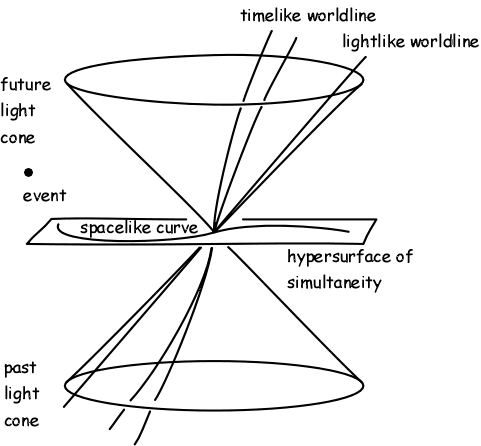
In your example, everyone is in the same inertial reference frame. Here's the other key thing to remember about relativity, and especially space/time. While the speed of light is a finite limit, you can (theoretically) accelerate forever. So when we see a light cone:

terminology.gif


(Taken from http://www.pitt.edu/~jdnorton/teaching/HPS_0410/chapters/spacetime/ which explains these concepts very well)

Remember that while straight up means zero velocity, and 45 degrees means light speed, every inertial reference frame's light cone will look identical, with the speed of light always being 45 degrees away. No matter how much you accelerate, things look the same, there is no preferred velocity:

FareyPoincareMovie.gif


This is an example of a poincare. An infinite plane represented in a single disk, with distance getting infinitely smaller as you reach the edge. You can imagine that the center is zero velocity and the edge is lightspeed. Picking a reference frame in reality to choose a "now" is like choosing a point on this disk. There are infinite points to choose from and the disk looks the same no matter what point you choose.

I like this image much better, but it's too large for the thread http://www-bcf.usc.edu/~fbonahon/Images/FareyPoincareMovie.gif
 
Last edited:

Back
Top Bottom