doronshadmi
Penultimate Amazing

- Joined
- Mar 15, 2008
- Messages
- 13,320
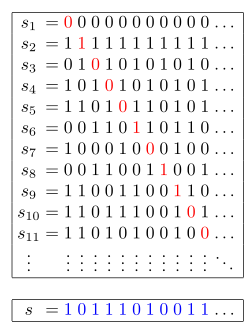
In order to understand better the considered challenge, let's obsereve the following example:
The problem with this example is as follows:
1) The order of [{a,g}, {b,g}, {c,g}, ...] or [{a,c}, {b,c}, {c}, ...] or [{a} , {b}, {c,d}, ...] is significant, or in other words, they can't be considered as pure sets, since one of the fundamental properties of pure sets is that order is insignificant.
2) In this case diagonalization can't be used in order to prove some statement under pure set theory like ZF(C).
3) So Cantor's theorem (which is: The cardinality of any set is less than the cardinality of its power set) can't be proved under ZF(C) for infinite sets, by using diagonalization.
jsfisher, since you wrote in http://www.internationalskeptics.com/forums/showpost.php?p=10949064&postcount=768
Code:
          *--------- |S| ---------*
          |                       |
 *-- a -- [{a,g},{a,c} ,{a}  , ...] The vertical elements of the matrix,
 |                                  are the members of |S| proper subsets of P(S)
     b -- [{b,g},{b,c} ,{b}  , ...] that provide {} as the member of P(S),
|S|                                 which is not in the range of any of
     c -- [{c,g},{c}   ,{c,d}, ...] these proper subsets.
 |
 *-- ...
The problem with this example is as follows:
1) The order of [{a,g}, {b,g}, {c,g}, ...] or [{a,c}, {b,c}, {c}, ...] or [{a} , {b}, {c,d}, ...] is significant, or in other words, they can't be considered as pure sets, since one of the fundamental properties of pure sets is that order is insignificant.
2) In this case diagonalization can't be used in order to prove some statement under pure set theory like ZF(C).
3) So Cantor's theorem (which is: The cardinality of any set is less than the cardinality of its power set) can't be proved under ZF(C) for infinite sets, by using diagonalization.
jsfisher, since you wrote in http://www.internationalskeptics.com/forums/showpost.php?p=10949064&postcount=768
then please demonstrate how a diagonal set is defined under a pure set theory like ZF(C)?jsfisher said:The only set defined in the proof is a diagonal set; it's sole use is to disprove the existence of a bijection.
Last edited: