• Security incident: ISF was recently accessed by intruders. Please change your password, and change it anywhere else you used it. Read more

Cont: Deeper than primes - Continuation 2

Status
Not open for further replies.
In order to understand better the considered challenge, let's obsereve the following example:
Code:
          *--------- |S| ---------*                                            
          |                       |                                                                         
 *-- a -- [{a,g},{a,c} ,{a}  , ...] The vertical elements of the matrix,     
 |                                  are the members of |S| proper subsets of P(S)    
     b -- [{b,g},{b,c} ,{b}  , ...] that provide {} as the member of P(S),  
|S|                                 which is not in the range of any of       
     c -- [{c,g},{c}   ,{c,d}, ...] these proper subsets.                              
 |                                                                             
 *-- ...

The problem with this example is as follows:

1) The order of [{a,g}, {b,g}, {c,g}, ...] or [{a,c}, {b,c}, {c}, ...] or [{a} , {b}, {c,d}, ...] is significant, or in other words, they can't be considered as pure sets, since one of the fundamental properties of pure sets is that order is insignificant.

2) In this case diagonalization can't be used in order to prove some statement under pure set theory like ZF(C).

3) So Cantor's theorem (which is: The cardinality of any set is less than the cardinality of its power set) can't be proved under ZF(C) for infinite sets, by using diagonalization.

jsfisher, since you wrote in http://www.internationalskeptics.com/forums/showpost.php?p=10949064&postcount=768
jsfisher said:
The only set defined in the proof is a diagonal set; it's sole use is to disprove the existence of a bijection.
then please demonstrate how a diagonal set is defined under a pure set theory like ZF(C)?
 
Last edited:
Ok, jsfisher did not answer to my last post to him.

But his view about order and diagonalization is actually seen here:
jsfisher said:
doronshadmi said:
Moreover, without first, second, third, etc. ... places, diagonalization can't be determined.
Bingo!
(http://www.internationalskeptics.com/forums/showpost.php?p=10989168&postcount=912).

So let's continue to explore the ordered collections as given in http://www.internationalskeptics.com/forums/showpost.php?p=10980744&postcount=896 (including the link).

It is shown that any ordered collection of P(S) elements, already appears in some |S|3 cube, where each cube has the name of some unique P(S) element that is not included within it.

Since the collections of P(S) elements are ordered in each given cube, it is trivially understood that by using Cantor's construction method (as used in his, so called, proof of his theorem), exactly one and only one P(S) element is not included in each given cube (out of |P(S)| cubes).

There are |P(S)| named cubes (with |S|3 elements each) that can't be unioned, since it is impossible to establish the set of all P(S) elements that no one of them is mapped with some S element.

So the only way to conclude that |S|<|P(S)| is to prove that there are more ordered collections in some cube (which are all elements of P(S)) than the number of the elements of S.

Cantor's proof of his theorem, which is based on diagonalization (where order is significant) did not prove his theorem, as explained above, so it is only a conjecture.

It means that further research has to be done in order to prove or disprove that |S|<|P(S)|, unless there is a rigorous proof that |S|<|P(S)| without using diagonalization ( for example: https://en.wikipedia.org/wiki/Cantor's_first_uncountability_proof ).

But I do not think that https://en.wikipedia.org/wiki/Cantor's_first_uncountability_proof proves Cantor's conjecture for any infinite set.
 
Last edited:
It is shown that any ordered collection of P(S) elements, already appears in some |S|3 cube, where each cube has the name of some unique P(S) element that is not included within it.


You never did prove that. Will you be providing a proof now?
 
Let's explore the construction of a single infinite cube.

X = |...P(P(P(S)))...|

Here is an example of a single infinite square matrix that belongs to a single infinite cube, where the name of the infinite cube is given by {}, which is the one and only one element that is not included in the infinite cube, because of its systematic construction method (known as Cantor's construction method (as used in his, so called, proof of his theorem)):

Code:
          *---------  X  ---------*                                            
          |                       |                                                                         
 *-- a -- [{a,g},{a,c} ,{a}  , ...] The vertical elements of the matrix,     
 |                                  are the members of X proper subsets of P(S)    
     b -- [{b,g},{b,c} ,{b}  , ...] that provide {} as the member of P(S),  
 X                                  which is not in the range of any of       
     c -- [{c,g},{c}   ,{c,d}, ...] these proper subsets.                              
 |                                                                             
 *-- ...

As can be seen, X value is permanently "under construction" for the infinite square matrix, which belongs to some infinite cube, such that given any diagonal ordered set (where {} is exactly the one and only one element that is not included in it), it is already induced in the infinite {}_cube, as demonstrated without loss of generality in http://www.internationalskeptics.com/forums/showpost.php?p=10980744&postcount=896 and http://www.internationalskeptics.com/forums/showpost.php?p=10979865&postcount=890.

In other words, the very notion of fixed infinite cardinality, does not hold and has to be replaced by the concept of proportion (seen here in the case of the infinite square matrix), average, etc.

For example, no fixed finite value is some infinite value, and no infinite value is fixed, but the proportion, average, etc. among infinite values can be fixed.

Some example in case of infinite sum can be seen among Grandi's series (https://en.wikipedia.org/wiki/Grandi's_series) such that only the infinite sum is 1/2 (which is the average between 0 and 1), and no finite sum has this value.
 
Last edited:
So then, you don't know what a power set is?

No, he does. His focus is elsewhere, and it is a fixation. He started this current arc convinced that the standard proof of Cantor's Theorem showed that the hypothetical mapping from S to P(S) omitted exactly one member of P(S) in the codomain.

If Doron's misunderstanding were true, then Cantor's Theorem would be false, which Doron tried, sort of, to show by some convoluted means (rather than the more direct approach).

After some struggle, Doron finally accepted that Cantor showed it must be a least one, not exactly one. But then Doron rebounded by claiming the proof was invalid because it didn't answer the irrelevant question of how many.

When he finally abandoned that aside, he became obsessed with a matrix construction. He was convinced he could get to the "exactly one" missing from the codomain result he'd thought he had found in the proof. He designated the empty set for convenience as the exactly one missing element from the collection of sets in his matrix. (And although Doron continues to misunderstand the "without loss of generality" concept, it applies here, and assuming the missing element is the empty set is acceptable.)

The matrix construction didn't bear fruit, so Doron added a dimension, and thus the cube. The empty set is still the designated exactly one that is missing.

It is still all nonsense, but since Doron is unable or unwilling to describe the construction with any specificity, unraveling the nonsense requires more effort than the task warrants.
 
The empty set is still the designated exactly one that is missing.
The empty set is an example without loss of generality.

but since Doron is unable or unwilling to describe the construction with any specificity
The construction is clearly explained and provided in http://www.internationalskeptics.com/forums/showpost.php?p=10980744&postcount=896 and http://www.internationalskeptics.com/forums/showpost.php?p=10979865&postcount=890 without loss of generality ({} can be replaced by any other single P(S) member).

Currently your last three replies are no more than hands waving that do not provide any meaningful and detailed information about the discussed subject.

So if you have something to say, it is about time to move beyond your "it is nonsense ... it is an assertion" non informative criticism.
 
Last edited:
Still just your assertion.
No, the construction method is accurate.

Your current criticism is no more than an assertion, since you do not support it by any detailed reply.

When you get out of your "it is nonsense ... it is an assertion" loop, please let me know.
 
Last edited:
So then, let's review

Message #1033 (Highlights added) (doron claims he has clearly explained the construction method in messages #896 & #890)

The empty set is an example without loss of generality.


The construction is clearly explained and provided in http://www.internationalskeptics.com/forums/showpost.php?p=10980744&postcount=896 and http://www.internationalskeptics.com/forums/showpost.php?p=10979865&postcount=890 without loss of generality ({} can be replaced by any other single P(S) member).

Currently your last three replies are no more than hands waving that do not provide any meaningful and detailed information about the discussed subject.

So if you have something to say, it is about time to move beyond your "it is nonsense ... it is an assertion" non informative criticism.


Message #1034 (Highlights added) (doron claims the construction method is accurate)

No, the construction method is accurate.

Your current criticism is no more than an assertion, since you do not support it by any detailed reply.

When you get out of your "it is nonsense ... it is an assertion" loop, please let me know.


Message #890 (Highlights, but not colored texts, is added) (doron says the constructed cube doesn't have all elements but does not show what his construction method is)

No.

What I actually said is that since (Any possible diagonal set of |S| P(S) elements is already a given column of |S| P(S) elements in some cube) and since (any given cube is constructed such that a given unique element of P(S) is not included in it) and since (it is impossible to establish the set of all P(S) members that no one of them is mapped with some S member (which means that |P(S)| cubes can't be unioned)), then by using diagonalization we are left with the equation |S|=|S|3+|1|, for all |P(S)| cubes, and being closed under |S| is insufficient in order to conclude that |S|<|P(S)|.

In other words, we have showed that diagonalization is insufficient in order to conclude that |S|<|P(S)|.

----------------------

In http://www.internationalskeptics.com/forums/showpost.php?p=10975499&postcount=880 I said that I discovered a mistake in my cube argument, because if we use a diagonal matrix across a cube, no one of it diagonal sets is some column in the cube.

Well, I continued to examine the diagonal matrix, and I have discovered that it is possible to show a diagonal set of such matrix that is already a column in the considered cube, and here is a concrete example (without loss of generality):

1) We construct a cube of |S|3 P(S) elements, where infinite composition of functions are determined from S to P(S), in such a way that a given unique element of P(S) is not included in the cube, and in this example the P(S) element not included in the cube is {}.

2) Here is an example of some matrix (let's call it matrix a) of that cube:
Code:
          *--------- |S| ---------*                                            
          |                       |                                                                         
 *-- a -- [{a,g},{a,c} ,{a}  , ...] The vertical elements of the matrix,     
 |                                  are the members of |S| proper subsets of P(S)    
     b -- [{b,g},{b,c} ,{b}  , ...] that provide {} as the member of P(S),  
|S|                                 which is not in the range of any of       
     c -- [{c,g},{c}   ,{c,d}, ...] these proper subsets.                              
 |                                                                             
 *-- ...

3) Now we determine some diagonal set across matrix a (where {} is out of its range), without changing the elements of matrix a:
Code:
          *--------- |S| ---------*                                            
          |                       |                                                                         
 *-- a -- [[COLOR="Blue"]{a,b}[/COLOR],{a,c} ,{a}  , ...]
 |    
     b -- [{b,g},[COLOR="Blue"]{b}[/COLOR]   ,{b}  , ...]
|S|       
     c -- [{c,g},{c}   ,[COLOR="Blue"]{c}[/COLOR]  , ...] 
 |                                                                             
 *-- ...

4) We discover that the diagonal set across matrix a, is already some column of matrix b:
Code:
          *--------- |S| ---------*                                            
          |                       |                                                                         
 *-- a -- [{a}  ,[COLOR="Blue"]{a,b}[/COLOR] ,{a,c}, ...]
 |    
     b -- [{b}  ,[COLOR="Blue"]{b}[/COLOR]   ,{b}  , ...]
|S|        
     c -- [{c}  ,[COLOR="Blue"]{c}[/COLOR]   ,{c}  , ...] 
 |                                                                             
 *-- ...

Generally, diagonal sets across matrices do not change even a single element of these matrices, through diagonalizations.

In other words, the diagonal matrix across a given cube does not hold, and we are back to |S|=|S|3+1 for all |P(S)| cubes, which means that diagonalization is insufficient in order to conclude that |S|<|P(S)|.


Message # 896 (Highlights added) (no method of construction is revealed)

I did not denied anything.

Each cube (out of |P(S)| cubes) is constructed such that exactly one and only one member of P(S) is not in each cube.
Each cube is named by the P(S) element that is not included in it, and any possible diagonal set is already a column in some cube.

Since it is impossible to establish the set of all P(S) members that no one of them is mapped with some S member, then the |P(S)| cubes can't be unioned, and as a result we are left with the equation |S|=|S|3+|1|, for all |P(S)| cubes.

In other words, we have shown that diagonalization is closed under |S| and therefore it is insufficient in order to conclude that |S|<|P(S)|.

More details are given in http://www.internationalskeptics.com/forums/showpost.php?p=10979865&postcount=890.


Funny how none of these posts show "construction is clearly explained"
 
It is well known that by using the notion of transfinite numbers in the case of the sat of natural numbers, the transfinite number known by the name aleph0 (which measures the size of the set of natural numbers) is bigger than any given natural number.

Since each given natural number is a finite number and since there is no such thing like the biggest natural number, if we use the place value method in order to represent transfinite number like aleph0, it has to be represented by infinitely many digits, for example: 1,000,000,000,... , where it is clear that 1,000,000,000,... > any natural number and also the term of the non-existence of the biggest natural number is satisfied.

In this case, the notion of transfinite numbers can be used in order to support the notion of infinitesimals, which are > 0 AND < any number of the form 1/n (for example 1/1,000,000,000,...).

This post is a preliminary notion about the possible relations between the notion of transfinite numbers and infinitesimals, and I think that it does not satisfy the Archimedean property.

What do you think?
 
Last edited:
I think you continue to try too hard to find meaning in notation that has no meaning.
Please be more accurate about the content of my last post.

For example, why, exactly, 1,000,000,... can't be considered as a valid notation for a number that is greater than any natural number (after all aleph0 is such number)?

Moreover, number h of non-standard analysis may have the form 1/1,000,000,000,... < all 1/n forms, isn't it?
 
Last edited:
Please be more accurate about the content of my last post.

You should first explain how your proposed notation is meaningful in any way, and what superiority it has over aleph0.

Positional notation already is well defined and meaningful. You pointless addition of ellipses ruins that meaning for no purpose.
 
Last edited:
You should first explain how your proposed notation is meaningful in any way, and what superiority it has over aleph0.

Positional notation already is well defined and meaningful. You pointless addition of ellipses ruins that meaning for no purpose.
Ok.

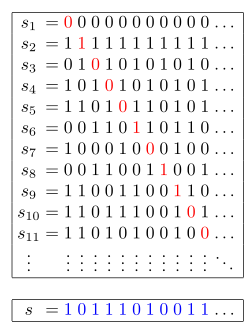
Let's accept that there is no bijection between the real numbers and the natural numbers, where both of them are represented by the place value method.

For example:

250px-Diagonal_argument_01_svg.svg.png


Even without adding s to the list of all s numbers, that may represent the natural numbers, we already assume that all natural numbers exist in that list, otherwise we can't conclude that there are more real numbers than natural numbers.

We can add the blue representation of the given real number to the list, and yet, we can get new real number that is not in that list, etc. infinitely many times, without changing this fact.

But if we are able to add real numbers to the list (including their matched s numbers) we actually can't conclude that the s numbers can represent the set of all natural numbers, in the fist place.

aleph0 can't be used to show this mathematical fact since, for example, aleph0+1 = aleph0.

This is not the case about, for example 1,000,000,... < 1+1,000,000,... by 1, which clearly shows this mathematical fact, and may help us to refine our understanding about the sizes of infinite sets.
 
Last edited:
Status
Not open for further replies.

ISF - Join now!

Every member here is approved by hand. No bots, no spam, just people who care about evidence and honest debate.

Membership is free!

Create your free account

Back
Top Bottom