• Quick note - the problem with Youtube videos not embedding on the forum appears to have been fixed, thanks to ZiprHead. If you do still see problems let me know.

Burning Painted Steel Beams, Making Iron-Rich Microspheres!

"He can not accurately say if a microsphere is present without destroying the chip to find it.

Any claims of no micro spheres before ignition then is false."

Fracturing or pulverizing a chip will not destroy its chemical composition.

Or, if you take a number of chips and halve them. Ignite one half to confirm they behave as expected. Grind the unignited halves and analyze them for the presence of microspheres.

Mark Basile said he observed upwards of hundreds of chips.
 
Fracturing or pulverizing a chip will not destroy its chemical composition.

Or, if you take a number of chips and halve them. Ignite one half to confirm they behave as expected. Grind the unignited halves and analyze them for the presence of microspheres.

Mark Basile said he observed upwards of hundreds of chips.

Why did the chips have different energy levels than real thermite?
How do you get less energy from thermite? lol

Why is no steel damaged at the WTC by thermite? Magic? Fantasy thermite was used?

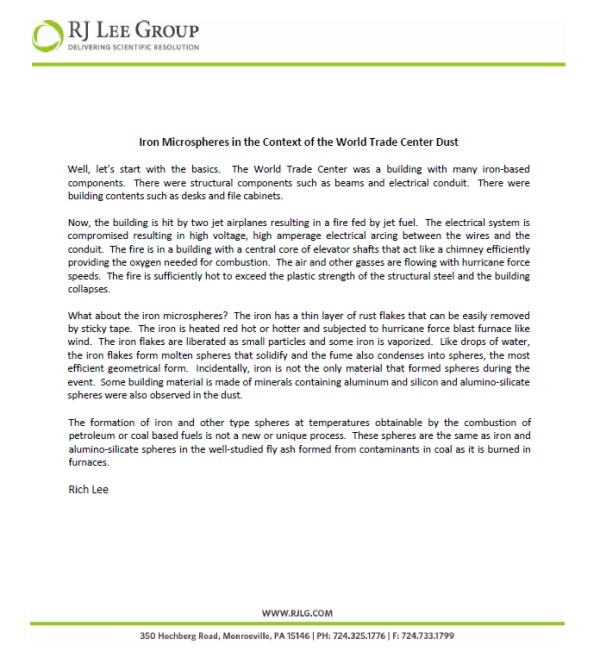
rjlee.jpg


Why did RJ Lee not find thermite in the dust? USGS? Looks like the only people who can find thermite are the one who made a fake conclusion in a vanity paper peer reviewed by 911 truth nuts.
 
Why did the chips have different energy levels than real thermite?
How do you get less energy from thermite? lol

Why is no steel damaged at the WTC by thermite? Magic? Fantasy thermite was used?

[qimg]http://www.nmsr.org/rjlee.jpg[/qimg]

Why did RJ Lee not find thermite in the dust? USGS? Looks like the only people who can find thermite are the one who made a fake conclusion in a vanity paper peer reviewed by 911 truth nuts.

That is old ground Beachnut.

The R J Lee Document you provide clearly makes note of the fact that the iron microspheres were comparable to those found in fly ash...that type of iron is iron oxide.
 
Old Ground, Harrit/Jones find iron oxide spheres...

That is old ground Beachnut.

The R J Lee Document you provide clearly makes note of the fact that the iron microspheres were comparable to those found in fly ash...that type of iron is iron oxide.
Jones sphere is iron oxide. It is in the paper, iron oxide. Fig 21, iron oxide. So many 911 truth followers failed to read the paper with fake conclusion of themite.
The closest the paper get to proving their "observations" indicate thermite is present in the dust, talk to fool 911 truth followers. The paper does not prove thermite existed, it prove the authors can give an opinion, and they say, "These observations reminded us of nano-thermite fabricated at the Lawrence Livermore National Laboratory and elsewhere".

Clearly Jones has iron oxide spheres, it is proved in data from the paper. Compare the figures to iron oxide.

And why can't 911 truth followers discuss the fact no steel was damaged by thermite? Will it ruin the fantasy of thermite?

911 truth has failed to answer/discuss why USGS did not find thermite, or, why did RJ Lee not find thermite?

Why do fake thermite chips have less energy than thermite?

In Fig 25, a sphere from the fake thermite dust is iron oxide and why is there Si in it? Why is there Ti in it? Ca?

Fig 29 shows the DSC traces don't match. Why did Jones/Harrit lie about thermite and include proof that they did not find thermite. If you compare the DSC trace it is not a match.

Fig 30, not a single chip matches thermite energy. Ironically, paper, plastic and other office contents have many times more heat energy than thermite. Some plastics burn releasing 10 to 14 times more energy than thermite.
Why did the thermite take so long to act? The thermite reaction is over in seconds, why did the WTC collapse take so long? WTC, why did the thermite there take all day to work?

The paper is a fraud.

New Ground... old question
Explain why no steel was damaged by thermite on 911. Avoid this, it will ruin the fantasy of thermite.
 
Last edited:
Yes, I meant that video and the time stamp is here:
https://youtu.be/h1VmaCl4HwU?t=42m57s

There Basile says that there are no spherules in the red/grey chips before the reaction but they are found first after the reaction. I think Harrit meant that.
I agree that these spherules weren't in the red/grey chips before the reaction and thus must have formed during the experiment.
You speculate that "the reaction" is the cause for the formation, and you speculate that Harrit speculates even further that "the reaction" must have been a thermite reaction, since "only" a thermite reaction .... well, whatever he meant.

But Basile presents evidence that "the reaction" must have been mostly hydrocarbon combustion, as there is so very little aluminium in the red layer, and waaaaaaaaaaaaaaaaaaaaaaaaaaay too much iron to account for the large droplets!
And Basile presents evidence that the droplets formed from the non-"enegetic" gray iron oxide layer - there's hadly even a need to assume that "the reaction" played a significant role!

What Harrit, Basile and you all ignore is that, in the experiment, the gray layer was heated by external power (to 700 °C in Harrit et al, to an unknown, potentially higher or lower temperature in Basile's test), and none of you have ruled out that either this heating of the gray layer alone, or the heating of the gray layer in conjunction with the hydrocarbon reaction, caused the gray layer to deform to more roundish shapes.


Did you look carefully how the chip was "burning"? Have you ever burnt plastic? Hydrocarbons require outward oxygen for burning but the chip was "burning" inwardly – no oxygen was needed. I have burnt both gunpowder and plastic and have seen the difference.
Yes, I looked carefully.
The red layer was clearly exposed to oxygen, clearly showed signs of decomposition and gassing out, and clearly reacted with a flame outside of the chip - in other words, a reaction with ambient oxygen is a total certainty. If it had burnde "inwardly", you would not have had a chance to observe anything.
Harrit et al measured the energy output, and their higher values of 7.5 and 6 kJ/g are clear proof that something burned on ambient oxygen, that something was with utmost certainty the hydrocarbon binder, and that hydrocarbon combustion very clearly dominated the reaction enthalpy!

In Basile's chip, there was, according to his own data, less than 5% thermite (with 0%, the most plausible value, also being <5%). The significantly less than 0.2 kJ/g energy by mass of the red layer that <5% thermite could release can be shown to not even be sufficient to crack (decompose) a normal hydrocarbon binder.

The reaction shown in the video, nor the residue, cannot be explained at all by a hypothetical thermite reaction, given the scarcity of thermite ingedients, and thus MUST be explained with the energy from the heating strip or from hydrocarbon combustion.


Unless you want to suggest that perhaps Basile's or Harrit's data are bad.

I referred to the figures in the OP and it was very easy to see what I meant. I usually don't give time stamps. I understand that many people are busy and don't necessarily have time to watch a video for one hour. But if they don't do it ever so they are not interested enough and it would have been in vain to give the time stamp. Videos most often are a logical whole and it is important to watch them in their entirety. I have time enough to watch 95 % of all the videos from the beginning to the end.
I am very familiar with the Basile presentation, I have watched the part where he talks about dust analysis several times, and have analysed his data, including the video of the burning chip #13, in much detail, years ago already. I wasn't sure what you were refering to, despite my knowing all figures in the Basile presentation as well as Harrit et al.

 
Last edited:
If you can provide corroborating opinion from a known professional, I will reconsider.

Can you provide corroborating opinion from a known professional for the Harrit study? For that matter, was anyone connected with the Harrit study a known respected professional (in forensic science)?

Bias much? :rolleyes:
 
Last edited:
I agree that these spherules weren't in the red/grey chips before the reaction and thus must have formed during the experiment. You speculate that "the reaction" is the cause for the formation, and you speculate that Harrit speculates even further that "the reaction" must have been a thermite reaction, since "only" a thermite reaction .... well, whatever he meant.

Thank you for your comment to the point. I always follow the evidence wherever it leads. I am not able to answer for the moment and without learning more.

What about heating the chips in vacuum? Would that solve the controversy?
 
Last edited:
What about heating the chips in vacuum? Would that solve the controversy?

Carrying out the DSC test in a vacuum would cast considerably more light on whether a thermite reaction occurred, because any such reaction would occur equally well in a vacuum whereas combustion in atmospheric oxygen would not. An inert atmosphere, such as argon or nitrogen, would serve equally well.

Dave
 
Thank you for your comment to the point. I always follow the evidence anywhere it leads. I am not able to answer for the moment and without learning more.

What about heating the chips in vacuum? Would that solve the controversy?
911 truth has no evidence, nothing to follow; a short trip to BS and lies.

There is no evidence for thermite. Iron spheres occur in fires.
 
Last edited:
Carrying out the DSC test in a vacuum would cast considerably more light on whether a thermite reaction occurred, because any such reaction would occur equally well in a vacuum whereas combustion in atmospheric oxygen would not. An inert atmosphere, such as argon or nitrogen, would serve equally well.

Dave

Not nitrogen aluminum reacts with nitrogen argon is the prefered inert gas for aluminum.
 
Fracturing or pulverizing a chip will not destroy its chemical composition.

Or, if you take a number of chips and halve them. Ignite one half to confirm they behave as expected. Grind the unignited halves and analyze them for the presence of microspheres.

Mark Basile said he observed upwards of hundreds of chips.

True but did Mark proform those tests did he look for pyrites sulfides of Iron and exclude them?
 
Thank you for your comment to the point. I always follow the evidence wherever it leads. I am not able to answer for the moment and without learning more.

What about heating the chips in vacuum? Would that solve the controversy?

As Dave Rogers already said, heating the chips under an inert gas such as argon or nitrogen would eliminate the combustion of the hydrogen - that would be a major improvement over what Harrit or Basile so far did.

If no spherules occur then, we will know for certain that the hydrocarbon binder was responsible for that. We'd still not know what that hydrocarbon is and what it does[1].

It would however not resolve the role the gray layer plays, especially if spherules still occur. I'd suggest trying to separate gray and red layer somehow (though I understand that's perhaps not trivial) and testing red material and gray material separately.


All this implies acceptance that DSC is a necessary or sufficient test for a forensic determination of what those red and gray materials are - a premise I actually don't accept. The objective of these studies still ought to be "what material are these chips" and not so much "which chemical and physical reactions happen when these chips are heated". There are better forensic test methods available to answer the former.


_______
[1] Actually, that's not quite true: Millette's study revealed that the binder for those chips that equal Harrit's chips a-d as per elemental composition and pigment morphology have an epoxy binder.
 
That is old ground Beachnut.

The R J Lee Document you provide clearly makes note of the fact that the iron microspheres were comparable to those found in fly ash...that type of iron is iron oxide.

Yes and Jones admitted to Dr. Frank Greening his microspheres were high in oxygen,
They were Iron Oxide.
 
As Dave Rogers already said, heating the chips under an inert gas such as argon or nitrogen would eliminate the combustion of the hydrogen - that would be a major improvement over what Harrit or Basile so far did.

If no spherules occur then, we will know for certain that the hydrocarbon binder was responsible for that. We'd still not know what that hydrocarbon is and what it does[1].

It would however not resolve the role the gray layer plays, especially if spherules still occur. I'd suggest trying to separate gray and red layer somehow (though I understand that's perhaps not trivial) and testing red material and gray material separately.


All this implies acceptance that DSC is a necessary or sufficient test for a forensic determination of what those red and gray materials are - a premise I actually don't accept. The objective of these studies still ought to be "what material are these chips" and not so much "which chemical and physical reactions happen when these chips are heated". There are better forensic test methods available to answer the former.


_______
[1] Actually, that's not quite true: Millette's study revealed that the binder for those chips that equal Harrit's chips a-d as per elemental composition and pigment morphology have an epoxy binder.

Incorrect Oystein, heat the chips in inert gas, if they ignite they are self oxidizing,
In a contained environment the Reduced Iron and Aluminum oxide can be capture if and
When the microspheres form. The reduced Iron to Al2O3 ratio can then be ascertained,
That would give you the strength of the thermite reaction.

You can also do a test on the Hydrocarbons, but once a proper inert gas test under argon
Is completed no other testing would be nessisary.
 
Originally Posted by Dave Rogers
Carrying out the DSC test in a vacuum would cast considerably more light on whether a thermite reaction occurred, because any such reaction would occur equally well in a vacuum whereas combustion in atmospheric oxygen would not. An inert atmosphere, such as argon or nitrogen, would serve equally well.

Dave

Not nitrogen aluminum reacts with nitrogen argon is the prefered inert gas for aluminum.

Agree, but the point of using nitrogen is to exclude combustion of the organic resin. If there is elemental aluminum, then there is thermite, which will react under nitrogen, argon, or even a vacuum. And elemental aluminum only reacts with nitrogen when you get to ~800 deg. Celsius. The thermite they claim to have found reacts at a far lower temperature.
 
Agree, but the point of using nitrogen is to exclude combustion of the organic resin. If there is elemental aluminum, then there is thermite, which will react under nitrogen, argon, or even a vacuum. And elemental aluminum only reacts with nitrogen when you get to ~800 deg. Celsius. The thermite they claim to have found reacts at a far lower temperature.

That is correct but argon is still the preferred inert gas because most bottled nitrogen does contain some trace NO2.
 
That is correct but argon is still the preferred inert gas because most bottled nitrogen does contain some trace NO2.

Not true:
http://www.tainstruments.co.jp/application/pdf/Thermal_Library/Applications_Notes/TN044.PDF

" As argon is more dense than air, the flow of the argon through the cell is diminished. The purge rate which is indicated on the flowmeter is not necessarily the rate through the purge gas opening in the DSC cell. For these reasons, the use of argon as a purge gas should be carefully considered."
"Nitrogen is the preferred purge gas"

The alternative to NO2-contaminated N2 is not Ar but NO2-free, "ultra-pure" N2. Coincidentally, that is exactly what Tillotson used.
 
Not true:
http://www.tainstruments.co.jp/application/pdf/Thermal_Library/Applications_Notes/TN044.PDF

" As argon is more dense than air, the flow of the argon through the cell is diminished. The purge rate which is indicated on the flowmeter is not necessarily the rate through the purge gas opening in the DSC cell. For these reasons, the use of argon as a purge gas should be carefully considered."
"Nitrogen is the preferred purge gas"

The alternative to NO2-contaminated N2 is not Ar but NO2-free, "ultra-pure" N2. Coincidentally, that is exactly what Tillotson used.

True but it is not nessisary to do the inert gas test in a DSC, any sealed isolation can do an inert gas test, a better test is to expose the materials to electrical arcing, that would positively
Ignite any thermite compounds.
If a reaction then does not occur presence of thermite is negative.
If a reaction does occur then fuel and oxidant are present, capture of reactants in a sealed
Chamber would allow for, chemical evaluation of the chips residue.
A simple test with vinigar can determine thermite residue from products of Iron oxidation
Events and show how much reduced Iron was produced.
Any process that removes the oxide coating from the iron microspheres will show
which are reduced Iron and which are iron oxides, I find it highly fraudulent of Harrit for
Not doing simple easy chemical testing to determine if the chips were reduced iron,
Or an oxidation product of Iron.
This is simple chemistry not rocket science.:D

Using the inert gas ignition, and examination of paint chip residue, with contamination of
International Harvester red paint, with aluminum cutting dust, I can confirm my created
Chips were 150-200 times more energetic than Harrit's chips and the residues were
Mostly reduced not oxidized iron.
Conclusion Harrit and Jones are not Looney Tooney the are, Bat, S. Crazy.:)
 
Originally Posted by Redwood
Agree, but the point of using nitrogen is to exclude combustion of the organic resin. If there is elemental aluminum, then there is thermite, which will react under nitrogen, argon, or even a vacuum. And elemental aluminum only reacts with nitrogen when you get to ~800 deg. Celsius. The thermite they claim to have found reacts at a far lower temperature.

That is correct but argon is still the preferred inert gas because most bottled nitrogen does contain some trace NO2.

I'd always prefer argon but if for some reason I didn't have any, I wouldn't feel too bad about using nitrogen. Just my usual old sloppy "good enough" habits as a retired industrial chemist used to dealing with bulk materials of technical grade purity. :)
 

Back
Top Bottom