Furcifer
Guest

- Joined
- Apr 30, 2007
- Messages
- 13,797
Just the butterflies flapping their wings faster for a few months in a row.
Hey, I see what you did there!


Just the butterflies flapping their wings faster for a few months in a row.
Just the butterflies flapping their wings faster for a few months in a row.


Or will 2015 become the new 1998? At the end of 2016 (assuming it is cooler than 2015), will people be saying the globe is cooling and therefore AGW doesn't exist? Kind of like when we had a record low of sea ice in the Artic, the following couple of years were full of denier headlines talking about record growth of sea ice which "disproved AGW".
I predict deniers will continue to deny.
Or will 2015 become the new 1998? At the end of 2016 (assuming it is cooler than 2015), will people be saying the globe is cooling and therefore AGW doesn't exist? Kind of like when we had a record low of sea ice in the Artic, the following couple of years were full of denier headlines talking about record growth of sea ice which "disproved AGW".
I predict deniers will continue to deny.
There will always be the fringe, but they'll become like 9/11 truthers- not taken seriously. The districts are so gerrymandered though, it might take awhile to shake out, politically.

Actually no, because 1998 coincided with a PDO phase-change from warm to cool while the next change (which, if not already happening, soon will be) will be from cool to warm. The new 1998 will have to wait on the end of this warm phase - another 10-20 years. That's too far away for the demographically challenged climate denier community to take much comfort from, I think.Or will 2015 become the new 1998?

This year, a colder than usual stratosphere widened the hole to a peak of 28.2 million square kilometres (10.9 million square miles) on Oct. 2, bigger than Canada and Russia put together.
It was a record for a hole recorded on Oct. 2 of any year, and the hole has remained at daily record levels on every day since then, the WMO said, citing data from NASA. Over the 30 days around the peak, the hole averaged 26.9 million square km, making it the third largest, after 2000 and 2006.
"This shows us that the ozone hole problem is still with us and we need to remain vigilant. But there is no reason for undue alarm," WMO Atmospheric and Environment Research Division senior scientist Geir Braathen said in a statement.
"Overall, however, this does not reverse the projected long-term recovery in the coming decades," the statement said.

The climate fact no one will admit: 2 ºC warming is inevitable
It is time to start preparing for a world more than 2 °C warmer than now. The UN’s own analysis of what countries are offering to do to limit greenhouse gas emissions shows they fall far short of what’s required. In fact, they suggest the world will have emitted enough carbon dioxide to warm the planet 2 °C by around 2036.
These offers, formally known as Intended Nationally Determined Contributions or INDCs, will be the basis of the global treaty on climate change to be finalised in Paris in December. It was always clear that this treaty would not go nearly far enough to limit warming to 2 °C by 2100, but now the numbers are in.
Ahead of the meeting, 119 INDCs have been submitted, representing 147 countries and 88 per cent of current emissions. The UN has now released a synthesis report analysing what impact they will have. It concludes that even if countries stick to them, annual global emissions will hit 43 gigatonnes of carbon dioxide (GtCO2) by 2030 – and will still be rising.
Advertisement
It has been calculated that to have a 66 per cent chance of limiting warming to 2 °C, cumulative emissions from 2011 must be limited to 1000 GtCO2. The UN report, however, says we’ll have burned through 75 per cent of this carbon budget by 2030. That means we could only emit another 250 GtCO2 after 2030 – which means we’ll bust the budget in around 2036 assuming emissions stay above 40 GtCO2 per year.
“I think it is clear that the INDCs will fall well short of what is required for any reasonable probability of avoiding 2 °C,” says Alice Bows-Larkin of the Tyndall Centre for Climate Change Research in Manchester, UK. And what happens after 2030 is crucial, too, she says. “We can’t assume that emissions will immediately decline.”



We're halfway there people
I wish I shared your optimism. I see little to no chance that it's going to stop at 2 degrees C.

I wish I shared your optimism. I see little to no chance that it's going to stop at 2 degrees C.

"It will be hard and it will require immediate action. But it is still possible, but only just!" Isn't that what all those climate reports have been saying since at least the turn of the century? It is starting to sound a bit ... strained.
"It will be hard and it will require immediate action. But it is still possible, but only just!" Isn't that what all those climate reports have been saying since at least the turn of the century? It is starting to sound a bit ... strained.
 "
"
The alternative at this point is "We're all actually doomed, and it doesn't matter anymore. We've killed ourselves. Good job.
Georgetown Goes All In on Renewable Energy | The Texas ...
www.texastribune.org/.../georgetown-goes-all-renewa...
The Texas Tribune
Mar 18, 2015 - Georgetown’s municipal utility on Wednesday unveiled plans to abandon traditional electricity sources like coal and gas power plants, instead exclusively tapping wind and solar energy to meet all of its customers’ power needs. ... The city announced a 25-year deal with SunEdison ...
I do realize it is a lot of hard trade-offs writing these report summaries. What mix of hope and gloom will give the best incentives and at the same time be true, realistic and politically acceptable?
If we fail to meet the 2 degree goal, we must at some point admit that we have failed or the reports will become farcical. I think we already have failed the 2 degree goal but not bad enough to give it up. And the reason for this is expediency and political reasons. But never, never should it be replaced with hopelessness!!
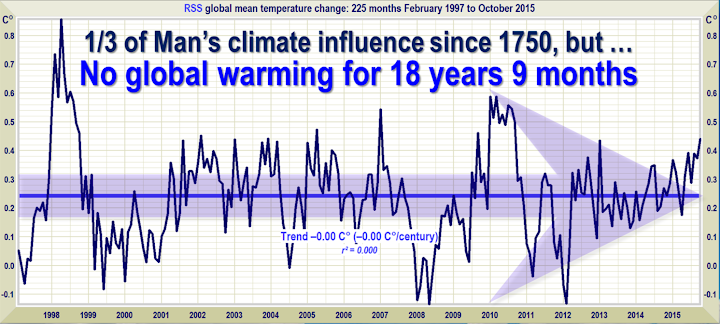
For instance, global temperatures measured by satellite show no significant rise for more than 18 years. This is despite the fact that the world’s carbon dioxide emissions since 1990 constitute more than one-third of all human CO2 emissions since the dawn of the Industrial Revolution in the 1850s. If human emissions of CO2 drive temperature, we’d have seen proof of that in the past two decades. The proof isn’t there.