Global warming discussion III

Status
Not open for further replies.
True, ...
Not quite true as I point out in my reply, Red Baron Farms - what that post has is an analogy of scientific consensus. The scientific consensus is that carbon sequestration in soil can only have a relatively small effect in global warming mitigation (I have seen figures of 10-20%).

What we have so far is a non expert (Gabe Brown) with an anecdote about his case study farm. He is very probably correct in his reported results. We have no idea whether he is correct in associating his results with any methodology such as Savory's HM. That cannot be determined from a single case study on one methodology. Or even multiple case studies on that methodology. This could be a case of an "agricultural placebo effect" - of course a farmer who takes more care of his farm using any methodology will have improved results :D!

What Gabe Brown is an expert in is an unproven methodology with strong doubts about its assumptions (Holistic Management: Misinformation on the Science of Grazed Ecosystems ).

Relying on scientists being involved in a single case study as evidence that the case study will be correct is a weak version of the argument from authority. Scientists make mistakes. It is better to wait for the published papers from those scientists with the actual scientific results from this one case study. This allows peers to review the results (i.e. the "ten transmission experts").

Personally I think that the published results will confirm Brown's anecdotal evidence. But the world is not Gabe Brown's ranch!
 
That is exactly an example of an argument from authority: ...
Fudbucker: It is exactly an example of understanding the meaning of argument from authority versus scientific consensus.
Scientific consensus is the overall opinion of a group of authorities who have looked at the evidence, i.e. your ten transmission experts.
If Gabe Brown's case study was being reviewed by a representative proportion of experts in grassland farming then their conclusions would be a consensus.

Argument from authority is taking the statement of an authority as correct because they are an authority, i.e. using your example, a subset (e.g. 1) of the ten transmission experts.
Gabe Brown's case study is being reviewed by a small number of experts in grassland farming and thinking that the case study is correct just because of their presence is a weak form of the fallacy (replace "statement" with "presence").

Your example does follow the basic syllogism of argument from authority
A says P about subject matter S.
A should be trusted about subject matter S.
Therefore, P is correct.
If you are trusting your expert because they are an expert then we have the fallacy. If your expert cites evidence to back up his opinion then there is no fallacy.
 
Last edited:
Fudbucker: It is exactly an example of understanding the meaning of argument from authority versus scientific consensus.
Scientific consensus is the overall opinion of a group of authorities who have looked at the evidence, i.e. your ten transmission experts.
If Gabe Brown's case study was being reviewed by a representative proportion of experts in grassland farming then their conclusions would be a consensus.

Argument from authority is taking the statement of an authority as correct because they are an authority, i.e. using your example, a subset (e.g. 1) of the ten transmission experts.
Gabe Brown's case study is being reviewed by a small number of experts in grassland farming and thinking that the case study is correct just because of their presence is a weak form of the fallacy (replace "statement" with "presence").

Your example does follow the basic syllogism of argument from authority

If you are trusting your expert because they are an expert then we have the fallacy. If your expert cites evidence to back up his opinion then there is no fallacy.

Again, this is wrong. We're talking about informal logic, not syllogistic reasoning. You trust a doctor because they are a doctor. They've spent years becoming an expert in medicine. That means their statements about medicine have prima facie evidentiary value. The reasoning goes like this:

1. X is an expert in medicine.
2. X makes medical claim Y
3. I am not an expert in medicine
4. I believe ~Y (Not Y)
5. There is a higher probability that X is right about Y than I am right about Y
6. Therefore, I should believe Y

Note that this is a probabilistic argument. Doctors and climatologists aren't always right. But- here's the key- they are right much more often than non-doctors and non-climatologists. Sure, you can keep your old belief that has just been contradicted by an expert, but the expert, by virtue of being an expert, is probably correct, and you're probably wrong.

Which is why it often comes down to competing experts in debates that are highly technical. Who's expert is the better authority? Who went to the best college, has the most awards, the most cited papers, etc? When we say something is the "consensus position", that doesn't magically make it correct. The scientific community has been wrong countless times. But the scientific consensus is usually (probably) right, and you have to meet a high burden of proof to overturn it.

Arguing that X is true because 90% of scientists claim X is the exact same thing as arguing X is true because a scientist claims X and you're not a scientist, so you should believe X is true. It's all just probabilities and degrees of belief.
 
Last edited:
Again, this is wrong. We're talking about informal logic, ...
No Fudbucker. You are talking about "informal logic". I am talking about "English as she is spoke" (:D) where argument by authority and scientific consensus have actual meanings.

[sarcasm]
I agree with your "informal logic". For example everyone should trust everything Dr. Oz states according to it!
[/sarcasm]
Unfortunately people do trust authority figures for many reasons.
 
No Fudbucker. You are talking about "informal logic". I am talking about "English as she is spoke" (:D) where argument by authority and scientific consensus have actual meanings.

[sarcasm]
I agree with your "informal logic". For example everyone should trust everything Dr. Oz states according to it!
[/sarcasm]
Unfortunately people do trust authority figures for many reasons.

I don't think you actually know what you're talking about, at this point, but I'm done with this little sidebar.
 
.

Is global cooling next ?

NOAA discusses recent changes (decline) in sunspot activity http://vencoreweather.com/2015/04/3...e-weakest-solar-cycle-in-more-than-a-century/


(From the article) The sun's X-ray output has flatlined in recent days and NOAA forecasters estimate a scant 1% chance of strong flares in the next 24 hours. Not since cycle 14 peaked in February 1906 has there been a solar cycle with fewer sunspots. We are currently more than six years into Solar Cycle 24 and the current nearly blank sun may signal the end of the solar maximum phase. Solar cycle 24 began after an unusually deep solar minimum that lasted from 2007 to 2009 which included more spotless days on the sun compared to any minimum in almost a century.

(From the article) There have been two notable historical periods with decades-long episodes of low solar activity. The first period is known as the “Maunder Minimum”, named after the solar astronomer Edward Maunder, and it lasted from around 1645 to 1715. The second one is referred to as the “Dalton Minimum”, named for the English meteorologist John Dalton, and it lasted from about 1790 to 1830 (below). Both of these historical periods coincided with colder-than-normal global temperatures in an era now referred to by many scientists as the “Little Ice Age”.
 
Arnold sun activity has an effect a full magnitude below GHG.
You should really try and understand what you post instead of wishful thinking.

The sun activity is going one way
The global temps the other

Solar_vs_temp_500.jpg
 
.

Is global cooling next ?

NOAA discusses recent changes (decline) in sunspot activity http://vencoreweather.com/2015/04/3...e-weakest-solar-cycle-in-more-than-a-century/


(From the article) The sun's X-ray output has flatlined in recent days and NOAA forecasters estimate a scant 1% chance of strong flares in the next 24 hours. Not since cycle 14 peaked in February 1906 has there been a solar cycle with fewer sunspots. We are currently more than six years into Solar Cycle 24 and the current nearly blank sun may signal the end of the solar maximum phase. Solar cycle 24 began after an unusually deep solar minimum that lasted from 2007 to 2009 which included more spotless days on the sun compared to any minimum in almost a century.

(From the article) There have been two notable historical periods with decades-long episodes of low solar activity. The first period is known as the “Maunder Minimum”, named after the solar astronomer Edward Maunder, and it lasted from around 1645 to 1715. The second one is referred to as the “Dalton Minimum”, named for the English meteorologist John Dalton, and it lasted from about 1790 to 1830 (below). Both of these historical periods coincided with colder-than-normal global temperatures in an era now referred to by many scientists as the “Little Ice Age”.
Uh huh, the Little Ice Age was regional and the temperatures haven't dropped yet.

Why isn't this in its own thread?
 
[qimg]https://lh3.googleusercontent.com/--SKUH0XInGk/VUSeKVPiAcI/AAAAAAAANGk/yWfNL6UguVA/s800/Screen%2520Shot%25202015-05-02%2520at%2520May%252C%25202%2520%2520%2520%25202015%2520%2520%2520%25205.51.16%2520PM.jpg[/qimg]

care to explain this Arnold?? .....seems your thesis lacks evidence :rolleyes:

And wait til you see what 2015 holds in store....:eye-poppi

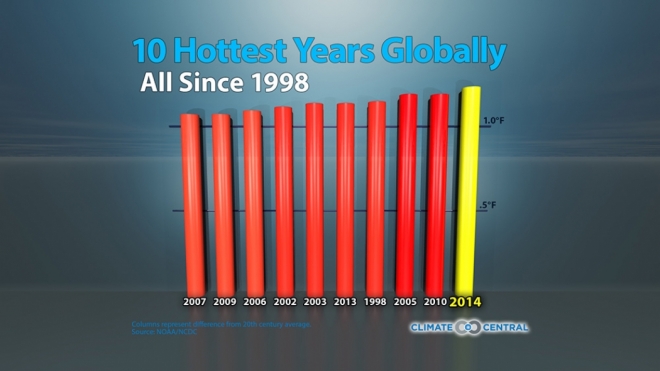
Out of date. :p
Top10YearsGlobally_2014_660_371_s_c1_c_c.jpg
 
As far as I'm concerned, just work on making sustainable technologies practical for the general public, and work on dealing with the lobbyists that prevent people from fully utilizing the technology on a private level. I've been a fence sitter on some of the causes of climate swings, but in my position I think there are some common interests in the need for a more sustainable mentality... certainly if not in the context of climate, for other matters related to the environment and general well being of people.


In other words... clear the path way for people to be able to put the solutions into execution. There should ideally be a means of taking different avenues to address these issues.
 
Last edited:
As far as I'm concerned, just work on making sustainable technologies practical for the general public, and work on dealing with the lobbyists that prevent people from fully utilizing the technology on a private level. I've been a fence sitter on some of the causes of climate swings, but in my position I think there are some common interests in the need for a more sustainable mentality... certainly if not in the context of climate, for other matters related to the environment and general well being of people.


In other words... clear the path way for people to be able to put the solutions into execution. There should ideally be a means of taking different avenues to address these issues.
Well said.:D
 
Given the state of knowledge - fence sitting on cause seems unimaginable.:eye-poppi

I mean the fossil fuel company's own scientists confirmed it in 1995 ( court documents revealed what they knew but refused to admit ....very like the tobacco companies )
Industry Ignored Its Scientists on Climate - NYTimes.com
http://www.nytimes.com/2009/04/24/science/earth/24deny.html?_r=2

Working just from a sustainable approach - while laudable...is a bit of a dodge in my view.
It's like saying I'm not sure why water comes from a tap but let's use it wisely.

As consequences like Califonia unfold, people need to understand the chain of cause and effect and push back against the "it's not us" flak the vested interests trot out. And understand it's not climate variability as the new right wing mantra claims ( of course AGW overlays CV - as now with El Nino )

One farmer cracked...."we're not stupid, we know climate is changing, it's just politically correct to talk about it"....:rolleyes:
 
Working just from a sustainable approach - while laudable...is a bit of a dodge in my view. It's like saying I'm not sure why water comes from a tap but let's use it wisely.

At the end of they day my angle makes it somewhat pointless to debate the nuances over whether climate change is a man made disaster... We have so many other issues that motivate me to see sustainable practices as beneficial to human well-being that it's mostly the same outcome if it can be implemented pragmatically. That's why I'm not terribly adamant about perpetuating a debate over it. From my perspective, anthropogenic climate issues do exist to some degree and I find it likely there's a degree of cumulative influence that's part of the measured data. A lot of my skepticism over it just tends to float over the problem of what to do for any part of the climate change effects that happens to be part of the naturally occurring fluctuations. I don't dismiss the human caused portion quite like I used to, but on the other hand I sometimes wonder what the mentality or expectation is of addressing some of the side effects if they were naturally occurring. I almost guarantee the same quagmire if we were dealing with sea level rise for unrelated causes to the climate changes. In other words I'm of the opinion that what can be done about it has some limits and solutions need to be done with that in mind.

Either way, my only input was that there are ways to address it by tackling common goals that don't entirely require people to debate whether it's a human caused problem or not by prerequisite. Since once you get past that point you're dealing with a political contingent that is slowing the progress of technologies being implemented. I take the climate data I see otherwise at face value.
 
Last edited:
You are giving the fossil fuel companies a free pass.

Would you be so sanguine if they were knowlingly impacting your drinking water??
No - you'd hold them to mitigating it and paying for the consequences.

That is what they are trying to avoid.

Exxon says "it's an engineering problem "....yeah it is ...but who bears the cost ??

Human caused?......yes we have methods from modest to extreme ( SO2 stratosphere injection ) to address it.

Climate variable? - dick all we can do about changing the forcing....we can't alter the orbit or change the output of the sun ( tho SO2 would alter what gets to us ).

Anthro based - the world can campaign as it is doing to both reduce the future impact, cope with current impacts and hold those responsible accountable just as with cigarettes and cancer....
Just as the Rockefellers are doing with Exxon - holding accountable and forcing change by board action, soicial media action and plain old dumping their investments.

Putting it down to natural variability just lets the coal owners shrug instead cleaning up their act which they are now forced to do in ever greater numbers.

Would you not be outraged at a company ruining your drinking supply ??
Why are you willing to give them a pass on the atmosphere when the science is just overwhelming

Here is what Gammon had to say concerning links between humans and climate change.

This is like asking, ‘Is the moon round?’ or ‘Does smoking cause cancer?’ We’re at a point now where there is no responsible position stating that humans are not responsible for climate change. That is just not where the science is.…For a long time, for at least five years and probably 10 years, the international scientific community has been very clear.”

In case there is any doubt, Gammon went on:
This is not the balance-of-evidence argument for a civil lawsuit; this is the criminal standard, beyond a reasonable doubt We’ve been there for a long time and I think the media has really not presented that to the public.”

Dr. Richard H. Gammon
Professor of Chemistry and Oceanography*
Adjunct Professor Atmospheric Sciences, University of Washington

That was 5 years or more ago....

I'm pleased you are modifying your position...that's a healthy response to new information.

Most of us here are pragmatists...not tree huggers. We'd love to see more nukes in play and recognise there are no magic solutions.

But letting companies like Koch continue to pollute, buy politicians with the proceeds of that polluting act AND get subsidized to the tune of billions upon billions of dollars a year!!!!

c'mon.....put the responsibility and cost squarely where it lies and force change as administrations all over the world have done.

Ontario is a big industrial economy - 18 million people - ranked up with small first world nations in GDP.

We went from 25% coal to zero in a decade because it's the responsible thing to do.
Coal use was costing billions in our province alone in health costs ( mostly from Ohio plants ).

We couldn't shut them ...but we shuttered the biggest single CO2 source on the continent..Nanticoke.

The buck has to stop with the corporations emitting CO2 - clean up or get out of the energy business.

Societies cannot subsidize the damage they cause worldwide.

Hell a ship dumping waste water from the bilge will get nailed.....but coal companies get pretty much a free ride tho slowly that is changing.

www.news24.com/tags/topics/pollution?pid=0&mobile=true
2015-01-16 10:18. Residents .... China will ban the sale and import of "dirty" coal in less than four months, in an ... China cracks down on environmental crimes.

They clearly know the source and are holding the companies accountable ...so should you.

It's not Ma Nature....it's H Sapiens.

 
Last edited:
You are giving the fossil fuel companies a free pass.
With all due respect, read my posts before you spend 45 minutes writing something that has nothing to do with the way I view the issue. You might find I am more familiar with the politics of implementing sustainable technologies than you think. And you might find that I have absolutely no problem with getting it done. Hence you might find the relevance of my suggestion that people find a set of common agreement points in order to get something going. It does not require manufacturing straw man arguments to make my angle seem like something it is not.
 
Last edited:
As far as I'm concerned, just work on making sustainable technologies practical for the general public, and work on dealing with the lobbyists that prevent people from fully utilizing the technology on a private level. I've been a fence sitter on some of the causes of climate swings, but in my position I think there are some common interests in the need for a more sustainable mentality... certainly if not in the context of climate, for other matters related to the environment and general well being of people.


In other words... clear the path way for people to be able to put the solutions into execution. There should ideally be a means of taking different avenues to address these issues.

That is what has been proposed all along. A market pricing mechanism to make the inevitable transition from fossil fuels to other fuels happen sooner rather than later. The fossil fuel industry has fought this tooth and nail, they want to burn all the fossil fuels now, as fast as they can.
 
Status
Not open for further replies.

Back
Top Bottom