Latest Bigfoot "evidence"

Status
Not open for further replies.
I've been doing a little research on primates in N. America, just to expand my knowledge base. I like to make sure I understand what I read correctly.

From what I understand, 50 million years ago, the earth was a lot warmer than it is today. Most of N. America was covered in tropical rain forest. There's even evidence of palm trees growing in Alaska at the time. During this period there quite a few species of primates that lived in N. America.

Then about 33 million years ago, a new ice age started, which caused global temperatures to drop dramatically. So dramatically it caused a "Mass Extinction Event". None of the primate species of N. America were able to adapt to the new climate, so they either went extinct or migrated south the equatorial S. America...leaving no primate species in N. America at all.

It wouldn't be until 20 million years ago that the first of the great apes evolved in Africa and Asia...and there is no fossil evidence that they ever migrated to either N. or S. America...nor did great apes evolve in S. America.

So from what I gathered, there's never been great apes in the Americas ever. I just want to make sure I'm understanding this correctly. I also was unable to find any examples of great apes that adapted to live in colder climates...did I miss any?

Not according to any practical, empirical, non-anecdotal, objective evidence.
 
That early primate history is pretty murky but, yes, it looks like the order primates got its start in what is now North America, but subsequently died out there after dispersing to what is now South America. This was several 10s of millions of years ago that we lost our primates in North America. Those creatures would've looked like tarsiers or some kind of weird lemurs to us - nothing that we might recognize as a monkey or an ape had yet evolved.

Thus, it is correct that no primates would return to North America until Homo sapiens did so at some point before about 15,000 years ago.
 
I don't know? I have wondered if perhaps it was done in my case as a sort of territorial display so I'd leave the area? But, the Bigfoot the guys saw in the tree did not try to break it down, it was watching them. When its cover was blown it came down the tree and hit the ground running. So again, I don't know. From judging by the diameter of that tree, I concluded it would have been impossible for the creature to break anyway. The only benefit it had would have been the ability to observe them from an elevated position.
Chris B.

What would the evolutionary advantage of any non-human primate, be, to try to intimidate the world's most dangerous creature?

You understand that animals which threaten, get too close to our homes, break trees in our vicinity, get killed with great speed by humans?

This would be the worst trait that any creature could have in this world.

TRAIT: Intimidate humans, make threatening territorial displays near humans, throw potentially deadly projectiles at humans.

RESULT: Extinction
 
I see this in the quote from Chris:

When its cover was blown it came down the tree and hit the ground running.

Great tracks for helping to learn how their feet work.

I'll bet we have no record of these very helpful tracks.

Just like the PGF tracks where Patty turned and walked away from the creek.

The way the foot is used when landing from a jump, the way it pushes off from a standing start, the way it is used when pivoting or turning...

All very useful in general when trying to learn about a new bipedal primate.

Alas, we have no examples.

Not even pictures.

All we get are plain, straight, tracks.

Bigfoot never does anything else with his feet.
 
[snip]
All we get are plain, straight, tracks.

Bigfoot never does anything else with his feet.

Have you ever tried to walk in snow shoes? Or in your parent's shoes when you were 4 years old? Of course if you had big feet you would only be able to walk in a straight line. Thankfully the Earth is a sphere, so you can get back to where you started under these circumstances. Although you may have to swim.

Of course, given my own experience with snow shoes, there should also be a lot of butt prints where the Bigfoot just fell over. Have any of these been found?
 
First facts are opinions, then they're frustrations. That's okay, because I'm accustomed to this kind of evasion.

My complaint is very relevant to you, actually, because you go on and on about evidence that's not really evidence, which is exactly what I'm referring to.

You must know by now that we know that you've got nothing.

Here's something you claim is evidence that's not really evidence.

"There's nothing there, so it's evidence that they hide it well." That's one good reason why bigfooter logic is commonly considered a joke.

I consider tracks as evidence. As they are evidence. If you do not consider them evidence I think you are in error. As even if you consider Bigfoot to be a hoax, tracks would be evidence of that hoax and so should be evaluated. Chris B.
 
I know you're not suggesting they levitate (I hope), but if they existed and moved around in the river bottoms as you claim, particularly along low-gradient systems like the Green and other Ohio River drainages, there is simply no way they could avoid soft depositional substrates that largely comprise these rivers' banks. Do they swim across the river to the steep side each time they encounter an outside bend and accompanying floodplain? I understand you have no choice but to claim they stick to the forested river buffer when traveling, because there isn't enough continuous forested land in rural kentucky for something like a bigfoot to move around unseen otherwise, but the soil in these buffers is about as good as it gets for making tracks. If bigfoot existed there, he'd be leaving tracks there. Clear tracks. Do you personally have examples of any clear tracks along the rivers? I would assume you must, otherwise why would you believe they travel along rivers?
The reason I believe they use these areas as travel corridors is due to finding tracks there. Yes, there are good tracks left sometimes. As I said before even if they tend to step on firmer ground as a rule, sooner or later it becomes impossible to keep from breaking that rule. Chris B.
 
The reason I believe they use these areas as travel corridors is due to finding tracks there. Yes, there are good tracks left sometimes. As I said before even if they tend to step on firmer ground as a rule, sooner or later it becomes impossible to keep from breaking that rule. Chris B.

Post photos up of these " good tracks" then. Id like to see them. I bet most everyone would. Surely you don't have some excuse against posting photos of footprints.
 
I consider tracks as evidence. As they are evidence. If you do not consider them evidence I think you are in error. As even if you consider Bigfoot to be a hoax, tracks would be evidence of that hoax and so should be evaluated. Chris B.

Of course it all depends on your definition of "evidence." If one wishes to use the term to mean all observations and statements used in an argument, then it is useful to distinguish "authentic evidence" from "bogus evidence," and "relevant evidence" from "meaningless evidence."

My statement in a discussion that "that this blond hair on my shirt comes from a unicorn living in my basement" is evidence, in the broad sense. The fact that I am lying, and that any scientific analysis of the hair would prove that it is human, would demonstrate that this is bogus, fraudulent evidence highly unlikely to convince my wife (I suspect that a scientific study would not be required for my wife to reach that conclusion, in fact). In most cases, the word "evidence" is used as short-hand for "authentic evidence."
 
The reason I believe they use these areas as travel corridors is due to finding tracks there. Yes, there are good tracks left sometimes. As I said before even if they tend to step on firmer ground as a rule, sooner or later it becomes impossible to keep from breaking that rule. Chris B.

What do they do when it rains?
 
The photo at the bottom of the following link is from Chris' website and shows what Chris says to be the right print of a large creature...

http://www.bfrpky.com/PICS.html

Seems like we went over that one before. At the link it is claimed to be in the center of a gravel lane (road) but Id like to see some nicely imprinted tracks in the depositional substrate along the rivers where he claims they travel. Such tracks should be well-defined, crisp and easy to look at unlike what is at the link.

One thing, Chris, if you're out doing "research" it might be worth bringing along a measuring tape. The track at the link was "14-16 inches" long? Five to 6 inches across?

Edit: Also, Kit, thanks for mentioning the Blu Buhs book the other day. Ordered it.
 
Last edited:
I feel like you're skirting some of the questions. Do you think they eat large animals i.e. deer and/or wild hogs in Kentucky?

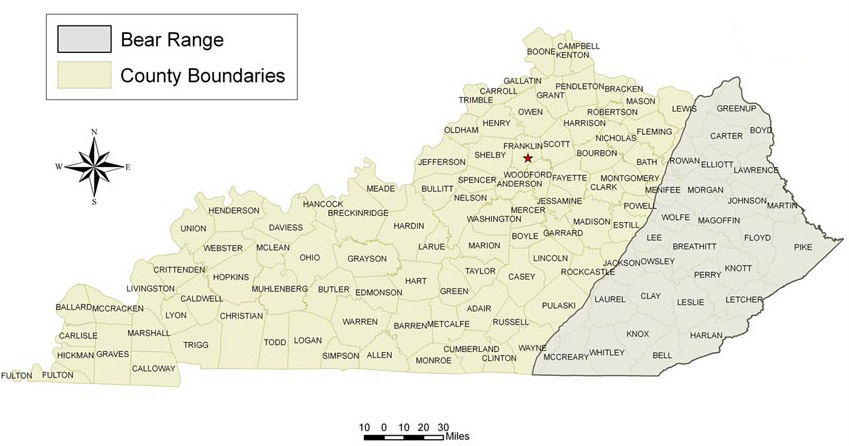
Please tell me why you think there are no black bears in western Kentucky.
You just stated "The best areas here have plenty of food and cover" What food do you mean? What cover? What food and cover varies east to west seasonally in KY? What kind of fruit tree were you talking about that was stripped clean?

I'm trying to give your theories, explanations and opinions an opportunity without the "show me the monkey" stuff. In short, I'm trying to understand the overall picture of bigfoot as an animal in Kentucky as posed by you. BF proponents have said that BF skeptics don't evaluate claims, that they just brush them off, so I'm trying to have a rational back and forth. I've not asked you to show your vids/photos or divulge your research location or get your BF saliva tested. When it is all said and done, if BF is an animal in Kentucky (or anywhere) it has to have a complete, explainable life cycle. It has to eat, drink, poop, reproduce and die.

blackbeardistribution.jpg


Here's the range of Black Bears in KY.

I think Bigfoot creatures are omnivores but that is speculation only. I've seen evidence of them eating vegetation but I've not seen any evidence of them eating meat yet. I think with the calorie requirements being similar to a bear, surely they're omnivores IMO.

I have an idea of what they eat. I will not give up more than I already have previously as this is an open forum. Polk and pine bark.

They must eat, drink, relieve themselves, reproduce, get sick and die. It's only a matter of time. Unless they're dying out, population must increase. I personally don't think their numbers are getting fewer.
Chris B.
 
[qimg]
I have an idea of what they eat. I will not give up more than I already have previously as this is an open forum. Polk and pine bark.
At 600 calories per pound, how many pounds of that do they have to eat to maintain? They must **** themselves dry.
 
Last edited:
. . . it might be worth bringing along a measuring tape.
So numbers mean stuff, too? Dang.

Yes, measuring tape. Yes, sterile gloves. Yes, sterile forceps. Yes, zip-top freezer bags. Yes, point and shoot camera with a decent optical zoom. Yes, willingness to follow these super-fresh tracks to the super-fresh footie that made them. Yes, ability to appreciate the irony of Bad Luck Brian.
 

Attachments

  • Screen shot 2015-03-30 at 2.21.52 PM.jpg
    Screen shot 2015-03-30 at 2.21.52 PM.jpg
    42.9 KB · Views: 3
Of course it all depends on your definition of "evidence." If one wishes to use the term to mean all observations and statements used in an argument, then it is useful to distinguish "authentic evidence" from "bogus evidence," and "relevant evidence" from "meaningless evidence."

My statement in a discussion that "that this blond hair on my shirt comes from a unicorn living in my basement" is evidence, in the broad sense. The fact that I am lying, and that any scientific analysis of the hair would prove that it is human, would demonstrate that this is bogus, fraudulent evidence highly unlikely to convince my wife (I suspect that a scientific study would not be required for my wife to reach that conclusion, in fact). In most cases, the word "evidence" is used as short-hand for "authentic evidence."

Absolutely ridiculous comparison. Do you believe Bigfoot to be a hoax? Of course you do. If someone has a trackway of prints claimed to be made by a Bigfoot, is that trackway not evidence of something? Even if it's evidence of a hoax as you believe, the tracks are evidence are they not? Chris B.
 
Status
Not open for further replies.

Back
Top Bottom