• Quick note - the problem with Youtube videos not embedding on the forum appears to have been fixed, thanks to ZiprHead. If you do still see problems let me know.

Syria and UN Security Council Decision

Status
Not open for further replies.
Another great article by Edward Dark about what happened after what was maybe the greatest single tragedy in the whole Syria tragedy: The assault on Aleppo in Summer of 2012.

How foreign imams radicalized Syria's war

Interesting article, any new ideas on a long term solution?

The US run coalition has made some very positive gains against ISIS in Syria and Iraq, but no one anywhere seems to have a solid coherent strategy for a lasting end to the conflict.

I don't agree with Turkey or other Syrian activists who say that the only way to get rid of ISIS is to remove Assad, but on the other hand, Assad's neighbors will not allow for an Assad only solution. Unless Saudi Arabia and Turkey are convinced of an alternative to Al-Nursa, than this conflict will continue for at least another decade.

Both Assad and the more extreme rebels groups have been primarily focused on killing off the moderates since they would have been the most logical choice to carry out a negotiated end to the conflict.

I think that it is good that the air collation has not attacked Assad yet, as the best solution in my mind would be to have the Europeans and the UN to act as a mediator between the Iran/Russian proxies in Syria and the Turkish/Saudi Arabian/Qatar proxies. The US for its part has stopped much of the aid to the FSA and other moderate rebels (since they have primarily lost the fight to the extremists), and are mainly focused on removing ISIS.


There are solutions that could end this conflict earlier than a decade, but it would require serious negotiations primarily between those fighting the proxy war in Syria.

If Assad agreed to fair representation for all Syrians, a monitored plan to reduce regime attacks on civilians (bread lines, refugee camps, etc.), and an end to the oppressive Syrian torture police state in exchange for an Arab League (i.e. mainly Saudi Arabian) agreement to end all support for opposition groups in the country and (if Assad agreed to it) limited military assistance against ISIS in the Eastern part of the country, than there could be an end to the conflict in 1-4 years instead of at least 10 or more.

Assad of course would have to be convinced that external military involvement would not result in a Russian style annexation of parts of Syria. And ironically this would likely require a UN and primarily Russian monitoring of all Arab League military involvement.

The FSA and other moderate groups are almost gone anyways, but the remaining groups need to be given an option that is not Al-Qaeda, ISIS, or death at the hands of the regime. A negotiated amnesty for those left in Aleppo would be a key first step, and it would allow Assad to focus on Al-Nursa in the Northwest.

All of Assad's neighbors want an end to thee Syrian war, and the violent and costly spillover that it has caused, but that won't happen as long as the two sides of the proxy war won't work together on a solution.
 
Russia is still trying to encourage negotiations, has lately invited both government and internal opposition figures (seperately) to Moscow. Word is that Moaz al-Khattib, the only credible in the long line of western-powered puppet opposition heads (who resigned after a couple of months), is in the boat, and so is Manaf Tlas. There have been amnesties again and again. It should be clear that everyone who isn't willing to lay down arms cannot be negotiated with at this point. The Aleppo ceasefire plan of that new UNO guy is hoghwash in my opinion.

Unfortunately I don't share your feeling that the neighbours want it to end. Turkey, maybe, but they still have the border closed for Kurds and open for ISIS. Israel is assisting Al Nusra (yes, that's Al-Qaeda) in the Golan even more openly than before. Jordan is forced to provide training grounds for Obama's "moderate" contras. So there's Lebanon and Iraq who are doing what they can but are neck-deep in the mess themselves.
 
Russia is still trying to encourage negotiations, has lately invited both government and internal opposition figures (seperately) to Moscow. Word is that Moaz al-Khattib, the only credible in the long line of western-powered puppet opposition heads (who resigned after a couple of months), is in the boat, and so is Manaf Tlas. There have been amnesties again and again. It should be clear that everyone who isn't willing to lay down arms cannot be negotiated with at this point. The Aleppo ceasefire plan of that new UNO guy is hoghwash in my opinion.

Unfortunately I don't share your feeling that the neighbours want it to end. Turkey, maybe, but they still have the border closed for Kurds and open for ISIS. Israel is assisting Al Nusra (yes, that's Al-Qaeda) in the Golan even more openly than before. Jordan is forced to provide training grounds for Obama's "moderate" contras. So there's Lebanon and Iraq who are doing what they can but are neck-deep in the mess themselves.

What do you think Russia is trying to achieve? Preservation of Assad's regime? Anything beyond that?
 
What do you think Russia is trying to achieve? Preservation of Assad's regime? Anything beyond that?


Here is a well-informed article from today about the Russian initiative. Concluding:

Nahed Hattar said:
[...] After a long meeting between Bogdanov and Nasrallah, three red lines set the contours of the Russian initiative. These red lines are the Syrian state and its strategic choices, the Syrian Arab army and Assad.

Within these contours, Moscow is offering a table for dialogue over everything else, a dialogue with no conditions or guidelines, neither Geneva I nor anything else, and no suggestions that violate these red lines or that undermine Syrian sovereignty and are considered an interference in Syrian affairs.

The initiative, after all, is a Russian need to provide a political cover for the increasing economic and defense support that the Kremlin has committed to since 2011 and nothing more. This does not mean that the patriotic parties are excluded. On the contrary, these forces with their programs and the direction they have taken are needed to consolidate Syrian unity in the face of terrorism and advance the process of reconstruction. However with the decline of forces on the ground for the benefit of terrorist groups, reconciliation with political parties and intellectuals, as important as it is, has no realistic meaning on the ground. What is left is the two paths set by Assad. The first is fighting terrorism until it is eradicated and the second is reconciliation with Syrian fighters on the ground to avoid further bloodshed and to unify efforts along the first path. Naturally, the Syrian-Syrian dialogue will be of great significance as a third path that consolidates the unity of patriotic and social forces towards overcoming the crisis and winning the war.
 
Russia is still trying to encourage negotiations, has lately invited both government and internal opposition figures (seperately) to Moscow. Word is that Moaz al-Khattib, the only credible in the long line of western-powered puppet opposition heads (who resigned after a couple of months), is in the boat, and so is Manaf Tlas. There have been amnesties again and again. It should be clear that everyone who isn't willing to lay down arms cannot be negotiated with at this point. The Aleppo ceasefire plan of that new UNO guy is hoghwash in my opinion.

Unfortunately I don't share your feeling that the neighbours want it to end. Turkey, maybe, but they still have the border closed for Kurds and open for ISIS. Israel is assisting Al Nusra (yes, that's Al-Qaeda) in the Golan even more openly than before. Jordan is forced to provide training grounds for Obama's "moderate" contras. So there's Lebanon and Iraq who are doing what they can but are neck-deep in the mess themselves.

Thank you for your post, very interesting.

I had to do some research on the Israeli/Al-Nursa link you were referring to. However that almost seems almost entirely limited to the Israelis talking to whoever is on the other side of their border, and providing medical aid to civilians and insurgents from all groups including Al-Nursa. Israel has a long history of providing medical aid to many different groups in the region including those who are fighting them.

As far as the UN documented times where the Israelis have met with Al-Nursa in the demilitarized zone. Keeping in contact is always a good idea. Al Qaeda's goals are dangerous to Israel, but Israel talks to terrorists including Hamas, even when they are shooting rockets at their civilians. Given the chaos across their border, and especially given Al-Nursas recent attacks into their territory where they kidnapped members of the UN, it is good for them to keep in contact with whichever group controls the land on their border.

As far as the situation in Syria is concerned however, providing limited medical assistance and talking to whatever groups control the border is much less impactful than the actions of the main players of the proxy war. Israel for the most part just wants to keep their civilians and soldiers from being blown up by terrorists. Which is why the Israeli airstrikes have only targeted the Hezbollah anti aircraft rockets and missiles that were destined for attacks on Israeli cities and planes. Hezbollah has no rebel planes to shoot down. Those anti air missiles could only have been used for attacking Israeli airplanes and civilian jetliners.

Most analyses of the situation conclude that what Israel fears most is actually a sudden fall of the Assad regime without a stable transition government because of the chaos that would cause.


As for the second part of your post, I am happy that Russia has been looking into possibilities for a peace plan, and beyond their conflicts of interests and their culpability in helping to create the mess in the first place, it is good that some members of the FSA have agreed to participate in negotiations with them. I do not see very much budging from those who have power though.

I agree that the Aleppo cease fire plan is poorly thought out, and I would add that all of the UN cease fire plans have been poorly thought out. However, I believe that you are definitely wrong if you think that any of Syria's neighbors want a continuation of the war though. I have a good friend from Beirut whom I have had many discussion about Syria with. One of the things that he has often discussed is the major economic and political impact of the refugee crisis for Jordan, Lebanon, and Turkey. Beyond that factor, all neighboring countries fear the chaos and increased terrorism spillover that has developed as a result of the war. The only possible wildcard is Turkey because of Erdogan's erratic behavior, and the profit that Turkey is making from smuggling goods, especially oil.


My main problem is that while the ISIS death and misery camp is starting to show major signs of crumbling primarily because of the actions of the US (Islam's Dysfunctional State: In Isis-controlled Syria and Iraq everyday life is falling apart), the Assad regime and their Hezbollah terrorist allies are not strong enough to capture back Syria for possibly at least a decade.


From the link you provided, the SNC and the Saudis have provided an extremely effective and simple sollution to almost all of the problems in Syria in a few years:

Nahed Hattar said:
a condition that is being proposed by the Saudis with a list of enticements such as accepting the entire structure of rule in Syria, constitutionally, politically, militarily and in terms of security as long as Assad steps down.
However, it seems that Assad is perfectly content with having the Iranian and Al-Qaeda terrorist proxies duke it out for probably another ten years while hundreds of thousands of more Syrian civilians die in the process.
 
What do you think Russia is trying to achieve? Preservation of Assad's regime? Anything beyond that?

While this is an old article from 2012, it gets to the heart of the issue:

Syria's Pipelineistan war

More than a year ago, a $10 billion Pipelineistan deal was clinched between Iran, Iraq and Syria for a natural gas pipeline to be built by 2016 from Iran's giant South Pars field, traversing Iraq and Syria, with a possible extension to Lebanon. Key export target market: Europe.

During the past 12 months, with Syria plunged into civil war, there was no pipeline talk. Up until now. The European Union's supreme paranoia is to become a hostage of Russia's Gazprom. The Iran-Iraq-Syria gas pipeline would be essential to diversify Europe's energy supplies away from Russia.

It gets more complicated. Turkey happens to be Gazprom's second-largest customer. The whole Turkish energy security architecture depends on gas from Russia - and Iran. Turkey dreams of becoming the new China, configuring Anatolia as the ultimate Pipelineistan strategic crossroads for the export of Russian, Caspian-Central Asian, Iraqi and Iranian oil and gas to Europe.

Try to bypass Ankara in this game, and you're in trouble. Until virtually yesterday, Ankara was advising Damascus to reform - and fast. Turkey did not want chaos in Syria. Now Turkey is feeding chaos in Syria. Let's examine one of the key possible reasons...

And more specifically from May 2013:

Why Russia is in Syria: Lawrence Solomon


Is Russian President Vladimir Putin supporting the murderous regime in Syria to restore Russia’s influence in the Middle East, lost during the Cold War? Is he flexing Russia’s military might to demonstrate it remains a Superpower? To maintain Russia’s arms sales to Syria, one of its biggest clients? Or is Putin merely acting out of spite, to get back at the U.S...

Russia’s importance on the world stage today rests overwhelmingly on energy, its main source of foreign exchange and — because much of Europe utterly depends on Russian gas — a dominant source of its political influence. The gas is delivered by monopoly exporter Gazprom, until this year the world’s most profitable company. According to unofficial sources, Putin, who has placed his cronies in control of Gazprom and personally makes all of its strategic decisions, uses this company to further his foreign policy, to cement his domestic control by delivering patronage, and to enrich himself — Putin is believed to own 4.5% of Gazprom’s shares, today worth roughly $4-billion.

To maintain Gazprom’s dominance in the European market, Putin has been fighting off competitors on numerous fronts. First, to prevent Europe from acquiring gas from a proposed gas pipeline from Turkey, Putin directed Gazprom to pre-empt it by building an economically dubious rival pipeline to Europe. Then, when it became apparent that Europe had immense shale gas potential, Putin supported Europe’s anti-shale movement, to keep Europe’s gas in the ground on green rationales. Now a new threat to Gazprom’s hegemony has emerged – ever-larger discoveries of natural gas in the eastern Mediterranean’s Levant Basin, much of which would ordinarily be destined for Europe....

Step One in Putin’s Mediterranean gambit involves Israel, by tying down its nine-trillion-cubic-foot Tamar field. Under terms of a 20-year deal completed earlier this year, Gazprom will now be the exclusive seller of Tamar gas. Very likely, Gazprom will soon also secure rights to Israel’s even larger Levianthan field. Step Two involves Cyprus, by securing rights to its gas. This Gazprom seems set to do, largely by acquiring the Greek gas distribution company...

Steps Three and Four involve two other Levant Basin countries, Syria and its client state, Lebanon. By maintaining Assad in power — not least since Syria hosts Russia’s only naval base in the Mediterranean — Putin will have outsized influence over Levant Basin gas, and the plausible means to continue to keep Europe dependent on him. Gazprom’s dismal performance of late makes his success in the Mediterranean that much more crucial.
 
HoverBoarder, if the Israelis are such remarkable humanitarians that they even treat terrorists belonging to an organization that is a danger to them, why don't they treat Hezbollah fighters?

Answer is of course that Al CIA-da is a terrorist organization but no threat to Israel, while Hezbollah is a threat to Israel('s goals) but no terrorist organization.

Keep on digging, it's good to see that you have at least noticed that the pre$$titute narrative has changed.
 
Last edited:
HoverBoarder, if the Israelis are such remarkable humanitarians that they even treat terrorists belonging to an organization that is a danger to them, why don't they treat Hezbollah fighters?

Answer is of course that Al CIA-da is a terrorist organization but no threat to Israel, while Hezbollah is a threat to Israel('s goals) but no terrorist organization.

Keep on digging, it's good to see that you have at least noticed that the pre$$titute narrative has changed.

The Israelis actually are very big humanitarians but get extremely little thanks for it. Hezbollah doesn't ask for help from the Israelis, instead they only send bombs. Plus, they target civilian cities, buses, assassinate leaders and opponents in Lebanon, and assassinate the investigators looking into their assassinations. Hezbollah is as much of a terrorist organization as they get, and were originally brought into Syria because they were much easier stomaching and willing to carry out war crime killings of Syrian civilians which a large portion of regime soldiers were refusing to carry out.

Assad has now carried out hundreds if not thousands of war crimes now, and that is why so many soldiers have defected, or were confined to their bases.

There would never have been a Syrian civil war if Assad hadn't gone so crazy killing his own civilians, and if Russia hadn't given them a free pass through their influence on the UN security council to carry out whatever completely unnecessary mass killings that they wanted as long as they continued to buy Russian weapons and stayed loyal to Putin's bloody Gazprom empire.


Speaking of which, did you read the article I posted about Putin's personal $4 billion/year Gazprom stake, and the reason why he cares about Syria in the first place. Basically military bases, weapon sales, and oil. Especially oil.

It is weird that oil was made such an issue on Iraq; and yet in Syria, where Putin is helping a brutal dictator carry out hundreds or thousands of heinous mass war crime killings, the left has largely given him a free pass.
 
The Israelis actually are very big humanitarians but get extremely little thanks for it. Hezbollah doesn't ask for help from the Israelis, instead they only send bombs. Plus, they target civilian cities, buses, assassinate leaders and opponents in Lebanon, and assassinate the investigators looking into their assassinations. Hezbollah is as much of a terrorist organization as they get, and were originally brought into Syria because they were much easier stomaching and willing to carry out war crime killings of Syrian civilians which a large portion of regime soldiers were refusing to carry out.

:dl:

It's just too easy.

Assad has now carried out hundreds if not thousands of war crimes now, and that is why so many soldiers have defected, or were confined to their bases.


Yeah, I remember when you and your buddy Virus were counting defections in this thread, summer of 2012 when Qatar was putting BIG incentives behind it, and yet it didn't happen on a broader scale. Just like I predicted back then.

As anglolaywer said, the hypocrisy is now so blatantly visible, not least thanks to the horrible events this year in Ukraine, which are to a large extent a sign reversal mirror of Syria, and the "Western" printed narrative covering them, that denial becomes an art form. Like branding Israel as humanitarians after their latest massacre in Gaza.

My wish for 2015 would be that all those people who went notably quiet in these threads after obviously recognizing where the wind blows from, at least try in their immediate network to shine some light on these issues, as subtly as needed, and stop being accomplices.
 
It's just too easy.

War crimes should not be so easy to carry out. That is the point.

If Russia had not given them a free pass to do so. There would have been no Syrian civil war in the first.


Yeah, I remember when you and your buddy Virus were counting defections in this thread, summer of 2012 when Qatar was putting BIG incentives behind it, and yet it didn't happen on a broader scale. Just like I predicted back then.

As anglolaywer said, the hypocrisy is now so blatantly visible, not least thanks to the horrible events this year in Ukraine, which are to a large extent a sign reversal mirror of Syria, and the "Western" printed narrative covering them, that denial becomes an art form. Like branding Israel as humanitarians after their latest massacre in Gaza.

My wish for 2015 would be that all those people who went notably quiet in these threads after obviously recognizing where the wind blows from, at least try in their immediate network to shine some light on these issues, as subtly as needed, and stop being accomplices.

So as far as Russia is concerned, is Syria not a Russian war for oil? Why or why not?
 
Interesting interview with the brave Bashar Al-Ja'afari, Syria's UN ambassador.

Bashar al-Ja'afari said:
[...] In 2012, Laurent Fabius, the French minister of foreign affairs, said himself that the jihadists — he didn't call them terrorists then — were doing well. The French minister! A permanent member of the Security Council in charge of maintaining international peace and security. He described their dirty actions by saying that they are doing well. The French minister of the interior, who is now the prime minister of France — the one who was crying over the bodies of the people killed in Paris — what did he say? At that time, the French ministers were competing to see who could go furthest in their animosity towards President al-Assad. “He should step down; he should go; he should resign.” It was à la mode then. The French minister of the interior said at the time, “I cannot do anything to prevent and stop French jihadists from going to make jihad in Syria.” He cannot, as minister of the interior, stop the terrorists coming from France from going to Syria to kill Syrians! Through Turkey, of course. Why? Because freedom of speech, freedom of what... freedom of lies. He “cannot stop them.”

Now, he can. Now, he knows the outcome of what he did. We warned him, in our statements: don't play with the terrorists, they will come back to you. They thought they were big powers and exempt, immune against this terrorist disease.

It is said publicly today that the Americans with the Turks will start training the terrorists in Turkey in spring. It has become public, no shame whatsoever. The Jordanians are doing the same, in secret camps in the northern part of Jordan, run by the French and the British and the Americans. The same thing in Saudi Arabia. The same thing in Doha and Qatar. This is scandalous behaviour.

That's why I say, there's no United Nations anymore, it's over. Multilateral diplomacy is not working, it's being manipulated by the powerful. This is why they want to privatize the United Nations, so that the influential donors can control the decision-making mechanisms, without giving a damn about the provisions of the Charter.

We are member states, and we are here based on this famous concept and principle of equal sovereignty. All that has disappeared, it’s about business now. Can you believe that Saudi Arabia is sponsoring the United Nations Counter-Terrorism Centre? Can you believe for a second that Qatar is sponsoring the committee for alliance amongst civilizations, the dialogue among cultures and civilizations and religions? They are buying the UN with dirty money. [...]
 
Good news: After 134 days of attacks by the scum of the Earth, ISIS has finally given up and against all odds, the town of Kobane has been liberated by the Kurds! :)
Which is excellent news. Shame they couldn't do the full Stalingrad on them, but on the other hand the ISIS scum driven out will have some questions to ask of their leadership. And of Allah, who didn't send a single flying horse to provide air-cover.

Iraqi and Syrian Kurds have now fought together, hopefully without too much friction. How the Turks must hate the precedent that sets.
 
Good news: After 134 days of attacks by the scum of the Earth, ISIS has finally given up and against all odds, the town of Kobane has been liberated by the Kurds! :)

It is good news, I only wish there was more of it.

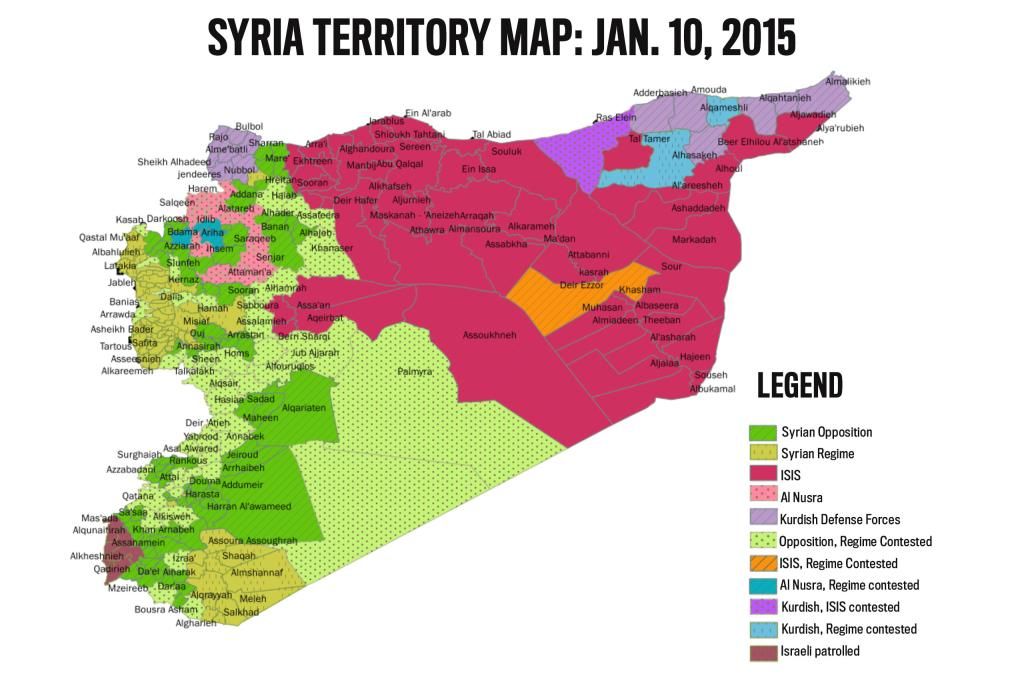
The CDC map linked to in the Daily Beast Article has a situation in Syria that militarily looks pretty grim:

Exclusive: ISIS Gaining Ground in Syria, Despite U.S. Strikes

150113-mak-syria-map-jan-embed.jpg


However, I found the interview with Assad in Foreign Affairs very, very interesting (I tend to really like the quality of the majority articles from Foreign Affairs).

Syria's President Speaks

Rudaw focused primarily on the Turkish aspect (Assad: Erdogan is ‘personally responsible’ for Syrian chaos), although I found that there is a lot more interesting aspects in it.

On the Moscow talks, there was a very long discussion, and I found this part most interesting:

Does that mean you would not want to meet with opposition forces that are backed by outside countries?
We are going to meet with everyone. We don’t have conditions.

No conditions?
No conditions.

You would meet with everyone?
Yes, we’re going to meet with everyone. But you have to ask each one of them: Who do you represent? That’s what I mean.

...

So what do you see as the best way to strike a deal between all the different parties in Syria?
It’s to deal directly with the rebels, but you have two different kinds of rebels. Now, the majority are al Qaeda, which is ISIS and al-Nusra, with other similar factions that belong to al Qaeda but are smaller. Now, what’s left, what Obama called the “fantasy,” what he called the “moderate opposition”—it’s not an opposition; they are rebels. Most of them joined al Qaeda, and some of them rejoined the army recently. During the last week, a lot of them left those groups and came to the army.

Are these former defectors who came back?
Yes, they came back to the army. They said, “We don’t want to fight anymore.” So what’s left of those is very little. At the end, can you negotiate with al Qaeda, and others? They are not ready to negotiate; they have their own plan. The reconciliation that we started and Mr. de Mistura is going to continue is the practical solution on the ground. This is the first point. Second, you have to implement the Security Council resolution, no. 2170, on al-Nusra and ISIS, which was issued a few months ago, and this resolution is very clear about preventing anyone from supporting these factions militarily, financially, or logistically. Yet this is what Turkey, Saudi Arabia, and Qatar are still doing. If it’s not implemented, we cannot talk about a real solution, because there will be obstacles as long as they spend money. So this is how we can start. Third, the Western countries should remove the umbrella still referred to by some as “supporting the moderate opposition.” They know we have mainly al Qaeda, ISIS, and al-Nusra

The aspect with Iran, Hezbollah, and Israel was also very interesting. He even makes some surprising admissions on HW abuses, although he refuses to touch upon some of the grievous UN data on regime HR abuses:

In terms of lower-level practical mistakes, are people being held accountable, say, for human rights abuses, for the excessive use of force, or the indiscriminate targeting of civilians, those kinds of things?
Yes. Some people were detained because they breached the law in that regard, and that happens of course in such circumstances.

In terms of their treatment of civilians or protesters, is that what you’re referring to?
Yes, during the protests at the very beginning, yes.

...
Part of what makes Washington so reluctant to cooperate with you more formally are the allegations of serious human rights abuses by your government. These allegations aren’t just from the U.S. government; they are also from the UN Human Rights Commission, the independent Special Investigative Commission of the UN. You are familiar with these allegations, I’m sure. They include denying access for relief groups to refugee camps, indiscriminate bombing of civilian targets, photo evidence provided by the defector code-named Caesar, who made a presentation to the U.S. Congress showing terrible torture and abuse in Syrian prisons. Are you prepared to take action on these issues in order to make cooperation with the United States easier?
The funny thing about this administration is that it’s the first one in history to build its evaluation and later decisions on social media. We call it a social media administration, which is not politics. None of these allegations you mentioned are concrete; all of them are allegations. You can bring photos from anyone and say this is torture. Who took the pictures? Who is he? Nobody knows. There is no verification of any of this evidence, so it’s all allegations without evidence.

But Caesar’s photos have been looked at by independent European investigators.
No, no. It’s funded by Qatar, and they say it’s an anonymous source. So nothing is clear or proven...


I thought that you would like his joke on Israel though:

So what do you think Israel’s agenda is?
They are supporting the rebels in Syria. It’s very clear. Because whenever we make advances in some place, they make an attack in order to undermine the army. It’s very clear. That’s why some in Syria joke: “How can you say that al Qaeda doesn’t have an air force? They have the Israeli air force.”
 
That map is pretty useless, not only because it treats desert the same as metropols. Here is a much better one. Gets updated every two weeks, scroll down for older versions (maintained by a "rebel" supporter).
 
Last edited:
Status
Not open for further replies.

Back
Top Bottom