It was more than 60 years ago that Dr. Charles E. R. Bruce offered a radically different perspective on the Sun:
"[The Sun's] photosphere has the appearance, the temperature and the spectrum of an electric arc; its characteristics are that of an arc, because it is an electric arc, or a large number of parallel arcs" [33].
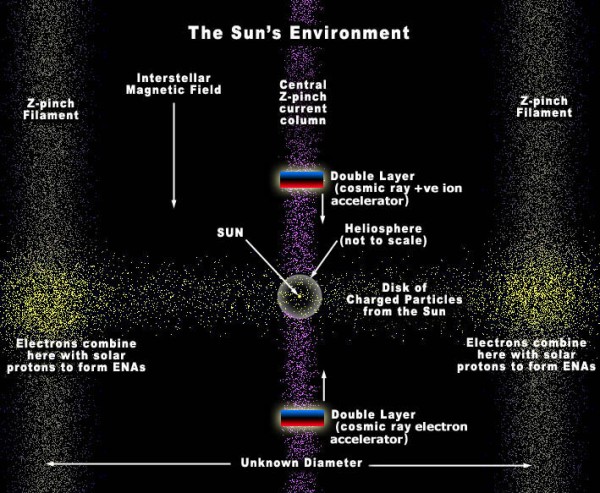
Years later, engineer Ralph Juergens suggested that the Sun is not an electrically isolated body in space, but the most positively charged object in the solar system; in fact, the center of a radial electric field. This field, he said, lies within a larger galactic field. With this hypothesis, Juergens became the first to make the theoretical leap to an external power
source supplying the Sun.
"The phenomena of the photosphere, the phenomena of the chromosphere, the phenomena of the corona, and the known characteristics of the interplanetary medium all fit so nicely into a unifying hypothesis based on energy supplied to the sun from the outside that I cannot resist mentioning it
here: I believe that the sun behaves as an anode collecting electric current from its environment, and that the energy it radiates is delivered entirely by way of this postulated electrical discharge" [34].




 It's becoming more and more obvious the EU / PC view is the best fit to ALL the new space discoveries and data.