What can individual people do about global warming?

The Cuban model is a good place to start.[1] Of course they were forced into it by the collapse of the USSR, which combined with the US embargo forced their economic collapse as well. So they were forced to rebuild their economy from the ground up without high energy inputs.

But that's Communism! :D

Sadly, I don't see this happening in places like the US any time soon. Americans have no cultural concept of "shortage" or "scarcity" and are never motivated to do things unless they understand why. Sure, maybe once Florida is underwater, some people might consider it, but generally people don't do things unless they're imminently forced. There is no planning ahead, there's only reacting to what's already happened.
 
But that's Communism! :D

Sadly, I don't see this happening in places like the US any time soon. Americans have no cultural concept of "shortage" or "scarcity" and are never motivated to do things unless they understand why. Sure, maybe once Florida is underwater, some people might consider it, but generally people don't do things unless they're imminently forced. There is no planning ahead, there's only reacting to what's already happened.
Actually if you keep reading you'll find that Cuba had to step back from it's socialist dogma. I guess when the old Cuban slogan "Socialism or Death" very nearly came true, they chose to live instead.:D

The real question is whether we can learn from the example and change the large energy basis for our economy BEFORE we face starvation and are forced into it? I suspect we will, but not nearly so rapidly.
 

No, merely the essence of efficiency. :)

(I don't remember the privations of the Great Depression or the wartime economies of the "World Wars," but I was born into and raised in the world that resulted from those events, by those who learned and survived the lessons of times,...but then my ancestors have a history of barely surviving the collapses of the societies they originated/blended from within - something all humans have in common)

---I wonder if I can top 8,000 posts before Wednesday morning?
 
Last edited:
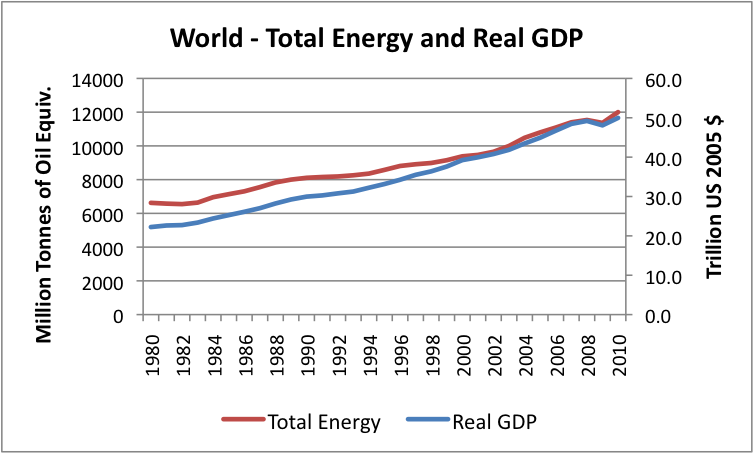
On top of this chart that I have already put up, to show how energy and GDP are related:
world-total-energy-and-real-gdp.png


An IPCC presentation has a slide with the following heading:
Most of the recent GHG emission growth has been driven by growth in economic activitiy
-Slide 9 here:
http://mitigation2014.org/communica...of_Edenhofer_sbsta_sed_wg3_overview1.pdf/view

In addition, New Scientist 5 july 2014 has an article about making the planet sustainable. All the usual stuff of CO2 in atmosphere, deforestation, overfishing etc. that you would expect. But it includes a reference to a study by Peter Victor of York University in Toronto, which found that:
* Business as usual economy increased greenhouse gases (no surprise of course)
* Slamming the breaks on the economy produced catastrophe - mass unemployment and poverty.
* But a phased in carbon tax, boosted anti-poverty programmes, reduced working hours, yielded results to dream of: GDP per person rose to 150% above current levels, and then levelled off, while unemployment, poverty and greenhouse gas emission all fell.

From the article:
It is possible for people to live well in a society in which economic stability rather than economic growth is the norm and social justice is served
http://www.newscientist.com/article...uild-a-sustainable-world--if-you-want-it.html
-Mostly behind a paywall
A more indepth study by Mr Victor is here:
http://www.greenparty.ca/sites/greenparty.ca/files/Peter_Victor-No_growth.pdf

Note: I can't believe I've just linked to the greenparty.ca. I have had so many objections to their policies in the past, it is very ambivilent to find something I generally agree with, but I suppose we often have some common ground with most people/organisations somewhere.

Of course we still need to cut consumption, invest in renewables, cut fossil fuel use etc. But it is economic growth that drives the growth in energy use.
 
Last edited:
But don't consider that economic growth is possible without increased energy use and even possible with decreased energy use.
Not in the long term.
Long term growth of GDP will result in long term growth of energy use. No amount of tweeking can make a growing economy sustainable.

Easily. In sectors of the economy that require high energy use, using energy more efficiently and/or replace them with economic models that don't require any increased input at all to be more productive.
Limits of energy efficiency have already been explained more than once.
Replacing applications are limited. Once you have substituted to a low energy application, any more grow puts you back onto a path of growing energy demand.

Cuba is a prime example of an economy that collapsed due to extreme reduction of energy inputs but that recovered and started growing again once the economic model changed. Especially in agriculture. Now they produce much more at a tiny fraction of the previous high energy inputs.
And will consume more energy once their economy recovers sufficiently. I can't believe people actaully use Cuba as an economic model.

2.3% growth of what? Energy? Population? Economy? Atmospheric CO2? Infrared radiation?
As I have already explained multiple times: 2.3% energy growth each year.
But you already knew that.
The idea that we could actually boil the oceans directly by energy use is kinda ridiculous actually. Sure we can warm the climate, but even that the sun does. We just increase the greenhouse gasses. MacDoc explained your error there.
The laws of physics show you are wrong.
When we reach a level of energy consumption (in this case in 400years), the waste heat from that activity is so great that the Earth boils. As I said earlier, its illustrative to show that growth is not sustainable.

Our economic path shows a corresponding increase in energy use. We can reduce our energy use per person up to a point, but that economic growth will result in a growing energy at some point until we seriously impact on the planet (even more than we are now) even if we stop burning any fossil fuels.

There is absolutely no chance by any foreseeable technology that we could possibly "suck out too much" CO2. As soon as you tried, biological decay and forest fires etc would put it right back. All we can do is make tiny adjustments to that cycle.
Thank you for reinforcing what I have said about the need for limiting growth.
Short answer is you still are wrong in making the assumption that increasing the economy necessarily requires increasing energy use,
More fallacies.
You have provided zero evidence that a growing global economy can be sustainable (ie. with zero energy growth)

or that the economy has to change the net thermal content of the planet.
Another fallacy.
I didn't say it did. I said if we continue with economic growth the waste heat from the increased energy use would warm the planet, owing to its huge quantity regardless of us moving away from fossil fuel use. (See post #125 for charts.)
 
But it is economic growth that drives the growth in energy use.

They are not linked despite your fantasy....you keep repeating
Correlation is not causation.

In addition to that who cares if there energy use if it's from a carbon neutral and/or sustainable source.

Of course we still need to cut consumption,
wrong
invest in renewables,
correct
cut fossil fuel use etc.
correct

The laws of physics show you are wrong.
When we reach a level of energy consumption (in this case in 400years), the waste heat from that activity is so great that the Earth boils. As I said earlier, its illustrative to show that growth is not sustainable.

:dl:

what load of horsepucky:rolleyes:
 
Last edited:
FW

So what are some examples of economic growth models that employ neutral or decreased energy usage? And what can we do about it individually? (Apologies if you already answered this and I missed it.)

Sweden and California and in general even the entire US

http://instituteforenergyresearch.o...rowth-in-households-and-commercial-buildings/

and this has barely scratched the potential.
Wobs is telling such a big lie it's even difficult to know where to begin.

Let's take a real world example.

A baker - can 100% within the carbon cycle and using solar energy for baking his bread - his industry can continue to bake bread as the incoming solar radiation is either used by him or keeps the planet warm via the enhanced greenhouse effect. We can have as much baking with solar as we can consume the output...more Black FOrest Cake please.

The growth in energy use "in his industry" and his industry's "waste heat" has zero impact as it is already in the terrestial energy budget that the sun drives.

Tell us Wobs...trace his "waste heat".....all it is utilization of a form of energy that already has entered the atmosphere and is within the radiation budget.

Perhaps on a ridiculous scale nuclear or fission might act as a climate driver but your premise is hilariously nonsensical.
But even the giant nuclear reactor that the planet itself is hardly registers against incoming SW solar and it's subsequent conversion to LW in the ocean and partial entrapment in the atmosphere.

There are other issues to worry about than increased non-fossil energy use.
Teaching some common sense being one of them.apparently :rolleyes:
 
Last edited:
FW


Sweden and California and in general even the entire US

http://instituteforenergyresearch.o...rowth-in-households-and-commercial-buildings/

and this has barely scratched the potential.
I've already explained this issue before, here it is again:
Examples of efficiency improvements are limited. Why? Well for a start, even if we ignore Jevons Paradox (at our peril) they look at a narrow issue (in this case household energy demand), so while appliances have become more efficient, our wealth has increased, and we buy more stuff, and have more money in the bank due to economic growth. Result? higher energy footprint overall (and while we still burn fossil fuels, higher carbon footprint)

Remember that many manufacturing and other industries have gone to devoping regions of the world, where we enjoy the products of these endeavours, but on the face of it, our footprint looks like its gone down when our actual energy budget has gone up over the long term.

Now lets look at those improvements in technology:
We average about 1% each in energy efficiency. This includes large % improvements in fridges, and lower % increments for things like power stations. How far will this go? there is always a theoretical limit for every efficiency measure we try to do.

Motors, hydroelectric, etc all have ~90% efficiency
LEDs are getting up to 135ln/w (some claimed higher), but the limit is 251ln/w.

What does society do when all our technology has reached these limits? You can't break the laws of physics. There is no perpetual motion devices.

When efficiency is maxed out, economic growth will result in more energy usage on top of the energy growth already shown in the chart in posts #133 & #144.

Let's take a real world example.

A baker - can 100% within the carbon cycle and using solar energy for baking his bread - his industry can continue to bake bread as the incoming solar radiation is either used by him or keeps the planet warm via the enhanced greenhouse effect. We can have as much baking with solar as we can consume the output...more Black FOrest Cake please.

The growth in energy use "in his industry" and his industry's "waste heat" has zero impact as it is already in the terrestial energy budget that the sun drives.

Tell us Wobs...trace his "waste heat".....all it is utilization of a form of energy that already has entered the atmosphere and is within the radiation budget.
A baker can only produce so many loaves or cakes, as we can only eat so many (assuming a levelled off world population). And assuming we don't start using bread as a currency LOL.


Perhaps on a ridiculous scale nuclear or fission might act as a climate driver but your premise is hilariously nonsensical.
But even the giant nuclear reactor that the planet itself is hardly registers against incoming SW solar and it's subsequent conversion to LW in the ocean and partial entrapment in the atmosphere.
As I have already said, (and shown in the charts in post #125, but here they are again below), we have over 200years before we feel this effect under an energy growth rate of 2.3%. This is even with no fossil fuel use.

Try it yourself if you want in a spreadsheet. We use something like 14*10^12W globally. Now add 2.3% each year, and the compound increases each year brings you to 1.22*10^17W in 400 years.

The waste heat from that would cook the Earth given waste heat is calculated by radiative power scales as the fourth power of temperature. And this is with renewables and/or nuclear fusion/fission or some other energy source that obeys the laws of physics.

Its the joy of exponential increases.
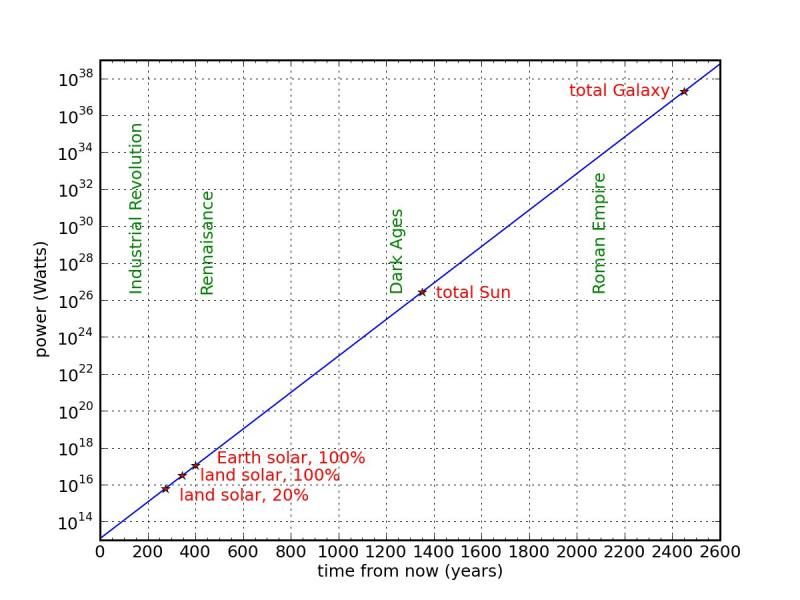

-20% solar means 20% efficiency solar panels covering all land
-100% solar means 100% efficiency covering all land (thermodynamics be damned).
-Earth solar 100% means covering the whole Earth with 100% efficient solar panels
These numbers are illustrative to give you an idea of scale, given a certain growth rate.

Here is the effect of using those levels of energy:
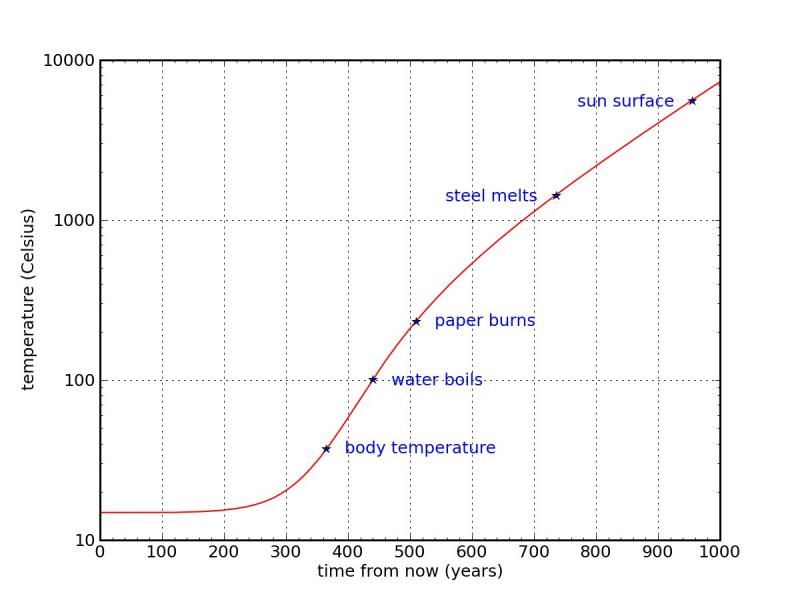
Notice the first 200ish years, we don't notice anything, but due to the increase being proportionate (2.3%), rather than increasing by a set level, the issue compounds.

But I'll say it again, this is simply illustrative, to show how economic growth is not sustainable. It is just another limiting factor for the economic model the world works to.

Edit:
But as I've said before, with a stabilising world population, I believe we shouldn't be looking to have growing economy in the long term. That we should be looking at a measure of development where we can say "that's enough growth", given a level of quality of life. We don't need more economic growth(and by extension energy growth) when the world attains a sufficient level of development. But what we do need is a plan of how to get there, and how to prosper under such a steady state economy going beyond that point.

 
Last edited:
20% solar means 20% efficiency solar panels covering all land
-100% solar means 100% efficiency covering all land (thermodynamics be damned).
-Earth solar 100% means covering the whole Earth with 100% efficient solar panels
These numbers are illustrative to give you an idea of scale, given a certain growth rate.

You really don't understand do you.....the limit of solar power remains with the incoming radiation and in no way "cooks" the planet.
Fooling with numbers like that is a fools game.

We can for practical purposes infinite economic growth AND a reduced energy footprint for the entire planet well within the current radiative balance.

Your premise is just a distraction from what is the primary goal and that is to leave fossil fuels in the ground AND enjoy an unparallelled quality of life and energy usage with as many toys and lights on as we desire.
 
And will consume more energy once their economy recovers sufficiently. I can't believe people actaully use Cuba as an economic model.
If they learned from past mistakes and had to go back on the political agenda they had used up to that point, why not use them as a model?

The laws of physics show you are wrong.
When we reach a level of energy consumption (in this case in 400years), the waste heat from that activity is so great that the Earth boils. As I said earlier, its illustrative to show that growth is not sustainable.

...

Another fallacy.
I didn't say it did. I said if we continue with economic growth the waste heat from the increased energy use would warm the planet, owing to its huge quantity regardless of us moving away from fossil fuel use. (See post #125 for charts.)
Wait, what? Are you saying that we would continue to heat up the Earth even if we move off of fossil fuels? How does that work? Are you talking about the positive feedback chain reactions occurring in the environment today raging out of control in spite of our activity? Or are you saying that any human activity regardless will heat up the Earth?
 
You really don't understand do you.....the limit of solar power remains with the incoming radiation and in no way "cooks" the planet.
You don't get it.
If we consume enough energy, we will cook the planet no matter what technology we use to generate said energy. It could be renewables, fission, fusion, or some undiscovered technology. The laws of physics dictate that we will have waste heat, and at those quantities, it would cook the Earth. I have even showed you where this takes us with raw numbers, and yet you still deny it. Why?

We can for practical purposes infinite economic growth AND a reduced energy footprint for the entire planet well within the current radiative balance.
You might want to re-think this. Infinite economic growth would require a never ending improvement in efficiency. It would eventually require us to operate technology at greater than 100% efficiency. I think you'll find that might be a bit tricky, as I've already discussed.

There is a limit to the efficiency of every technology, be it motors, light bulbs, battery chargers, fridges..... We know how much energy is required to lift a person a certain distance, to pump a unit of water, to light a room to a certain standard, to drive a highspeed train etc. And for all of these things, there is a limit to how little energy we can use.

Your premise is just a distraction from what is the primary goal and that is to leave fossil fuels in the ground AND enjoy an unparallelled quality of life and energy usage with as many toys and lights on as we desire.
Edit:
Why?
If we get the world population to a certain acceptable level of quality of life, why grow the economy further? It would only have a detrimental effect on the environment, and wouldn't make the population happier on average. Once we have maxed out energy efficiency, we will only increase energy consumption for the sake of economic growth for its own sake.
 
Last edited:

You might want to look into why California has reduced its consumption per person:
http://piee.stanford.edu/cgi-bin/docs/publications/Deconstructing_the_Rosenfeld_Curve.pdf
"For 2001, we find that up to about 23% of the overall difference between California and the United States could be due to policy measures, the remainder being explained by various structural factors."

So, energy policy had little influence on the difference, but other societal factors (which are numerous) had a greater effect.
 
You just don't get it wobs do you? The planet has a certain amount of energy entering the system, and a certain amount of energy leaving the system. Primarily that source is the sun. The input of solar energy doesn't change if the energy is used or not used in an economy. In other words, it makes little difference to the energy budget of the planet if the apple decays on the forest floor, or if a deer eats it and a bear eats the deer, or if a human being collects and sells that apple to another human being who then eats it. In one case the apple helps drive an economy, and in the others it doesn't. Nor does the value the humans put on that apple change its calorie content. Nor does a loan to buy the apple effect the calorie content. Nor does the commodity market. Nor does any taxes on anyone making an economic gain from trading that apple. None of the economic activity that we humans abstractly place on that apple change it's calorie content one bit. The calories of energy in the apple remain the same, and the same amount of energy eventually gets released, ultimately radiating away from the system. Where human activity can and does effect that system is in changing the insulation qualities of the atmosphere, not by direct heating of the planet by the economy.
 
Last edited:
You just don't get it wobs do you? The planet has a certain amount of energy entering the system, and a certain amount of energy leaving the system. Primarily that source is the sun. The input of solar energy doesn't change if the energy is used or not used in an economy. In other words, it makes little difference to the energy budget of the planet if the apple decays on the forest floor, or if a deer eats it and a bear eats the deer, or if a human being collects and sells that apple to another human being who then eats it. In one case the apple helps drive an economy, and in the others it doesn't. Nor does the value the humans put on that apple change its calorie content. Nor does a loan to buy the apple effect the calorie content. Nor does the commodity market. Nor does any taxes on anyone making an economic gain from trading that apple. None of the economic activity that we humans abstractly place on that apple change it's calorie content one bit. The calories of energy in the apple remain the same, and the same amount of energy eventually gets released, ultimately radiating away from the system. Where human activity can and does effect that system is in changing the insulation qualities of the atmosphere, not by direct heating of the planet by the economy.

Your ignoring what I have said is noted. Guess that makes your post a strawman arguement.
 
Your ignoring what I have said is noted. Guess that makes your post a strawman arguement.
Again, I am not ignoring your argument. I am saying your argument is wrong, irrelevant, flawed, mistaken, illogical....pick whatever term you wish.

ETA One thing I will add though. Not everything you said is flawed. You did say this:
Earning lots (and working lots) works if that work is to help the environment.
That goes back partly to what I noted earlier about changing the economic model so that society values more those sectors of the economy that don't increase AGW, while diminishing those that do increase AGW. Then growing the economy can actually be helpful.
 
Last edited:
Again, I am not ignoring your argument. I am saying your argument is wrong, irrelevant, flawed, mistaken, illogical....pick whatever term you wish.

ETA One thing I will add though. Not everything you said is flawed. You did say this: That goes back partly to what I noted earlier about changing the economic model so that society values more those sectors of the economy that don't increase AGW, while diminishing those that do increase AGW. Then growing the economy can actually be helpful.

So if the economy grows so much that we use 1.22*10^17W every hour in 400 years time (see projection in previous post), where will all the waste heat go? Assuming we obey the laws of physics of course as stated many times already.

Macdoc said only a few posts up that he/she believes:
We can for practical purposes infinite economic growth

Energy efficiency will not prevent this.

Remember, I have said repeatedly that this is just illustrative, to show how a growing economy is not sustainable. I am not saying we will be doing that. The numbers are there to demonstrate why we can't continue to grow the economy indefinitely.
 
Last edited:
Everyone: the problem is, wobs is talking about an almost entirely different issue, and illustrating it in a confusing way.

Wobs is talking about how exponential growth must always be unsustainable in the long run. As an example, wobs is pointing to waste heat: even if there were no other limits to growth, eventually exponential growth in energy use produces too much waste heat for the planet to radiate into space without heating up to ridiculous temperatures. This is not meant to be (I hope) a realistic argument about an actual problem, but an extreme-case example akin to calculations showing how a breeding pair of rabbits, with no other constraints on their population, could fill up the entire solar system with rabbits in a few decades.

I think everyone can agree that except for locally (e.g. effluent into a river or bay), waste heat from industry is not a problem today, any more than rabbit overpopulation is. (Personally, I don't think it will ever be, because there are too many other constraints on exponential industrial growth for that one to ever come into play. I don't even think another doubling of industrial output is possible.)

But since everyone else is talking about greenhouse warming due to carbon emissions from industry, which is a real problem today in the real world, wobs' example is causing a lot of confusion and friction. It's as though everyone else is saying "the car's going too fast, we should slow down and steer more carefully before it goes off a curve" and wobs keeps pointing out "but in 400 miles the road ends so we're going to crash eventually anyhow."

The answer is, all of the above. Yes, we have to reconfigure our industry to minimize waste and harm, including carbon emissions. Yes, we have to conserve. Yes, we have to adjust our lifestyle expectations. Yes, exponential growth must inevitably stop. And even if we did all these things immediately, which we won't (judging by the fact that we haven't yet), we're still already well into overshoot with respect to natural resources, a situation from which even the best possible remedy will be a disaster of unprecedented scale.

So no, Cuba is not going to resume economic growth, not for very long anyhow. They might get a boost in the short term by re-connecting with the world economy, but eventually the world economy will be where Cuba is now.
 
Waste heat from increased energy use:
Everyday appliances—including toasters, boilers, and lawn mowers—all generate heat while operating far from their theoretical efficiency limits. Electricity production is currently ~37% efficient, automobile engines are ~25% efficient, and ordinary incandescent lightbulbs are only ~5% efficient; the rest is immediately lost as heat.
Even every Internet search creates heat at the Web server, and each click of the keyboard engenders heat in our laptops. Information data processing of mere bits and bytes causes a minuscule rise in environmental temperature (owing to flip/flop logic gates that routinely discard bits of information).
Individual computer chips, miniaturized yet arrayed in ever higher densities and passing even higher energy flows, will someday be threatened by self-immolation.
Such widespread inefficiencies would seem to present major opportunities for improved energy conversion and storage. But there are limits to advancement. No device will ever be perfectly efficient, given friction, wear, and corrosion that inevitably create losses.
https://www.cfa.harvard.edu/~ejchaisson/reprints/Eos_AGU_Chaisson08.pdf

The numbers in the link differ, owing to different assumptions, but the principle is the same, that:
Because flux scales as σT 4, Earth’s surface temperature will rise ~3ºC (an IPCC “tipping point”)
In this case, the 3C rise would occur in 275years, and that is just from waste heat, not from greenhouse gas emissions. Edit: (Again, I am not denying CO2 and other gasses are important issues).

And found from here:
http://en.wikipedia.org/wiki/Waste_heat
Simple global-scale estimates with different growth rates of anthropogenic heat[15] that have been actualized recently[16] show noticeable contributions to global warming, in the following centuries. For example, a 2% p.a. growth rate of waste heat resulted in a 3 degree increase as a lower limit for the year 2300. Meanwhile, this has been confirmed by more refined model calculations.[17]
 
Last edited:
Waste heat from increased energy use:

https://www.cfa.harvard.edu/~ejchaisson/reprints/Eos_AGU_Chaisson08.pdf

The numbers in the link differ, owing to different assumptions, but the principle is the same, that:

In this case, the 3C rise would occur in 275years, and that is just from waste heat, not from greenhouse gas emissions. Edit: (Again, I am not denying CO2 and other gasses are important issues).
There is a huge difference between 3 degrees, and only if that extra energy comes from non-renewable sources, and your claim that we would boil the oceans and it doesn't matter if the energy is renewable or not. But in any case, atmospheric greenhouse gases play a much larger factor. Even that 3 degrees wouldn't happen if their amount in the atmosphere were lowered enough to reverse AGW and it would be much more if the greenhouse gases continue to rise.
 
Last edited:

Back
Top Bottom