FW
Sweden and California and in general even the entire US
http://instituteforenergyresearch.o...rowth-in-households-and-commercial-buildings/
and this has barely scratched the potential.
I've already explained this issue before, here it is again:
Examples of efficiency improvements are limited. Why? Well for a start, even if we ignore Jevons Paradox (at our peril) they look at a narrow issue (in this case household energy demand), so while appliances have become more efficient, our wealth has increased, and we buy more stuff, and have more money in the bank due to economic growth. Result? higher energy footprint overall (and while we still burn fossil fuels, higher carbon footprint)
Remember that many manufacturing and other industries have gone to devoping regions of the world, where we enjoy the products of these endeavours, but on the face of it, our footprint looks like its gone down when our actual energy budget has gone up over the long term.
Now lets look at those improvements in technology:
We average about 1% each in energy efficiency. This includes large % improvements in fridges, and lower % increments for things like power stations. How far will this go? there is always a theoretical limit for every efficiency measure we try to do.
Motors, hydroelectric, etc all have ~90% efficiency
LEDs are getting up to 135ln/w (some claimed higher), but the limit is 251ln/w.
What does society do when all our technology has reached these limits? You can't break the laws of physics. There is no perpetual motion devices.
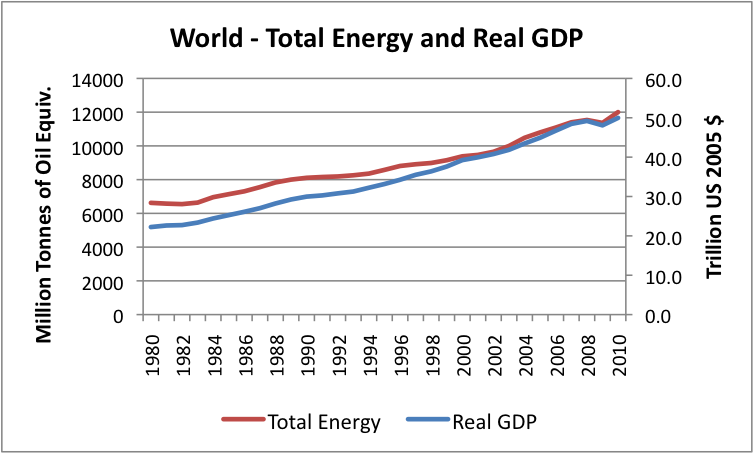
When efficiency is maxed out, economic growth will result in more energy usage on top of the energy growth already shown in the chart in posts #133 & #144.
Let's take a real world example.
A baker - can 100% within the carbon cycle and using solar energy for baking his bread - his industry can continue to bake bread as the incoming solar radiation is either used by him or keeps the planet warm via the enhanced greenhouse effect. We can have as much baking with solar as we can consume the output...more Black FOrest Cake please.
The growth in energy use "in his industry" and his industry's "waste heat" has zero impact as it is already in the terrestial energy budget that the sun drives.
Tell us Wobs...trace his "waste heat".....all it is utilization of a form of energy that already has entered the atmosphere and is within the radiation budget.
A baker can only produce so many loaves or cakes, as we can only eat so many (assuming a levelled off world population). And assuming we don't start using bread as a currency LOL.
Perhaps on a ridiculous scale nuclear or fission might act as a climate driver but your premise is hilariously nonsensical.
But even the giant nuclear reactor that the planet itself is hardly registers against incoming SW solar and it's subsequent conversion to LW in the ocean and partial entrapment in the atmosphere.
As I have already said, (and shown in the charts in post #125, but here they are again below), we have over 200years before we feel this effect under an energy growth rate of 2.3%. This is even with no fossil fuel use.
Try it yourself if you want in a spreadsheet. We use something like 14*10^12W globally. Now add 2.3% each year, and the compound increases each year brings you to 1.22*10^17W in 400 years.
The waste heat from that would cook the Earth given waste heat is calculated by radiative power scales as the fourth power of temperature. And this is with renewables and/or nuclear fusion/fission or some other energy source that obeys the laws of physics.
Its the joy of exponential increases.
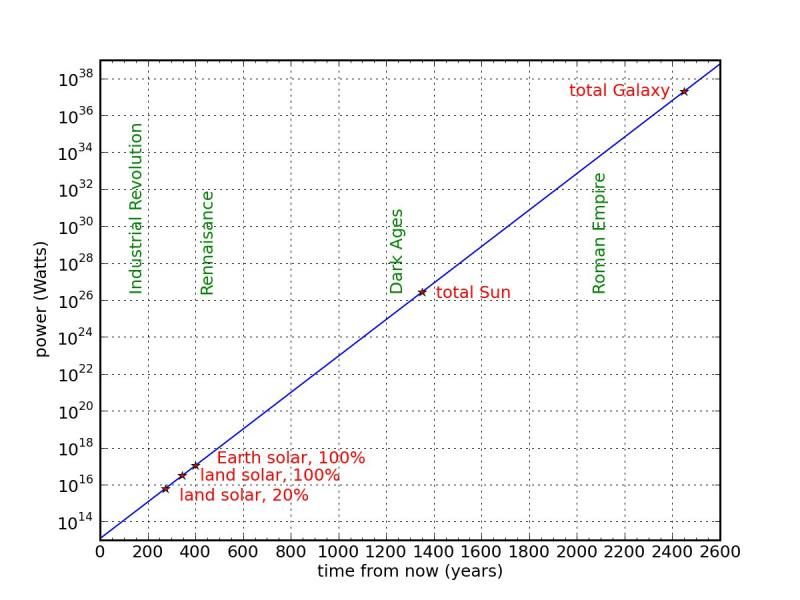
-20% solar means 20% efficiency solar panels covering all land
-100% solar means 100% efficiency covering all land (thermodynamics be damned).
-Earth solar 100% means covering the whole Earth with 100% efficient solar panels
These numbers are illustrative to give you an idea of scale, given a certain growth rate.
Here is the effect of using those levels of energy:
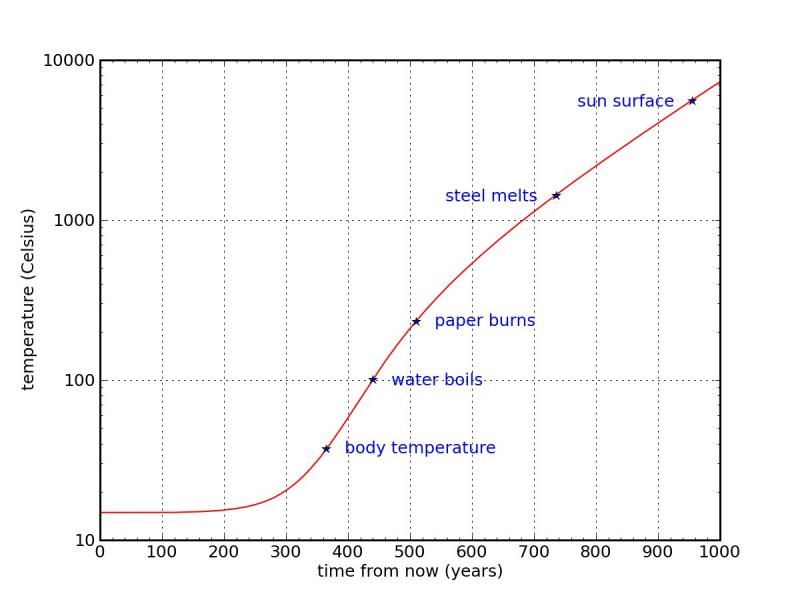
Notice the first 200ish years, we don't notice anything, but due to the increase being proportionate (2.3%), rather than increasing by a set level, the issue compounds.
But I'll say it again, this is simply illustrative, to show how economic growth is not sustainable. It is just another limiting factor for the economic model the world works to.
Edit:
But as I've said before, with a stabilising world population, I believe we shouldn't be looking to have growing economy in the long term. That we should be looking at a measure of development where we can say "that's enough growth", given a level of quality of life. We don't need more economic growth(and by extension energy growth) when the world attains a sufficient level of development. But what we do need is a plan of how to get there, and how to prosper under such a steady state economy going beyond that point.