Split Thread WWII & Appeasement

I agree that the military situation was better in 1940 than in 1938. Chamberlain believed there were deficiencies in the air force in 1938, and that was dangerous. How on earth could the RAF or British Navy have saved the Czechs in 1938? The French and Soviet Russia didn't want to know, and neither ddi America or Canada or New Zealand or Australia.

There is an opinion in that Alfred Price Battle of Britain book in 1989:

Henri, I'll give you a small concession. There is no way Chamberlain should've have unilaterally given Germany an ultimatum: invade Czechoslovakia and Britain shall declare war. That would've been the act of a crazy person. Instead he should've gone to the other half of the Allies: France and the Soviet Union, and asked them to publicly declare the same. Hitler probably backs down knowing that he was going to face war with 3 of the most powerful militaries* in the world at the time, simultaneously, and basically alone. Had they refused, then "peace in our time" was the right call.

*recall that the USSR's horrible struggle against Finland in the Winter War was what largely convinced Hitler, hey the Red Army isn't really all that. That hadn't happened yet in '38
 
But they would have come to the aid if their allies the Czechs


In the technical sense that some bombers could have reached London in 1938 flying from bases in Germany this is technically true. There is no reason to suppose these decidedly less powerful attacks would have been more effective than the far larger raids of 1940 at terrorizing the population.


Yeah there you are buying into the mythic version of the BoB, the RAF was never really that close to defeat, certainly nowhere near offering the kind of air superiority a landing would have needed.


Yes we realize you 'think' a great many things that are utter nonsense. A far stronger Wehrmacht in 1939-40 needed nine months to recover from Attacking Poland to striking at France and that was with the USSR as an ally. Supposing they could somehow mount such an attack in 1938 with a Hostile Soviet union at their back is pure fantasy.


It was dangerous for the Battleships mainly because of the threat of U-Boat attack, the destroyers that would have intercepted an attempted German landing, not that any such thing was remotely possible in 1938 any more than it was in 1940


I'm sure there is, but we are having a discussion on this forum so if you have any facts to offer please post them here.

And to remind you of some of the outstanding issues you have yet to address:

You claimed Britain would be defeated in a week, please provide evidence for this.

You claimed the USA had the 'military clout' to intervene and then claimed it was too weak to intervene, please state which of these claims you wish to retract.

Good questions which is why he is running from them!

He also seemed to think that the Germans invading the Channel Islands means they could successfully invade England itself - I'd love to see the tricky mind distortion he uses to come up with that. chuckle

He was also asked to comment on why the German air attacks on England in WWI were not successful in causing the British to surrender - they didn't have radar so how did they defend against aerial attacks Henri?
 
I agree that the military situation was better in 1940 than in 1938.

So you're agreeing with yourself essentially?


Chamberlain believed there were deficiencies in the air force in 1938, and that was dangerous.

Again Chamberlain believed that based on false estimate. The question is who gained most from the Munich Agreement, Britain or Germany? Of course you refuse to address it because you know the answer is Germany


How on earth could the RAF or British Navy have saved the Czechs in 1938?

If you could point to where anyone has argued they could in this thread please do so, otherwise address the real questions that have been put to you.

The French and Soviet Russia didn't want to know.

Another claim that contradicts the facts. No one wanted war in 1938 but if it had come over Czechslovakia France would have fought and at the very least the USSR would not have been allied with Nazi Germany and would almost certainly have intervened on behalf of their Czech allies.


and neither did America

Please make up your mind. Did the USA have the clout to intervene but wasn't interested or was it too weak to intervene? Pick one or the other.


or Canada or New Zealand or Australia.

Both wrong and irrelevant.

There is an opinion in that Alfred Price Battle of Britain book in 1989:

I'm sure there is, but if you could go with some facts about 1938 instead of another link discussing the BoB in 1940 it would help your argument, if one can call it an argument.
 
Last edited:
That gave me an idea for Kitten Defence©

Line the roads with kittens - they even slow down nazis. Proof.

[qimg]http://whywelovecats.com/wp-content/uploads/2017/09/A-Waffen-SS-trooper-pets-two-young-kittens.jpg[/qimg]

Unless he's planning on biting their heads off, in which case my idea is rubbish.

He'd still have to stop to bite their heads off


But they would have come to the aid if their allies the Czechs


In the technical sense that some bombers could have reached London in 1938 flying from bases in Germany this is technically true. There is no reason to suppose these decidedly less powerful attacks would have been more effective than the far larger raids of 1940 at terrorizing the population.


Yeah there you are buying into the mythic version of the BoB, the RAF was never really that close to defeat, certainly nowhere near offering the kind of air superiority a landing would have needed.


Yes we realize you 'think' a great many things that are utter nonsense. A far stronger Wehrmacht in 1939-40 needed nine months to recover from Attacking Poland to striking at France and that was with the USSR as an ally. Supposing they could somehow mount such an attack in 1938 with a Hostile Soviet union at their back is pure fantasy.


It was dangerous for the Battleships mainly because of the threat of U-Boat attack, the destroyers that would have intercepted an attempted German landing, not that any such thing was remotely possible in 1938 any more than it was in 1940


I'm sure there is, but we are having a discussion on this forum so if you have any facts to offer please post them here.

And to remind you of some of the outstanding issues you have yet to address:

You claimed Britain would be defeated in a week, please provide evidence for this.

You claimed the USA had the 'military clout' to intervene and then claimed it was too weak to intervene, please state which of these claims you wish to retract.


I refer you to the youtube link I posted earlier

I don't often post youtube links, but think this is quite relevant to the course of this discussion

:boxedin:

 
Again with the claim that the Navy didn't operate in the Channel.

Certainly the Battleships and Aircraft Carriers were kept at Scapa Flow to keep their anchorage out of air raid range (an anchored ship is a sitting duck for obvious reasons). Similarly U-Boats were a worry but the Cruisers and Destroyers patrolled the Channel constantly. After the fall of France they regularly patrolled right up to and sometimes in to Channel Ports to shoot things up.
 
He was also asked to comment on why the German air attacks on England in WWI were not successful in causing the British to surrender - they didn't have radar so how did they defend against aerial attacks Henri?

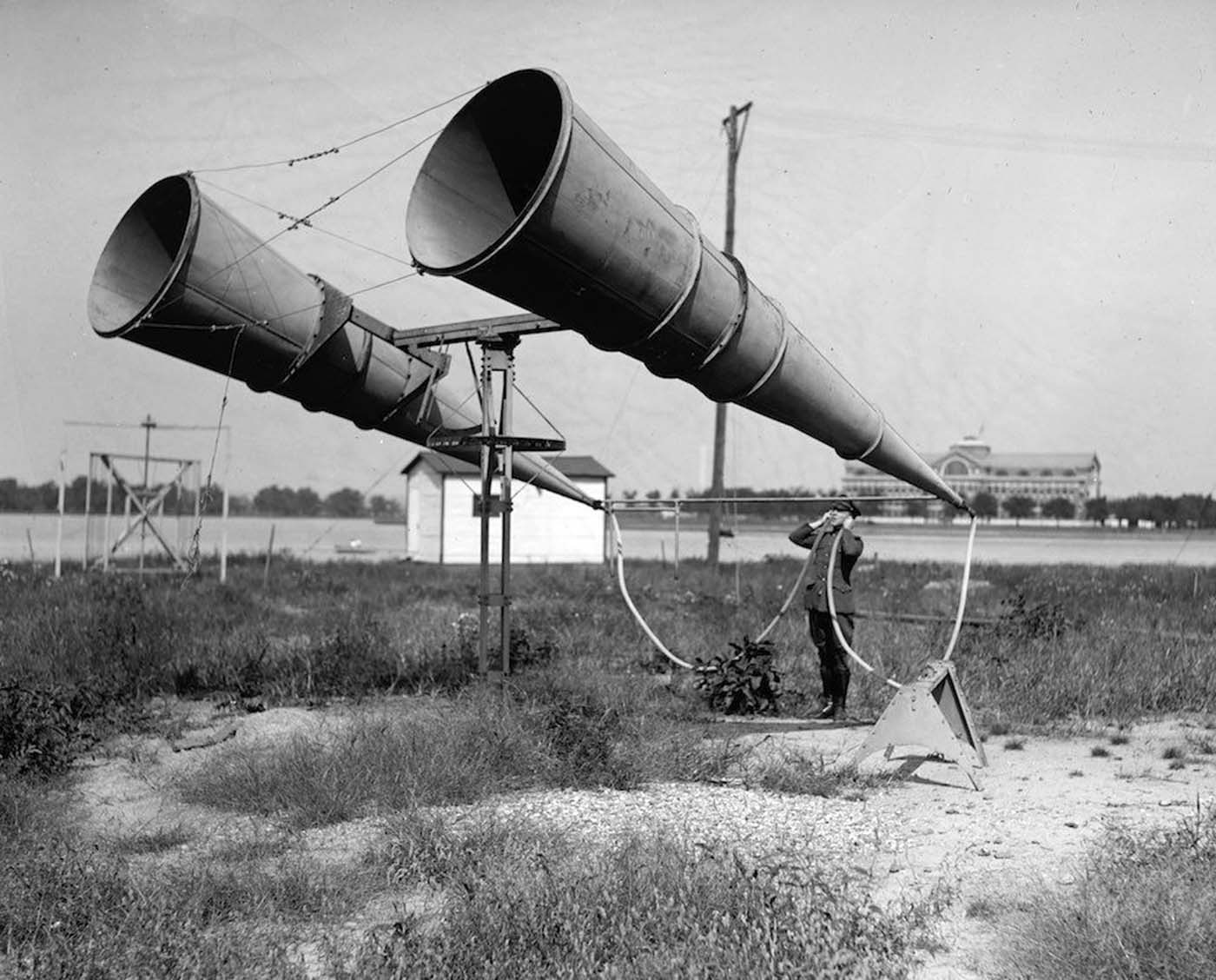
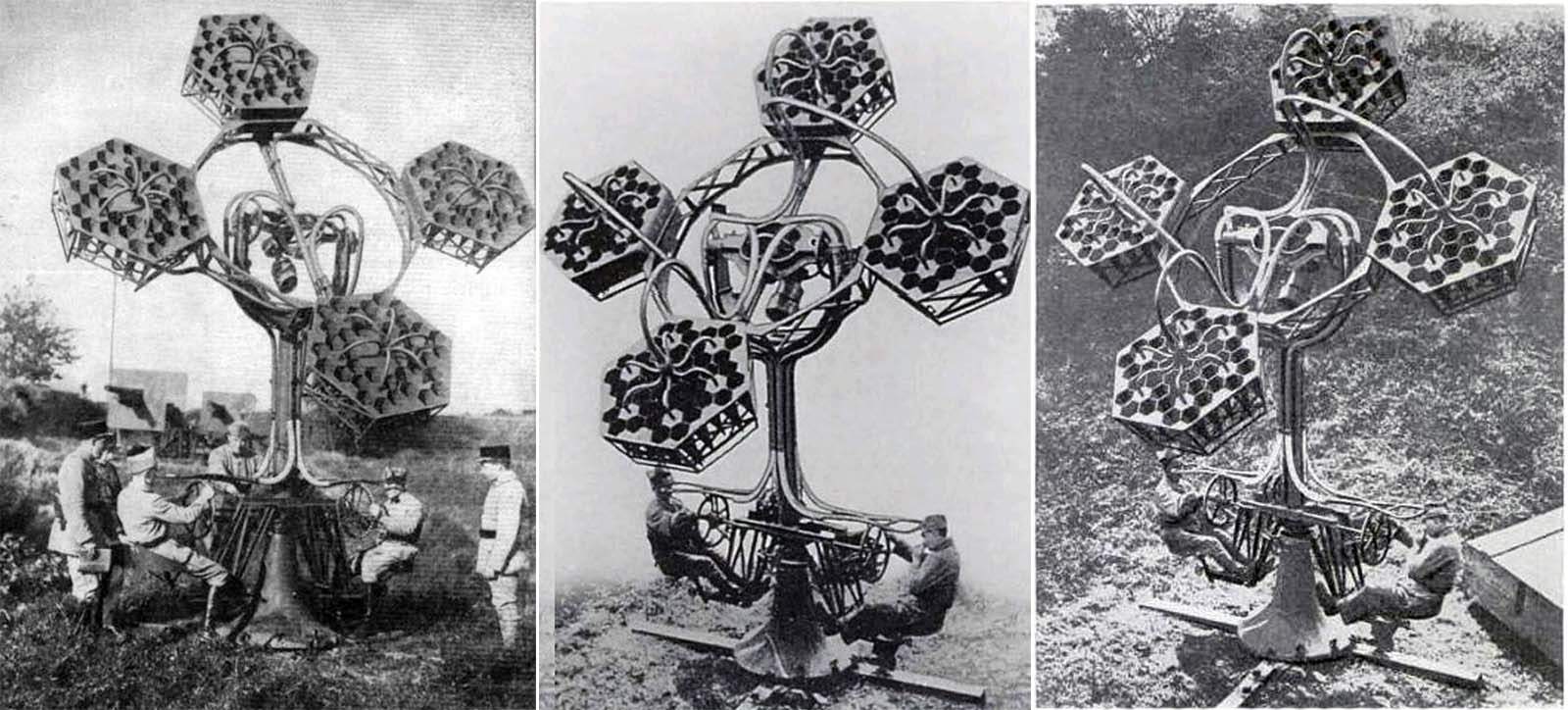
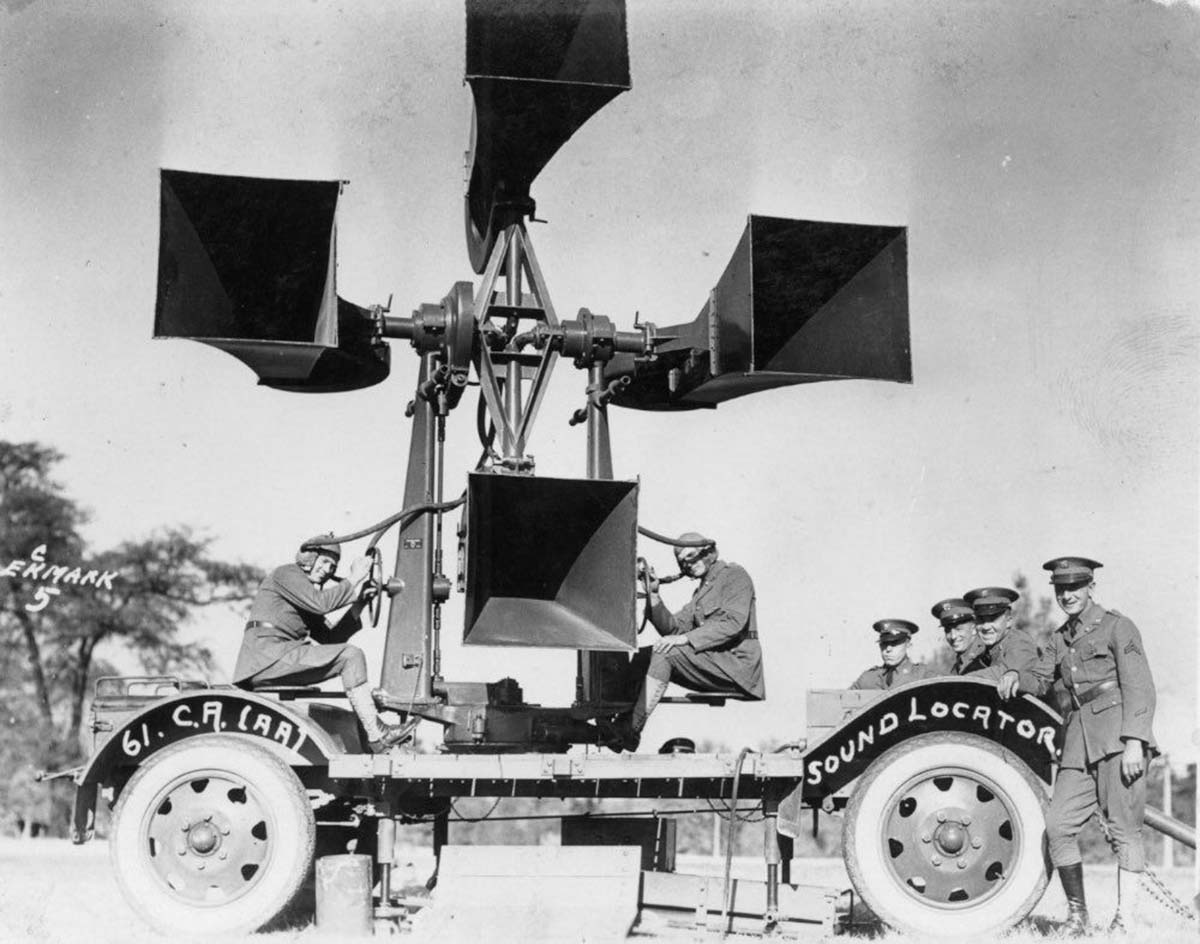
Since Henri is in intellectual coward mode I'll provide more info for my own question.

https://rarehistoricalphotos.com/aircraft-detection-radar-1917-1940/

acoustic_locator_11.jpg


acoustic_locator.jpg


Sound mirrors normally work by using movable microphones to find the angle that maximizes the amplitude of sound received, which is also the bearing angle to the target. Two sound mirrors at different positions will generate two different bearings, which allows the use of triangulation to determine a sound source’s position.

acoustic_locator_12.jpg


Sound mirrors normally work by using movable microphones to find the angle that maximizes the amplitude of sound received, which is also the bearing angle to the target. Two sound mirrors at different positions will generate two different bearings, which allows the use of triangulation to determine a sound source’s position.

Another way was to use trawlers and other small boats to stay at sea and report aircraft sights and sounds.

I look forward to Henri's claim that the German had silent aircraft engines--lol
 
Last edited:
Since Henri is in intellectual coward mode I'll provide more info for my own question.

https://rarehistoricalphotos.com/aircraft-detection-radar-1917-1940/

[qimg]https://4.bp.blogspot.com/-eyPsCUn0O68/V8jmQwIYR5I/AAAAAAAAK4g/R_jxLZp6Xa47n9KAVaQ2LEzv0hWWHEeKwCLcB/s1600/acoustic_locator_11.jpg[/qimg]

[qimg]https://4.bp.blogspot.com/-f_NZX5a1bZE/V8jmRNFSDjI/AAAAAAAAK4k/36n01fNBaPoDwnwDAXaL7xs8ClVLmM6QwCLcB/s1600/acoustic_locator.jpg[/qimg]


[qimg]https://2.bp.blogspot.com/-8cbKCMBdDvw/V8jmRC7_WPI/AAAAAAAAK4s/mW24UNfiYZcMz_MAEjZnnWwzoHK_VsXfwCLcB/s1600/acoustic_locator_12.jpg[/qimg]


Another way was to use trawlers and other small boats to stay at sea and report aircraft sights and sounds.
I look forward to Henri's claim that the German had silent aircraft engines--lol

To be fair, a lot of the German aircraft engines would have been silent by the time they reached the shores of the UK.
 
Also called U-Flugzeug.

Lets not forget that the Soviets designed submarine transports to move their armies underseas - learned of course from captured Nazi plans that were fully developed and in use in 1937. There existence being so top secret the Germans didn't even know about them.

Project-621.gif


http://www.public.navy.mil/subfor/u.../Issues/Archives/issue_13/soviets_giants.html

Hey Henri if you are going to make stuff up at least make up BIG stuff......

Here is an American design from the same super secret Nazi files

Soviet-Giants.gif
 
Last edited:
Lets not forget that the Soviets designed submarine transports to move their armies underseas - learned of course from captured Nazi plans that were fully developed and in use in 1937. There existence being so top secret the Germans didn't even know about them.

[qimg]http://www.public.navy.mil/subfor/underseawarfaremagazine/Issues/Archives/issue_13/USW%20fall%2002/Project-621.gif[/qimg]

I refer you to my previous comment about whisper mode on their aircraft engines.

Most of the German invasion barges would have been submersible.
 
Well if you want to solve the problems of the Bf109's lack of range:

d7rCAXm.jpg


Now granted they didn't start the project until 1942 but...
 
Last edited:
The USSR wasn't that much of a military power in early 1938, though, so I'm not entirely sure why is everyone so fixated on them one way or the other.

First of all, Munich happened right in the middle of the Great Purge. Not even right after it, but WHILE Stalin was busy killing or sending to the Gulag some 35,020 of his officers. (Cf Glantz.) I don't think he was quite prepared to give the army its collective balls back and send them into a war.

The army also had a massive officer problem at the time. To fill in the gaps left by the purges AND rapid expansion of the army, officers were promoted 2-3 levels over what their rank allowed. Officers whose level of training was at best enough for regiments or battalions were given command of whole armies, or in a couple of cases, FRONTS. And to fill in the gaps those left behind, cadets were turned into lieutenants wholesale, without even finishing the military school training. The Soviet Army had a MASSIVE lack of experience or, for that matter, competence at all levels in '38. (Again, cf Glantz.)

The expansion of the army also bore no sane relation to the industry's ability to supply them, a trend that would continue all the way until Barbarossa. The army lacked most of the ammo and spare parts to function anywhere NEAR its nominal strength, and the logistics were actually worse than the German logistics disaster. Which is an achievement.

German industry had actually outproduced the USSR when it came to munitions between '35 and '39 by more than half. (Source: Goldsmith, “Power of victory”.) But the Soviet army had expanded faster than the German army, especially in tanks and aircraft. But the rest of those divisions hadn't kept up with those numbers. You can see where that's going.

And the numbers weren't yet there in the first place anyway. Sure, we all know that in '41 the Red Army had some 8.5 million soldiers. But in '39 it had 1.6 million. In '38 I don't remember exactly, but IIRC it was somewhere around half that.


Basically there's a GOOD REASON why in '38 Stalin didn't go, "Screw you guys! I'm making my own defense of Czechoslovakia. With blackjack! And hookers!" Between the officer problems, Stalin's current paranoia of them, the lack of numbers, the lack of equipment AND the lack of logistics, the Soviet army just wasn't anywhere NEAR prepared for a war in '38. Much less an OFFENSIVE war.
 
Last edited:
The USSR wasn't that much of a military power in early 1938, though, so I'm not entirely sure why is everyone so fixated on them one way or the other.

First of all, Munich happened right in the middle of the Great Purge. Not even right after it, but WHILE Stalin was busy killing or sending to the Gulag some 35,020 of his officers. (Cf Glantz.) I don't think he was quite prepared to give the army its collective balls back and send them into a war.

The army also had a massive officer problem at the time. To fill in the gaps left by the purges AND rapid expansion of the army, officers were promoted 2-3 levels over what their rank allowed. Officers whose level of training was at best enough for regiments or battalions were given command of whole armies, or in a couple of cases, FRONTS. And to fill in the gaps those left behind, cadets were turned into lieutenants wholesale, without even finishing the military school training. The Soviet Army had a MASSIVE lack of experience or, for that matter, competence at all levels in '38. (Again, cf Glantz.)

The expansion of the army also bore no sane relation to the industry's ability to supply them, a trend that would continue all the way until Barbarossa. The army lacked most of the ammo and spare parts to function anywhere NEAR its nominal strength, and the logistics were actually worse than the German logistics disaster. Which is an achievement.

German industry had actually outproduced the USSR when it came to munitions between '35 and '39 by more than half. (Source: Goldsmith, “Power of victory”.) But the Soviet army had expanded faster than the German army, especially in tanks and aircraft. But the rest of those divisions hadn't kept up with those numbers. You can see where that's going.

And the numbers weren't yet there in the first place anyway. Sure, we all know that in '41 the Red Army had some 8.5 million soldiers. But in '39 it had 1.6 million. In '38 I don't remember exactly, but IIRC it was somewhere around half that.


Basically there's a GOOD REASON why in '38 Stalin didn't go, "Screw you guys! I'm making my own defense of Czechoslovakia. With blackjack! And hookers!" Between the officer problems, Stalin's current paranoia of them, the lack of numbers, the lack of equipment AND the lack of logistics, the Soviet army just wasn't anywhere NEAR prepared for a war in '38. Much less an OFFENSIVE war.

I think, but I'm not 100% sure, the world's perception of the Red Army prior to the Winter War was that it was pretty formidable.
 
I think, but I'm not 100% sure, the world's perception of the Red Army prior to the Winter War was that it was pretty formidable.

Perception is one thing - actually being able to deliver is another.

As we've discussed earlier, it was a perception in Great Britain that the Germans might be able to effect an invasion in 1940 - the reality was that if the Germans had tried they would have destroyed their own military either through drownings or having the lack of resupply for their invasion force result in their death or capture in short order.

It's Henri's perception that the Luftwaffe could carry out virtually unopposed terror bombing and defeat the UK in a week in 1938. The reality is that most German bombers wouldn't have been able to fly to Britain and return after dropping a minimal bombload, and no fighter escorts for said bombers would have resulted in Snoopy being able to deal with them.
 
Perception is one thing - actually being able to deliver is another.

As we've discussed earlier, it was a perception in Great Britain that the Germans might be able to effect an invasion in 1940 - the reality was that if the Germans had tried they would have destroyed their own military either through drownings or having the lack of resupply for their invasion force result in their death or capture in short order.

It's Henri's perception that the Luftwaffe could carry out virtually unopposed terror bombing and defeat the UK in a week in 1938. The reality is that most German bombers wouldn't have been able to fly to Britain and return after dropping a minimal bombload, and no fighter escorts for said bombers would have resulted in Snoopy being able to deal with them.

Yes, if Hitler thought the Red Army was a huge capable force, that probably would've weighed on his decision to go to war for Czechoslovakia, even if in reality they weren't. Germany would essentially be fighting the same enemies as in WW1, but with no Habsburg or Ottoman empire.

And I've always wondered, how seriously did the flag/general officers in Britain at the time take an operation Sea Lion? For example, did they know Germany's plan relied on towed river barges that were lucky to make 3 or 4 knots?
 
Last edited:

Back
Top Bottom