WTC7 - The fires failed Girder 44-79

Before the NIST stated their findings, you would have been hard pressed to find a single practicing structural engineer who would believe it possible for natural fires to bring about the total high speed collapse of a steel office tower.
Why?

Because from all their experience, education, and acquired knowledge about steel-structured highrise buildings, structural engineers found it inconceivable that any credible fire scenario could accomplish such an historical first.

That is until the NIST created a computer simulation that allowed natural fires to do what they had never done before..sort of. The graphic display of the computer modeled collapse does not accurately resemble what was observed in reality but it does have WTC7 collapsing.

Surprisingly, even though the engineering community's long understanding that steel office towers were invincible to total collapse from natural fires, the NIST's sensational hypothesis was absorbed with hardly a whimper.

But, in the 'drums of war' dark period that followed 9/11, it is hard to imagine that many structural engineers had a willingness to investigate and comment on the NIST's declaration that its WTC7 collapse hypothesis was proven.

MM
That's wrong without pants on.
A number (>1) of engineers worldwide before the NIST stated their findings at the end of 2005, came to the same conclusion.

Collapses of the world trade center towers
[No author name available] 2005 Indian Concrete Journal 79 (8), pp. 11-16

September 11 and fracture mechanics - A retrospective
Cherepanov, G.P. 2005 International Journal of Fracture 132 (2), pp. L25-L26

Structural responses of World Trade Center under aircraft attacks
Omika, Y., Fukuzawa, E., Koshika, N., Morikawa, H., Fukuda, R. 2005 Journal of Structural Engineering 131 (1), pp. 6-15

Use of high-efficiency energy absorbing device to arrest progressive collapse of tall building Zhou, Q., Yu, T.X. 2004 Journal of Engineering Mechanics 130 (10), pp. 1177-1187

Progressive analysis procedure for progressive collapse Marjanishvili, S.M. 2004 Journal of Performance of Constructed Facilities 18 (2), pp. 79-85

Anatomy of a disaster:A structural investigation of the World Trade Center collapses Abboud, N., Levy, M., Tennant, D., Mould, J., Levine, H., King,
S., Ekwueme, C., (...), Hart, G. 2003 Forensic Engineering, Proceedings of the Congress, pp. 360-370

World Trade Center disaster: Damage/debris assessment Thater, G.G., Panariello, G.F., Cuoco, D.A. 2003 Forensic Engineering, Proceedings of the Congress, pp. 383-392

How did the WTC towers collapse: A new theory Usmani, A.S., Chung, Y.C., Torero, J.L. 2003 Fire Safety Journal 38 (6), pp. 501-533

Clifton, Charles G. Elaboration on Aspects of the Postulated Collapse of the World Trade Centre Twin Towers. HERA: Innovation in Metals. 2001. 13 December 2001.

"Construction and Collapse Factors" Fire Engineering v.155, no. 10, (2002): 106-108.

Zdenek P. Bazant, Yong Zhou - Why Did the World Trade Center Collapse?—Simple Analysis - Journal of Engineering Mechanics (Vol. 128, No. 1) - 2002/01

Zdenek P. Bazant, Yong Zhou - Addendum to "Why Did the World Trade Center Collapse?—Simple Analysis"- Journal of Engineering Mechanics (Vol. 128, No. 3)

Corbett, G.P.
"Learning and Applying the Lessons of the WTC Disaster" Fire Engineering v.155, no. 10, (2002.): 133-135.

"Dissecting the Collapses" Civil Engineering ASCE v. 72, no. 5, (2002): 36-46.

Thomas W. Eagar, Christopher Musso ."Why Did the World Trade Center Collapse? Science, Engineering, and Speculation"
JOM v. 53, no. 12, (2001): 8-12. 2001/12. Journal of Materials (JOM) The Minerals, Metals & Materials Society

World Trade Center Building Performance Study: Data Collection, Preliminary Observations, and Recommendations
Federal Emergency Management Agency and the Structural Engineering Institute of the American Society of Civil Engineers (SEI/ASCE) , Therese McAllister, report editor

"Collapse Lessons" Fire Engineering v. 155, no. 10, (2002): 97-103

Marechaux, T.G. "TMS Hot Topic Symposium Examines WTC Collapse and Building Engineering" JOM, v. 54, no. 4, (2002): 13-17.

Monahan, B. "World Trade Center Collapse-Civil Engineering Considerations" Practice Periodical on Structural Design and Construction v. 7, no. 3, (2002): 134-135.

Newland, D.E., & Cebon, D. "Could the World Trade Center Have Been Modified to Prevent Its Collapse?" (2002)

Do you ever tire of being consistently wrong?
Is there anything of significance you have been right about?

 
Last edited:
I believe that I have given an adequate response to that question. Repeatedly re-phrasings serve no useful benefit to this 'discussion'.


I said; "Before the NIST stated their findings, you would have been hard pressed to find a single practicing structural engineer who would believe it possible for natural fires to bring about the total high speed collapse of a steel office tower." I did not say that "every single structural engineer would make that guarantee"


You might want to ask a NIST supporter like Chris Mohr, sinceI believe he also uses the term in his writings.

Or you might like to look here;
http://www.aisc.org/WorkArea/showcontent.aspx?id=7046


bolding is mine

No building?

Again, I believe this question has been appropriately answered.

MM

Yup.

You have answered them.

You think that structural engineers have figured out how to make steel framed office towers 100% impervious to global/total collapse due to unfought office fires based on historical evidence.

You think that based on this historical evidence, design parameters/standards have been implemented for ALL structural engineers to use in order to make said steel framed office towers 100% impervious to global/total collapse to unfought office fires.

Yet based on all these structural design standards and historical evidence, there are still engineers who will not guarantee their steel frame office tower designs to be 100% impervious to global/total collapse due to unfought office fires.

Despite all that you think, they STILL fireproof steel to protect it from... WHAT? Surely if they can design whole steel frame office towers to be 100% impervious to global/total collapse due to unfought office fires, they should be able to sure as crap design a steel framed office tower to be 100% impervious to a PARTIAL collapse right? And now they don't they don't have to fire proof any steel anymore right MM?

Thanks for making your stance VERY clear.

Can you please point me to these universal standards and design parameters available to all structural engineers to use? Can you also let them know that the fire proofing suppliers have been pulling the wool over their eyes for quite some time now?

Thanks again.
 
I love how fast MM had to backpedal from "the science would have said the building wouldn't collapse!" to "the hypothetical engineers would've said it was impossible for the steel-framed office tower to undergo a high-speed total collapse!"

Really, imaginary people who would've hypothetically agreed with him if they had been asked. What more needs to be said.

I wonder how he's going to explain 662? Maybe say that they were influenced by the NIST prelim report? No, wait, that was 2004. The 9/11 Report? No, that was also 2004. Almost every report BasqueArch listed is before 2004. MM? anything to say about 662?
 
The glass, iron and wood Crystal Palace was not a steel framed office tower.

It did not suffer a total high speed collapse and its two towers remained standing until they were later demolished.

"The fire burned most of the night, melting the glass panels and softening the steel superstructure such that, one by one, the great supporting arches twisted and fell. By morning, nothing was left but a tangled ruin."
http://en.citizendium.org/wiki/Crystal_Palace

MM

Why is "office tower" so damn special?

Steel is steel. Period. It hates fire. Bad things can happen, up to and apparently including total collapse!!
 
Originally Posted by Redwood
Humbug. The dangers of fire to steel have been known for ages. That's why fire-resistant measures, such as coatings and masonry have been applied to steel from the beginning.

The mighty Crystal Palace, one of the glories of Victorian architecture, stood for more than 80 years before it was destroyed by fire. If ever an unprotected steel (or cast iron) structure were to survive a massive fire, that would be it, as it was essentially a giant atrium, with minimal live load.


The glass, iron and wood Crystal Palace was not a steel framed office tower.

Correct! As I mentioned, it was a giant atrium. Unlike an office building, it carried a minimal load, which made it less likely to collapse. But collapse, it did, after having stood for more than 80 years.

It did not suffer a total high speed collapse and its two towers remained standing until they were later demolished.

The towers outside the atrium were not involved in the fire.

How is the speed of the collapse relevant? WTC 1 & 2 did indeed fall quickly, at about 60-70% of g. Having the weight of a Tennessee-class battleship (about two, for WTC 2) dropped about 4 meters onto the lower section of the building will tend to do that.

"The fire burned most of the night, melting the glass panels and softening the steel superstructure such that, one by one, the great supporting arches twisted and fell. By morning, nothing was left but a tangled ruin."
http://en.citizendium.org/wiki/Crystal_Palace

MM

Thanks for the reference. There's more in the link:

The Palace was doomed, and rather like Thomas Andrews aboard the Titanic, Sir Henry knew it.

How could he possibly have known the palace was doomed? Everyone knows fire can't harm steel! :rolleyes: Replace a few glass panels, slap on a fresh coat of paint, and it should be good as new after the fire, right?
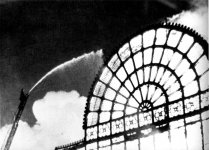
As described by an eyewitness, the sight of the end of the Palace was quite as moving, though in an opposite fashion, as had been its opening by Queen Victoria eighty-two years previous:

"Great crashes and explosions could be heard, and billowing mountains of spark-filled clouds, about twice the height of the 350-ft. towers, rolled away over South Kent, flaming with the glow of the fire . . . when we got to the Crystal Palace parade at the top of the hill, we found a seething mass of people -- cars, bicycles, and pedestrians -- and still more thousands streaming up from every hill and road. Fire-engines trying to run out their hoses; cars and bicycles and humans rushing over the hoses -- and over and above all the blinding blaze of the C.P. alight almost from end to end."

EXPLOSIONS? Must be demolition charges! Call the nanothermite squad!

Also note that the C.P. fire was fought, unlike WTC 1,2, and 7, but the efforts were ineffectual:
 

Attachments

  • Crystal Palace firefighting effort.jpg
    Crystal Palace firefighting effort.jpg
    78.3 KB · Views: 2
Why is "office tower" so damn special?

Steel is steel. Period. It hates fire. Bad things can happen, up to and apparently including total collapse!!

It's retarded. Single story warehouses and giant steel atriums collapse only supporting the weight of a roof. An office tower has multiple floors on top adding to the load. Seems like a giant failure of logic to me.

ETA: Like Redwood said :D
 
Last edited:
It's retarded. Single story warehouses and giant steel atriums collapse only supporting the weight of a roof.

I actually witnessed this happen from an overpass in my hometown. An old furniture warehouse caught fire. The extensive combustibles on the ground level created enough heat to fail the steel trusses holding up the roof. Failure was from thermal loading alone, aside from the ordinary dead load of the roof.
 
I actually witnessed this happen from an overpass in my hometown. An old furniture warehouse caught fire. The extensive combustibles on the ground level created enough heat to fail the steel trusses holding up the roof. Failure was from thermal loading alone, aside from the ordinary dead load of the roof.

How many tanker trucks on fire, under overpasses, completely destroys the bridge? Truthers will say "a bridge isn't a steel framed office building". I say "exactly".
 
How many tanker trucks on fire, under overpasses, completely destroys the bridge? Truthers will say "a bridge isn't a steel framed office building". I say "exactly".

I'm sorry, I was unclear. The warehouse was about half a mile from the overpass, which was undamaged. The overpass simply afforded a birds-eye view of the blaze and resulting collapse.
 
I'm sorry, I was unclear. The warehouse was about half a mile from the overpass, which was undamaged. The overpass simply afforded a birds-eye view of the blaze and resulting collapse.

Ha! I know. I was just giving another example.

 
... The extensive combustibles on the ground level created enough heat to fail the steel trusses holding up the roof. Failure was from thermal loading alone, aside from the ordinary dead load of the roof.

What was the color of the smoke? Don't say black, because black = oxygen-starved = not hot enough to fail steel


[/twoofymode]
 
One completely unsupported personal opinion deserves another.
MM says that prior to 911 one would be hard pressed to find am engineer who would believe that a steel office structure could globally collapse due to fire loading

I say that prior to that date and continueing to the present one would be hard pressed to find an engineer who would state that such a collapse was not a definite possibility given the range of variables that could accompany such a senario

The three WTC structures that did suffer complete collapse were all long span large open space design, one of which was constructed over an existing older low rise structure. The other two experienced what would not conform to the above definition of "natural fire" in that it developed as a result of thousands of gallons of accelerant over several consecutive floors and an eroding of significant amounts of both passive and active fire retarding mechanisms.

MM also points out that such structures as the warehouses and the Crystal Palace collapsed progressivly over time. Others point out the abscense of load in such structures. Inded in an office structure if floor s collapse this removes lateral support to adjacent colums which in turn are under load and should these columns buckle then all that constitutes that load will collapse and represent a dynamic load on the surviving lower floor structure, incidentally already loaded with approx twice the normal dead load (the original floor collapse material)
In common post and beam construction small floor areas collapse in any one instance but in in long span construction large areas collapse
A highly more complex system than a unloaded roof structure.

MM ignores the fact that if instead of a roof there was more structure, then collapse would have that additional mass impacting lower, as yet undamaged structure.

As for JayUtah's query of MM's credentials, he is a video editor which requires no schooling in math or physics or engineering. I do not know if he has any post high school formal training in math, physics or engineering.
My own credentials would be marginally better as an electronic tech who switched to college diploma electronics part way through second year B.Sc.-physics university course and having worked in aviation nav/comm and television production/broadcast
 
I actually witnessed this happen from an overpass in my hometown. An old furniture warehouse caught fire. The extensive combustibles on the ground level created enough heat to fail the steel trusses holding up the roof. Failure was from thermal loading alone, aside from the ordinary dead load of the roof.

And considering that an "office tower" is actually going to be more complex than a warehouse, and thus more prone to failure, MM's insistence on the term actually weakens his case.
 
And considering that an "office tower" is actually going to be more complex than a warehouse, and thus more prone to failure, MM's insistence on the term actually weakens his case.

Not sure that "complexity" would be an issue with regard to failure. On the other hand, an office occupancy is a none entity, whereas a warehouse might have high hazard materials stored, and as a result will have higher rated assemblies around it strucutre.
 
Not sure that "complexity" would be an issue with regard to failure. On the other hand, an office occupancy is a none entity, whereas a warehouse might have high hazard materials stored, and as a result will have higher rated assemblies around it strucutre.

It's not very cost effective to make a giant warehouse a tank. Usually, you have special rooms or containment and a great deal of prevention with haz-mat storage. The worst warehouse fires that I have seen the results of were in paper and cardboard storage facilities. 50,000 sq ft or more worth of fuel. :eek:
 
It's not very cost effective to make a giant warehouse a tank. Usually, you have special rooms or containment and a great deal of prevention with haz-mat storage. The worst warehouse fires that I have seen the results of were in paper and cardboard storage facilities. 50,000 sq ft or more worth of fuel. :eek:

From a fire standpoint, paper, furniture etc at a bigger hazard than many toxic chemicals. Ran into problems with a recent project of a 255,000 sq ft warehouse that had been orginally built just for auto parts - classified low hazard - it was switching to a furniture warehouse, and the requirements for the building increased significantly as did the cost for the retro fit. Everything form the travel distances to the sprinkler system
 

ISF - Join now!

Every member here is approved by hand. No bots, no spam, just people who care about evidence and honest debate.

Membership is free!

Create your free account

Back
Top Bottom