• Quick note - the problem with Youtube videos not embedding on the forum appears to have been fixed, thanks to ZiprHead. If you do still see problems let me know.

WTC7 Revisited

UN numbers for deaths caused by Desert Storm + sanctions. Your apparent misunderstanding smacks of straw old man.


Ah, yes, MY misunderstanding. Of course, Saddam was guilty of nothing when he invaded a sovereign state. Alleged deaths attributable to the U.N. sanctions are American war crimes. Anti-Americanism, like its close relation anti-Semitism, is a strange disease.
 
Your accusations are irrelevant and without foundation and are dismissed as such.

I say this in the spirit of friendship and hope you will take it as such but do yourself a favour do not pretend to lecture me or anybody else about the injustices on this planet. Don't start throwing figures about the death toll in the Middle East nor the effects of the economic sanctions and presume to think that I or anybody else is blissfully unaware. We are all aware; we all fully understand and do not need to be told by you.

I suggest you keep out of this arena in future, state your case, put forward your facts and calculations but do not ever kid yourself that the reason you are subject to "BS" is because grown adults are simply unable to see what is so blindingly obvious to you and you alone.

Your apology is accepted in the same spirit.Now get your thread back on topic.

What is it that is so blindingly obvious to me and me alone?
 
What is it that is so blindingly obvious to me and me alone?

I did initially prepare a lengthy reply to your question but upon reflection have decided against posting it.I will acknowledge other members requests to no longer politicise and derail his thread. I will leave this thread and in doing so again request you reconsider your accusations and withdraw them.

Please do not take this a dodge; it is simply an acknowledgement that to continue a political pissing contest in this thread is not wanted. As such please get your thread back on topic, that being WTC 7.
 
Last edited:
This particular debate seems to take up a lot of bandwidth, both here and on other sites, and I don't understand why.
If a building falls because the load bearing structures failed from fire or damage, or if they fail due to a CD, the building is still going to fall at the same rate, unless whoever is performing the CD wants to blow virtualy every support structure in the building, and doing that doesn't make sense.

I'm not a physics major, or even particularly good at math, but I do have experience with explosives and the techniques of controlled demolitions, and the purpose of a Cd is not to make the building fall faster, it's just to make the building fall ( in a controlled manner so as to minimize demolition/removal expenses).

CD's are planned to remove just enough of the load bearing structures to initiate collapse; this minimizes both the work involved, the time necessary, and the costs involved. Anything else ( such as blowing large enough numbers of load bearing structures to make any appreciable difference in collapse times) is wastefull and pointless. I would think that if it were to be performed in a clandestine manner it would be even more pointless, as it would leave additional detritus that would provide evidence of the act.

So can someone please tell me what the ballyhoo is about?
 
Last edited:
This particular debate seems to take up a lot of bandwidth, both here and on other sites, and I don't understand why.
If a building falls because the load bearing structures failed from fire or damage, or if they fail due to a CD, the building is still going to fall at the same rate, unless whoever is performing the CD wants to blow virtualy every support structure in the building, and doing that doesn't make sense.

I'm not a physics major, or even particularly good at math, but I do have experience with explosives and the techniques of controlled demolitions, and the purpose of a Cd is not to make the building fall faster, it's just to make the building fall ( in a controlled manner so as to minimize demolition/removal expenses).

CD's are planned to remove just enough of the load bearing structures to initiate collapse; this minimizes both the work involved, the time necessary, and the costs involved. Anything else ( such as blowing large enough numbers of load bearing structures to make any appreciable difference in collapse times) is wastefull and pointless. I would think that if it were to be performed in a clandestine manner it would be even more pointless, as it would leave additional detritus that would provide evidence of the act.

So can someone please tell me what the ballyhoo is about?

What you are saying makes sense, but I'm not sure you are entirely correct. While I have no experience with CD, I do understand that normal CD's sever way more structural members than is necessary in order to assure a neat and safe collapse. This can be seen in numerous videos on line where there are explosions throughout the building when all that is necessary is to blow the lowest columns.

How much this would affect the fall time is another question which is compounded by the inaccuracies inherent in the modelling. Nonetheless, I believe I have come far enough with WTC1 and 2 to demonstrate that CD was very unlikely. I am working within the truth movement to spread this knowledge. Contrary to most opinions here, some truthers are actually interested in the truth. I am hoping I can bring the same level of proof to WTC7 regardless of what the conclusion may be.
 
I want to discuss two different topics, namely the air pressurization, and the effective strength of the remaining structure. Let me also say that some of the slings and arrows aimed at Gregory appear unearned. There is an opportunity to learn from this, guys...

Quote cut for brevity. See the rest of Ryan's post here.

I have adjusted my calculation to the actual floor area and shape of the building. I get 16.5 GJ to expel air by the same method. This is still higher than the actual energy expended which is around 14 GJ. It is important to remember that I am not taking aperature or compression into account, only inertia. Thus there is no restriction to the air flowing out of the building so broken windows or missing facade are not an issue.

To refine this further, it would be necessary to estimate any internal damage and also the amount of floor openings due to elevators and such which would reduce the floor area. I would appreciate any opinions on upper and lower bounds for these.

Responses to Ryan:

#1. I'm not sure I agree that there is no cost to get the air moving. The air is not moving relative to it's compartment. I agree that it will have momentum and as the lower floor of the compartment is decellerated during impact there will be some pressure caused by the decelleration of the air as well but I think that this will be negligible compared to the pressure caused by the compaction of the compartment.

#2. In order to arrive at the expended energy during collapse. I am removing energy interatively in "jerks" at each floor impact such that the fall time becomes 6.5 sec. My interpretation of "very little structural resistance" is based on the air resistance accounting for all resistance rather than the comparatively low total energy dissipated during collapse which is expected in a bottom up collapse.

#3. Dr. Greening has pointed out previously that adiabatic heating can be a significant energy factor. Have you taken this into account in your more "pressure oriented" method?

#4. Agreed.

#5. At this level of refinement, I would caution the truth movement not to jump up and down crying CD is proven. There are still a lot of factors that have not been taken into account.
 
Last edited:
What you are saying makes sense, but I'm not sure you are entirely correct. While I have no experience with CD, I do understand that normal CD's sever way more structural members than is necessary in order to assure a neat and safe collapse. This can be seen in numerous videos on line where there are explosions throughout the building when all that is necessary is to blow the lowest columns.

How much this would affect the fall time is another question which is compounded by the inaccuracies inherent in the modelling. Nonetheless, I believe I have come far enough with WTC1 and 2 to demonstrate that CD was very unlikely. I am working within the truth movement to spread this knowledge. Contrary to most opinions here, some truthers are actually interested in the truth. I am hoping I can bring the same level of proof to WTC7 regardless of what the conclusion may be.
Oh, you joined the guys with the "ample evidence" to tell them they are wrong? So we the people did not do it to our selves, 19 terrorist did it and CD is a fantasy along with thermite of Jones (who made it up 4 years out of the blue after 9/11 because he is anti-war, but would rather attack others politically). Have you told them yet they are missing the "ample evidence".

Yep, I joined the NAZIs to tell them they were wrong; You can not hang me for that. lol; you are one not so truthful truther.

You better get back to learning how things work, with help from the guys here who help you learn. Back to WTC7 revisited, the smoking gun many a time for the 9/11 truth movement.
 
Gregory:
What have you used for the end point (lack of better word) of the collapse? What I'm referring to is the building unlike the towers was not completely demolished (large section of the north face laid over the pile). The collapse (by looking at the photos of the debris pile) seamed to die out toward the end. The building was also falling over instead of straight down. Some pictures of the pile,ect
http://www.debunking911.com/pull.htm

I'm wondering how much this would figure into you equations?
 
Gregory:
What have you used for the end point (lack of better word) of the collapse? What I'm referring to is the building unlike the towers was not completely demolished (large section of the north face laid over the pile). The collapse (by looking at the photos of the debris pile) seamed to die out toward the end. The building was also falling over instead of straight down. Some pictures of the pile,ect
http://www.debunking911.com/pull.htm

I'm wondering how much this would figure into you equations?

I'm calculating from the roof to the ground. The building up of the pile would have reduced the effective PE somewhat. I don't think it would be significant in terms of air expulsion since it builds up gradually.
 
I'm calculating from the roof to the ground. The building up of the pile would have reduced the effective PE somewhat. I don't think it would be significant in terms of air expulsion since it builds up gradually.
Thanks, I'm curious to see Ryan's reply to your response. The "pressurization" (#1) has me wondering. Like I said before I don't see any large (sudden) releases of air that would lead me to believe that the building was capable of holding much pressure back (lots of damage) unlike the towers.
 
Thanks, I'm curious to see Ryan's reply to your response. The "pressurization" (#1) has me wondering. Like I said before I don't see any large (sudden) releases of air that would lead me to believe that the building was capable of holding much pressure back (lots of damage) unlike the towers.

I don't think the building was highly pressurized. As the bottom most floor collapses the floors come together the air gets pushed out. This happened successively for each floor from the bottom up and was driving the dust clouds. The dust clouds can be observed billowing outward at significant speeds from very low down.
 
Last edited:
Gregory, I have seen videos on youtube where only the bottom supports were knocked out an the building didn't collapse, just the bottom floor came out and the rest of the building managed to stand. Hopefully the demolition crew didn't get paid in those cases. I think the videos were posted as humor, but your post reminded me of them.

I think its safe to say that they remove all the support points because it's the only way they can guarantee a total collapse.
 
Quote cut for brevity. See the rest of Ryan's post here.

I have adjusted my calculation to the actual floor area and shape of the building. I get 16.5 GJ to expel air by the same method. This is still higher than the actual energy expended which is around 14 GJ. It is important to remember that I am not taking aperature or compression into account, only inertia. Thus there is no restriction to the air flowing out of the building so broken windows or missing facade are not an issue.

To refine this further, it would be necessary to estimate any internal damage and also the amount of floor openings due to elevators and such which would reduce the floor area. I would appreciate any opinions on upper and lower bounds for these.
.

Try removing the core of the building bounded by columns 58,59,60 to the east and 76,77,78 to the west as already having failed and collapsed. This area was partially intact at roof level as the north wall begins moving but we can operate on the assumption that all was missing (or at least already moving and having expelled most of the air in that volume under the roof) below the roofline in that area by the time the north wall begins moving.

Roughly speaking it reduces the floor area of all floors by about 25%.
 
Last edited:
#1. I'm not sure I agree that there is no cost to get the air moving. The air is not moving relative to it's compartment. I agree that it will have momentum and as the lower floor of the compartment is decellerated during impact there will be some pressure caused by the decelleration of the air as well but I think that this will be negligible compared to the pressure caused by the compaction of the compartment.

The reason there's no cost to get the air moving is because it too has gravitational potential -- on the order of 0.7 GJ if I didn't slip an order of magnitude. This is the same reason a sealed box full of air falls at the same rate as a box full of vacuum, corrected for mass, in a freestream.

As that air is expelled and "turns the corner" against the ground, there is a local felt pressure by the ground (dynamic pressure), but the pressure at the descending "piston" is the same. Incompressible flow. From the "piston"'s perspective, the streamlines haven't changed. It doesn't know about the air turning ahead of it.

What backpressure you get, again, will be primarily due to Venturi effect (the remainder being turbulence, etc.).

#2. In order to arrive at the expended energy during collapse. I am removing energy interatively in "jerks" at each floor impact such that the fall time becomes 6.5 sec. My interpretation of "very little structural resistance" is based on the air resistance accounting for all resistance rather than the comparatively low total energy dissipated during collapse which is expected in a bottom up collapse.

The "jerks" aren't quite the same thing as your spreadsheet -- you're summing up in a Riemann fashion rather than a continuous integral, which is perfectly adequate for this estimate. What I mean is that the total work done against the air is much higher than it might seem because the backpressure applies over the entire height of collapse, whereas the structural elements apply only over a small fraction, equal to or less than the yield strain of the materials, or ~3%.

#3. Dr. Greening has pointed out previously that adiabatic heating can be a significant energy factor. Have you taken this into account in your more "pressure oriented" method?

I did not, simply because "adiabatic," among other things, means "reversible." The heating is a temporary cost. When the air escapes the structure, that heat will be returned as kinetic energy, minus some small correction of course since our system and our gas aren't ideal.

While the energy loss to heating will be very small, we can also bound it by computing the heating during pressurization. Suppose our structure withstands 1 PSI of overpressure before it starts breaking windows all over, so 1 PSI is our self-regulating backpressure. In adiabatic compression, we have the following equation of state:

p Vγ = constant (1)​

where γ = 1.4 for air. We also will need the Ideal Gas Law:

p V = n R T (2)​

So let State 1 be the air in WTC 7 before compression, and State 2 be the air after compression. For sake of argument, assume State 1 is STP -- yes, I know the fire would have heated the air, but ignore that for now; it doesn't make that much difference here. We've already decided that p2 = 16 PSI, or p2 / p1 = 16/15. From Eq. (1), we can then calculate the relative volumes, and we find:

V2 / V1 = (p1 / p2) (1/γ) = 0.95.​

Next, we find the resulting increase in temperature by writing the ideal gas law for both State 1 and State 2, and then dividing both equations, to get:

(p2 V2 / p1 V1) = T2 / T1 (3)​

and thus T2 / T1 = 1.02. Since above we assumed that T1 = 300 K, we find that the compression causes a rise of about six Kelvins in the temperature.

Now we can estimate the energy content as a result using the specific heat of air. At this point we have to make a decision based on our method of estimation -- under the adiabatic model, there is no heat entering or leaving, so this equation doesn't strictly exist. We're highballing it. We can choose instead to use either the specific heat under constant pressure (CP) or constant volume (CV), but neither is strictly appropriate. I've chosen to go with CV, modeling that the air will be expelled as it is and only then expand, thus carrying away the maximum amount of energy as it does so.

Under this assumption, the energy content from heating is as follows:

ΔH = ρ V N CV ΔT (4)​

where ρ is the density of air (and hence ρ V is the total mass of air); N is the molar mass of air, approximately 29 g/mol; and CV is the specific heat under constant volume, 20 J / mol K. I roughly estimate the air mass at 850 tonnes, assuming a footprint of 3900 m2 and 180 m height. This gives us the maximum energy loss possible due to heating:

ΔH = 3.5 GJ​

This is about 40% of the energy expended against the backpressure that I computed before. Since that estimate is sensitive to the actual backpressure seen in the building, which could be +/- 100%, this result is not particularly significant. Remember that this is the worst case loss to adiabatic heating, and the expected value is closer to zero. I think this will be lost in the noise.

Again, this calculation supposes the building only withstands 1 PSI of overpressure before the air finds another way out. That number is going to be very, very hard to estimate, and the result is strongly dependent upon it.

#5. At this level of refinement, I would caution the truth movement not to jump up and down crying CD is proven. There are still a lot of factors that have not been taken into account.

The other big uncertainty in the problem is the actual energy dissipated during collapse. Since you've estimated a collapse time very close to "freefall," your calculation will be maximally sensitive to small errors in the timing. An underestimate of only 0.5 seconds, for instance, means about another 14% of the total gravitational potential was actually consumed, or about 13 GJ additional energy. As a result, your error bars on the energy available are going to be large -- I'd estimate +/- 100% -- unless you can estimate the collapse time very accurately. I can't.

At the end of the day, if we could sum up all of the energies properly, I would expect to find the following:

Ebuilding = 14 GJ +/- 10
+ Eair = 7 GJ +/- 10
= Etotal = 20 GJ +/- 10​

Something like that. The uncertainties are so high that I doubt we will ever conclude one way or the other.

What you can conclude, however, is the following:

  1. The energy budget is rather tight
  2. The energy expenditure against the air is much higher than most people would expect, possibly higher than the destruction energy of the structure during collapse
  3. The speed of collapse suggests, but does not definitively prove, that the structure suffered very heavy internal damage prior to total collapse
I'll be interested to see how the third conclusion tracks against NIST's final report. We know they'll propose that an internal failure triggered the collapse. This investigation suggests that the internal failure was very widespread -- this investigation seems to conflict with a finding that the failure was only on one floor. I'm expecting to see a nearly total core failure leading the collapse after having walked through this derivation.

 
Last edited:
What you are saying makes sense, but I'm not sure you are entirely correct. While I have no experience with CD, I do understand that normal CD's sever way more structural members than is necessary in order to assure a neat and safe collapse. This can be seen in numerous videos on line where there are explosions throughout the building when all that is necessary is to blow the lowest columns.

How much this would affect the fall time is another question which is compounded by the inaccuracies inherent in the modelling. Nonetheless, I believe I have come far enough with WTC1 and 2 to demonstrate that CD was very unlikely. I am working within the truth movement to spread this knowledge. Contrary to most opinions here, some truthers are actually interested in the truth. I am hoping I can bring the same level of proof to WTC7 regardless of what the conclusion may be.
Sorry about the delay in response, but during the week I'm not able to access the Internet.
The secondary explosions you are referring to have nothing to do with making the structure collapse, their purpose is to assure that the debris is broken into managable sized pieces, making removal easier.
Again, unless someone is willing to blow virtually every load bearing structure in a building simultaneously, collapse time would not be meaningfully different.
As an aside, someone else here mentioned buildings which failed to fall after the support structures were blown. This happens, but is almost always the product of a bad shot, where some of the charges fail to detonate.

Here's an idea:
Instead of looking for vidoes of CD's then comparing them to the WTC videos, why don't you search for some videos of buildings collapsing from known fire/impact/etc., then compare those collapse times with the known CD's ( using buildings of similar construction)?
 
Sorry about the delay in response, but during the week I'm not able to access the Internet.
The secondary explosions you are referring to have nothing to do with making the structure collapse, their purpose is to assure that the debris is broken into managable sized pieces, making removal easier.
Again, unless someone is willing to blow virtually every load bearing structure in a building simultaneously, collapse time would not be meaningfully different.
As an aside, someone else here mentioned buildings which failed to fall after the support structures were blown. This happens, but is almost always the product of a bad shot, where some of the charges fail to detonate.

Here's an idea:
Instead of looking for vidoes of CD's then comparing them to the WTC videos, why don't you search for some videos of buildings collapsing from known fire/impact/etc., then compare those collapse times with the known CD's ( using buildings of similar construction)?

Comparing videos of CD's to the WTC collapse videos has never been my strategy. Maybe you are thinking of someone else. If you are aware of any impact/fire collapses other than WTC, I'm sure everyone would be very interested to know about them.
 
The reason there's no cost to get the air moving is because it too has gravitational potential -- on the order of 0.7 GJ if I didn't slip an order of magnitude. This is the same reason a sealed box full of air falls at the same rate as a box full of vacuum, corrected for mass, in a freestream.

As that air is expelled and "turns the corner" against the ground, there is a local felt pressure by the ground (dynamic pressure), but the pressure at the descending "piston" is the same. Incompressible flow. From the "piston"'s perspective, the streamlines haven't changed. It doesn't know about the air turning ahead of it.

What backpressure you get, again, will be primarily due to Venturi effect (the remainder being turbulence, etc.).

I still don't quite get this.

Say the container was open on the sides but did not collapse upon impact. Would the air's momentum be retained in "turning the corner"? (I think we can ignore Bernoulli during the fall because the container wasn't really open.)

In this case I picture the air's momentum causing a pressure differential between the upper and lower parts of the container and that the pressure differential would suck as much air into the upper part as is expelled from the lower part. To get the air out, I would think it needs to be pushed out requiring lateral acceleration.

If the air is incompressible it's also in-decompressible so the air cannot run out of the container such that all momentum/energy would be transferred to the ground/pile.

I have never studied fluids so I am probably missing something.
 
I still don't quite get this.

Say the container was open on the sides but did not collapse upon impact. Would the air's momentum be retained in "turning the corner"? (I think we can ignore Bernoulli during the fall because the container wasn't really open.)

We can ignore Bernoulli during most of the fall. If we assume the floors are all individually sealed until they actually contact the ground, then the only flow case we need to consider is a single floor, top descending and bottom fixed, where the air "turns the corner."

At this point there will be a slight loss of energy due to the air's inertia, but until then, the air falls as a solid body and expends its own gravitational energy. The air in the 40th story will fall 39 floors, picking up speed, for free, and then only require acceleration for the very last floor. This inertial term will actually decrease with initial height, since acceleration per unit time is roughly constant, therefore acceleration per unit distance will decrease.

In this case I picture the air's momentum causing a pressure differential between the upper and lower parts of the container and that the pressure differential would suck as much air into the upper part as is expelled from the lower part. To get the air out, I would think it needs to be pushed out requiring lateral acceleration.

If the air is incompressible it's also in-decompressible so the air cannot run out of the container such that all momentum/energy would be transferred to the ground/pile.

Right. So what happens is this:
  • The air at the bottom, in contact with the ground, has its momentum changed.
  • This results in an equal-and-opposite force at ground level. The air sees this as a change in its velocity. The ground sees this as an increase in pressure ("dynamic pressure," = 1/2 rho v2).
  • The air that is actually "turning the corner," however, at any given instant, is all in contact with the ground.
  • Because we're in an incompressible flow situation (until the speed gets very high, e.g. Venturi effect), the average chamber pressure (static pressure) doesn't change. All of the pressure effects are dynamic pressure.
  • What this means is that, to calculate the actual felt pressure at any point, all you need to know is the fluid velocity.
  • The fluid velocity at the top of the chamber -- at the descending floor -- is unchanged. The fluid "turning the corner" does not reflect pressure waves or create eddies that move against the flow and up to the descending floor.
  • As a result, the descending floor sees no meaningful change in pressure, again until the incompressible assumption no longer holds.

It's tricky stuff. You also have large-scale circulation to deal with. There is also ambient air pressure pushing down on the top of the structure the whole time...
 
Last edited:
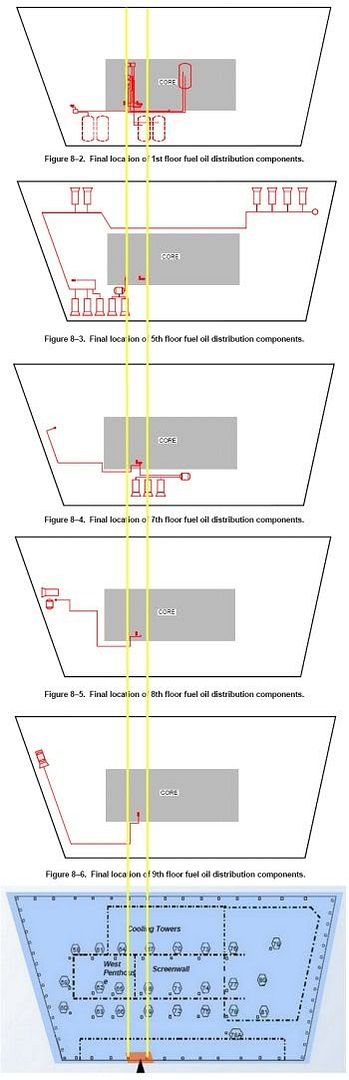
It appears that the gash on the south facade of WTC7 was in proximity to the diesel risers. I superimposed the width of the upper level damage shown on a preliminary NIST report onto other diagrams in a NIST report that show the location of the diesel risers which fed various floors.

The risers were near the perimeter of the core area on the south side of the core. The gash was near the same location. Even if the gash didn't completely extend into the core area or was slightly west or east of the risers, the jolting could have been sufficient to sever the lines. This is one possible explanation for fires starting and burning on numerous floors.

One of the preliminary NIST reports on WTC7 refers to damage in the location of the gash, but it is stated as roof and upper level debris damage. Apparently at the time of writing, NIST wasn't aware that the gash extended nearly all the way down the south facade and in nearly the same location as the diesel risers.

wtc7g.jpg
 

Back
Top Bottom