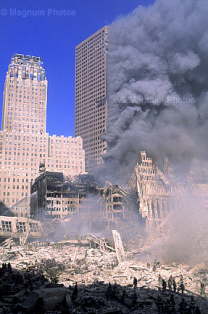
WTC7 and the NIST free fall failure

I was wondering if my personal experience with skyscrapers (seems windy up there!) was accurate, so I consulted a 4th grade science book.

Winds tend to blow much harder on the upper floors of a skyscraper than on those lower down. As a result, there is a powerful bending force on the base.
 
How can they not, I'm a certified firefighter whose got FF certificates to prove it. Hell I even got FEMA certificates!

Those directing their attention to me clearly don't have FF certificates.

Your logic is somehow strange. That you have a firefighting certificate doesn't mean that the firefighters at ground zero necessarily have to agree with you about 20 floors on fire at the WTC7 south side.
That you even got FEMA certificate doesn't necessarily mean the you was on site at the evening of Sep 10.

So where are the firefighters who saw 20 floors on fire?
 
Or perhaps the fairly well known wind-tunnel effects that cities with tall buildings built upon a grid system are subject to...

Femr2, are you aware that weather (including wind) can change during a 7 hour period? I'm asking because it seems like you aren't.
 
Truther Translation:

"I can't understand or read what the witnesses describe because I can't inerpret any of their statements."

If you went to court tomorrow because you hit someone with your car & witnesses saw you hit that person & then drove away. Don't you think that they would testify against you for hitting a person? Yes they would!

As far as damage to your car from hitting a person is physical evidence of the crime you comitted.

Witness testimony will outweigh hearsay any day!

Thanks for clearing that up for the truthers because truthers alway though if a hundred witnesses say so and NIST do not without any physical evidence then NIST is always right.

walsh00027.png
 
But that doesn't explain why you makes claims to something when you weren't there standing beside Boyle.

Either you were there or you weren't. Which is it?
Let's say you wasn't there and I wasn't there.

Boyle was asked for the fire and he replied something about the damage. No word about the 20 floors on fire.
Firehouse: When you had fire on the 20 floors, was it in one window or many?
Boyle: There was a huge gaping hole and it was scattered throughout there. It was a huge hole. I would say it was probably about a third of it, right in the middle of it.

The second interesting thing in the Boyle interview:
Captain Chris Boyle (Engine 94):
There was an engine company there, right at the corner. It was right underneath building 7 and it was still burning at the time. They had a hose in operation, but you could tell there was no pressure. It was barely making it across the street. Building 6 was fully involved and it was hitting the sidewalk across the street.

A lot of smoke, I guess.

However, the early fires died down early. NIST do not mention the time they actually lighted the building sim but the first sim image indicates a small fire in the south at 1pm that later spread trought the entire floors.
Deputy Chief Peter Hayden
It came down about 5 o'clock in the afternoon, but by about 2 o’clock in the afternoon we realized this thing was going to collapse.
Firehouse: Was there heavy fire in there right away?
Hayden: No, not right away
, and that’s probably why it stood for so long because it took a while for that fire to develop.
I assume there was no heavy fire at 2 o'clock.

Am I right? Otherwise translate it for truthers, please.

Deputy Chief Peter Hayden
...but also we were pretty sure that 7 World Trade Center would collapse. Early on, we saw a bulge in the southwest corner between floors 10 and 13, and we had put a transit on that and we were pretty sure she was going to collapse. You actually could see there was a visible bulge, it ran up about three floors.

The problem is, the south west corner wasn't there anymore up to the 18th floor. So probably he saw the not so straigh edge of the damage through the smoke from beneath that corner and WTC6 of course.
 
Last edited:
Femr, I know you suffer from paranoid personality disorder. Don't have to tell me anything about that.

How many eyewitnesses ever remarked in the 9/11 Commission or to NIST that what they saw that day was a "missile"?
Some. The No Planers have accurate countings on that.

How many witnesses and first responders remarked in the 9/11 Commission or to NIST that they heard explosions, saw explosions, felt the rumble? The answer is a lot! Nevertheless you will hardly find it in one of the reports.


In other words, the debate about something that isn't in the reports is not equal to "paranoid". It's more a kind of omission, I guess.
 
Last edited:
Deputy Chief Peter Hayden
It came down about 5 o'clock in the afternoon, but by about 2 o’clock in the afternoon we realized this thing was going to collapse.
Firehouse: Was there heavy fire in there right away?
Hayden: No, not right away
, and that’s probably why it stood for so long because it took a while for that fire to develop.
I assume there was no heavy fire at 2 o'clock.

Am I right? Otherwise translate it for truthers, please.

No, you're not right to interpret Hayden's words that way. All he's saying here is that the realisation that the building would collapse occured at about 2pm.

If anything, this would suggest the fires were intense.
 
Last edited:
Some posts moved to AAH.

Keep it civil from now on please.
Replying to this modbox in thread will be off topic  Posted By: Gaspode
 
Wow. Must be a Saturday thing. Folk roun'ere making no sense at all :eye-poppi

You really don't think the weather at WTC7 was the same as the weather at WTC1. Riiight.

No, I do not. At a height of 1300 feet, the wind speed will be much higher. THe wind speed around 7WTC would be much lower, and would be more turbulant, due to the other buildings.

That's fair enough, though I'd suggest it makes little difference to the potential strength of the prevailing wind, perhaps even increasing it in places.

Perhaps, but I am talking about the wind around 7WTC, which is what I was discussing.

You must be getting confused. I don't *get this wind speed of 9m/s*. Achimspok measured it.

Well, I think I will go with what the meterologists tell me. You know, the experts.

I will agree that around the top of 1WTC, the wind speed would be much higher.


Infantile. Go out and have a few (more) beers.

Thanks. I did, but I prefer Crown Royal straight up. Not that I need your permission.
 
No, you're not right to interpret Hayden's words that way. All he's saying here is that the realisation that the building would collapse occured at about 2pm.

If anything, this would suggest the fires were intense.

actually it was 12pm when that "engineer" said it would collapse 5 hrs later and was "right on the money."

history commons:

(12:00 p.m.) September 11, 2001: Engineer at WTC Site Predicts Collapse of Building 7 An engineer at the World Trade Center site correctly predicts that WTC Building 7 is going to collapse. Deputy Chief Peter Hayden of the New York Fire Department will later recall: “We had our special operations people set up surveying instruments to monitor, and see if there was any movement of, [WTC 7]. We were concerned of the possibility of collapse of the building. And we had a discussion with one particular engineer there, and we asked him, if we allowed it to burn could we anticipate a collapse, and if so, how soon?” The engineer apparently predicts correctly that WTC 7 will collapse and also the time it will take before it comes down. As Hayden will continue: “And it turned out that he was pretty much right on the money, that he said, ‘In its current state, you have about five hours.’” Hayden will not reveal the name of this engineer. [BBC, 7/6/2008] WTC 7 will collapse at about 5:20 p.m. (see (5:20 p.m.) September 11, 2001), indicating that the engineer makes his prediction around midday or shortly after. [CNN
 
No, I do not.
Yes, you already said so. Interesting ;)

At a height of 1300 feet, the wind speed will be much higher.
Wind speed != weather, btw :)

In general, in an area with no buildings (aka flat land), sure.

As a fixed and rigid rule ? No, especially so close to the coast.

As a fixed and rigid rule when there's the fairly well known wind tunnel effect in grid-based city streets, which can result in some streets having almost unwalkable streets (due to high wind) on otherwise calm (low wind) days.

THe wind speed around 7WTC would be much lower, and would be more turbulant, due to the other buildings.
Would be, could be should be ?

How about was ?

Jebus. This, er, discussion, has arisen from Achimspok suggesting (via measurement around WTC1) that the wind speed around WTC7 was not necessarily particularly s-l-o-w.

You want to argue with that measurement a short distance away, cool. Suggest you start measuring, as anything but is hand-waving.

Perhaps, but I am talking about the wind around 7WTC, which is what I was discussing.
Indeed.

Well, I think I will go with what the meterologists tell me. You know, the experts.
Well make sure you don't omit any important factors when you measure the wind speed around WTC7 at various times then.

I will agree that around the top of 1WTC, the wind speed would be much higher.
Higher than what ? What number is it that you are disputing ?
 
Yes, you already said so. Interesting ;)


Wind speed != weather, btw :)

In general, in an area with no buildings (aka flat land), sure.

As a fixed and rigid rule ? No, especially so close to the coast.

As a fixed and rigid rule when there's the fairly well known wind tunnel effect in grid-based city streets, which can result in some streets having almost unwalkable streets (due to high wind) on otherwise calm (low wind) days.


Would be, could be should be ?

How about was ?

Jebus. This, er, discussion, has arisen from Achimspok suggesting (via measurement around WTC1) that the wind speed around WTC7 was not necessarily particularly s-l-o-w.

You want to argue with that measurement a short distance away, cool. Suggest you start measuring, as anything but is hand-waving.


Indeed.


Well make sure you don't omit any important factors when you measure the wind speed around WTC7 at various times then.


Higher than what ? What number is it that you are disputing ?

You're so confused that you don't have the first clue as to what I was pointing out.

Please go back to here and read from there.

If you have questions AFTER that, you know, ones that ACTUALLY make a lick of sense in the context that I was discussing, feel free.
 
femr2, your expertise in such a myriad of subjects really is quite something to behold.

I was thinking of posting something similar myself...but then I read your post.

Once again...this is why the vast majority of experts produce a collective yawn and laugh at the arguments that MT, FEMR, and ARCH keep repeating.
 
You're so confused that you don't have the first clue as to what I was pointing out.

Not confused at all...
triforcharity said:
Once it hit the SW corner of the building, it would cause a swirling action, possibly bringing smoke from 6WTC up into the area of 7WTC. How much? Not too much would be my opinion, due to the wind's low speed.
achimspok said:
At the height of WTC1 I measured a speed of the wind of about 9m/s. That's not that slow.
triforcharity said:
I wasn't talking about 1WTC. I was talking about 7WTC.

Please follow along.
femr2 said:
I think it's a pretty safe bet that the weather at WTC7 was pretty similar to the weather at WTC1, you think ?
triforcharity said:
No, not at all. I do not agree one bit. 1WTC did not have turbulent flows of wind going around it from other buildings, since the area was WELL above any of the surrounding buildings. (aprox. 1300 feet up versus aprox 750 feet)

Now, where do you get this wind speed of 9m/s from? This equates to about 20 mph. I used this to get the historical data for Manhattan.


And so on.

If you have questions AFTER that
Questions ? No, simply indicating your assumption of low wind speed at WTC 7, when achimspok has measured pretty high wind speed all those many leagues away at WTC 1.

Have you determined a metric for wind speed around WTC 7 yet ? At roof level and ground level ?

you know, ones that ACTUALLY make a lick of sense in the context that I was discussing, feel free.
It all makes sense, though it's quite interesting how quickly you lost the context and started asking me where the 9m/s value came from :boggled:

Hey ho.
 
Not confused at all...


And so on.

Good. Now, why would the wind speed at 7WTC be different from the tops of 1WTC?

I'll give you a hint. It has alot to do with the height of the building.


Questions ? No, simply indicating your assumption of low wind speed at WTC 7, when achimspok has measured pretty high wind speed all those many leagues away at WTC 1.

Yes, it makes a HUGE difference. Thank you.

Have you determined a metric for wind speed around WTC 7 yet ? At roof level and ground level ?

I am still working on roof level, but I am going with the 4mph from the historical data I linked to earlier.

It all makes sense, though it's quite interesting how quickly you lost the context and started asking me where the 9m/s value came from :boggled:
Hey ho.

I simply asked a question, as I had not been an active poster in this thread, and as such, had not seen where the value came from. Hence, my question.

Thank you for clarifying it.

And don't call me a ho.

Now, do you agree, or disagree that the wind speed at floor 20 or so at 7WTC would be much different than at the 90th floor of 1WTC?

Do you agree or disagree that the turbulance wind around 7WTC would be different than around 1WTC?

Do you agree or disagree that 6WTC would have been down-wind and a substantial distance away from 7WTC that it's smoke would not likely have been mixed with the smoke from 6WTC?
 

Back
Top Bottom