Moderated WTC 1 features list, initiation model / WTC 2 features list, collapse model

Let's review:

This is the Sauret projection of WTC1:

sauret_fieldA_060sm.png


We want to know how to turn subpixel tracing drop data into information about southward tilt.

Each point a, b and r can be described at a vector drawn from the axis of rotation to the point.

building_and_vectors.png


We want to know how these vectors project onto the Sauret viewpoint as a tilt angle of a rigid model tilts from 0 to 3 degrees, and compare the rigid model with how the points actually moved in the viewers plane of projection.


Not complicated stuff and basic notation of vectors seems the obvious tool to use.


DO I treat all vectors as if they line up with r? No. The purpose of the quantity lambda is to add the equivalent to a phase shift to each term, depending on the angle it makes with the viewing plane when theta = 0.

angles2.jpeg


Each projection naturally takes the form

point_drops.png


where the lambda value accounts for how far the vector is tilted away from the viewing plane when theta = 0.


I wrote everything in pretty simple terms in the rewrite.

(image was here. Deleted for typo)

IMPORTANT CORRECTION: Lambda values are drawn incorrectly in the image above. Typo!

The algebraic form of each equation defines lambda values correctly!!


The "lambda value" of each vector is just the angle it makes with the viewing plane when theta =0.

This graphic defines lambda values correctly for a typical vector:

differences_projection.png
 
Last edited:
Here is a correct graphic of the lambda values:

lamdaangles.png


I'll place this at the link location in a few minutes.
 
I don't need the time. Please click the link and read.

I don't do all the ego feeding and stroking. I don't keep points. Too boyish. It's just 2-D vector projection onto a rotated axis. Just the tool to use.

It should take you only a few minutes to read it. Not complicated.
It took me only a few minutes to spot 10 errors (six obvious, four slightly subtle) on 26 December. You've had three days to fix them, and haven't yet. I'm going to give you the full week, whether you want it or not.

Think of it as a take-home exam. You tried to turn it in early, but your instructor wouldn't accept it because you hadn't even begun to make progress on any of the problems.

(image was here. Deleted for typo)

IMPORTANT CORRECTION: Lambda values are drawn incorrectly in the image above. Typo!
I didn't see your post before you corrected the typo, so I don't know whether that typo was one of the 10 errors I spotted.

But I'll give you a hint: Even after deleting the typo, your long post still contains at least 3 errors.

It will be far more embarrassing for you if, after being told there are errors on your web page and given a week to fix them, you aren't even able to find those errors.

You've got until 3 January. Sniping at me here will just increase your embarrassment if you can't find your errors, and takes time that would be better spent on repairing your web site.
 
Whatever.

I don't do pissing contests, so I'll be moving on.....

Here are some things the reader will need to know to follow the discussion to come:

A general vector is of the form xi +yj + zk with 3 degrees of freedom.

A class of normalized vectors (vectors of unit length 1) representing all possible directions in 3-D can be written with only 2 degrees of freedom, using angles theta, phi as defined in conventional spherical coordinates as shown

spherical_coordinates.gif


For my purposes, I will change the definiition of theta: Theta is the angle the unit vector makes with the plane z=0. Theta=0 means a horizontal viewing vector p in all my equations.

For all unit vectors r=1. The reader can easily see that the class all possible unit vectors in the above graphic would form a spherical shell of radius 1. Any point on the shell represents a unique, different direction and can be represented by a specific phi, theta pair of numbers

for all -90<=theta<=90
and all -180=phi<180

Rewritten in terms of 2 angular coordinates any directional vector becomes

A*cos(theta)*cos(phi)i + cos(theta)*sin(phi)j + sin(theta)k

The advantage to using coords phi, theta is that both angles have a simple, practical meaning in the case of WTC1 antenna orientation and any derived displacement vectors.

>>>>>>>>>>>>>>>>>>>>>.

Vector projected towards a viewer: We are interested in how any vector in 3-D is projected onto any viewpoint.

Vector equations for basic perpendicular and parallel vector projections of any vector onto any projection are given in the first section at the following link:

http://en.wikipedia.org/wiki/Vector_projection

We want the thing called "vector rejection" in the very first section. And here she is:

vector_rejection.png


Displacement vector definition: a is what I will call D(from frame #, to frame #)

The displacement vector D between point in frame 120 and 220, for example, can be written..

D(120, 220)

This defines a unique vector in 3-D.


Coordinate system definition: Center of antenna before leaning is the positive z axis, basic cartesian system with positive x through the south wall outward and positive y through the east wall outward. Origin undertermined until necessary.


Viewing vectors definition: In the vector rejection equation b(with a "hat") is a unit vector which points from the eyes of an observer from any particular viewpoint to the object being looked at, in this case various points on the WTC1 upper perimeter and antenna. But instead of "b", I will call my viewing vectors p. We will have 3 projection vectors, all of unit length and pointing from the cameras of the Sauret, NBC NW and NBC NE viewpoints to the objects being looked at.

Projection vectors can be written as

p(phi, theta)

or

p = A*[cos(theta)*cos(phi)i + cos(theta)*sin(phi)j + sin(theta)k]

where A is just a constant to normalize the vector.

>>>>>>>>>>>

So, the projection of vector D into any viewpoint is

D(projection) = D - (D*p)p

>>>>>>>>>>>>>..

3 working equations become:

D(Sauret projection) = D - (D*p)p
D(NW projection) = D - (D*p)p
D(NE projection) = D - (D*p)p

Each equation has a different p.

Two of these equations should be enough to determine D completely, but three is more fun. It's a party.

We can define the unit vector d as being parallel to D but of unit length,

so D =( magnitude of D)*d and we can do the same for all plane projections of D

>>>>>>>>>>>>>>>>>>>>>>

For any viewpoint, the "vector rejection" can be derived for any vector D as

D(projection) = D - (D*p)p. we can write p in terms of it's components as

p = pxi + pyj + pzk, where px^2 + py^2 + pz^2 = 1

and D = Dxi +Dyj + Dzk

The vector equation becomes 3 scalar equations by equating coefficients. These equations can be written in matrix form rather nicely because they are all linear in Dx, Dy and Dz.

This gives us a 3x3 matrix where each coeficient is written in terms of px, py and pz only.

It can be thought of as a "transformation matrix", transforming any 3 coefficients Dx, Dy, Dz to their "vector rejection" coefficients. It would be more correct to call it a vector operator.


Matrix entries:

a(1,1) =1-px^2 ....... a(1,2)= -px*py....... a(1,3)= -px*pz
a(2,1)= -px*py....... a(2,2)=1-py^2 ....... a(2,3)= -py*pz
a(3,1)= -px*pz....... a(3,2)= -py*pz....... a(3,3)= 1-pz^2

if the coefficients are rewritten as px=p1, py=p2 and pz=p3, the coefficients can be written

a(m,m)=1-pm^2 for m = 1, 2, 3

and for the cross terms,

a(m,n) = -pm*pn for all m, n from 1 to 3 where m, n are not equal.


Basically the 3x3 matrix operates on a 1x3 matrix with coefficients Dx, Dy, Dz, changing the 1x3 matrix into the components of the corresponding "vector rejection".

If you plug in any D vector in terms of it's components, after the matrix operation you get the 3 components of it's "vector rejection".

It is important to remember that many different vectors D can map onto the exact same "vector rejection", so there is no 1:1 correspondence between Dx, Dy, Dz and the components of it's vector rejection. We would never expect to be able to reconstruct an exact vector D from a single rejection. Common sense tells us that we need at least 2 viewpoints to reconstruct a specific vector D from knowledge of it's vector rejections since whole classes of vectors can look identical from a single viewpoint.

A vector rejection has lost information of it's original vector that it cannot get back. This means the 3x3 vector operator cannot be inverted to yield unique Dx, Dy, Dz values from knowledge of it's vector rejection. There is no inverse operation that allows us to revert the vector back to it's original state.

By choosing the viewer coordinate system carefully, the vector components labelled "projection" and "rejection" can take on a very simple form, as well the viewing vector p

 
Last edited:
WD Clinger post 666: "If your graph was supposed to be observer-dependent, then you mislabelled the vertical axis. A difference in meters is an objective measure. There are no relativistic velocities here, so lengths and differences between lengths are the same for all observers."
link to post : http://www.internationalskeptics.com/forums/showpost.php?p=6660378&postcount=666

If this is what you believe you will use in the pissing contest you are preparing for, it's probably best think about it a bit more carefully.

339354536.png


Consider, how did femr manage to scale the vertical in ft from a "non-plumb" coordinate system?

In many years of physics, I have never heard the expression 'plumb coordinate system".

Since you are taking a week, perhaps you may want to think about how to locally scale "non-plumb" coordinate systems using the knowledge of the orientation it takes with a "plumb" coordinate system.

If you take a meter stick and tilt it a known angle away from you, does it cease to measure anything? Can't you scale using the same meter stick just by multiplying it's true length with the cosine of the angle tilted away from you?
 
Last edited:
The information within this post and post 784 is pretty much everything that is necessary to reconstruct 3-D vectors from the 2-D vector projections in multiple viewpoints. Readers that understand these basic principles should be able to follow an argument involving 3_D reconstruction:


Any vector projected towards any viewer: We are interested in how any vector in 3-D is projected onto any viewpoint.

Vector equations for basic perpendicular and parallel vector projections of any vector onto any other vector are given in the first section at the following link:

http://en.wikipedia.org/wiki/Vector_projection

We want the thing called "vector rejection" in the very first section, which is:

vector_rejection.png


Basically, any vector can be expressed in terms of 2 components, the part parallel with the line of sight and the part perpendicular to it, as shown:

perp_and_parallel.png


The line of sight is the vector p. The blue lines are projection lines, or projection planes in 3-D. The viewer actually sees the vector as it projects onto a blue plane.

The parallel component is the portion of D that is invisible to the viewer. The perpendicular component is the portion of the vector D that is completely visible to the viewer. The viewer sees all of the perpendicular component and none of the parallel component.

3-D vector reconstruction from knowledge of 2 or more vector projections is the effort to rebuild these invisible parallel components of the vector D from knowledge of the visible perpendicular parts from each viewpoint..


Definition of line of sight vector:

p is a unit vector parallel with a direct line between the viewer and the object viewed.

I will call this unit vector p defined as:

pvector.jpeg


Which I will call the "p vector". The p vector is defined in the building coordinate system. All possible directions of a unit vector can be described by only 2 variables. It is useful to use conventional spherical coordinates phi and theta as those 2 variables.

spherical_coordinates.gif


(Correction: I prefer theta =0 to be a horizontal vector. Equations define theta=0 to be a vector with no vertical component.)

Using variables phi and theta allows us to write the p vector as:

pangles.jpeg


Why is this formulation of the p vector useful? Because both phi and theta have a simple, tangible meaning to the viewpoint's orientation. Theta is the angle that the direct line of sight makes with a horizontal plane. Phi is the angle the line of sight vector cuts with the building's own x axis. A view head on looking at the north face is phi = 0. Phi will be positive for viewpoints within the building cs NW quadrant, phi will be negative for viewpoints within the building cs NE quadrant.

There are 2 convenient ways to describe the p vector, shown below:

pdescriptions.gif


The line of sight unit vector can be described in terms of it's p coefficients in the building cs or in terms of it's unique phi, theta values.


Definition of viewer coordinate system:

Cartesian coordinates are aligned with the line of sight and the projection planes of the viewer. The positive x axis is defined as the line of sight.

p_is_xv.jpeg


The vertical plane containing the camera and the object viewed is the x, z plane when y=0 (defined as y=0 for all x, z). The y plane is always parallel to the earth's surface. (The y axis is always perpendicular to a plumb bob.)

This means any plane x=c is a projection plane. So, simply put, a viewer coord system has a line of sight (direct line to object viewed) and a 2- plane of projection, perpendicular to the line of sight. The viewer sees things just as they are projected onto the 2-D projection plane.

Any y, z plane (mathemetically described as x=c for any c) is a projection plane.


Transformation between building cs and viewer cs:

Review of basic 3-D vector projections onto rotated coordinates:

A transformation matrix for a basic 3-D rotation is written as:

vmatrix.png


vmatrix2.png


These are the relations between the components of any vector in the building coordinate system and any general viewer coordinate system.

Elements of the viewer cs transformation matrix can be written in terms of a phi, theta values or in terms of p coefficients.


in terms of a general phi, theta pair, the matrix becomes:

1293997755_phi_thetamatrix.png


In terms of p coefficients the matrix becomes:

1293997241_pmatrix.png
 
Major_Tom's errors, part 0

[size=+1]Executive summary.[/size]

Major_Tom has given us no reason to trust his graphs, calculations, or conclusions, while giving us many reasons not to.

[size=+1]Introduction.[/size]

Major_Tom kicked off this thread by listing 41 alleged features he thought were relevant to the collapse of WTC 1. Although Major_Tom has refused to identify any connection between those features and the subject of this subforum, he appears to quibble with NIST's and other published descriptions of the collapse. Major_Tom has also declared his intention not to publish in the research literature, so there will be no proper peer review of anything he writes.

Major_Tom says he has proved his central claim with "mathematical certainty". To concoct an illusion of mathematical something or other, he has posted considerable technobabble both here and at his web site. Having wasted several hours in reading this thread and looking over Major_Tom's web site, I am reporting what I have learned:

  • Many of Major_Tom's conclusions are based on his own calculations.
  • Most of Major_Tom's graphs and calculations are based on equations he has posted at his web site.
  • At least sixteen of Major_Tom's equations are incorrect.
  • Most of Major_Tom's graphs and calculations are based upon those incorrect equations.
  • All of Major_Tom's conclusions that depend upon those graphs and calculations are worthless.

[size=+1]One week.[/size]

On 26 December, Major_Tom announced his 2-part "proof" of one of his central claims and stated his belief that "this approach addresses all the concerns WDC has raised." I declared the second part of his "proof" to be "a mess", and asked for permission to copy one of his images to my web site so I could demonstrate the trouble he was still having with his coordinate transformations. Major_Tom gave permission to copy, and said he would "need less than a week to fix most problems". I gave him a week to fix his problems. When Major_Tom became impatient and posted several incorrect equations here at JREF, I offered hints.

The week has passed. Major_Tom was unable to find any of the errors he had inserted into the second part of his alleged proof.

[size=+1]Major_Tom's errors undermine his claims.[/size]

If Major_Tom can't spot the errors in his equations when they are displayed in conventional mathematical notation for all the world to see, how likely is he to notice bugs in the unpublished spreadsheet formulas and computer programs he transcribed from those equations?

The next two parts of this series will identify several major errors in Major_Tom's equations. These errors are serious enough to invalidate all of Major_Tom's "drop" graphs and most of his calculations.
 
Major_Tom's errors, part 1

The images in this post were created by Major_Tom, and are displayed here with Major_Tom's permission. The equations shown in these images are critical pieces of Major_Tom's alleged "proof that the antenna and perimieter did not tilt as a rigid body".

As will be shown below and in the next part of this series, several of Major_Tom's equations contain major errors that undermine Major_Tom's proof, calculations, graphs, and conclusions.

Major_Tom was told that the second and more mathematical part of his alleged proof contains serious errors, and was given a week to fix the problems. Major_Tom was unable to find or to fix any of those problems, even when given hints.

[size=+1]Ridiculous, but correct because 98=0.[/size]

To understand Major_Tom's errors, we must first understand that Major_Tom's preferred coordinates are about twelve degrees off plumb.

In some of Major_Tom's pictures and calculations, the axis that's most nearly vertical is labelled y or ys; in other pictures and calculations, that axis is labelled z or zs. In the second part of Major_Tom's alleged proof, he goes back and forth between those two conventions without remarking upon the change in labelling.

Several of Major_Tom's errors involve transformations between his preferred system of Cartesian coordinates, in which the y-axis (or z-axis) is tilted about 12 degrees from the vertical, and a more intuitive coordinate system in which the y-axis (or z-axis) is vertical. One must also understand that when Major_Tom speaks of "drops", he is not talking about vertical drops, but is speaking of differences between the y-coordinates (or z-coordinates) of points in his preferred coordinate system.

To make his notation even more confusing, Major_Tom often writes something like rs to indicate the y-or-z-coordinate of a vector r, as in this example:

Major_Tom said:


That first equality looks a bit iffy. If you didn't know that 98=0, you'd think it's completely wrong.

Believe it or not, Major_Tom has defined 98 to be 0.

I am not making this up. Major_Tom is using 98 as his notation for the y-or-z-coordinate of a point on the 98th floor of WTC 1, and Major_Tom is using that point on the 98th floor as the origin for his preferred system of Cartesian coordinates. In Major_Tom's notation, 98=0.

How were we able to guess that 98 stands for the y-or-z-coordinate of that point as measured in Major_Tom's preferred coordinate system? Because
  • the second equality says rs = r cos (θ + φ)
  • r is the coordinate-independent length of a vector r that runs from the origin at the 98th floor to a point directly above it on the roof
  • θ is the angle of tilt (relative to vertical) for WTC 1
  • φ is the angle of tilt (relative to vertical) for Major_Tom's preferred coordinate system
  • so r cos θ is the vertical coordinate of r as measured in a coordinate system whose origin is at the point on the 98th floor and whose vertical axis is vertical
  • and rs = r cos (θ + φ) is the y-or-z-coordinate of r as measured in Major_Tom's preferred coordinate system, with a y-or-z-axis that's φ off plumb.
With Major_Tom's ridiculous notational conventions and preferred coordinate system in mind, we now proceed to examine some of Major_Tom's actual errors.

[size=+1]Errors 1, 2, and 3.[/size]

To explain how he computed the (non-vertical) "drops" that are at the heart of his alleged proof, Major_Tom wrote:
Major_Tom said:
Angles are defined as shown:

lamdaangles.png
In that picture,
  • Major_Tom's preferred coordinate system is in red
  • a more intuitive coordinate system, with a vertical y-axis, is in gray
  • a is a vector from the origin on the 98th floor to a point on the antenna
  • b is a vector from the origin on the 98th floor to a lower point on the antenna
  • r is a vector from the origin on the 98th floor to a point on the roof
If Major_Tom's web site and JREF posts can be believed, he calculated his (non-vertical) "drops" as follows:
Major_Tom said:
Those aren't "drops" in any sense, even after we allow for Major_Tom's ridiculous notation. What those equations actually express are the y-or-z-coordinates of the rotated vectors a, b, and r, as measured in Major_Tom's preferred coordinate system in which the y-or-z-axis is off-plumb by the angle φ. That's easy to verify by letting θ=0.

It's worth emphasizing that the incorrect equations shown above really are the equations that Major_Tom claims to have used when calculating his "drops". Even after he had been told of his errors, Major_Tom repeated those equations at JREF on 29 December. When told that his JREF post "still contains at least 3 errors", Major_Tom dismissed that warning, calling it a "pissing contest", and repeated that provocative phrase in several posts. Despite being given a week to repair his errors, Major_Tom was unable to find anything wrong with his JREF posts or web site.

The next part of this series will identify thirteen other errors in equations taken from the same page of Major_Tom's web site. Five of those errors were obvious, and were enough to invalidate virtually all of Major_Tom's calculations. The other eight errors may have been just as fatal, but it might take some mathematical sophistication to notice them.
 
Major_Tom's errors, part 2

The images in this post were created by Major_Tom, and are displayed here with Major_Tom's permission. The equations shown in these images are critical pieces of Major_Tom's alleged "proof that the antenna and perimieter did not tilt as a rigid body".

As shown below and in the previous part of this series, several of Major_Tom's equations contain major errors that undermine Major_Tom's proof, calculations, graphs, and conclusions.

[size=+1]Errors 4, 5, 6, and 7.[/size]

In response to criticism of his preferred system of Cartesian coordinates, in which the most nearly vertical axis is twelve degrees off plumb, Major_Tom demonstrated his ability to perform the necessary vector transformations by posting the following technobabble at his web site and also at JREF:
Major_Tom said:
All four of those equations are incorrect.

In that first equation, the main connective should be a minus sign.

The third equation is missing a square root.

The fourth equation contains a subtle error: The principal value of single-argument arctan is limited to the range of negative pi/2 to pi/2. Two-argument arctan should have been used instead.

Thanks to the subtle error in the fourth equation, the second equation yields incorrect results whenever the correct result is negative.

ETA: I guess I should also mention the abuse of standard mathematical notation on the left hand sides of the first two equations. I'm assuming the vertical bars were meant to be parentheses; otherwise the subscripts make no sense.

[size=+1]Errors 8, 9, 10, 11, 12, 13, 14, 15, and 16.[/size]

Errors 5, 6, and 7 weren't just typos, because Major_Tom repeated each of those errors three more times in other equations on the same web page.

[size=+1]Conclusion.[/size]

Everyone makes mistakes, which is one of the reasons we should be skeptical of calculations performed by pseudonymous partisans who don't show their work, don't publish their spreadsheet formulas and computer programs, and refuse to submit their findings for peer review.

In Major_Tom's case, we can judge his ability and willingness to debug his calculations by examining his ability and willingness to correct his formulas.

After Major_Tom was told that the formulas at his web site contain obvious errors, he was given a week to fix the problems. Major_Tom was unable to find or to fix any of those problems, even when given hints.

If Major_Tom's calculations were performed with the same skill and care he has devoted to his web site, then his calculations are worthless.
 
Last edited:
The images in this post were created by Major_Tom, and are displayed here with Major_Tom's permission. The equations shown in these images are critical pieces of Major_Tom's alleged "proof that the antenna and perimieter did not tilt as a rigid body".

As shown below and in the previous part of this series, several of Major_Tom's equations contain major errors that undermine Major_Tom's proof, calculations, graphs, and conclusions.

[size=+1]Errors 4, 5, 6, and 7.[/size]

In response to criticism of his preferred system of Cartesian coordinates, in which the most nearly vertical axis is twelve degrees off plumb, Major_Tom demonstrated his ability to perform the necessary vector transformations by posting the following technobabble at his web site and also at JREF:

All four of those equations are incorrect.

In that first equation, the main connective should be a minus sign.

The third equation is missing a square root.

The fourth equation contains a subtle error: The principal value of single-argument arctan is limited to the range of negative pi/2 to pi/2. Two-argument arctan should have been used instead.

Thanks to the subtle error in the fourth equation, the second equation yields incorrect results whenever the correct result is negative.

ETA: I guess I should also mention the abuse of standard mathematical notation on the left hand sides of the first two equations. I'm assuming the vertical bars were meant to be parentheses; otherwise the subscripts make no sense.

[size=+1]Errors 8, 9, 10, 11, 12, 13, 14, 15, and 16.[/size]

Errors 5, 6, and 7 weren't just typos, because Major_Tom repeated each of those errors three more times in other equations on the same web page.

[size=+1]Conclusion.[/size]

Everyone makes mistakes, which is one of the reasons we should be skeptical of calculations performed by pseudonymous partisans who don't show their work, don't publish their spreadsheet formulas and computer programs, and refuse to submit their findings for peer review.

In Major_Tom's case, we can judge his ability and willingness to debug his calculations by examining his ability and willingness to correct his formulas.

After Major_Tom was told that the formulas at his web site contain obvious errors, he was given a week to fix the problems. Major_Tom was unable to find or to fix any of those problems, even when given hints.

If Major_Tom's calculations were performed with the same skill and care he has devoted to his web site, then his calculations are worthless.

Will MT acknowledge his errors or will he ignore your posts or attack you personally?
 
A minus sign...

Relabel an axis in a graphic...

And WD Clinger doesn't like a tilted coordinate system.


Yes, I acknowledge these sins.

The mislabel of one axis is later corrected in the same link. I'll check the minus sign but you will find it will change nothing. The typo is more limited than you realize.

Coordinate system and using the word "drop" to measure downward displacement along the red z axis when viewed from the Sauret viewpoint, I'll think of a new way to describe it.

Nothing changes.

Note, all femr's graphs where the vertical axis is scaled in ft or meters make the same drop calculation "errors".

We are obviously measuring downward displacement as measured from the Sauret viewpoint using the red z axis as a "meter stick". We'll find a new word that doesn't imply "plumb drop".

Absolutely no results will change.

Thanks for the feedback.
 
Last edited:
differences_projection.png


Some mistakes here. I'll fix the graphic. When I have more time I'll show the mistakes are limited to the graphic above and affect nothing else.


WDC post 790: "Errors 5, 6, and 7 weren't just typos, because Major_Tom repeated each of those errors three more times in other equations on the same web page.

Yes, they basically are. I'll show you that once the graphics are fixed, the results don't change at all.
 
Last edited:
I need a few days to fix the errors in the graphics.

After that, only one disagreement remains: The use of tilted meter sticks to measure downward displacement for a viewer looking upwards, and a more careful use of the word "drop".

Again, the "drop" that is actually being measured is how the viewer measures perceived drop when looking upward at the building.

Once done, the exact same proof remains.

On that: It is impossible to measure downward displacement along the building's z axis because that requires 3-D vector reconstruction. It is impossible to know 3-D displacement without reconstructing the 3-D vector.

We can know and measure the downward displacement each viewer sees along the viewer's z axis. When the word drop is used in the link, that is what is being measured in every case.


WD Clinger, you may prefer the building coordinate system, but without 3-D reconstruction of vectors it is useless for our purposes. All the information we have of actual building movement is from measured downward displacement from a particular viewpoint. That is what we really have to work with.

We start with the information of how the event projects onto different viewpoints. Nobody knows how any point moves in the building coordinate system until 3-D vectors are reconstructed.

You must start gathering information from the red viewer coordinate systems. You have no choice! Your preferred coordinate system is pretty useless to extract actual data from videos.

Can you convert the videos to movement in your coordinate system? No you cannot. How would you measure objective building cs z axis drop from the information in videos? You cannot.

We can only know the drops along the red z axis of any viewer coordinate system. This is knowable.

I'll change some vocabulary concerning "drop" but you have not touched the proof of deformity.
 
Last edited:
I need a few days to fix the errors in the graphics.

After that, only one disagreement remains: THe use of tilted meter sticks to measure downward displacement for a viewer looking upwards, and a more careful use of the word "drop".

Again, the "drop" that is actually being measured is how the viewer measures perceived drop when looking upward at the building.

Once done, the exact same proof remains.
Were these formulas the actual ones you used to make your calculations and graphs?
 
No. They were put in later to show basic vector relations in an introduction.


Look, guys, a lack of a square root sign in a graphic will not change the way the antenna moves earlier than points on the perimeter in pretty much every graph you've been shown.


Trig misprints will not make the early movement of the antenna go away:

excasest002.gif


How many times have you been shown that the SW corner fire moves well after the antenna using object tracking?
 
Last edited:
Look:

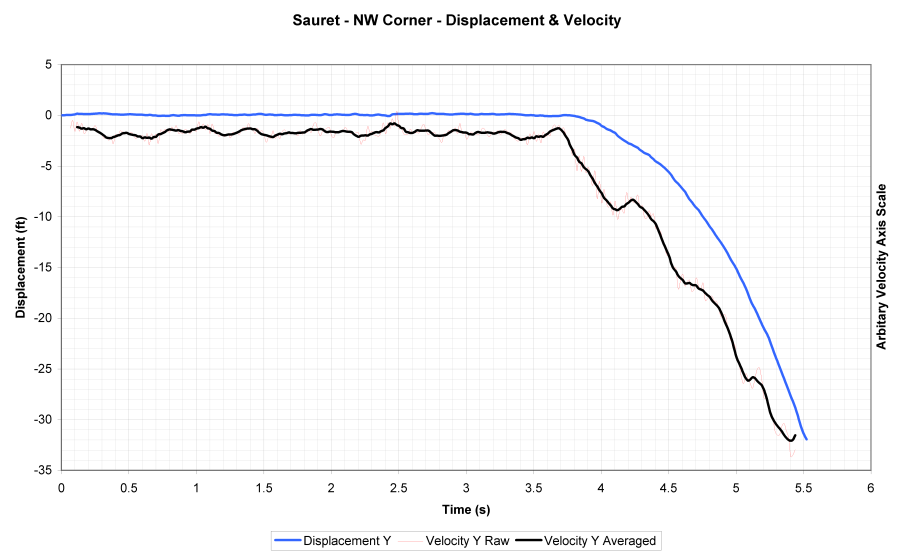
No math, just comparison of the NW corner drop with a model undergoing rigid rotation over 1 degree from the exact same viewpoint.

1degtilt.gif


To frame 220.

So how do you expect to find some problem with a trig relation to account for this?

Obviously the north face cannot tilt more than 1 degree for this to be true, no?


Meanwhile, your antenna has been visibly moving downward since frame 130.

How can you pretend all this stuff is not happening?
 
Last edited:
Graphics and the basic vector relations were worked out by 2 different people.

He did his correctly. I had some basic mistakes in my vector graphics.

These relations are very basic and still true:

point_drops.png


Typo in the lamda value. I'll fix it and it won't change the graph of the other researcher.

Here are the value and slope ranges for the 3 functions over the region of interest. They are simple and still true.

value_slope.jpeg


Once I fix the lamda value graphic nothing will change.

Here is the graphic representation by the other researcher:

image00011.png


If my limits match his limits when the lamda expression is fixed, the conclusions of the presentation remain basically untouched.
 
In summary, once the minus sign and some square root symbols are inserted into the graphics, WD Clinger has one basic complaint remaining: The use of viewer coordinate systems.

He recommends only using the "plumb" coordinate system, while I will use multiple coordinate systems for different purposes.

It is pretty easy to see why the building coordinate system is useless to describe motion as it is seen from each viewpoint. Try it yourself. It is impossible to reproduce motion in the building coordinate system by using the Sauret video.

What you really see is movement as it is projected onto the Sauret viewpoint. The question is: How is rigid tilting seen from the Sauret perspective, and using building coordinates to describe this is a pretty silly thing to do.

If you do describe rigid tilting motion in terms of a building coordinate system, you still have to project that information onto a 2-D viewer plane to actually use this information to compare with the Sauret video.

My choice of viewer coordinate systems allow you to project any vector onto any viewpoint to compare with observed motion.

The WD Clinger single coordinante system leaves you with a mathematical mess is you actually want to reconstruct 3-D vectors from the information in the videos. It leaves you with a mathematical mess if you actually want to compare theoretical motion as described in the building coordinate system onto a viewpoint.

It's a great idea, WD Clinger, but it is mathematically useless as I will show as we reconstruct vectors.

(I know what your complaint of the word "drop" is. I measure using the red z axis meter stick, you use the "plumb" z axis. "Apparent drop" is a step closer, but it is still a quantity measured in ft or meters. It is exactly the quantity I want when comparing to the Sauret video.

Can you calculate drop in the building cs and compare that with the Sauret viewpoint motion? No you cannot. You still need to project the information downward in order to compare it with the Sauret video. The information is useless until you put it in a form to compare it with observed motion from an actual viewpoint.)

In my coordinate systems, mathematics will be quite simple. In yours, a real mess.
 
Last edited:

Back
Top Bottom