• Quick note - the problem with Youtube videos not embedding on the forum appears to have been fixed, thanks to ZiprHead. If you do still see problems let me know.

Why Flight 93?

This is why the AOA is interesting, and if you have a good AOA you can use it for neat things instead of looking up the darn numbers. I always think of the AOA as a source of DATA and I could skip looking in the big book of graphs to find max endurance, just fly it on the AOA, or max range, just fly it on the AOA. Take off for the KC-135 was tied to the AOA through the Collins ADI and helped us reach the correct attitude for takeoff. It could be used for max lift on approach, and thus the correct approach airspeed. There was a AOA readout to show us on speed for approach.

The AOA would not be zero at cruise speed. I am not even sure if the reading on the AOA probe is linear. Who is the real aero guy around here. The KC-135 AOA was normalized and we had a read out in the cockpit .2 was about max range, .4 endurance, .6 approach speed.

The AOA on 93 was reading -16 for level cruise, and -6 for takeoff. I think it was -20 near impact. But those are not angles, those are readings from the AOA. The readout was decoded to a scale of 5 to –25, take off was –6, and cruise (bet it was max range) –16. I think we need a table or charts to decode the raw numbers to angles and/or normalized readings us pilots need to decide to push or pull, Please another banana please.

If I did not say earlier, many pilots critiqued my using the AOA for max range, they said it was not very accurate at that end of the scale. But it was very close, and I used it to check my speed, I wanted to fly .81 mach anyway, it was close to 99 percent max range, and on the fast side.

I think if you take the readings and know how the instruments work you can figure out angles or normalized readings. Our KC aoa was not an angle, just normalized with marks for approach speed, endurance, and max range. Oh, the big stall was in the red zone.
 
Engineers always make things like this too complicated. Crips, AOA is merely the angle between the chord line of the wing and the relative wind or slipstream. The readout in the cockpit or FDR is probably different for different aircraft. I'm mostly from the old school same as rwguinn with a vane on the nose somewhere providing the indications to the cockpit. Although I have flown early versions of a glass cockpit, the AOA indicator was an analog gauge in degrees. On some aircraft there is a light indicator that shows on speed for an approach. I've never used one like that and I also don't remember the T-38 having an AOA indicator. I flew it a few years before Beachnut, so there may have been a modification.

I've primarily only used it to determine close proximity to a stall condition during high G maneuvering. For example, in the F-111 prior to a later flight control modifications the aircraft would enter a post stall gyration (from which no one has ever recovered) at about 21 degrees AOA. I do recall checking it on approach to ensure the proper speed/wing sweep for fuel weight was in the ball park. I never used it for anything else.

It is only remotely related to pitch attitude. For example, you can be flying straight and level and enter a stall condition (high AOA) by simply "yanking" (ape like) on the control stick very rapidly. How much the pitch attitude changes, of course, depends on airspeed. It would be in an upward direction, but an unknown amount. The reverse condition would apply inverted.

The cockpit readout or the FDR input should not differ if the aircraft is upright or inverted.

I don't understand how the AOA would tell us much of anything regarding UA93. Well, it would indicate trends, but it seems to me pitch would tell the primary story (and we know it was pointed downward toward the ground). It would tell us nothing about the roll axis.

I suspect that the inertial system in a B-757 could provide AOA, but whether it's inertial or vane we'd still need to know the meaning of the numbers specific to that aircraft before it would tell us anything useful.

Inertial systems are supposed to be reliable in all flight conditions, but they aren't. They could certainly tumble in a condition such as UA 93 experienced which was well outside the normal flight envelope for that aircraft.

I hope this helps to understand it better, but I do not believe it's important in discussing anything at all about UA 93.
 
Last edited:
To what age do you expect to live? :D
I guess a 7606 grad may not make it.

You 111 guys fly way too fast. I think one of the birds (111) out of depot in SAC made a dump light north of SAC, the space guys saw it as a thermal event. They called me, asking me about our beale air space north of beale one day when I was chief of current ops. I do not think I have ever seen a dump, and I did a lot of refuelings. We did have an f-4 roll around us, but I did not see that as a great event in my 300,000 pound tricycle, the boom loved it. A barrel roll around the tanker. That call was strange.
 
Yea, that's known as "Torching". The fuel dump outlet was between the two tail pipes, so dumping fuel in conjunction with lighting the afterburners would ignite that stream of fuel and creating a very long stream of flame behind the aircraft.

One evening in England a friend inadvertently "Tourched" during a weather recall. He was low level and heard the recall, pulled up to altitude, and dumped with the afterburners going. The weather conditions were such that it created an eery glow over East Anglia. There were numerous calls to Police Agencies throughout that part of England, some as far away as London reporting a UFO!:jaw-dropp

Needless to say, he received "counseling" over that incident....
 
I would have been in trouble a lot in a fighter, if I lived long enough. A lot of tankers booms have had the show.
 
I'm not quite following here...
Let us assume a coordinate system, such that
+ X axis (FS) is aft.
+Z axis (WL) is up, i.e., vertical tail is +WL (Z axis).
+Y (+BL) is then out the left wing.
These references do not change, regardless of aircraft orientation.
The vane (fairly typical--test aircraft used 4 holes in a ball-end probe) has as its reference the axis of the tube it is mounted on (or aircraft x-axis)
Thus, a nose-up attitude (+AoA) would indicate a + rotation about the Y axis, regardless of the aircraft attitude in 3D space, right? Or am I totally hosed, here?
Then we can get into pitch attitude...

OK, now we are getting somewhere. The AoA is the angle between the wings chord line and the direction of air flow. The wing chord line is fixed relative to the X axis (i.e. it is a fixed wing aircraft). Flaps may change this somewhat. The air flow is always 180 degrees from what I have called the velocity vector. I should qualify this by saying it is the velocity relative to the air, not the ground. Thus the AoA is also relative to the velocity.

Beachnut, what AoA is relative to and how it is measured are two different things, so don't hold your breath assuming I will go looking for a velocity vector instrument or sensing device.
 
Gregory, are you trying to say that you were able to determine the exact direction of "plowing" from the provided pictures? You do realize that the "plowing" direction doesn't have to be perpendicular to wing imprints?

This is the crater I get, running a rigid 3D 757 model through the ground. Plane model was aligned according to last recorded FDR data.


I'm too lazy to do the calculations at the moment, I just took two plane models, one half burried, other just above the ground (look at the gif below), aligned them on the same trajectory (I guess that would be velocity vector central through the fuselage, tail to nose; theoretical AoA = 0), drew lines through wing tips and the center of the fuselage and checked where they intersect with the terrain. I got the white area seen on the GoogleEarth snapshot above. Red dots show the positions of wingtips and the center of the fuselage.

For nitpickers - this graphics is only intended to quickly show the orientation of ground imprints made by a plane the size of 757, flying with the same parameters as provided in the NTSB CSV file; I didn't bother to line up the crater with the actual point of impact. GU seems most perplexed by the crater orientation, not by its location. Also keep in mind that this crater outline was produced with parameters from a plane that was still in the air at the time. Since the plane was still turning after the FDR data got recorded, the actual crater would probably also be turned slightly more in the clockwise direction. And, as mentioned, I didn't account for any AoA or plane breaking up.

Last FDR CSV data used:
Pitch: -41.1°
Roll: 142.0°
True Heading: 177.4° (from magnetic 187°)

Animated gif with the plane (due to plane's attitude, it may not appear so, but this is a straight down view of the area)


So, even though the plane is flying due south (177.4°), it can still leave a skewed imprint ("30 degrees east of south") and the angle of the wing imprints doesn't have much to do with direction of the "plowing" action.

More importantly, notice the angle between the imprint of the vertical stabilizer and wing imprints. It's not symetrical or perpendicular to the wings. This appears to look the same in the actual crash site photos. As for the plowing action, yes, I can imagine some of it on the photos, but it looks like it's directed towards south, just as the plane's mass was at the time of impact. I don't see any anomalies here.
 
Gregory, are you trying to say that you were able to determine the exact direction of "plowing" from the provided pictures? You do realize that the "plowing" direction doesn't have to be perpendicular to wing imprints?

This is the crater I get, running a rigid 3D 757 model through the ground. Plane model was aligned according to last recorded FDR data.


I'm too lazy to do the calculations at the moment, I just took two plane models, one half burried, other just above the ground (look at the gif below), aligned them on the same trajectory (I guess that would be velocity vector central through the fuselage, tail to nose; theoretical AoA = 0), drew lines through wing tips and the center of the fuselage and checked where they intersect with the terrain. I got the white area seen on the GoogleEarth snapshot above. Red dots show the positions of wingtips and the center of the fuselage.

For nitpickers - this graphics is only intended to quickly show the orientation of ground imprints made by a plane the size of 757, flying with the same parameters as provided in the NTSB CSV file; I didn't bother to line up the crater with the actual point of impact. GU seems most perplexed by the crater orientation, not by its location. Also keep in mind that this crater outline was produced with parameters from a plane that was still in the air at the time. Since the plane was still turning after the FDR data got recorded, the actual crater would probably also be turned slightly more in the clockwise direction. And, as mentioned, I didn't account for any AoA or plane breaking up.

Last FDR CSV data used:
Pitch: -41.1°
Roll: 142.0°
True Heading: 177.4° (from magnetic 187°)

Animated gif with the plane (due to plane's attitude, it may not appear so, but this is a straight down view of the area)


So, even though the plane is flying due south (177.4°), it can still leave a skewed imprint ("30 degrees east of south") and the angle of the wing imprints doesn't have much to do with direction of the "plowing" action.

More importantly, notice the angle between the imprint of the vertical stabilizer and wing imprints. It's not symetrical or perpendicular to the wings. This appears to look the same in the actual crash site photos. As for the plowing action, yes, I can imagine some of it on the photos, but it looks like it's directed towards south, just as the plane's mass was at the time of impact. I don't see any anomalies here.
Excellent model. You do not have to worry much about the AOA and other factors. Your work is in the ball park (better), if not better than needed if this was an accident and we needed to know how the impact looked. Gregory has no thesis, he is wondering around with no stated goal but a nebulous want the truth; No real goal, no progress.

Good job on the graphics. Do you have a data file of the FDR, vs the graphs? Can I get a copy? I think your model shows clearly the impact relative to the ground with the data. Nice job again.
 
Good job on the graphics. Do you have a data file of the FDR, vs the graphs?
Thanks, Beachnut. What exactly do you have in mind? SLOB's FOIA request has provided a spreadsheet file and what seems to be a raw FDR file (.dlu). Spreadsheet files can be imported into OpenOffice or Excel, but don't contain as much parameters as the AA77's one, while the raw FDR file probably requires some propriety software by FDR manufacturer. Here are the spreadsheet CSV files. If you want the raw file, I'll have to think of something else (it's a bit chunkier at about 35MB).
 

Attachments

Thanks, Beachnut. What exactly do you have in mind? SLOB's FOIA request has provided a spreadsheet file and what seems to be a raw FDR file (.dlu). Spreadsheet files can be imported into OpenOffice or Excel, but don't contain as much parameters as the AA77's one, while the raw FDR file probably requires some propriety software by FDR manufacturer. Here are the spreadsheet CSV files. If you want the raw file, I'll have to think of something else (it's a bit chunkier at about 35MB).
I can not decode the raw data, but this looks good. If it contains the data you used, it is great. The graphs had offsets as much as 15 degrees on headings on the different graphs. Thanks.

it is perfect - I have been looking for the files like this - It looks like this FDR did not loose any data, and it is a different make than Flight 77's FDR. Thanks again.
 
Last edited:
Sorry, you don't get it. A plane can be diving towards the ground with 0 degrees angle of attack.
Sure. But the FDR numbers Gravy posted shows the aircraft had a -20° AoA at the moment of impact. Which is why I raised the issue of AoA in the first place.
 
I didn't bother to line up the crater with the actual point of impact. GU seems most perplexed by the crater orientation, not by its location. Also keep in mind that this crater outline was produced with parameters from a plane that was still in the air at the time. Since the plane was still turning after the FDR data got recorded, the actual crater would probably also be turned slightly more in the clockwise direction. And, as mentioned, I didn't account for any AoA or plane breaking up.

Last FDR CSV data used:
Pitch: -41.1°
Roll: 142.0°
True Heading: 177.4° (from magnetic 187°)

I think you came very close to the actual point of impact celestrin, as anyone can se from the attached FBI aerial below. Job well done in visualizing the impact.

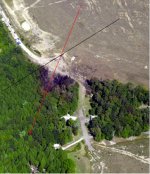
As I mentioned in an earlier post it is possible to measure the roll angle of the aircraft form the impact crater and the direction of the debris/ aircraft heading. In the figure below the red arrow is aligned from the center of the crater in the main direction of the debris/aircraft heading. While the black line is aligned along the wing imprint. When I measure the angle in the picture below I get an angle of about 144 deg. You can also do this exercise with the aerial exhibit photos or in the figure provided by celestrin above. When I do it, I get angles in the area of 140 - 150 degrees.
 

Attachments

  • Flight angle.jpg
    Flight angle.jpg
    81.6 KB · Views: 3
Sure. But the FDR numbers Gravy posted shows the aircraft had a -20° AoA at the moment of impact. Which is why I raised the issue of AoA in the first place.

Corsair, those AoA numbers from the FDR can not be in DEGREES. It is a set of numbers correlating to AoA, but we don't know what the correlation is. We need additional information to translate those numbers into degrees.
 
Both the debris ejected from the crater and the plowing action were aligned along the aircrafts heading on impact. As celestrin says there is no anomalies here.

The key to understanding the look of the impact crater is hidden in the fact that the aircraft was rolled on impact and in the internal construction of the fuselage. That explains why a lot of earth was thrown up to the left and in the front of the plowing action, while almost nothing on the right hand side of the crater when you look in the direction of the aircrafts heading on impact.

Since its way to late, I am going to pull an Apollo on you and leave you with this. But I will come back tomorrow with some figures and why I think so. Actually it is quite simple and can easily confirmed by a simple experiment.
 
Corsair, those AoA numbers from the FDR can not be in DEGREES.
I'm just going by what Gravy posted, and he listed the number as degress. Since he's usually one to get the facts correct, I took the data in the post at face value. :)

Perhaps Gravy can answer whether the AoA value from the FDR that he posted was actually in degrees or not.
 
Last edited:
Last edited:

Back
Top Bottom