Why a one-way Crush down is not possible

Status
Not open for further replies.
DGM, while I am sure some of these people have some facinating information I don't think they can tell me much about a lack of deceleration or velocity loss in the fall of the upper block of WTC 1. Or about the factors of safety of the tower columns.

I am not going just by photos when examining this. The factors of safety were derived by knowing the building loads, the sizes of the columns, and the fact that the unit stress was kept the same on each column of a particular story to eliminate floor warpage due to differential deflection between the core and perimeter.

The Missing Jolt paper used the Sauret video to measure the fall of the upper block of WTC 1. What could clean up workers tell us about that?

If you are referring to distorted column ends there are a large volume of photos showing these things. That is better than the memories of individuals workers.
I was referring to the comment that "why we don't seem to see more of the re-bar". I figured you'd get that. Why don't you resurrect the thread on your latest paper (the jolt) if you now what to discus it?
 
I was referring to the comment that "why we don't seem to see more of the re-bar". I figured you'd get that. Why don't you resurrect the thread on your latest paper (the jolt) if you now what to discus it?

DGM, the missing rebar question was something I simply joined in the conversation on to explain just how much rebar there would have been in each tower. The issue is something Bill Smith was bringing up. Your post would have been better off being addressed to him, but you may not have realized that.

I am sure he will see this here and hopefully will respond to you.

From the perspective of the missing rebar notion, I do think your offer of putting someone looking into that in touch with cleanup workers is a very good one. They would remember whether it was ubiquitous or not.
 
Last edited:
You said all this and didn't actually say anything. So you are going to use the copout "that it has been explained to me many times" and that I am just not listening. Of course, you just say this with no links or basis for it.
Because I figured you might actually remember something that was discussed within the last 10 pages:
#1460
#1448
Or try all of the material spanned in the last 10 pages. It's been covered, many times in much better context than I can write it in. I suggest you reserve your copout remarks for a more fitting situation.


There is no evidence of a dynamic load in the collapse of WTC 1's upper block and I would venture to say probably not in WTC 2 either although that is difficult to measure.
Well dynamic loads by definition are loads that change rapidly, this would also include any unusual loading conditions resulting from the rotation of say, the upper structure against the columns below it. You're claim seems obviously based on your thinking that there was no resistance or deceleration in the duration of the collapse, which would be wrong, and I picked out the total collapse time to demonstrate this to you with better clarity since the time period was easily measurable. It tells me there was resistance, but it was overcome before it had any seizable effect on the overall acceleration of the falling mass. Hand wave it away, but it doesn't change that your based assertion is wrong, and it subsequently affects the credibility of your remaining assertions since they ride on that concept.

Your comment that this is simple material is nonsense. Understanding and designing for dynamic loads is much more difficult than designing for static loads. Most engineers don't get to do it until they have a reasonable amount of experience. I am wondering whether you have a full appreciation of dynamic loading.

Understanding the presence of a dynamic load and being able to calculate it are two different things. I'm not qualified to do calculations, but I do have an appreciation for the former at least. You have a capability to do these calcs, but I'm concerned your confusion over the fundamentals isn't helping with your situation.
 
Last edited:
Because I figured you might actually remember something that was discussed within the last 10 pages:
#1460
#1448
Or try all of the material spanned in the last 10 pages. It's been covered, many times in much better context than I can write it in. I suggest you reserve your copout remarks for a more fitting situation.


Well dynamic loads by definition are loads that change rapidly, this would also include any unusual loading conditions resulting from the rotation of say, the upper structure against the columns below it. You're claim seems obviously based on your thinking that there was no resistance or deceleration in the duration of the collapse, which would be wrong, and I picked out the total collapse time to demonstrate this to you. There was resistance, it was overcome before it had any seizable effect on the overall acceleration of the falling mass. Hand wave it away, but it doesn't change that your based assertion is wrong, and it subsequently affects the credibility of your remaining assertions since they ride on that concept.


Understanding the presence of a dynamic load and being able to calculate it are two different things. I'm not qualified to do calculations, but I do have an appreciation for the former at least.

In the case of an impact dynamic load or shock load it causes amplification of the static load due to rapid deceleration of the impacting object. The reality is that to defeat the reserve strength of the columns by the statically insufficient load of the upper block there needed to be a large dynamic load.

The general argument here is that the impacts occurred gradually and no large jolt was noticed. The problem with this is that the energy of deformation does not change and even separate impacts would still cause an aggregate energy drain from the upper block with a resultant velocity loss, which isn't observed.
 
The general argument here is that the impacts occurred gradually and no large jolt was noticed. The problem with this is that the energy of deformation does not change and even separate impacts would still cause an aggregate energy drain from the upper block with a resultant velocity loss, which isn't observed.
But it seems that deforming all of the columns wasn't strictly necessary to overcome that resistance. Aren't the connections the limiting factors in the design strength, and wouldn't we expect those to fail sooner than it takes to actually bend the columns under particularly unusual loading conditions (this vs this)?

The detached columns in the debris pile seems to indicate this was much more the case. And so does the buckling of the columns at the moment of collapse initiation:

WTC 2 Exterior panel buckling
The exterior paneling at lobby level showing the interlocking pattern which they were built in
WTC column end (bolts missing)
Another column closeup showing where the bolts would have been

And the same failure pattern was observed where the planes impacted the buildings. Nearly all of the exterior panels that were taken out failed because the connections gave out rather than the plane actually shearing through the columns themselves.
 
Bill has been shown many photos of rebar in close-up photos. His only response has been to say he "can't see enough of it", which would be laughable if he actually meant that.
He's trolling and has no interest at all in seeing photos of rebar.

Yes Bill Smith failed to surprise me with his response to my post. We already got "noplaners", and now we can add "norebarers" to the list.
 
But it seems that deforming all of the columns wasn't strictly necessary to overcome that resistance. Aren't the connections the limiting factors in the design strength, and wouldn't we expect those to fail sooner than it takes to actually bend the columns under particularly unusual loading conditions (this vs this)?

The detached columns in the debris pile seems to indicate this was much more the case. And so does the buckling of the columns at the moment of collapse initiation:

WTC 2 Exterior panel buckling
The exterior paneling at lobby level showing the interlocking pattern which they were built in
WTC column end (bolts missing)
Another column closeup showing where the bolts would have been

And the same failure pattern was observed where the planes impacted the buildings. Nearly all of the exterior panels that were taken out failed because the connections gave out rather than the plane actually shearing through the columns themselves.

We don't know exactly what happened to the columns and connections in the fire affected areas as the city of New York did not save the steel for investigators.

The welds between the core column sections were about 60% of the bending strength of the column itself but only occurred every three floors and no bending load would have been on those connections initially due to the horizontal bracing at every floor.

The connection of columns to horizontal beams is done to reduce the slenderness ratio for buckling and the amount of force on them due to a vertical load above is a fraction of what it is on the column. They are not in the direct load path. They would have also kept bending loads from reaching the welds before column buckling occurred.

The perimeter column panels were staggered so that no more than one third of them had connections to lower panels on any one floor. It is not likely that perimeter columns would have failed naturally in the initial stages of the collapse without a dynamic vertical load. The failures of these connections due to aircraft impact was due to shear and bending failure induced by a huge local dynamic horizontal load on them and the columns from the impacting aircraft.
 
Last edited:
We don't know exactly what happened to the columns and connections in the fire affected areas as the city of New York did not save the steel for investigators.
The NIST report did however document pre-collapse data which showed that the exterior columns were beginning to deflect as early as 18 minutes into the event. Additionally estimations have placed these deflections at as much as 55 inches later into event. There was also visible buckling in the original video that this was extracted from which offers a glimpse into what was going on before the dust began to obscure the remainder of the initiation.

buckling.png


I believe it's also imperative to bear in consideration that the helicopters circling the North tower reported that it was leaning to the south shortly before it collapsed. Some of the accounts are described in the 102 minutes book (also summarized in NIST NCSTAR1-8 page 37).

While few column samples could be definitively identified as being in the impact and fire regions, the video, photographic and witness accounts give a pretty good indication of what was happening. Do you dispute this?

The welds between the core column sections were about 60% of the bending strength of the column itself but only occurred every three floors and no bending load would have been on those connections initially due to the horizontal bracing at every floor.
But within the fire regions the strength of the bolted connections would have been reduced from exposure to the heat. Wouldn't this make them more vulnerable to failure from unanticipated out-of-plane bending of the column tree sections? Most of the bolts observed from the available examinations showed signs of tensile fracture, and many were bent in the shank. The end plates show no signs of plastic deformation either.


The connection of columns to horizontal beams is done to reduce the slenderness ratio for buckling and the amount of force on them due to a vertical load above is a fraction of what it is on the column. They are not in the direct load path. They would have also kept bending loads from reaching the welds before column buckling occurred.
Sounds right when you consider the building's design loads, but doesn't this work best when you don't have 15 to 29 floors rotating around a fulcrum and applying an unanticipated out-of-plane loading condition to these parts?

The perimeter column panels were staggered so that no more than one third of them had connections to lower panels on any one floor. It is not likely that perimeter columns would have failed naturally in the initial stages of the collapse without a dynamic vertical load. The failures of these connections due to aircraft impact was due to shear and bending failure induced by a huge local dynamic horizontal load on them and the columns from the impacting aircraft.
Aside from the red I'm not disputing any of this. The aircraft impacts were also out-of-plane though. Also, the lateral deflection of the columns whether by creep or otherwise is dangerous for a reason. Those columns are at their best when they aren't buckling and when the loads fall within the allowable limits.
 
Not without a jolt(s) and a velocity loss. There are none.

I've seen a video that shows once of the collapses from a scarily close perspective. At this range, you can hear the floors failing one-by-one, with accelerating frequency and volume...bang, bang, BANG, BANGBANGBANG...it made a real impression.

Anyway, these were the "jolts" you seek. They were audible, they just weren't visible. This is possibly because the disintegrating outer shell obscured what was going on inside.
 
The rebar was 70 to 90 ksi steel. That is considered high strength for construction. You can find this information in the NIST report.
That size rod is not undersize for use as rebar in a floor. Go look up welded wire fabric.

90 ksi steel would in fact be high strength, but I think you are confusing the both of us. Rebar and welded wire fabric are two seperate things. As far as I remember the floors were simply reinforced with standard 60 ksi rebar and the web wasn't as tight due to the truss support system. As for the size, that's thinner than M10 which is the thinnest rebar redily available.

I only said high strength because it is high strength. It wasn't for effect but accuracy.

I doubt it. The truth movement seems to like pointing out what high strength materials were used in making the floor system but fail to acknowledge they were the weak link that ultimately lead to the global collapse. Remove them from the equation and the damage to the exterior and core probably wouldn't have lead to a cascade failure.
 
Understanding and designing for dynamic loads is much more difficult than designing for static loads. Most engineers don't get to do it until they have a reasonable amount of experience. I am wondering whether you have a full appreciation of dynamic loading.

In the marine structural field you have to consider dynamic loads from the beginning! The structure is located in the interface water/air and the water is moving - waves - which impose dynamic loads ... all the time. And they are of two types - the regular dynamic loads with frequency of the waves and the sudden impact ones - a rare freak wave impacting the structure. There is a third case - when two marine structures collide.

The latter is of interest for 911 research and with my 40+ years experience of marine structural design and damage analysis I would say that the top part of WTC 1 cannot possibly one way crush down the bottom part by imposing a dynamic load from the top. If the top part really tried to do it, the top part would first have been subject to a violent jolt and second to serious local failures to itself and then the destruction would have been arrested. No jolt is seen on any video and one reason is that the top part never imposes a dynamic load on the bottom part! The top part is actually destroyed locally so its roof is dropping, while the bottom part is still intact. A little later the bottom part is destroyed from top down by CD. No doubt about it.
 
Wow, still holding on to that CD idea huh Heiwa??

I was there that day, and I didn't hear a series of timed explosions going off. Neither did many of my Brothers who were there. Sure, some say they heard something LIKE explosions, some even did hear explosions. (One would expect some explosions from transformers, etc. etc. etc. ) But, not bombs.

I think your idea is slightly flawed. If you wanna hitch your wagon to that idiotic idea, explain how it got in there, and NOBODY saw???
 
Heiwa:
In the marine structural field you have to consider dynamic loads from the beginning! The structure is located in the interface water/air and the water is moving - waves - which impose dynamic loads ... all the time. And they are of two types - the regular dynamic loads with frequency of the waves and the sudden impact ones - a rare freak wave impacting the structure. There is a third case - when two marine structures collide.

Correct me if I'm wrong, but the world trade centre wasn't in the water/air interface...was it? Mind you, losing touch with reality is a frequent occurrence when reading your posts.

Heiwa:
The latter is of interest for 911 research and with my 40+ years experience of marine structural design and damage analysis I would say that the top part of WTC 1 cannot possibly one way crush down the bottom part by imposing a dynamic load from the top. If the top part really tried to do it, the top part would first have been subject to a violent jolt and second to serious local failures to itself and then the destruction would have been arrested. No jolt is seen on any video and one reason is that the top part never imposes a dynamic load on the bottom part! The top part is actually destroyed locally so its roof is dropping, while the bottom part is still intact. A little later the bottom part is destroyed from top down by CD. No doubt about it.

Let's get this straight. You work, apparently *cough* in marine structural design, and you're convinced 9/11 was a controlled demolition...because block A wouldn't crush block C. You haven't read anything that's been said to you, have you. You haven't taken a single word on board. You are a ______(fill in the blanks)
 
Last edited:
There has been analysis done by Muhammad Columbo showing that the spires were comprised of the 23 internal core columns only. None of the outer core columns were part of the remaining spires.

Gordon Ross shows Muhammad's analysis on his site here about halfway down the page

http://gordonssite.tripod.com/id2.html

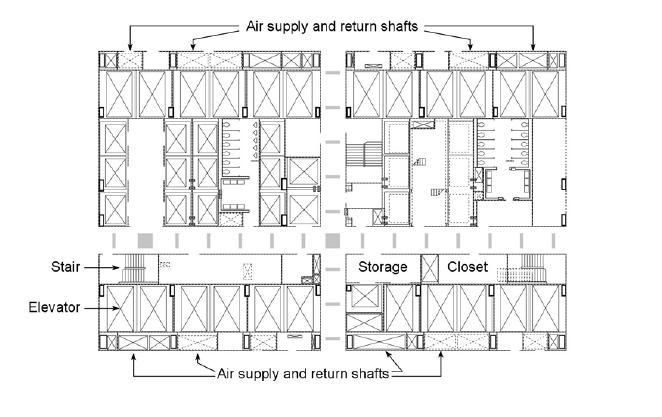
1) All the outer core columns adjoined office space and were covered by heavy reinforced wallboard :

corearchitecture-1.jpg


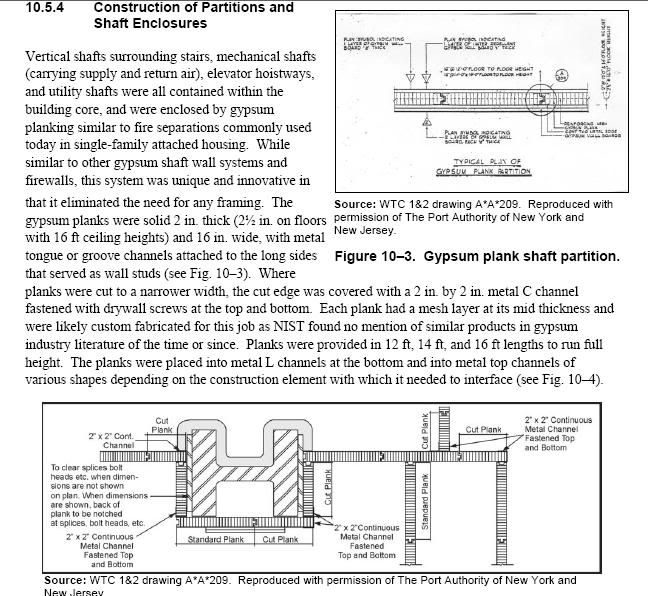
The placement of charges of any kind would prevent the replacement of the wallboard panels as is obvious here:

partitionwallsystem.jpg


2) Here are some shaped charges being placed. Such operations in a working building are incompatible with 1)

cuttercharges-1.jpg


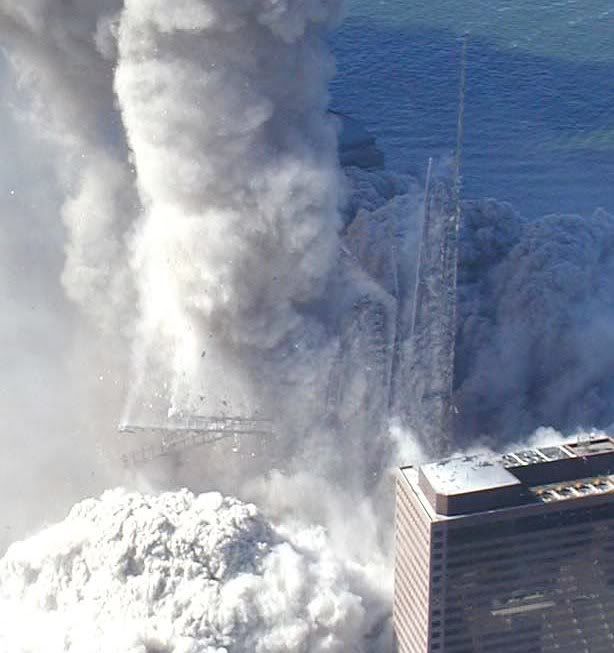
3) And finally, you believe these are all inner core columns, i.e. 6 columns wide in total ?

wtc1peelingcore.jpg
 
Last edited:
1) All the outer core columns adjoined office space and were covered by heavy reinforced wallboard :

[qimg]http://i250.photobucket.com/albums/gg274/sap-guy/corearchitecture-1.jpg[/qimg]

The placement of charges of any kind would prevent the replacement of the wallboard panels as is obvious here:

[qimg]http://i250.photobucket.com/albums/gg274/sap-guy/partitionwallsystem.jpg[/qimg]


2) Here are some shaped charges being placed. Such operations in a working building are incompatible with 1)

[qimg]http://i250.photobucket.com/albums/gg274/sap-guy/cuttercharges-1.jpg[/qimg]

3) And finally, you believe these are all inner core columns, i.e. 6 columns wide in total ?

[qimg]http://i250.photobucket.com/albums/gg274/sap-guy/wtc1peelingcore.jpg[/qimg]

Very good points and info, thanks. However, in figure 2 you can clearly see that nearby office workers didn't notice the two men placing the shaped charges. That's because the building had no occupants, of course....

This wouldn't have been feasible in any working office building, before or since 9/11. It takes a special kind of retarded logic for truthers to overlook things like this.
 
Tony S, thanks for your replies regarding pulverized concrete and quiet explosives.

I credit you for being more sane than most other truthers, as you've allowed that the concrete was largely destroyed by the energy of the collapses.

I'm rather dismayed by your apparent reliance on some comments made in 2001 regarding possible promising areas for nanothermites, extrapolating those to fit into the alleged demolition of the WTC towers.

I believe the words were 'Nanoenergetics hold promise as useful ingredients for the thermobaric (TBX) and TBX-like weapons, particularly due to their high degree of tailorability with regards to energy release and impulse management. The feature of “impulse management” may be significant. It is possible that formulations may be chosen to have just sufficient percussive effect to achieve the desired fragmentation while minimizing the noise level.'

The context of these comments was regarding TBX weapons and fragmentation. I see no indication that this is relevant to cutting core columns of skyscrapers, even if it might have been 'promising' to researchers back in 2001.
Usually 'promising' means 'not yet developed fully', so I'd be very cautious about assuming that this stuff would have any meaningful applications as you seem to suggest.

If that's all you're going on it's awfully slim.

Elsewhere you wrote 'The core columns were made up of three stories tall sections which were butt welded together. I believe that some type of explosive charge was used every third floor to break the welds of the outer core columns, after the collapse was underway for a few floors. As they were inside the tower, any blast from the charges would not be visible, and the debris falling outside would mask any escaping ejections and the collapse itself would mask the noise. I don't think much would have to be done to the perimeter columns except to separate the orthogonal walls at the corners every 10 to 20 floors. This could have been done by attacking the spandrel splices at the corners, allowing the perimeter walls to petal outward.'

You're entitled to your opinion of course, but I was a bit alarmed to read ' As they were inside the tower, any blast from the charges would not be visible, and the debris falling outside would mask any escaping ejections and the collapse itself would mask the noise'

Really, what you're offering is that there is no direct evidence, either audible or visual, of the explosives you postulate, and therefore no way to verify or disprove the idea.

In other words, they couldn't be detected. In that case, it seems just as likely that they just weren't there in the first place.
That would solve your engineering problems right away.

Even a light application of Occam's Razor would discourage this type of theorizing amongst more prudent thinkers, one would think. Tony, quite honestly this stuff seems a bit foolish and wishful thinking on your part. I really wonder why you continue to waste time with these ideas.
 
One also must wonder how Dr Jones/Harrit's magical grey and red chips would play into the scenario offered by Tony S.

I believe Dr. Harrit thinks there were many tons of this stuff, brought in on pallets, as he puts it. Dr. Jones speculates that it was unwittingly painted onto steel columns by contract workers - to what thickness no one (except skeptics such as Mackey and Greening) has even bothered to calculate seriously.

What this might have to do with Tony's idea of breaking the outer core columns is anybody's guess, but this kind of vague, 'kitchen sink' approach to the theory, IMHO results in a mishmash of ideas which fail to make any sense.
If one is forced to lower the threshold of credibility so far as to accept this kind of speculation, then there are lots of other weird and wacky ideas that are just as valid and credible.

I can't see how any of this is ever going to be taken very seriously by the engineering community or the scientific community, for example. I can't believe grown men are seriously considering these things. Wow.
 
Bill, I think a full core is superimposed on the video in that clip. It doesn't look like they are actually showing the core remnant. The reason I say this is that it is fully intact up top.

The makers of he video indicate that this was the actual authentic video of the collapse. I notice that the still standing core looks to be about 8 x 4 columns completely intact and including all crossbracing.. That would be the entire centre set with all the larger outer core columns gone. One thing is certain- no gravity-only collapse allowed this to happen.

http://video.google.com/videoplay?docid=-1615521411849861778 at 30 seconds
 
Last edited:
I read over your post Dave and would like to know how you determine the remaining kinetic energy in the upper block and what the velocity is after each small jolt on a series of columns. This also relates to how quickly the series of separate jolts occur, as if the kinetic energy cannot be made up between jolts there will be a velocity drop which you aren't predicting. I don't think you are looking at the whole picture.

There isn't any need to look at the whole picture. Once the upper block starts moving, it can only be stopped by an absolute deceleration. If the acceleration never falls below zero, collapse must propagate. For angles over 0.25 degrees in this model, that's the case. I can infer from that that the energy balance favours collapse, because Newtonian mechanics is self-consistent.

Your analysis currently does not account for axial plastic deformation and buckling separately. There are three energy loss mechanisms in the deformation of the columns: axial elastic, axial plastic, and buckling.

Agreed, and I'd be interested in knowing if anyone has a better functional form for the resistive force as a function of distance. For the time being I simply tried to get the energy loss about right. The qualitative conclusion, which doesn't depend particularly strongly on the functional form, is that tilt angle has a very big effect on the value of jolt.

It would be interesting to see a spread sheet of your calculated energy losses due to column deformation and how fast these occur relative to one another and how far the upper block has fallen in the total time for the separate tilt jolts to occur over one floor.

Interesting but not crucial - events that are separated in space must also be separated in time. I haven't converted it to a time dependence. Ryan Mackey's figure for the angle at which the separate floor impacts can't be resolved is still valid.

Do you know that the actual core column sizes are available on the Internet? They are here http://wtcmodel.wikidot.com/nist-core-column-data

I'll look it up and put them in when I get time. The structure I define isn't far different.

Additionally, it sounds like you are applying the full force of the upper block on each separate set of columns being impacted at any one time. Are you doing that? It also sounds like your model requires the lifted end to finally move down with a pivot in the center of the core, like a seesaw. Is that what you picture? What happens the next floor down? Does it reverse itself?

As I stated in the post, I'm simply assuming that the upper block is descending at a constant angle of tilt i.e. angular velocity is zero. There's no need for the angle of the upper block to change during or between impacts. I'm not "applying the full force of the upper block" on the support, I'm applying an upward force from the support to the upper block, so at all times the force is calculated from the simplified functional form for the column resistance. The force exerted by the upper block must be the same, from Newton's Third Law.

Dave
 
Last edited:
Status
Not open for further replies.

Back
Top Bottom