Why a one-way Crush down is not possible

Status
Not open for further replies.


I agree. The implications were psychologically uncomfortable for me too. The avoidance of thinking stuff that causes fairly severe psychological discomfort may account for some people simply refusing to think certain things. It is not easy, psychologically speaking, mentally to process such an awe-inspiring depth of evil. It may be far easier metaphorically to grasp at straws and to conduct frantic doggy paddles to try to stay afloat in a sea of denial.

I clearly remember the day i realised what had happened. i had the distinct sensation of having to force my mind open far enough to take it all in.
 
Last edited:
There have been several people who have shown that due to conservation of momentum alone that natural collapses would have taken much longer than 17 seconds. I would think you would know who they are and where to find their discussions on it.

Where can I find your work on this?
Where can we find your work checking this failed value?

You checked the numbers you post? Do you think 17 is correct? The 17 seconds is in error. Who would repeat it without checking it? Would an engineer miss an error like this? Who gave you the faulty numbers?
When you finally check the numbers and do the work it should be close to 12.08 seconds. You can check with other engineers...
I think you should check the numbers and ideas you post instead of misleading people with wrong information; like the claims of controlled demolition; total poppycock to pass on lies like controlled demolition when there is no evidence, wrong numbers and faulty analysis.
You spew controlled demolition when 19 terrorists killed 8 pilots, and flew planes into buildings. Why do you make up lies?

... 0.00087 percent of all engineers are a fringe few who have delusions on 911, no coherent scenario; just failed papers, faulty calculations, delusions and dirt dumb conclusions based on hearsay, lies, and failed opinions. Not a chance to earn a Pulitzer Prize and total loss of respect in the engineering community.
As Chairman of the CTBUH I am well connected to most of the leading practitioners of tall building design. The Council represents organizations with well more than 100,000 employees. I do not know anyone or organization in the Council that supports the controlled demolition theory. The ASCE has an engineering membership of 120,000 and they participated in the production of the NIST report. NIST itself employs about 2,900 scientists, engineers, technicians, and support and administrative personnel and hosts about 2,600 associates.

The controlled demolition theory is an embarrassing failure for 7 years. That poor fool who tried to refute Bazant's work? He was roasted in a real journal. Do you have some junk science to save Heiwa from failed pizza box engineering? Do you share the no-plane stuff of Heiwa? Does anyone in 911Truth have a scenario to go with their delusions and failed ideas on 911? When will you present support in the form of real evidence or calculations for Heiwa’s OP?
 
Last edited:
The floors of C and A. There is no question of the upright columns failing at this point so C must become impaled on A like a cocktail sausage on a stick.

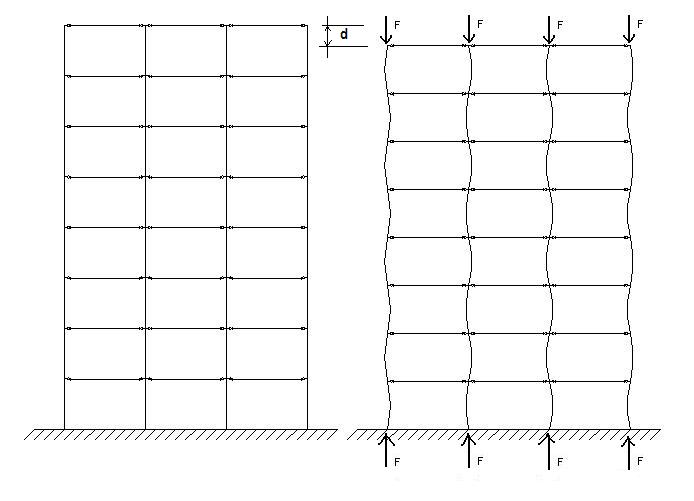
Note that there are no masses in the structure (so it is not really WTC 1 lower part) and that the forces F are applied on the continuous vertical elements that have constant properties from top to bottom = uniform stress in them. These vertical elements are connected to horizontal elements - also with constant properties via joints that can only transmit forces (and no moments). So the forces F compresses the vertical elements and they deflect vertically and laterally and some forces develop in the horizontal elements fitted between the vertical elements that will affect them and the joints. Note that the inner vertical elements are connected to two horizontal elements at each level, while the (wall) vertical elements are only connected to one.
 
Last edited:
But before failures occur, something else must happen: elastic compression and applied energy is transformed into compression.

WTCFlex.JPG

That is not what happened at WTC 9/11

The falling top block (your "C") did not land on the rows of columns as you persist in wrongly claiming.

Draw the diagram of what actually happened then I may be able to comment.

Remember I have already corrected one of your diagrams which showed the wrong mechanism. Your turn to do the corrections this time.
 
Note that there are no masses in the structure (so it is not really WTC 1 lower part) and that the forces F are applied on the continuous vertical elements that have constant properties from top to bottom = uniform stress in them. These vertical elements are connected to horizontal elements - also with constant properties via joints that can only transmit forces (and no moments). So the forces F compresses the vertical elements and they deflect vertically and laterally and some forces develop in the horizontal elements fitted between the vertical elements that will affect them and the joints. Note that the inner vertical elements are connected to two horizontal elements at each level, while the (wall) vertical elements are only connected to one.

Is it true to say that the vertical columns at first impact are still perfectly braced. The collapse of C is perfectly straight down with no sidewards force.

So So C impacts A. The vertical columns of C crunch through the floor of A and strip away some of the lateral supports of A's vertical columns. Menwhile A is doing exactly the same to C. If this continues for three or four floors in each block then the vertical columns of A are sheathed in the body of he falling C block and vice versa. What happens then ?
 
Last edited:
That is not what happened at WTC 9/11

The falling top block (your "C") did not land on the rows of columns as you persist in wrongly claiming.

Draw the diagram of what actually happened then I may be able to comment.

Remember I have already corrected one of your diagrams which showed the wrong mechanism. Your turn to do the corrections this time.

This is just a test to see if you understand simple structures at all. You can apply the forces F on the horizontal top elements (and in air outside), if you like, and they will deform in bending and the force F will be transmitted to adjacent vertical elements (as long as the horizontal element does not break) and we are back to starting point again.

Now, if a force F is applied on a horizontal top element and breaks it, where does force F go? And do you agree that the two parts of the broken element will still hang on the vertical elements?
 
Last edited:
This is just a test to see if you understand simple structures at all. You can apply the forces F on the horizontal top elements (and in air outside), if you like, and they will deform in bending and the force F will be transmitted to adjacent vertical elements (as long as the horizontal element does not break) and we are back to starting point again.

Now, if a force F is applied on a horizontal top element and breaks it, where does force F go? And do you agree that the two parts of the broken element will still hang on the vertical elements?

There is something quaint about your "testing" my understanding Heiwa. :D

Is part of the test to see if I can pick the fundamental error(s) in your post?

Let me "cut to the chase". There is no force "F" >> did that get your attention? :)

The only force is the resisting force from the structure below. Not the maximum force that could be applied if the lower structure was capable of exerting it. Fundamental error #1

When the point of contact is the floor and not the outer tube column the only resistance has a maximum of the shear failure of the floor joist to outer column connection.

Now if a force is applied to a floor joist as the horizontal beam it will either fail in shear at the ends or in bending at the middle. And visual evidence all the failed joists seen on pictures show shear failure at the end NOT bending failure in the middle.

The issue is of more general application. In a race condition when a rapidly falling load impacts on a beam such as the WTC floor joists the "shear failure" will always win the race against "bending moment failure".

Now Mr Engineer who wants to test my understanding, if you are interested critique that statement. No clue as to whether It is true or false or somewhere between dependent on circumstances. You may care to cover each of the three in your critique. Here. In the thread. For all readers to see. :D

BUT remember it matters not which failure occurred for the rest of my explanation. :)
 
You're right, Ozeco41. Heiwa claims to be some sort of shipbuilding engineer. God save us if we ever end up peering over the boughs of a craft he's had a hand in.

Bananaman (The Scared).
Sadly there are many engineers like him in that they can get lost on the wrong premise or wrong paradigm. Perfectly competent in routine applications. But, if ever they "lose the plot" they cannot self correct and many of them cannot even apply the corrections when pointed to the error.

Many times in my later senior engineering career the two successive CEO's used me to "paradigm bust" when the engineering hierarchy was "lost and locked" on a wrong path. Sewage sludge strategy, sewer infiltration strategy, asset maintenance financial and physical strategies (somehow the accountants had the former and the engineers the latter and the two clubs rarely talk to each other). All for the Water and Sewerage Authority for Sydney, NSW Australia. Its too lengthy a scene setting to post here to show the analogies to the WTC situation which is "lost and locked" on wrong solution by at least two prominent members posting here. And aspects of Greening, Bazant et al.

So I stick with explanations for those in less exalted positions or those who are prepared to listen and I usually avoid taking sides on NIST or "Official" positions. Except to comment when I think they are right on technical issues of significance. I cannot recall any where they are wrong on significant issues.
 
Last edited:
But before failures occur, something else must happen: elastic compression and applied energy is transformed into compression.

[qimg]http://heiwaco.tripod.com/WTCFlex.JPG[/qimg]

So if you apply forces 4F to above structure (it is the lower part A) and it deforms d, I hope you agree that energy E stored in the structure is E = 4 F d?

OK. This is the process that Tony Szamboti connects with the famous jolt that cannot be spotted. Compression/damping takes time and whatever applies the 4F (the moving upper part C - not shown - in this case) must slow down.

Now if more force/energy is applied - destruction process starts, what element fails first in above structure?

And how are the forces applied after this first failure?

And how does the structure deform then? How does the destruction process continue? What element fails then?

What happens when you remove the top floor and tilt those arrows slightly away from vertical?
 
What happens when you remove the top floor and tilt those arrows slightly away from vertical?

That's a good question. Remove the upper, three horizontal elements (your top floor), so that the vertical elements have no lateral support there. The first lateral support is at next horizontal element level!

Those arrows (vectors) are the forces 4 F acting on the tops of the vertical elements.

Instead of tilting them, it is easier just to add forces 4 Fh that act laterally on the top of each vertical element. They are balanced by forces -4 Fh at ground level. The combination F and Fh is a tilted arrow, so to say. What happens?

Well, F continues to compress the structure vertically exactly as before and Fh will displace(shear)/bend the vertical elements sideways around the joints below, i.e. the whole structure will displace transversly. The latter also requires energy.

If you know a little about beam analysis you can easily calculate the displacements of joints and deformations of elements in the whole structure and see how forces 4 F and 4 Fh go through all elements from top to ground. There is equilibrium everywhere.

It seems NIST is not capable of doing simple beam analysis.

PS. I wonder what Bin Laden's mountain fortress is doing in this thread?
 
Last edited:
I think you are we weing here a little. But it's okay if this transfinite math does something for you.

Tony I'm not surprised you scoff so far all the University math profs laugh but I know they are in the pockets of the math textbook makers so I take thier criticism as confirmation.

Einstein, Newton, Aristotle et. al got it wrong 'cause they didn't have TM.

The proper application of TM makes the 911 problem simple at best and trivial in most cases.
 
Note to Tony S. regarding the missing jolt paper.

Tony, I have a very hard time following your logic. On p. 10 you state 'Bazant claims that a minimum force amplification of 31g, or 31 times the static weight of the
upper stories, would have occurred in a collision between the upper and lower blocks of the Twin Towers after a fall of one story. [17]' (17. Bazant and Zhou, 2002, p. 3.)

You use this 31g figure as the basis to calculate your estimate for the kinetic energy losses, hence the 'jolt'. However, when you actually read p 3 of 'Why did the World Trade Center Collapse?' it is clearly stated that 'The solution P = Pdyn yields the following elastically calculated overload ratio due to impact of the upper part:

where Po=mg=design load capacity.

So all it does is give a calculation for the overload ratio vs the design load capacity. It demonstrates with calculations that the acceleration of the upper block far exceeds the strength of the impacted floor below.

There is no valid reason that there should be massive deceleration. As stated in the 2006 paper 'Mechanics of Progressive Collapse:
Learning from World Trade Center and Building Demolitions ' Bazant and Verdure; 'the kinetic energy of
the falling upper part far exceeded the energy that could be absorbed by limited plastic deformations and fracturing in the lower part of tower. ' The kinetic energy of the top part of tower impacting the floor below was found to be about 8.4 × larger than the plastic energy absorption capability of the underlying story, and considerably higher than that if fracturing would be taken into account (p3)

They then provide very comprehensive Crush-down/Crush-up calculations to show in detail how much energy was involved. The summary of these findings is published in the Journal of Engineering Mechanics, 'What Did and Did not Cause Collapse of WTC Twin Towers in New York'.

It is very clear from their calculations that the buildings were not in freefall, as your analysis also finds. This of course immediately argues against explosive demolition, and we don't need to bother with it further at this point. But also it is clear that the loss of kinetic energy amounts to a fairly small percent, and certainly there is no agreement with your assertion that there would be an enormous deceleration.

Tony, your jolt theory paper is of course nowhere near as comprehensive an analysis as either of the Bazant papers, nor was your paper published in an engineering journal. But even so, you have completely ignored the loss of perimeter column capacity due to bowing, where Bazant et al have not. So the context for your analysis lacks the appropriate parameters to be meaninful in the first place; the bowing of columns cannot be handwaved out of existence, it is central to the mechanism for the collapse of the towers.

Further, the bowing, without a doubt caused by the high-speed plane impacts and subsequent fires, cannot plausibly be the result of some mythical pyrotechnic devices planted there by unspecified Men In Black (not Jewish, of course). That is a ludicrous and pathetic hypothesis, not based in science at all. In my view it is a cop out, an abandonment of serious inquiry.

So comparing the 3 Bazant papers with your paper's claims, not only does your main claim NOT fit with the statements in the Bazant papers, making for a rather poor refutation to begin with, but you haven't even BEGUN to formulate good math counter to the Bazant Crush-Down/Crush-up equations. You don't even bother, instead focusing on what appears to be a misrepresentation of Bazant's work, and an attempt at misdirection to justify your argument to incredulity.

If you're going to continue making wild claims about explosives, you ought to at least consult with leading experts in demolitions to look at the feasibility. I think if you were really serious about this inquiry, you'd have done so long ago, and probably would've modified your approach to EXCLUDE controlled demolition, as it just doesn't fit.

I also noticed you mentioned the '2.25s close to freefall' in the WTC7 collapse, the Holy Grail of truther 'CD in the gaps' conspiracy theories. I will address that another time, this is enough for today. I'm going canoeing now.

This obsession you guys have with CD is making fools out of you. Seriously.

 
Last edited:
Is it true to say that the vertical columns at first impact are still perfectly braced.

Probably so for the first 3-4meters.

The collapse of C is perfectly straight down with no sidewards force.

Despite your claim of what you see in that video, this is wrong. If you want to clim this, then Heiwa needs to change his scenario, cuz he clearly states that columns "rub" against each other. Plus, his diagram shows C tilting. So you're wrong, or Heiwa's wrong. Pick one.

So So C impacts A. The vertical columns of C crunch through the floor of A and strip away some of the lateral supports of A's vertical columns. Menwhile A is doing exactly the same to C. If this continues for three or four floors in each block then the vertical columns of A are sheathed in the body of he falling C block and vice versa. What happens then ?

Since it's descending at an angle, and you realize that the core lateral supports have been lost, both sets of core columns will have lateral impacts. The core columns most likely then break at the welds, since they were the weakest link. The A columns descend now too. The C columns are freed to add to the descending mass.

The ext floors that may still be connected to these columns follow along with the columns, and may break off and add to the descending mass.

Contrary to Heiwa's claims, there can be no "entanglement" or "arrest to friction" , since the descending floors/columns are moving along with the collapse front now.

Collapse continues.
 
Probably so for the first 3-4meters.


Despite your claim of what you see in that video, this is wrong. If you want to clim this, then Heiwa needs to change his scenario, cuz he clearly states that columns "rub" against each other. Plus, his diagram shows C tilting. So you're wrong, or Heiwa's wrong. Pick one.


Since it's descending at an angle, and you realize that the core lateral supports have been lost, both sets of core columns will have lateral impacts. The core columns most likely then break at the welds, since they were the weakest link. The A columns descend now too. The C columns are freed to add to the descending mass.

The ext floors that may still be connected to these columns follow along with the columns, and may break off and add to the descending mass.

Contrary to Heiwa's claims, there can be no "entanglement" or "arrest to friction" , since the descending floors/columns are moving along with the collapse front now.

Collapse continues.

Yesterday you and I agreed that the top 10% was still supported by 250-odd columns (85% of the original amount)

For this argument we have to forget about that and theorise a freefall drop.
So looking at it in slow motion C lands flat on A.
http://www.youtube.com/watch?v=y9-owhllM9k

Do you agree from the video ?
 
It demonstrates with calculations that the acceleration of the upper block far exceeds the strength of the impacted floor below.

Seriously.

Seriously, please do not compare an acceleration of anything and not ... an upper block (???) to the strength of a floor below.

You are just making a fool of yourself!
 
Link, pls!

Try every one of your posts where you fail to explain how you can hold BOTH the "bounce" scenario and "entanglement" scenario to be true, for starters.

Picking one or the other would be a first step in building some credibility.

But you won't, will you?
 
Status
Not open for further replies.

Back
Top Bottom