
Why a one-way Crush down is not possible

Status
Not open for further replies.
As someone brought up before in another thread, once the top fails the next floor it impacts, It does not arrest. This is the point where truthers throw out gravity and attempt to make their survivability case by using a model of impact on a horizontal plane. (VW bugs and school bus for example) But both the top and the floors it collects are constantly gaining momentum due to gravity and have now passed the initial floor of acceleration. They continue to gain momentum as they impact the second and third floor and fail them. The very fact that it failed the first floor during the first 12 feet of acceleration makes global collapse inevitable. Otherwise that first floor would not have failed to begin with because at that point it had the best case scenario for survivability. Once the event moves past that threshold and gathers the mass of that floor collapse arrest becomes impossible. If you notice with every one of heiwas models. the first unit (lemon, sponge, pizza box, whatever) always survives. That behavior alone tells us his modeling examples are meaningless.

A.W....do you confirm the following:-

''Whatever downwards force the moving body exerts on the stationary body of identical construction fixed in the ground is reciprocated by the stationary body equally and oppositely. After that it depends which is used up first.''
 
Conservation of momentum does NOT apply since there is an external force (gravity).

A.W....do you confirm the following:-
''Whatever downwards force the moving body exerts on the stationary body of identical construction fixed in the ground is reciprocated by the stationary body equally and oppositely. After that it depends which is used up first.''

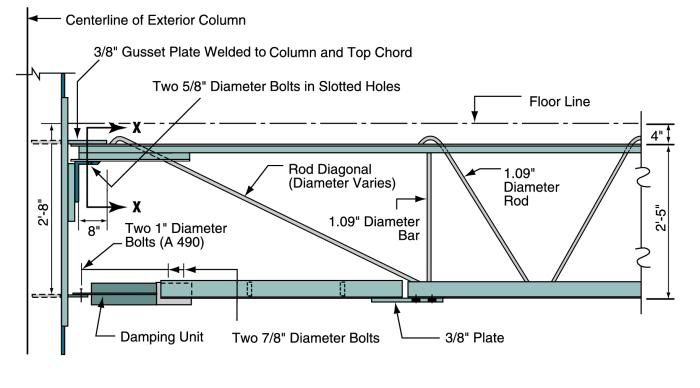
No., Again. You are omitting gravity. Therefore the force is not reciprocal. Why the hell cant you get that through your thick skull? What you are proposing is little different than expecting an automobile engine to stop running simply because of the collective energy loss due to friction and heat. It does not happen in the real physical world. Think of gravity as your engine fuel.


getting back to our collapse.The truss/perimeter column connections are all that is needed to fail for global collapse to ensue. It is as simple as that.

truss-side.jpg
 
Last edited:
I was thinking about your axiom Heiwa. If it is written in say two clear lines of text which absolutely defeat Bazant and the gvernment story, you could have it passed around among engineers in general with a request to only confirm the axiom and sign their name to it. No more thn that. In this way you would give them a way of saying that 9/11 was an inside job without them actually having to say he words. Richard Gage could pass these forms out at his lectures for instance. After a while you could have thousands of signed up engineers saying that Bazant is a fraud. Maybe you could write a counter-axiom that Bazant implies. Might be some mileage in this ?

As a starter 2 Feb 2009 I have submitted a Discussion of paper to ASCE Journal of Engineering Mechanics about the BLGB paper. ASCE informed on 8 April it was still being reviewed. Editor Ross Corotis seems to like the paper. The axiom may form part of my paper.
In the BLGB paper Bazant & Co suggest:

"It is well known that, in inelastic buckling, the deformation must localize into inelastic hinges (Bazant and Cedolin 2003, sec. 7.10). To obtain an upper bound on Wc, the local buckling of flanges and webs, as well as possible steel fracture, was neglected (which means that the ratio K/Wc was at least 8.4). When the subsequent stories are getting crushed, the loss m0gh of gravitational energy per story exceeds Wc exceeds 8.4 by an ever increasing margin, and so the velocity v of the upper part must increase from one story to the next. This is the basic characteristic of progressive collapse, well known from many previous disasters with causes other than fire (internal or external explosions, earthquake, lapses in quality control; see, e.g., Levy and Salvadori 1992; Bazant and Verdure 2007). Merely to get convinced of the inevitability of gravity driven progressive collapse, further analysis is, for a structural engineer, superfluous."

The quote is 100% nonsense. And the last sentence is really stupid.

And what about: ".... progressive collapse, well known from many previous disasters ..." ? It has never taken place before and after 911!

Anyway, to resolve the dispute I have asked for evidence of any structure that will be subject to progressive collapse. FGS, if there are structures around that can progressively collapse, we have to inform the public about them! Maybe they are working inside such a structure, &c. It is a safety matter.

My business is safety at sea - rotten ships, non-working life saving appliances, unsafe procedures aboard and ashore, corrupt national safety at sea agencies + staff, criminal ship owners and insurance fraud, &c. Evidently same things occur ashore and I advise on that, eg 911 WTC 1 structure.

Safety first is my motto.
 
Ridiculous Heiwa. Neither NIST nor Bazant comment about your model. They refer to the actual collapses of the WTC Towers.

Why persist in conflating the two? Your model is artificially constructed to support your version of what you want to "prove". It does not represent or resemble the "collapse which actually happened" at WTC on 9/11.

???? Sorry, my model is just to show what happens, when part C drops and impacts and compresses part A. Does a gravity driven one-way crush down of part A follows?

According my axiom and experience one-way crush down is luckily not possible.

Conclusion - the WTC 1 destruction on 911 was not a gravity driven one-way crush down of part A.

So what was it?
 
No., Again. You are omitting gravity. ... The truss/perimeter column connections are all that is needed to fail for global collapse to ensue. It is as simple as that.

Is it? Produce any structure with said connections ... and let it globally collapse, when you damage the connections! You'll win a prize!
 
You keep banging on about the height of the lower structure as though that meant something, so it would appear that the model you are trying to refute involves over-loading the perimeter and core columns vertically, which no one with any sense is suggesting here.

You're still trying to treat a building as two colliding ships.

???? You can overload any element/joint you like in part C and A, just remember you need energy for it. Tell me what element/joint fails first ... and what happens then.
 
Got any 1/16656 inch dia bolts handy?

Is it? Produce any structure with said connections ... and let it globally collapse, when you damage the connections! You'll win a prize!

Sure Anders, Get back to me when you can successfully scale that 1 inch bolt truss connection, A bolt diameter dimension that represents 1/16656 of any models total height. And thats not even including the square of the area. Mmkay?
 
Last edited:
Sorry - in my model there is only parts C and A. Anything between parts C and A disappears to enable a free fall drop C on A. No part D!
Then your model has nothing to do with reality.
Actually there is nothing between C and A except virtual columns that disappear due to FIRE!
Nothing magically disapeared on 9/11.
But let's assume there is a part D on top of part A.
No need to assume, it's a known fact.
So you suggest part D is compacted between C and A, and then that this part D impacts part A.
I suggest that before part C even moves, part D is slowly falling apart. In fact it's the failure of part D that leads to C dropping in the first place. The parts that fall are damaging part A before part C even moves. The parts that fall off are also adding load to the top floor of A before C moves.
Doesn't part D also impact part C?
Yes, but not as hard as it impacts part A. The lose parts of D can only fall downward (damn gravity...) to impact part A. They can't fall upward, they can only impact C when C falls into them. The damage to C and D is not symetrical, D is disintgrating at this point while C is mostly intact.
And ... part D is damaging part A before part C gets there???!!!??? all the way down!!!!
Yes, but after part D collapses, part D is mostly crushed and being pushed down from above by part C (and that pesky gravity). It becomes the buffer at the base of part C. As A is crushed floor by floor, it's mass does not disapear, it adds to the falling mass. Each floor of part A is hit harder than the one before it, while the buffer between C and A grows, all the way down.
Please, do you suggest that part A is one-way crushed down by a part D of the building that was between A and C before impact? But it was only air? Nothing!
It was only nothing in your fantasy world.
And please - gravity does not pull in one direction! Gravity is a force of attraction between two masses. Both masses are attracted. It is not like love!

The acceleration of the earth upwards towards part C is about 1/1015 of the acceleration of part C downwards. Do you really want to consider that relevant?
 
???? Sorry, my model is just to show what happens, when part C drops and impacts and compresses part A. Does a gravity driven one-way crush down of part A follows?

According my axiom and experience one-way crush down is luckily not possible.

Conclusion - the WTC 1 destruction on 911 was not a gravity driven one-way crush down of part A.

So what was it?

Heiwa - your apparently deliberate circling becomes tedious - you appear to be more intelligent than you therefore pretend when you miss the point.

Is that for my benefit - I will not fall for it? Is it for others who may?

Here is is - a response at basic level of logic:
  • "my model is just to show what happens," - your model can show what happens to your model - it does not model what happened at WTC on 9/11
  • Does a gravity driven one-way crush down of part A follows? No - not with your model ;
  • According my axiom and experience one-way crush down is luckily not possible. Taking the axiom first your statement omits the necessary qualifiers - it would be more correct to say "crush down is luckily not possible for my model and any structures of which my model is representative" - and "luckily" stricken because luck is not a factor;
  • According my axiom and experience one-way crush down is luckily not possible. That may be true of your model. I doubt you have experience of WTC and even so you would need to show how the model was analogous - that you may have learned from experience is irrelevant to the truth or otherwise of the necessary explanation;;
  • Conclusion - the WTC 1 destruction on 911 was not....... - Your conclusion does not follow from what you state as has been explained to you many times.
  • So what was it? - setting aside the terminology you choose the global collapse of the WTC Towers on 9/11 has been explained for you on several occasions. It is not the same as what would happen with your model. Why that is so has also been explained. You have not responded to those explanations.

I remain prepared to give reasonable assistance to you if you wish to understand what actually happened with the WTCV Towers on 9/11.

I have no interest in discussing your model. It is quite obvious that it will not "top down collapse" under gravity. That is because it does not model the WTC Collapses.
 
Last edited:
No., Again. You are omitting gravity. Therefore the force is not reciprocal. Why the hell cant you get that through your thick skull? What you are proposing is little different than expecting an automobile engine to stop running simply because of the collective energy loss due to friction and heat. It does not happen in the real physical world. Think of gravity as your engine fuel.


getting back to our collapse.The truss/perimeter column connections are all that is needed to fail for global collapse to ensue. It is as simple as that.

[qimg]http://i294.photobucket.com/albums/mm89/AWSmith1955/truss-side.jpg[/qimg]

Here is the sitation I laid out earlier again. If gravity is not lready contained in it ,then please plug gravity in and show us how it would make the situation different.

''Whatever downwards force the moving body exerts on the stationary body of identical construction fixed in the ground is reciprocated by the stationary body equally and oppositely. After that it depends which is used up first.''
 
Last edited:
On the surface that statement looks true bill, but it misses one important part as demonstrated by the WTC Towers on 9/11.

It is only true if the impact between the two puts like against like.

The "Top Block" on 9/11 did not contact column on column, floor on floor, core on core OR as I said "like on like".

The top bloc fell wedged inside the outer walls of the bottom section of tower - "C" inside "A" if we use HEiwa's letters.

The whole outer sections of the Top Block fell on the single floor beneath it. Also the core most probably had limited axial column on column contacts if any.

So, my answer, the only valid answer for me or anyone, is "No! I do not and cannot confirm the following. It is not always true." And in context of WTC 9/11 it is not true.

Two things Oz. If you look up at the bottom of C in your minds eye you will see a pattern of column locations and so on. Then if you look at the top of A you wll see the same pattern in reverse. So the damages are equal when the two parts engage.
The other thing is if the columns top and bottom were were out of alignment then so was the whole block which puts the top block perimeter walls out of line with the walls on the bottom of the building on at least two sides. So I doubt that the top fell into the bottom.
 
Last edited:
The parts that fall are damaging part A before part C even moves. The parts that fall off are also adding load to the top floor of A before C moves.

In my model upper part C drops and impacts lower part A. You suggest that there is another part D between part C and part A that moves before part C and adds load on part A before C moves.

I am confused! What is between part C and A except air, furniture and human beings that I exclude in my model for obvious reasons. Does part D produce the one-way crush down? Pls feel free to include this part D in my model and then explain what element in part C and A fails first, when parts C and A ... and D impact each other.
Is it support elements in C or A? Note - there are no support elements in D.

And, please, do not suggest that no support elements fail but only joints between vertical support elements and horizontal floor elements and that just 97 floors pan cake on top of each other!

Or was it part D that produced all joint failures?

Anyway - just produce a model where a top part can crush down a bigger bottom part and we are in business.
 
Heiwa
I have no interest in discussing your model. It is quite obvious that it will not "top down collapse" under gravity. That is because it does not model the WTC Collapses.

Thanks! Pls return to this thread when you can produce a structure that models the one-way crush down WTC destructions.
 
Sure Anders, Get back to me when you can successfully scale that 1 inch bolt truss connection, A bolt diameter dimension that represents 1/16656 of any models total height. And thats not even including the square of the area. Mmkay?

My model is full scale and about 411 m high! See http://heiwaco.tripod.com/mac5.htm .

So no need to scale anything. If you want to include any joints between horizontal element m and its supports below that forms the units in the model, pls feel free.

OK - we have parts C and A as before. Now horizontal elements m are connected to vertical supports via joints.

Actually, the joints were there before, because you cannot connect a horizontal element m with a vertical support without a joint. But now there is a bolted joint.

OK - part C drops on and impacts part A! There is compression everywhere. And then something breaks! What element or joint or bolt fails first? A joint or a bolt? OK, in C or A? Where? What floor? And what happens then?

Pls, explain how a one-way crush down by C of A takes place because a joint or bolt fails.

Do you suggest that WTC 1 was destroyed because a bolt failed?
 
In my model upper part C drops and impacts lower part A. You suggest that there is another part D between part C and part A that moves before part C and adds load on part A before C moves.

Part D is the several floors that were impacted by the plane and set on fire. I'm not saying part D as a whole moved before C. I'm saying pieces of part D fell on part A before the global collapse began. And part D was significantly weakened already before part C began to move (obviously, as this is why C moved to begin with). Which direction do you think the pieces of D went when D broke apart? Up towards C, or down towards A?
 
Anyway - just produce a model where a top part can crush down a bigger bottom part and we are in business.
I told something to this effect to thewholesoul not long ago. The size is not relevant so much as the dynamic weight of the mass exceeding the ultimate strength of the structural members.
 
I have not seen a Heiwa model in which the entire structure does not consist of integrated parts. The bottoms of the pizza boxes are integral with the edges. A sponge, a stacking tray, a lemon, all are totally homogeneous.

This has diddly to do with the way the towers were put together.

The faliure as, by all evidence, entirely in the columns on, at most, three floors and in the floor-to-perimeter-column joints.

Your models do not have frangible floor-to-perimeter joints and are, thus, irrelevant to the discussion.
 
???? Sorry, my model is just to show what happens, when part C drops and impacts and compresses part A. Does a gravity driven one-way crush down of part A follows?

According my axiom and experience one-way crush down is luckily not possible.

Conclusion - the WTC 1 destruction on 911 was not a gravity driven one-way crush down of part A.

So what was it?


You still haven't explained how the ceiling of one floor stops all the other floors crashing down on it. Maybe you think you have explained it, but you haven't.
 
Part D is the several floors that were impacted by the plane and set on fire. I'm not saying part D as a whole moved before C. I'm saying pieces of part D fell on part A before the global collapse began. And part D was significantly weakened already before part C began to move (obviously, as this is why C moved to begin with). Which direction do you think the pieces of D went when D broke apart? Up towards C, or down towards A?


This is what I was trying to say. When the whole top part of the building starts to fall, what stops it?
 
Status
Not open for further replies.

Back
Top Bottom