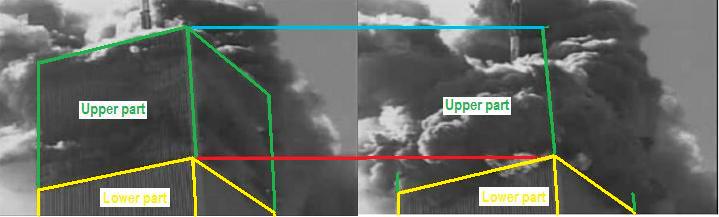
Why a one-way Crush down is not possible

Status
Not open for further replies.
I see what Tony means though because at no point do we see the top block overlap the lower block which means that the walls were in perfect alignment. That would imply a straight-down collapse....column-on-column.
Obviously if 250 columns had knelt they would have knelt in one direction and that would have walked the top block visibly out of line with the lower block.
If you look at the attached video you will note there is no rotation of any kind of the roofline prior to collapse initiation. No rotation = no kneeling of 250 columns.

http://www.youtube.com/watch?v=y9-owhllM9k Antenna video

(Note; there are those who claim that although there is no rotation of the roofline in this relatively clear video that there actualy IS rotation in videos taken from other angles. Think that through)
Bill there are three options:
  • Top falls outside bottom. Not so see your linked video;
  • Top falls directly on top of bottom. Again not so - look carefully at where the top disappears at the "top edge of the bottom" at about the 10-15 seconds timing. AND
  • Top falls behind therefore inside bottom. Look at the video again at that same timing point.

The top moved down and clearly the bottom is neither crushed nor buckled nor apparently affected in any way.

Therefore the top is neither falling outside NOR falling directly on top.

Also there is no evident damage to the top - it simply disappears behind the upper edge of the bottom bit for the time we can see.

So my claim is correct at least for that one of the four walls.

Lets take this step by step so I will leave it there for this post.
 
Beach:
Heiwa why are you stuck making up lies about 911; over 7 years after the event?

I'd say he either makes money from it, has his ego compensated for some deficiency by it, or is as mad as a hatstand.

I'm betting on a bit of all three.

Bananaman.
 
Thanks for observations. You 100% debunk Bazant & Co in their BLGB paper that explains the one-way crush down intact C crushing A and then the one-way crush up rubble B crushing C with some crazy differential equations and associated assumptions. So a Bazant one way crush down didn't take place!...
that is your interpetetion. I have not read Bazant for about a year. I recall discomfort with some of his approach - cannot recal what so it was not my intention to debunk and there may still be other issues I would want to examine.
[/QUOTE]
Good!
...So how did all the structural elements in the structure shear off at joints or inside the elements themselves? Falling elements? Why would elements connected to other elements fall? Some supports failed! They buckled! OK - some elements displaced downwards. But when did shearing off by falling elements start?
I have already addressed most of these issues in other posts but it is probably time to draw them together into one cherent explanation. I will try to do so in the near future.
Falling elements must apply their energy/forces on other elements and then shear them off at joints or inside the element. It is not so easy. Just visit The Heiwa Challenge thread where you are invited to produce any structure that can do that. You see the other, static elements apply energy/forces on the falling elements, too.

The falling elements are assumed loose and the other elements are still connected to one another. One falling, loose element has no chance against several static elements still connected. The lonely one may contact one of the the many but will then be pushed aside; the energy of the falling element will simply not be applied to the many. And so one. So a falling object C cannot destroy an assembly A of similar objects C (A=10C) joined together. C may break loose one C of A but that's it. If you can provide evidence to the contrary, pls do.

Anyway, thanks for debunking Bazant & Co. That's the purpose of my article in post #1.
I will take a rain check here due to other commitments.
- will return when time to think clearly and write.

eco
 
The North Tower measurements show the upper block fell at approximately 0.7g and it never decelerated. How can you claim it did?

If it fell at an acceleration of 0.7g, and the downward force was gravity, then it was experiencing a continuous deceleration of 0.3g. This, added to the continuous acceleration of 1.0g, produced a resultant acceleration of 0.7g. Apparently everyone understands this except you.

Dave
 
Bill there are three options:
  • Top falls outside bottom. Not so see your linked video;
  • Top falls directly on top of bottom. Again not so - look carefully at where the top disappears at the "top edge of the bottom" at about the 10-15 seconds timing. AND
  • Top falls behind therefore inside bottom. Look at the video again at that same timing point.

The top moved down and clearly the bottom is neither crushed nor buckled nor apparently affected in any way.

Therefore the top is neither falling outside NOR falling directly on top.

Also there is no evident damage to the top - it simply disappears behind the upper edge of the bottom bit for the time we can see.

So my claim is correct at least for that one of the four walls.

Lets take this step by step so I will leave it there for this post.
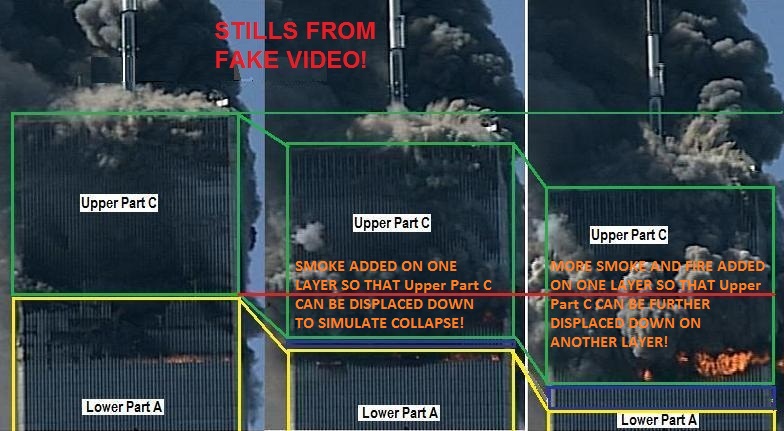
OK - step by step! Se below three pictures:

WTCstartx.jpg


Picture 1 is no failures.
Picture 2 is when roof has dropped for 2 seconds about 10 meters or 3 floors. What bottom has contacted what top? What elements have failed and where and why? Is there anything between the bottom/top?

Picture 3 is when roof has dropped for 3 seconds about 30/35 meters or 7-9 floors. Where is top/bottom of what. What elements have failed, &c? Why is smoke coming out of Upper Part C, if Upper Part C is supposed to be intact and crushing down elements below in Lower Part A?
 
OK - step by step! Se below three pictures:

[qimg]http://heiwaco.tripod.com/WTCstartx.jpg[/qimg]

Picture 1 is no failures.
Picture 2 is when roof has dropped for 2 seconds about 10 meters or 3 floors. What bottom has contacted what top? What elements have failed and where and why? Is there anything between the bottom/top?

Picture 3 is when roof has dropped for 3 seconds about 30/35 meters or 7-9 floors. Where is top/bottom of what. What elements have failed, &c? Why is smoke coming out of Upper Part C, if Upper Part C is supposed to be intact and crushing down elements below in Lower Part A?

Very useful pictures Heiwa. It makes other things jump out too. It's not dificult to mentally sketch in the column locations above and below for instance.
 
OK - step by step! Se below three pictures:

http://heiwaco.tripod.com/WTCstartx.jpg

Picture 1 is no failures.
Picture 2 is when roof has dropped for 2 seconds about 10 meters or 3 floors. What bottom has contacted what top? What elements have failed and where and why? Is there anything between the bottom/top?

Picture 3 is when roof has dropped for 3 seconds about 30/35 meters or 7-9 floors. Where is top/bottom of what. What elements have failed, &c? Why is smoke coming out of Upper Part C, if Upper Part C is supposed to be intact and crushing down elements below in Lower Part A?


:eye-poppi Do... Do you think C is a solid block of material?
 
Hmm, according to Heiwa's pictures, part "A" is getting shorter and part "C" is the same height in all of the pictures.

Actually, part "C" GREW a few pixels from picture 1 to picture 2.
 
:eye-poppi Do... Do you think C is a solid block of material?

According to the OCT, NIST, Bazant, Seffen, a.o., C is rigid (solid, neglegibly damaged, &c) ... and crushes down WTC 1 part A while remaining rigid. Don't you agree that it is obviously not the case? So, bye, bye, OCT, NIST, Bazant, Seffen & Co. :)
 
Last edited:
Now now folks - don't fall for some clearly drawn lines superimposed on a murky picture. Talk a bout desperate grasping of straws.

Naughty Heiwa. :(

Look at the video that bill linked which shows clearly what I said earlier.

http://www.youtube.com/watch?v=y9-owhllM9k

In those first few seconds the top block falls within the bottom - C inside A in Heiwa's nomencalature.

Since both are same size slearly either C is copressing OR A is expanding already (OR both)

But the key is still C inside A :rolleyes:
 
According to the OCT, NIST, Bazant, Seffen, a.o., C is rigid (solid, neglegibly damaged, &c) ... and crushes down WTC 1 part A while remaining rigid. Don't you agree that it is obviously not the case? So, bye, bye, OCT, NIST, Bazant, Seffen & Co. :)

Stop lying, Anders, we can all see through it.
 
3bodyproblem; said:
@AI- No one has claimed that the collapse acclerated at 1g. There was a negative acceleration due to restistence. This point has been made again and again yet some such as yourself remain willfully ignorant of it. Either show how the deceleration should have been greater than was observed or move on. There isn't one single person here that believes the collapse accelerated at 1g, making analogies to show how this isn't possible is quite boring and useless.

Although the exact time of the collapse of WTC 1 and 2 cannot be determined with precision because of the growing dust cloud, each collapse took approximately 10-12 seconds. NIST NCSTAR "Within 12s, the collapse of WTC1 had left nothing but rubble." Only 2 seconds slower than the time for a reasonably dense object that was not overly influenced by air buoyancy at 1.2kg/cubic metre (and air drag), to fall from the WTC roof to the plaza. Therefore, air resistance alone will make it take longer than 10 seconds for gravity to pull an object to the ground from the former height of WTC1 or 2 (time would be about 9.2 seconds in a vacuum). That 12s represents extraordinarily insufficient resistance within the intact tower structure to have permitted the kind of impacts imagined to produce sequential kinetic energy impacts and kinetic energy explosions in a ripple down manner. The energy from gravity has to be used up and it cannot be expected to do two jobs at once. Either all the energy from gravity is used up to create imagined tonnes of TNT kinetic energy explosiveness in sequential one-off explosive ripple-down events or it is used up to get an already explosively disassembled (by other means) building to the ground in that sort of time frame.

Additionally it is clear from video of the WTC2 event that the top load tipped over to the East, so did not apply a symmetrical weight load to the tower below yet within about 2 seconds of the explosive collapse initiation, the top load was explosively disassembled in mid-air upwards. Moreover for the initial symmetrical explosive collapse process below the tipped over top, during the first few seconds the ripple down, explosive blow outs shot down the tower faster than the explosively ejected building material from the top could keep up. This means that in the initial stage of the "WTC2 collapse process" the symmetrical-ripple-down-explosiveness, purportedly from a top load exerting an asymmetrical weight load, since it had tipped over before it was explosively disassembled upwards, was faster than the time for a reasonably dense object to fall through air.

On page 305 of the 9/11 Commission Report, we are told, in the government's "complete and final report" of 9/11 that the South Tower collapsed in 10 seconds. Here is the exact quote: "At 9:58:59, the South Tower collapsed in ten seconds". Actually that is probably slightly too short a time period for the collapse to have been possible in air.

Considerable energy was used up in causing the observed massive high-speed sideways ejection of material (sometimes upwards) and much of the glass and concrete was pulverised and the ductile (not brittle) steelwork was shattered, twisted and mangled. The energy requirements to do anything even remotely like that rival the total amount of potential energy that the entire towers had to give when converted to kinetic energy, via gravity as the energy input. So while gravity is strong enough to cause reasonably dense objects to fall that far, through air, that fast, and while gravity is probably not strong enough to have so thoroughly disintegrated the towers under their own weight, gravity is certainly not strong enough to have done both simultaneously.
 
Now now folks - don't fall for some clearly drawn lines superimposed on a murky picture. Talk a bout desperate grasping of straws.

Naughty Heiwa. :(

Look at the video that bill linked which shows clearly what I said earlier.

http://www.youtube.com/watch?v=y9-owhllM9k

In those first few seconds the top block falls within the bottom - C inside A in Heiwa's nomencalature.

Since both are same size slearly either C is copressing OR A is expanding already (OR both)

But the key is still C inside A :rolleyes:

Thanks for the link, where it is even more obvious that upper part (C) does not crush lower part (A) at all ... but self-destructs (compresses??) prior to that:

WTC1x.jpg


Picture left start - picture right after 3 seconds.

So upper part (C) doesn't drop on lower part (A). It self-destructs/compresses. Evidently not due to gravity! Nothing drops on upper part C!

Thanks for pointing out this! OCT-ists, NIST, Bazant, FEMA, CIA, FBI, &c, will not be happy.
 
Considerable energy was used up in causing the observed massive high-speed sideways ejection of material (sometimes upwards) and much of the glass and concrete was pulverised and the ductile (not brittle) steelwork was shattered, twisted and mangled. The energy requirements to do anything even remotely like that rival the total amount of potential energy that the entire towers had to give when converted to kinetic energy, via gravity as the energy input. So while gravity is strong enough to cause reasonably dense objects to fall that far, through air, that fast, and while gravity is probably not strong enough to have so thoroughly disintegrated the towers under their own weight, gravity is certainly not strong enough to have done both simultaneously.

On the one hand we have your bare assertion, unsupported by any attempt at calculations, that there was not enough potential energy in the Twin Towers to produce the observable effects. On the other we have the painstaking and thorough calculations by Frank Greening, Gregory Urich, Newtons Bit and others - I've even reproduced them myself and reached the same conclusion - which demonstrate mathematically that there was ample potential energy to produce these effects. Oh, the dilemma - should I believe you, or my own lying maths?

Dave
 
Except that his challenge was accepted, yet he basically refused to answer any of the posts. Couple that with the fact he backed out of actually paying any of the money he had promised, and you have a fraud. Way to continue your history of supporting frauds.

It was accepted? Well great. I noticed the thread was closed because Parky showed up and began the derailment as is standard fare for him/her.

1. So someone here decided to take on the challenged then backed out because Heiwa didn't answer some questions?
If I recall, they demanded part of the money be put into escrow, correct? But that wasn't part of Hewais challenge, correct? Model it and he will pay. Quite simple really. By changing the challenge that is simply a passive-aggressive way of avoiding the challenge all together. Which means the challenge still stands and is still completely avoided by engineers, scientists, etc.

2. Strange to avoid science when it is so easy to do, eh? Why do people at JREF fear science, Disbelief?

3. So let me get this straight, someone will do it for money, but not do it to support the WTC 1 official collapse scenario? :newlol

4. Don't you think, Disbelief, NIST would have modeled it if an anonymous poster on this site could easily model the collapse to prove Hewia wrong?

5.If so, doesn't this make NIST look just a tad bit incompetent?
 
Why is smoke coming out of Upper Part C, if Upper Part C is supposed to be intact and crushing down elements below in Lower Part A?

There was smoke coming oput of it from the get-go, immediately after the aircraft struck.

The deflagration of jet fuel blew open elevators and staved in fire doors. There are styairways to conduct the smoke upward. There are elevator shafts to conduct the smoke upward.

Pretty simple stuff here, really.
 
If it fell at an acceleration of 0.7g, and the downward force was gravity, then it was experiencing a continuous deceleration of 0.3g. This, added to the continuous acceleration of 1.0g, produced a resultant acceleration of 0.7g. Apparently everyone understands this except you.

Dave

Did you see and understand this little example I showed above?

Imagine you have a 100 lb. metal weight being supported with 30 legs which together can support 300 lbs. This means 10 legs can just support the 100 lb. weight.

Now remove 27 of the legs and what happens? The 100 lb. weight falls at 0.7g.


The 0.3g less than gravitational acceleration is not deceleration in the sense of effecting a transfer of momentum of the moving upper block to the lower structure. It is just minor resistance to the upper block's full acceleration due to gravity. To transfer momentum you need negative velocity change. With a 0.7g acceleration the velocity of the upper block continues to increase.

Aside from the above, at a bare minimum a 3g deceleration of the upper block would be necessary to overload the core columns. This deceleration or jolt just isn't there, and this proves something else was causing the lower structure columns to fail to support their load. The upper block simply could not overload them without a negative velocity change due to a high deceleration of at least 3g.

You couldn't be any more wrong about how you are stating this.
 
Last edited:
In those first few seconds the top block falls within the bottom - C inside A in Heiwa's nomencalature.

Since both are same size slearly either C is copressing OR A is expanding already (OR both)

But the key is still C inside A :rolleyes:

If C is inside A, why are the perimeter columns at the top of A not showing any signs of being pushed out by debris or pulled in by the failed floor trusses?
 
Did you see and understand this little example I showed above?

Imagine you have a 100 lb. metal weight being supported with 30 legs which together can support 300 lbs. This means 10 legs can just support the 100 lb. weight.

Now remove 27 of the legs and what happens? The 100 lb. weight falls at 0.7g.

Yes, I saw it, but it's such an absurd fantasy that it's a little difficult to know how to respond to someone who could believe something so ridiculous. We have three legs each capable of supporting 10lbs and a weight of 100lb, so one or more of the legs will break. When they've broken, the weight will fall at 1g. That's assuming, of course, that the legs are made of some material with similar yield behaviour to steel. You seem to be suggesting that the remaining legs will continue to exert the same upward force after they've broken. I wonder what world you live in.

The 0.3g less than gravitational acceleration is not deceleration it is just some minor resistance to full acceleration due to gravity. To decelerate you need negative velocity change.

Exactly. If the resistance to the collapse gives less than 1g upward force, there will be no overall deceleration. If the upper block is falling at an angle, then the effective force from breaking individual structural elements will be averaged over a number of collisions, and will appear as a resistance to collapse, visible as a downward acceleration less than 1g. To see an absolute deceleration, you need a single impact across the entire block, which would only happen if all the columns collided simultaneously. Since we know the upper block fell at an angle, we know this didn't happen, so we don't expect a jolt. The resistance to collapse you claim not to see is just the difference between 1g and the actual downward acceleration. It's there, you just don't recognise it when you see it.

You've been told this a hundred times by many different people, all of whom understand exactly what's wrong with your paper. It's your failure to understand that's the problem.

Dave
 
Status
Not open for further replies.

Back
Top Bottom