Who started both World Wars?

Status
Not open for further replies.
What is your point? Dahlerus is refering to a point in time 26 days after the beginning of the war

No, no, no. He's saying he didn't realize until 26 days later that he'd been fooled.

or more important 9 days after the invasion of Poland by the Soviets (your later ally, no declaration of war by Britain or France).

If it's supposed to bother me that the U.S. was allied with the Soviets in WWII, it doesn't. They kicked Nazi ass all over Europe. Good on them.

Dahlerus and the rest of the world understood what kind of game the Germans and Soviets were playing, since the secret annex of the Molotov-Ribbentrop accord (concocted only a week or so before the invasion) had not been published in the Times of London for practical reasons: it was secret.

Dahlerus is refering to plan B, after the negotiations had failed, against the wishes of Hitler. It had been Britain and America who had encouraged the Poles not to give in to German demands by handing out (baseless) promisses of support, that never materialized. Poland was gladly handed over to 'Uncle Joe' (Churchills description) Stalin.

Wrong.

That was easy.

And wrong.
 
The alllies threw 20 times as much on Germany as the other way around. The Germany never bombed America. Between Britain and Germany, Britain started bombing civilian targets a few hours after Churchill became PM. Rotterdam was a pawn in the European scale war, declared by Britain and France.
http://www.heretical.com/miscellx/blitz.html

First up, Rotterdam was bombed on the 14th of May. The first bombing of Germany was on the 15th/16th. As you already know. As you have been told time after time.

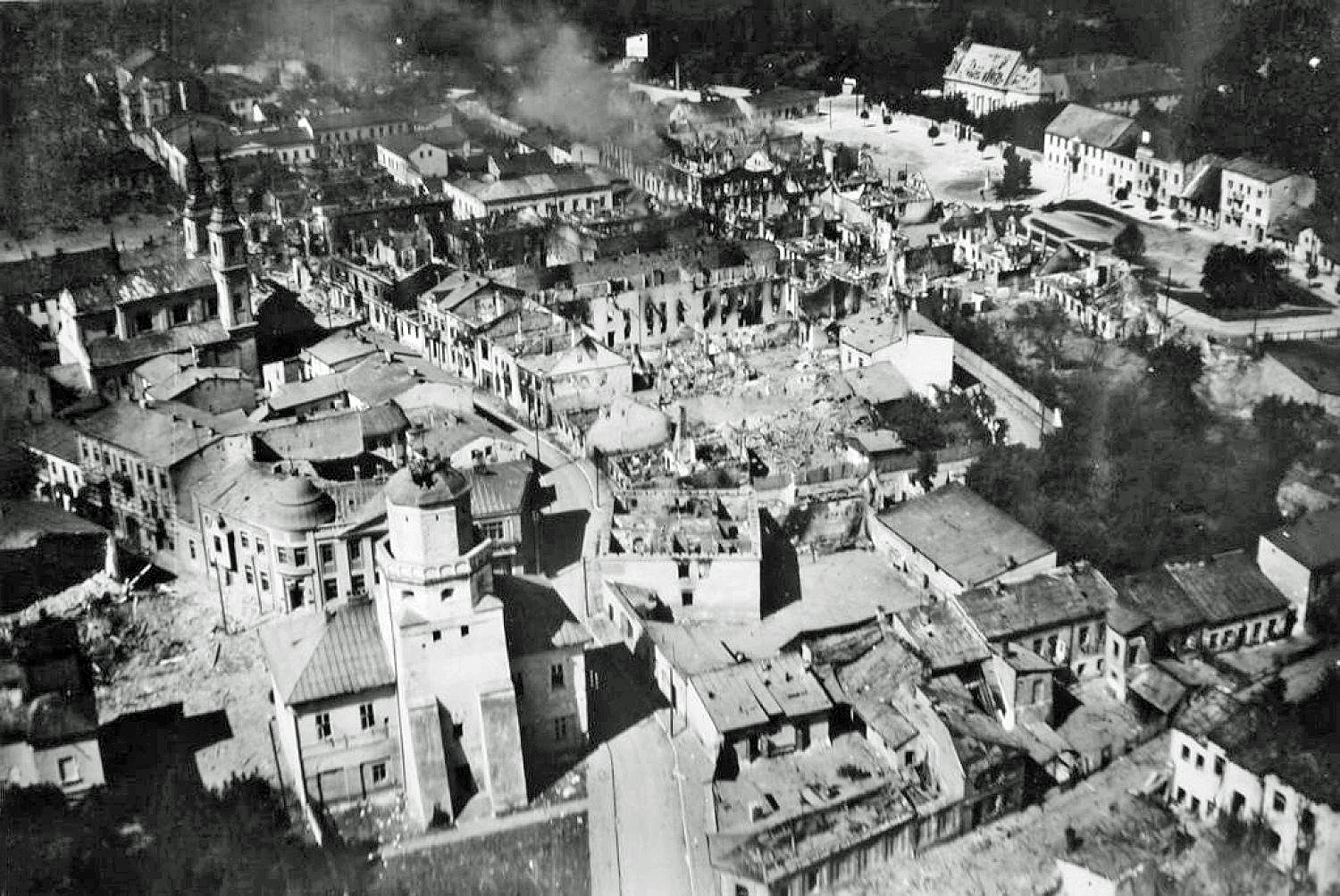
That's not even getting into Wielun.
 
The alllies threw 20 times as much on Germany as the other way around.


As has been repeatedly told to you, that is because the Allies developed the capability to conduct strategic bombing in a major way, something Germany never did. Germany never viewed its air force in a strategic manner, it was always thought of as a tactical adjunct to ground operations. This was to prove a serious impediment to Germany and a benefit for the Allies.


The Germany never bombed America.


Considering it lacked (a) a heavy bomber with a 3,000-plus mile combat radius that could traverse the Atlantic; (b) an operational base closer to the U.S. so that shorter ranged bombers could be used; (c) a navy with numerous aircraft carriers and supporting vessels, it should hardly be surprising that Germany never bombed American soil.

Also, it was Germany which formally declared war on the United States first. It was under no obligation to do so.


Between Britain and Germany, Britain started bombing civilian targets...


When you provide a meaningful and substantive definition of "civilian targets" then we can discuss it.

I note too you still consistently ignore the very real and measured effects the bombing campaign had on the Germany economy.

What did Albert Speer tell Hitler shortly after the July 1943 raid on Hamburg? That raids of similar effect on six other major German cities "would bring Germany's armaments production to a total halt." Erhard Milch said, "If we get just five or six more attacks like these on Hamburg, the German people will just lay down their tools, however great their willpower." Two months' of war production from the city was lost due to the raid; five months after the attack production was still only at 80% of what it had been before the raid.
 
Last edited:
Zniszczenia1939_0.jpg
Ah, yes, Wielun. Nice of Germany to limit their bombing to strategic targets.
 
I don't get why the Nazi thinks that the allies were wrong to throw 20 more ordinance on the enemy. This is is called affecting the enemy centers of gravity. There was stuff in Germany they could use as part of their war potential. The allies decided they didn't want them to have it so they destroyed it. This is how wars are fought and won. Certainly the bombing campaign was inefficient but that's more a limitation on the technology available at the time.
 
I don't get why the Nazi thinks that the allies were wrong to throw 20 more ordinance on the enemy. This is is called affecting the enemy centers of gravity. There was stuff in Germany they could use as part of their war potential. The allies decided they didn't want them to have it so they destroyed it. This is how wars are fought and won.


It was also a matter of the Allies realizing that, up until the invasion of the continent could be undertaken, the only weapon with which they could strike at Germany was the heavy bomber. So Britain and the U.S. spent the time and resources to develop and use it.


Certainly the bombing campaign was inefficient but that's more a limitation on the technology available at the time.


Usage also played a role. Bomber Command could have done much more to damage German industry than it actually did. But the strategic philosophy of Harris was unflinchingly wedded to the pre-war theories of air power, and he simply never accepted the idea that strikes against specific pieces of the German economy would produce meaningful results. (The MEW and USAAF ideas of attacking key components of the enemy's economy to cripple it were proven correct, though the amount of effort needed to achieve the results were underestimated. It didn't help that certain key industries, such as electrical production, were left off the target lists for the wrong reasons.)
 
Last edited:
The overall point being here is that once you're in a war you apply your elements of national power to force the enemy to your will. The complaint about tonnage of bombs drop is simply that the Axis was inferior to the allies in applying elements of national power to the enemy and they lost.

This is why one should avoid seeking the judgment of war. A lesson the Bohemian Corporal probably learned about the time he found out what the barrel of his pistol tasted like. Of course we only know the last thing to go through Hitlers mind before he died, the second to last thing that went through his mind is pure speculation.
 
The Germany never bombed America.

Denmark had never raised a finger against Germany. Neither had the Netherlands, or Belgium, or Luxembourg...

So forgive me if I fail to feel sorry for Germany when a country it declared war on bombs it.

But Russia had already mobilized when Germany declared war, hadn't it?

Yes.
Russia ordered general mobilisation after Austria, but before Germany.

I tend to fall on the "Austria started it", since Serbia agreed to all the points bar the one that essentially stripped it of its sovereignity. Yes, Germany provided the moral support, but Austria was the driving force.
 
Well, Austria started shelling Belgrade in late July, before there was any general mobilisation (even Austrian), so I would say fighting had started.

Fair point. The Schlieffen plan made it inevitable that the Austro-Serbian war that had already started would expand into a war over most of Europe; without the German attack, there was at least a possibility (though not a realistic one, I suppose) that Austria or Serbia might be persuaded to back down. But there's plenty of blame to spread around, for sure.

Dave
 
Last edited:
Fair point. The Schlieffen plan made it inevitable that the Austro-Serbian war that had already started would expand into a war over most of Europe; without the German attack, there was at least a possibility (though not a realistic one, I suppose) that Austria or Serbia might be persuaded to back down. But there's plenty of blame to spread around, for sure.

Dave

Possibly, but then again, expecting Russia to not back Serbia, or expecting Serbia to back down over the final point, is not really reasonable IMO. Even Germany thought Serbia's response to the ultimatum was fair.

Which comes back to Austria-Hungary. And a look at the inner workings of that empire really does show someone desperate to hold onto what they have, and determined to take advantage of any situation which might allow them to stave off disintegration.
 
Possibly, but then again, expecting Russia to not back Serbia, or expecting Serbia to back down over the final point, is not really reasonable IMO. Even Germany thought Serbia's response to the ultimatum was fair.

Which doesn't put Germany's subsequent support of Austria-Hungary in a very good light. Again, though, I'll admit it's sharing the blame rather than absolving Austria-Hungary.

Dave
 
A more appropriate question would be what created the conditions for world war to emerge.

Asking who started World War I & II is like asking who started the Civil War or who started the War on Terror.
 
I tend to fall on the "Austria started it", since Serbia agreed to all the points bar the one that essentially stripped it of its sovereignity. Yes, Germany provided the moral support, but Austria was the driving force.

That's a good point. I tend to agree, though I'd throw in some initial responsibility Russia's way also. No doubt they saw a weak Turkey as a way to grab Constantinople for the Orthodox.
 
A more appropriate question would be what created the conditions for world war to emerge.

That's a key question. On this question, I do believe Germany was looking to establish its own imperium, being a relative newcomer to the game. I can't necessarily fault them for that, given that France, Turkey, England, Austria, and Russia already had multinational empires, unlike Germany, whose empire was really a "reich," i.e., a realm.

Battling empires is the ultimate culprit, in my opinion, with a localized conflict in the Balkans being exploited by the outside players, including England, France, Russia, Turkey, and Germany. I.e., everyone.

Perhaps the issue of "denying" Germany an empire is relevant. I don't know.

Asking who started World War I & II is like asking who started the Civil War or who started the War on Terror.

You mean "slavery" and "Osama" are the wrong answers? ;)
 
Which doesn't put Germany's subsequent support of Austria-Hungary in a very good light. Again, though, I'll admit it's sharing the blame rather than absolving Austria-Hungary.

Dave

Problem was that Germany gave it unqualfied apporval of Austrian action against Serbia (historians refer to it as "The Blank Check") before it knew how far Austria wanted to go with Serbia (baiscally Austria wanted to destroy Serbia and make it a Austrian puppet state) and by the time Germany found out it could not back down without a huge loss of prestige.
 
Problem was that Germany gave it unqualfied apporval of Austrian action against Serbia (historians refer to it as "The Blank Check") before it knew how far Austria wanted to go with Serbia (baiscally Austria wanted to destroy Serbia and make it a Austrian puppet state) and by the time Germany found out it could not back down without a huge loss of prestige.

So here's a question: How do we know that Austria really wanted to do that? Sure, we know that the loss of the Archduke was not a big one to Austria, all things considered. But it was not a matter that could be taken lightly, either. Not being exactly the most enlightened gov't in Europe at the time, they might have found it completely reasonable to demand that they be allowed to police the streets of Belgrade until Union or Death stopped threatening Bosnia, which was still Austrian territory, and sovereignty be damned.

So how do we know?
 
Problem was that Germany gave it unqualfied apporval of Austrian action against Serbia (historians refer to it as "The Blank Check") before it knew how far Austria wanted to go with Serbia (baiscally Austria wanted to destroy Serbia and make it a Austrian puppet state) and by the time Germany found out it could not back down without a huge loss of prestige.

This is a simplistic one-sided way of putting it. You might as well argue that Serbia wanted to destroy the Austrian empire. Austria was merely defending the existing territorial situation where Serbia was leading a pan-slavist movement. At the cost of Austria.

There is no need to moralize about the conflict or take sides. Austria wanted the status quo, Serbia wanted to create South-Slavia (Jugoslavia), which indeed came into being in the wake of the outcome of WW1. Just like 'Czechoslovakia' or larger Poland. The first and second fell apart at the first opportunity, Poland still exists because it is an ethnic pure state, as a consequence of large scale ethnic cleansing of the Germans by the Poles.

Here is an ethnic map of Europa from 1914:
http://img465.imageshack.us/img465/9180/dievoelkereuropas1914xxl4pb.jpg
From this map it becomes clear that the original (ethnic) Polish lands were considerably smaller than present day Poland.

Compare that map with this one showing the borders of the Austrian empire:
http://www.demokratiezentrum.org/uploads/RTEmagicC_karte_osman_reich.jpg.jpg

The conflict was a real one between Austria and Serbia and nobody else his business. The Germans choose the side of Austria for ethnic reasons and Russia the side of Serbia. Also for ethnic reasons. Ignore these basic facts of history at your own peril, as the Americans soon are going to find out after the crash of the dollar.
 
Some interesting questions:

1. What orders did Hitler make in regards to Warsaw on September 15th 1939?
2. How many ships did U-Boats sink in the first week of war?
3. Why did the Allies not declare war on the Soviet Union on September 17th 1939?
4. How many millions of tonnes of supplies were coming from the Soviet Union to Germany after and before Poland was defeated?
5. September 19th Hitler announces his 'housecleaning' rules - what were they?
6. What city gets the 'personal treatment' from the 1st and 4th air armies of Germany?
7. What happens with SS-Obergruppenführer Reinhard Heydrich’s forces in Bydgoszcz on September 24?
8. September 25, 420 German planes bomb civilian targets in Warsaw? Why?
9. September 27, Hitler informs the German General Staff of his plans for a war in the West and instructs them to plan an attack on France.
10. When did German aerial mine laying begin against England and how many neutral ships were sunk?
 
Status
Not open for further replies.

Back
Top Bottom