• Security incident: ISF was recently accessed by intruders. Please change your password, and change it anywhere else you used it. Read more

What book is everyone reading at the moment? Part 2.

Just reread it, inspired by you, and it's also a novel that you are never finished with - i keep finding more to enjoy, every time I read it. Deep, funny, and infinitely generous to those of us who love language. So glad you loved it, Orphia😊

Started on Finnegan's Wake again as well - an almost impossible read, but if you let go, and don't struggle with trying to understand everything, it's quite fun.
I'm tempted to start it all over again, this time with one of the "guides" to Ulysses I keep hearing about. Or, just ploughing through again like I did the first time, which was so much fun.

However, and by a nice coincidence, I've started a book by a Swedish author, Johanna Swanberg. My Year as a Fraud, 2024.

I've read 71 of 375 pages, and it's very easy to read, a bit of a contrast to Ulysses. :)

It's about a woman who inadvertently starts a wellness retreat, and it's shaping up to be fun. The skeptical friend who passed it on to me gave it 7 out of 10.
 
I'm tempted to start it all over again, this time with one of the "guides" to Ulysses I keep hearing about. Or, just ploughing through again like I did the first time, which was so much fun.

However, and by a nice coincidence, I've started a book by a Swedish author, Johanna Swanberg. My Year as a Fraud, 2024.

I've read 71 of 375 pages, and it's very easy to read, a bit of a contrast to Ulysses. :)

It's about a woman who inadvertently starts a wellness retreat, and it's shaping up to be fun. The skeptical friend who passed it on to me gave it 7 out of 10.
Haven't read it, have only read about it, but 7 out of 10 from your skeptical friend sounds promising!
 
I'm tempted to start it all over again, this time with one of the "guides" to Ulysses I keep hearing about. Or, just ploughing through again like I did the first time, which was so much fun.
I felt that way about my first read of Moby Dick a couple years ago. I'd heard that it's interminable and that the descriptions went on way too long. I found it all really interesting (although I did have some issue with the extremely lengthy run-on sentences). I even bought two more versions because I'd returned the first one to the Little Free Library kiosk. I kind of wish I hadn't because I really liked the cover and couldn't find another one. (Or I read it on Kindle, I forget.)
One was a highly abridged but lavishly illustrated Young Adult version. The other is highly annotated which I will be putting off for some time yet. I read the YA version a few weeks ago and didn't feel shorted at all.
 
Last edited:
A few chapters in and She Who Became the Sun is excellent so far. Rich in detail, very well written, and the fantasy touch makes it even more exciting to read. It's 400 pages but I'm looking forward to the experience!
 
I'm tempted to start it all over again, this time with one of the "guides" to Ulysses I keep hearing about. Or, just ploughing through again like I did the first time, which was so much fun.

However, and by a nice coincidence, I've started a book by a Swedish author, Johanna Swanberg. My Year as a Fraud, 2024.

I've read 71 of 375 pages, and it's very easy to read, a bit of a contrast to Ulysses. :)

It's about a woman who inadvertently starts a wellness retreat, and it's shaping up to be fun. The skeptical friend who passed it on to me gave it 7 out of 10.
What a delightful idea for a book, I'll add it to my reading list.
 
Tender is the Flesh.
Post-endemic novel where it's all the animals (all of them!) that have contracted somekinda virus making them deadly to eat or even be around. The government allows humans to be processed for protein. (Yes, I know it sounds like that other, no-spoilers-from-me movie, but this is stated up front.) It is an easy read, meaning for its presentation, not its extremely graphic content. Still, it didn't bug me as much as the American Psycho book.
One complaint I had is that it's written in the present tense, and the main character is almost always referred to as just "he", making it difficult to parse who the narrative is about at times when there are other men involved. "He said.." -- which "he" are you talking about? The conclusion is a bit abrupt as well.
 
My latest read is the Taschen Basic Art series book on Dali, by Gilles NƩret. Seems to be well written and illustrated, as the series always is. It covers his work from his Impressionist period onwards. Looking forward to a good, informative read.

When looking for that book, I was also looking for the one on de Chirico in the same series. Unfortunately, it was published in 2005, is out of print, and good used copies go for over £100! Though I did find one on ebay for about £45. Not sure I'm willing to pay that much. We shall see...
 
The Face in the Frost, The House with a Clock in Its Walls, and The Curse of the Blue Figurine, John Bellairs

I’ve been reading as much as usual (a lot), but I’ve also been preoccupied with a novel I’m writing, so I’ve slacked off in the reviews department. This will partly make up for it.

John Bellairs (1938-1991) was born in the town of Marshall, Michigan, a place of great architectural variety and evocative, faintly sinister settings. He grew up to be a teacher and, in a small way, a writer of quirky books: St. Fidgeta and Other Parodies and The Pedant and the Shuffly, the first being in part a hagiography of the patron saint of fidgeting Catholic kids who cannot be still in church, and the second a James Thurberish fantasy with lots of wordplay. Neither made much of a splash, though both are readable.

Then, after he read Tolkien’s The Hobbit and The Lord of the Rings, Bellairs decided that while he enjoyed the tales, neither work was playful enough nor lightened by puckish humor. The result was his adult fantasy The Face in the Frost, a tour de force that alternates between funny parts and genuinely scary ones. The heroes are the English Franciscan friar Roger Bacon and the wizard of unspecified homeland Prospero (but not the one you’re thinking of). It is a quest novel involving an evil-hearted sorcerer (Prospero’s college roommate from magic school) who desires to gain an object of power even if it means his old classmate’s death. It rips along at a nice pace and sags0 only a bit in its conclusion, which pulls in a deus ex machina student of the kabbalah.

He planned a follow-up novel switching from a late Medieval setting to a modern American one. His publisher turned it down, but Phyllis Fogelberg, founder of the late lamented Dial Books for Young Readers line, told him she would publish it provided he rewrote it as a novel for tweens and teens. The result was The House with a Clock in Its Walls, the first book featuring young Lewis Barbavelt, his uncle Jonathan, and the next-door neighbor and good witch Mrs. Zimmermann. Brilliantly, Bellairs set this story in a fictional town, New Zebedee, Michigan, based directly on Marshall. Recently orphaned Lewis comes to live with his uncle Jonathan just when evil magic begins to manifest in the small town. Bellairs vividly presents ti0me and place, and it’s impossible not to root for young Lewis as he deals with a long-dead sorcerer named Isaac Izard and his evil widow Selena. It seems that Izard, who hated everybody and everything, built not only the house where Jonathan now lives, but a Doomsday Clock, which has just started ticking. Whether the reader is a young one or an old’un like me, the book is a fun, spooky read, better than the movie in evoking personalities and places. By the way, the real House With(out) a Clock in Its Walls still stands in Marshall.

Having made a success and having launched a series with that book, Bellairs later wrote another YA, The Curse of the Blue Figurine, this one set in the 1950s in a fictional Massachusetts town, Duston Heights (based on the town where Bellairs lived while working as a teacher, Haverhill). This created a new young protagonist, Johnny Dixon. Though not orphaned, Johnny grieves and feels lonely when his mother dies of cancer and the USAF stations his father in Korea as a fighter pilot. His Gramma and Grampa Dixon take him in, and right across the street from them lives the elderly and incredibly cranky academic, Professor Roderick Childermass. Johnny is a bookworm and loner who likes spooky radio shows and horror movies. In the cellar of the local church, he discovers a small blue figurine, an Egyptian ushabti. He takes it, not realizing it is a cursed object, belonging to a corrupt priest, Father Baart. Before long eerie things begin to happen, his folks think he’s going crazy, and the irascible Professor Childermass teams up with Johnny to fight the powers of darkness. Again, the characters and place are vividly dramatized.

If you’d like a dose of fun mixed with creepiness, any of these three books would answer.

 
The Face in the Frost, The House with a Clock in Its Walls, and The Curse of the Blue Figurine, John Bellairs

The Face in the Frost is one of the books listed in Appendix N of the Dungeon Master Guide for 1st Edition Advanced Dungeons & Dragons, recommended reading for playing and running D&D.
In a 1979 review of the novel in Dragon Magazine, Gary Gygax said he had only read the book recently, so it wasn't an influence on the creation of the game, but he said that it "could have been a prime mover of the underlying spirit of D&D."
 
The Wind from the Sun
A collection of Arthur C. Clarke short stories, most of which I'd never read. What a treat! (I could swear I posted this already...)
I'm often amazed at the images he can conjure up with just a few words, about the immense beauty of the universe. It reminds me of the end of Contact, where I think only someone like him could describe it.
Most of the stories were great, only one I didn't care for, which is a pretty good percentage. The book does have the distinction of inspiring me to do my own book cover art painting based on the title story. One of my bucket list items was to do art for a book cover. I have created and published my own, but I was thinking more "paid commission". But this will be purely a personal piece. Might have it done within a couple weeks. I've already done a lot of work with choosing the elements and creating the composition. (NO AI !!!) If it works out well I may do other paintings of scenes from books that stick in my mind.
 
Last edited:
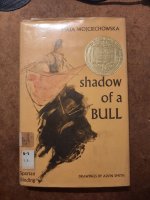
Shadow of a Bull
I came across this book often in the grade school or junior high library, but had never picked it up for some reason. Mistake - I think I really would have liked it then. It's very good even now. The signout cards bring back a lot of good memories as I filled out a LOT of them.
It's going back in the the Little Free Library kiosk when I'm done.
20260903_091306.jpg20260903_091330.jpg
 
I'm about halfway through Alas, Babylon, about the lead-up to and aftermath of a nuclear attack on the U.S.
I had read and reported on it here previously in 2014. But I remember absolutely nothing about it. And that really disturbs me. And I love that sort of story. Around the same time I read another book of the same type (which I really hated, but at least I remember bits of it), and I know I'm not conflating the two. I have to wonder why there is this particular hole in my mind. I wasn't on much medication then (not like now), except maybe some liquid courage...
The only other time I can remember something like that happening is coming across Superman IV: The Quest for Peace on cable and wondering how I had not seen an official Reeve movie, being a big Superman fan. Perhaps I'd forgotten about it because it is so unspeakably bad. But that's not the case for this book.
Earlier this year I bought a copy of Artemis, by Andy Weir (he of Project Hail Mary, The Martian, et. al.). I got one chapter in and I realized I had read it before. And then also remembered I didn't like it at all. I'm glad I often do book reports here because it's helpful to go back to them sometimes to check.
 
Last edited:
Wicked Will, Bailey MacDonald
Continuing my reads through the world of YA books, I happened upon this story by a young(er) lady who lives in my general neck of the woods. Maybe I can meet her some day and tell her that I enjoyed this historical mystery, or maybe it’s a mysterious historical.

It’s set in 1576. To the sleepy little market town of Stratford upon Avon comes a small caravan of players, looking forward to performing for the locals while hoping for better things in the near future. They meet a young lad, Will Shakespeare, who joins them as a guide into the town, and as they near the place, they run into an evil-tempered old man named Speight who threatens and curses them.

You guessed it, Speight turns up dead. The mystery is a tangle: he has twin sons, with whom he does not get along, and he has constantly changed his will, disinheriting the one who’s most out of favor, then switching to a new will, disinheriting the other. The acting company’s leader, Matthew, is arrested upon suspicion of murder, and his young nephew Tom, a boy of Will’s age whose specialty is playing feminine roles in an age when women were not allowed to act, joins forces with the very talkative and over-imaginative Will to try to find the real culprit.

Could it be old Bill Fadger, the crackpot craftsman in charge of the actors’ costumes and props? Or one of the old man’s sons, Francis or Giles? Or a stranger who slinks around town, all dressed in black? Or the church sexton, Coste, who’s a little too fond of drink and of the bones he stores in the charnel house?

It’s a fast read, spiced by reference to Shakespearean languages and ideas. As it turns out, wicked young Will is not exactly the best of detectives, but he has talents in other directions.

I had already read the same author’s juvenile mystery involving a young Ben Franklin. I’m impressed.
 
I'm about halfway through Alas, Babylon, about the lead-up to and aftermath of a nuclear attack on the U.S.
I had read and reported on it here previously in 2014. But I remember absolutely nothing about it. And that really disturbs me.
I read it decades ago, and I'm afraid the only thing I remember about it is that breasts are for babies, legs are for men.
 
I read it decades ago, and I'm afraid the only thing I remember about it is that breasts are for babies, legs are for men.
That is almost a direct quote from the book, but it's not really the type of focus it gives. Farther into it I am finding it rather forgettable, so I guess I'm not surprised. I'd read Earth Abides about the same time and remember more from it. (BTW, that was also made into a good mini-series a couple years ago.)
 
That is almost a direct quote from the book, but it's not really the type of focus it gives. Farther into it I am finding it rather forgettable, so I guess I'm not surprised. I'd read Earth Abides about the same time and remember more from it. (BTW, that was also made into a good mini-series a couple years ago.)
Hammer in starring role?
 
"The Dude"?
Oh, my...
OK, rather than let that go or have someone else explain it:
I mentioned the Earth Abides mini-series..
You asked if Hammer was in the starring role.
I said I didn't get it, and said it wasn't The Dude either.

The Dude is a character played by Jeff Bridges in the cult favorite movie The Big Lebowski. One of the oft-memed catchphrases he had was "The Dude abides", speaking of himself in the third person. Therefore, my reference was that it was Earth that abides, not The Dude.

BTW I've only seen the movie once. While it plays a big part in meme-dom and certain fan cliques, I didn't think much of it. But I know a lot of the memes. Including:

That rug really tied the room together.
STFU Donny!
The Chinaman is not the issue here.
 
Last edited:

ISF - Join now!

Every member here is approved by hand. No bots, no spam, just people who care about evidence and honest debate.

Membership is free!

Create your free account

Back
Top Bottom