• Security incident: ISF was recently accessed by intruders. Please change your password, and change it anywhere else you used it. Read more

'What about building 7'?

Status
Not open for further replies.
Can any of the 'truthers' here answer my questions.

Why WTC7?
What was special about it?
Why did it have to be destroyed?

They won't so I will...

Insurance
Sekrit documents and Hard Drives
Insurance
Sekrit documents and Hard Drives
Insurance....

TAM:D
 
It implies nothing of the kind. My question wasn't even serious, I was being sarcastic about the question I was responding to.

Sarcasm is nearly impossible to see over the innernetz. Still, although I'm skeptical, I'll let you slide for now.

Of course fireproofing doesn't make steel totally impervious to fire. I just think it should work a lot better than allowing a total collapse in a building that had the fire condition that 7 had.

How so? The fires that burned in WTC7 were unprecedented in that they were uncontrolled and unfought for 7+ hours. Why is it such a surprise that the building could not withstand this? I would like to hear your specific reasoning. Your assumption that the SFRM "should" have prevented collapse is only an assumption unless you can show otherwise.

In all seriousness...most, if not all, of us here are willing to listen if your willing to talk...but you have to go beyond the usual TM rhetoric.
 
Cooperman:

If you look at the overarching premise that is the theory that NIST has concerning the collapse of WTC7, then I disagree that the protections that were in place were inadequate for most realistic applications, and here is why.

1. The chances of a fire going untreated, both in terms of passive and active fire protection, for 7 hours in an urban building, even a tall skyscraper, are incredibly slim. The circumstances presented on that day (no water pressure for firefighting, loss of the sprinkler system) were highly unusual, if not rare, and were a DIRECT result of the attacks and collapses from the previous 2 buildings.

2. The temperatures that were needed to cause the expansions (and contractions) of the steel, and subsequent sheering and breaking of connections that led to the 9 floor internal collapse and hence buckling of column 79, were totally possible with simple office fires. 400C is NOTHING for an office fire to achieve.

TAM:)
 
I just think it should work a lot better than allowing a total collapse in a building that had the fire condition that 7 had.

Luckily, we have people who are educated on the matter and aren't just guessing as to how it should have worked.
 
I am serious, I do not know. I could guess you mean either Gravy or Mackey, but they would be guesses based on the respect they have earned here, and your paranoid assumptions of their ignoring habits.

TAM:)

Good guess. Was easy as I knew it would be.

I'm not paranoid.

Just wise about people who want to keep a watchful eye.

MM
 
Interesting that you didn't correct Thunder when he said it was called thermal insulation.

It is commonly referred to as fireproofing.

Thermal insulation would be correct. FirePROOFing is NOT correct. Hence, I correct YOU and not Thunder.
 
Where did I claim it was literal?

I simply used the common term of fireproofing to describe SFRM. I made no claim that it was actually fireproof.

Then aparently you need to work on your wording.

No, it really is called "fireproofing." That is what they call it in the real world.

It's what a layman would call it. Just like bullet proof vests. They are NOT bullet proof, but they are RESISTANT.
 
It implies nothing of the kind. My question wasn't even serious, I was being sarcastic about the question I was responding to.

Of course fireproofing doesn't make steel totally impervious to fire. I just think it should work a lot better than allowing a total collapse in a building that had the fire condition that 7 had.

Well, how can they use something that wasn't available at the time? 2 hours was the industry standard. It did it's job perfectly. Everyone got out of the building safely.
 
It's what a layman would call it. Just like bullet proof vests. They are NOT bullet proof, but they are RESISTANT.

I have never yet heard of body armour (the so-called "bullet-proof vest") that would stop a .50 BMG round.

I used to wear what most people would call a "fire-proof suit" of asbestos and fiber glass with a reflective coating. It would, indeed, reflect about 90% of ambient heat.

Of course, two feet from 5,000 gallons of burning JP-4, I assure you, that other 10% is a mother bear.
 
Last edited:
I love that so many debunked canards are still around.

Ordinary office fires. There's no such thing as all fires are pretty extraordinary. I mean can you melt a cast iron wood stove using just "ordinary" wood?

You bet. I've done it. Lots of things that are considered "ordinary" burn quite spectacularly. And when there's no water to fight the fire.....well what do you think should have happened?

In fact I think that's a good to-the-point question for Cooperman and friends. What do you think should have happened if it was just an "ordinary office fire" without water to fight it if not cause an eventual collapse? What should it have looked like?
 
I love that so many debunked canards are still around.

Ordinary office fires. There's no such thing as all fires are pretty extraordinary. I mean can you melt a cast iron wood stove using just "ordinary" wood?

You bet. I've done it. Lots of things that are considered "ordinary" burn quite spectacularly. And when there's no water to fight the fire.....well what do you think should have happened?

In fact I think that's a good to-the-point question for Cooperman and friends. What do you think should have happened if it was just an "ordinary office fire" without water to fight it if not cause an eventual collapse? What should it have looked like?

Perhaps it could have looked like the One Meridian Plaza fire

http://www.interfire.org/res_file/pdf/Tr-049.pdf

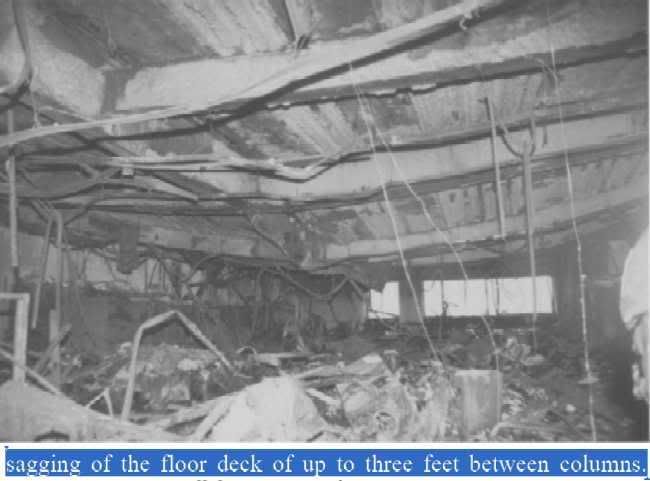
This was a 38 storey building that burned for 18 hours over several floors. There was no pressure to fight the fire and it only burned out when it reached the 30th floor and the sprinklers there put it out. It was described as the fire of the century and 3 fireman died trying to tackle it. Eventually they abandoned firefighting efforts and let it burn.

It didn't collapse. After EIGHTEEN hours of uncontrolled fire.
 
Perhaps it could have looked like the One Meridian Plaza fire

http://www.interfire.org/res_file/pdf/Tr-049.pdf

This was a 38 storey building that burned for 18 hours over several floors. There was no pressure to fight the fire and it only burned out when it reached the 30th floor and the sprinklers there put it out. It was described as the fire of the century and 3 fireman died trying to tackle it. Eventually they abandoned firefighting efforts and let it burn.

It didn't collapse. After EIGHTEEN hours of uncontrolled fire.
No pressure? Firemen killed and you make fun of fire. How much water did they put on the building to keep it from collapsing? On WTC7? Questions?

Failure! It was totaled by fire, and they kept fighting the fire from other buildings. If they had not fought the fire and the fire systems failed the building may of collapse. The firemen left because they feared collapse. OOPS>

onemeridiansag.jpg

No damage from fire here! One Meridian, Totaled by fire. Ordinary office fires without aircraft impacts, or 10,000 gallons of jet fuel. Which building collapsed and set fire to this one? The fire was fought, this is why it burned for so long instead of collapsing. oops


Where is one meridian plaza today? The same place WTC 1, 2, 4, 5, 6, and 7 are.


It did not collapse because firemen saved it!
Read your source next time!
After more than 11 hours of uncontrolled fire growth and spread, interior firefighting efforts were abandoned due to the risk of structural collapse.
Out of 19 hours, 11 were spent fighting the fire.

Why did they stop INTERIOR fire fighting? In case you missed it three times.
interior firefighting efforts were abandoned due to the risk of structural collapse
Structual collapse.
Why? ... risk of structural collapse! Exactly what was said about WTC 7, risk of structural collapse.

From your source, the one you should have read.
Fire-resistance rated construction features, particularly floor-ceiling assemblies and shaft enclosures (including stair shafts), failed when exposed to continuous fire of unusual intensity and duration
Office fires.
 
Last edited:
There was no pressure to fight the fire and it only burned out when it reached the 30th floor and the sprinklers there put it out. [...] Eventually they abandoned firefighting efforts and let it burn.

As the fire was going into its sixth hour it had spread up to the 26th floor. With inadequate water pressure coming from the standpipes, firefighters stretched hoses up the building's stairwells to help fight the fire. While hoses were being taken up to the fire a sprinkler technician arrived to fix the water pressure. This improved the hose streams, but the fire had engulfed several floors and could not be contained with just hoses. By 7:00 AM, almost eleven hours into the fire, firefighters were able to get control of the fire on the 22nd through 24th floors, but the fire was still out of control on the 25th and 26th floors and was spreading upwards. [...] After the evacuation, the only fire suppression efforts left were water streams being directed to the building from the neighboring Girard Trust Building and One Centre Square.


There were efforts, using water, to contain the fire in One Meridian Plaza. WTC7 didn't have that luxury; it didn't even have working sprinklers after the collapses of the Twin Towers.

One Meridian Plaza also suffered significant structural damage due to the fire. Not enough to threaten it's stability, sure, but thermal expansion took its toll.

And that's all ignoring the difference in structural design. It's like comparing one person's successful battle with a specific cancer to another person's lost battle to the same cancer. You'd be looked at sideways for suggesting the latter was actually murdered simply because the former survived, especially if the former survived a longer battle because of better access to cancer treatment.
 
Last edited:
Status
Not open for further replies.

ISF - Join now!

Every member here is approved by hand. No bots, no spam, just people who care about evidence and honest debate.

Membership is free!

Create your free account

Back
Top Bottom
