• Quick note - the problem with Youtube videos not embedding on the forum appears to have been fixed, thanks to ZiprHead. If you do still see problems let me know.

'What about building 7'?

Status
Not open for further replies.
He still pretends to be an engineer at the A&E petition...

The job title "Senior Engineering Specialist" exists so that you don't need a license or a degree to fill it, but there will be some level of technical competence required. If the job title is "Something Something Engineer," then -- depending on state law and exact duties assigned -- you may need a license or some other specific credential. At the Dept. of Energy, SES is essentially a project manager with some technical knowledge. Since INEL is primarily a nuclear research facility, someone with a degree in the kind of physics that covers nuclear power would be qualified to be an SES. But saying he was a Senior Engineer when he was a Senior Engineering Specialist is exactly the opposite of the title's intent.
 
... But saying he was a Senior Engineer when he was a Senior Engineering Specialist is exactly the opposite of the title's intent.

And no way in hell is Jones not perfectly aware of the distinction.

Still, the section in the petition list is titled "Engineering Professionals (degreed only)". Listing Jones is fraudulent.
 
As I recall, the engineering faculty at his former alma mater made that distinction very clear to him in the statement they released. I'd have to go look up the exact wording.

Here I was thinking he actually was an degreed engineer. I'd be interested in what his school said.

I have had to correct the production people sometimes when they create credits for our shows. Sometimes they list me as a broadcast engineer.
Its "Broadcast Technician", or just "Technical".
 
These two words jumped to my eyes:


...
Biography:
Before going to BYU I was known as a senior engineer at the Idaho National Engineering Laboratory (now simply the Idaho National Laboratory) -- where I had the title Senior Engineering Specialist.
It looks to me like he's choosing his words very carefully.
 

That could be what I remember. The statements I'm thinking of were issued the same year he made his presentations at BYU and UVSC (now UVU). That link seems to include recent statements. I agree with them, but I recall the BYU engineering department saying something along the lines of his not being qualified in any of the sciences to which he alluded. Thanks for providing the link though.
 
Correct thinking and ideas are more important the credentials. But lying and deception is unacceptable behavior.. and Jones is thinking is flawed about 9/11 as well.
 
...and Jones is thinking is flawed about 9/11 as well.

Flawed in a particular way I've seen before. A few other physicists I've seen -- whether formally qualified or just "I know a lot of physics" -- seem to think that because they practice the abstract "mother" science upon which so many others are predicated, they know all the applications of that science.

In Jones' case, the physics he practices is the kind that deals with little fiddly bits of matter too small for most of us to know or care about. It's exactly the kind of stuff they did at INEL when he was there, but not the kind of physics that tells us why ships capsize in following seas, or why an aluminum airplane can poke a hole in a steel wall, or why buildings fall down.

These generalists (or misapplied specialists) as a rule don't appreciate the methods of the specializations or derived sciences they criticize. More aptly, they don't know about them. So when they jump in, they try to derive everything anew from first principles. Those derivations aren't per se wrong. But they don't approach the type or degree of knowledge the specialists practice successfully.

Structural analysis is a highly developed science. It's rigorously predictive enough that the law requires us in some cases to undertake it for safety purposes. It's correct to say that it's based on classical Newtonian mechanics. However, it's not correct to say that everything valuable about it can be found in the opening chapters of Principia. Practical engineering depends, in many cases, on curves fit dumbly to empirical data. These tend to be more predictive. Newton still applies, but we have learned that it applies in nuanced ways that aren't typically discovered through theoretical derivation.

Embed one end of a steel I-beam solidly in concrete and let the free end cantilever outward. How much weight on it until it fails? In the mode of Jones you could derive a model for it based on how far from the fulcrum you hang the weight, the cross-sectional area of the beam, and some notions about the inherent resistance of steel to bending.

Or you could just hang weights from it until it yields. That's the engineer's approach. Do that a bunch of times with different weights and distances from the fulcrum, and then fit curves to it. That doesn't mean that the curve-fitting equation will look like it's derived from a Newtonian ideal. But it does mean that it captures actual behavior. It also lets you look at modes of failure, such as what happens if torsion occurs as part of the loading. I-beams are notoriously susceptible to torsion, and they don't resist much load after one end rotates. That introduces the notion of anisotropic behavior. In the synthetic approach, that would be folded into the cross-sectional area consideration. Anything other than a circular cross section will resist bending moments in a complex way relating to the geometry.

The analytical approach seems "messy" to physics generalists who want to show their prowess in the form of pages of densely notated derivations. But that's now Newton did it. When Sir Isaac got around to studying the mechanics of cantilevered beams, the engineer's approach was exactly what he used. And because of imprecision in his measurements, he actually ended up fitting the wrong curve to it and later scientists had to revise his findings. He had the right idea; he was just limited by circumstance.

So Jones "augments" the existing models with simplistic ideas that his generalist's intuition say should apply -- conservation of momentum and energy. These are true scientific principles, but they don't apply to structural analysis in the specific way Jones thinks they do. He applies them at the macro scale, where Newtonian mechanics doesn't really explain a lot of observable behavior.

Jones isn't the first physicist to be unaware that materials properties don't scale in naively predictable ways, hence the cinder block gaffe. He isn't the first physicist to suppose that columns are robust enough to let a structure topple significantly before buckling. He isn't the first physicist to hubristicly suppose that those who have taken the basic principles of his science far beyond his comprehension and into the realm of practical use and descriptive nuance, are somehow ignorant. Yes, the models used for structural analysis in the real world include such things as conservation of energy and momentum. But not necessary as explicit terms.

And so after cobbling up his own untested models based on handwaving allusions to first-year physics, Jones then berates the authors at NIST and elsewhere for not using them. Why don't they include the basic concepts? he asks. Perhaps because these are the people whose PhDs are relevant to the problem and whose methods have been tested and validated many times over the 200 years of rational engineering.

That's how real stuff gets done. I've seen generalists propose elaborate synthetic (i.e., extended from first principles) methods for problems that practitioners solve analytically (i.e., by considering elements of observable behavior) using simple control laws -- "if this happens, do that." And the analytical solutions are always more predictive and robust. Why? Because a synthetic approach requires you to consider all the applicable first principles (including those you may have forgotten) and put them in an appropriate context according to what order of effect you think they have. The analytical approach necessarily includes all the whys and wherefores. And it considers them as they are actually seen to combine to produce aggregate results. It's impossible to forget to include something you didn't know about or you didn't think was important. In the larger sense, this is why licensed engineers have to sign off on certain things, not physicists.

Nearly all physicists I know are quite honest about what they don't know. I had a guy talk to me about measuring diffraction for some research he was doing. He kept peppering his pitch with disclaimers about what he had yet to work out on the practical end of things, and saying things like, "I probably don't know as much about this as I need to." Jones is one of the uncommon exceptions: the physicist with delusions of grandeur. Well, or of competence. Granted, it's a problem more among amateur physicists than professionals. But a small minority of physicists seem to fall into the same trap some physicians do -- a sort of God complex. The "glaring omissions" he attributes to the professional investigators are reckoning merely according to his untested notions, not against the actual licensed, peer-reviewed science. His expertise in particle physics does not mean his expectations in structural engineering have value.

 
I learned at about age 25 that having expertise in one thing does not grant expertise in even related areas, especially if only tangentially related.
I had my diploma in electronics, I had certification to repair various aviation nav aids, I had spent a year as the only tech on a remote Arctic weather station, and I had done well in many varying situations in that time.
I then moved south and bought a house. It required bathroom upgrades so I went into DIY mode and installed, among other things, new plumbing.
Then I turned the water on......... my copper supply pipe joints leaked and leaked bad. I then learned that plumbing solder, unlike my electronics solder, does not have a flux core.

That was when I had the epiphany regarding expertise since after actually consulting true experts in plumbing I managed to learn a thing or two.
Closing in on 60 y/o now, I laugh about it.
 
What struck me as rather stupid in Jones' comments was the experiment he did dropping cinder block and deducing that there was not enough pulverization ergo / dust ergo gravity dropping of slabs and contents could not pulverize or produce the dust observed. Of course this too place over time and the first fractures would be gross break up like a wreaking ball hitting a concrete all... but repeating this 500 times you WOULD get pulverization and dust.
 
I learned at about age 25 that having expertise in one thing does not grant expertise in even related areas, especially if only tangentially related.
I had my diploma in electronics, I had certification to repair various aviation nav aids, I had spent a year as the only tech on a remote Arctic weather station, and I had done well in many varying situations in that time.
I then moved south and bought a house. It required bathroom upgrades so I went into DIY mode and installed, among other things, new plumbing.
Then I turned the water on......... my copper supply pipe joints leaked and leaked bad. I then learned that plumbing solder, unlike my electronics solder, does not have a flux core.

That was when I had the epiphany regarding expertise since after actually consulting true experts in plumbing I managed to learn a thing or two.
Closing in on 60 y/o now, I laugh about it.

It holds true even within your own particular field. As an architect, I have worked on many building types,(including a space in the mall of the WTC) but high rises, prisons, and hospitals are three ares I would be a novice about. Even within particular building types, a change in structure changes all the rules. Worked on a 13 story post tension condo building.....it was like a foreign language because everything you do in a post tension structure is the opposite of what you do in beam joist construction.
 
So Jones "augments" the existing models with simplistic ideas that his generalist's intuition say should apply -- conservation of momentum and energy. These are true scientific principles, but they don't apply to structural analysis in the specific way Jones thinks they do. He applies them at the macro scale, where Newtonian mechanics doesn't really explain a lot of observable behavior.

You're being too generous to Jones, and too hard on physicists in general, with that analysis. As far as I can tell, Jones has never actually done any conservation of momentum or energy calculations on the collapse dynamics of WTC1, 2 or 7; he just likes to pretend that he has, and that the results disagree with observation. In this he seems to be basically referring to the utterly absurd paper by fellow Brigham Youngite Kenneth Kuttler, in which the author starts by asserting that the collapse times of WTC1 and 2 disagreed with a vague statement in the 9/11 commission report, then selectively ignores laws of physics so as to come up with unrealistic collapse times for both. Jones's repeated assertion that the collapse of WTC7 violates the conservation of momentum has not, to the best of my knowledge, ever been backed up by any calculations. Jones doesn't fail by thinking too much like a physicist; he fails by letting his conspiracist beliefs overrule his professional standards.

On the other side of the coin, those of us who have done some simple calculations, based on conservation of momentum and energy, of the collapse times, find that in fact these simple models do give reasonable agreement with observed collapse times. Provided, that is, we don't force our models to include physically impossible results - such as, for example, the instantaneous conversion of all the concrete in a floor into sub-100 micron dust in the first impact, a result Jones himself specifically debunks when he's arguing for thermite and against explosives, but conveniently leaves unexamined at other times.

I agree that Jones appears to have an unwarranted belief in his own fallibility, but I don't think that's specifically an attribute of physicists. Rather, it seems that a small minority of physicists, no more or less than a small minority of every other subdivision of society, is prone to the cognitive errors that give rise to belief in impossible and ill-formed conspiracy theories. I don't think physicists are particularly prone to these errors, but of course neither is there any reason we should be any more immune to them.

Dave
 
I agree that Jones appears to have an unwarranted belief in his own fallibility, but I don't think that's specifically an attribute of physicists.

Nope, and I said as much -- or at least tried to. And no, I don't think it's a big percentage of the relevant fields. As I said, practically all the physicists I know or know of are quite honest about what they can and cannot do.
 
"Here is the part of the very same Jowenko interview that no truther has ever posted, linked to or acknowledged.

"

Apparently my original response to your lie was deemed too uncivil.

Locknar said:
"To rephrase the post avoiding rule 0/12 issues, something along the lines of "Apparently you will not admit you have lied" or "Your comment is intellectually dishonest but will not admit it."; both examples make the same point but do not personalize the discussion."

What he said.
 
Apparently my original response to your lie was deemed too uncivil.


What he said.

MM, I think the handful of people following this thread are aware of your suspension and I for one didn't feel it was justified. Do you really need to carry it on ?
 
"Here is the part of the very same Jowenko interview that no truther has ever posted, linked to or acknowledged.

k3wwdI0XawI"

"Apparently my original response to your lie was deemed too uncivil."

Locknar said:
"To rephrase the post avoiding rule 0/12 issues, something along the lines of "Apparently you will not admit you have lied" or "Your comment is intellectually dishonest but will not admit it."; both examples make the same point but do not personalize the discussion."

"What he said."

I, too, was surprised to see the *suspension, so I asked about it:

Apparently, it was more "body of work" than any particular individual infraction.

I am not referring to that "*red herring".

What I am referring to is;
"Apparently you will not admit you have lied", and "Your comment is intellectually dishonest but will not admit it."
 
"Yes, Mr. Jowenko maintained his assertion that WTC 7 was a controlled demolition.

The key here is that it doesn't matter. In every court in the land, several times a day, expert witnesses -- bought and paid for by each party -- sit on the witness stand and tell contradicting stories about how their profession views a set of pertinent facts.

The existence of conflicting expert opinion is not itself a scary thing.

It's not even especially noteworthy in this case because there is a huge preponderance of such expert testimony against one guy.

That's a no-brainer.

Your point would have some merit if, Mr. Jowenko, like the expert witnesses you allude to, had rehearsed his opinion prior to being interviewed for national News.

He was most certainly not "bought and paid for".

Truly unbiased and 'fresh' opinions from an expert such as Mr. Jowenko are very valuable.

Of course you already know this.


Hellbound said:
"Not ot mentiont hat these have to be the best demolition engineers in the nation that carried this out.

I mean, how many people can rig up a controlled demolition such that it can still be viable after severe fires and massive structural damage?"

Your question is fair but it presumes that it was impossible to sufficiently protect the controlled demolition setup.

With no compelling evidence of raging core fires, or massive internal damage, for the lower floors in question, days of preparation, demolition overkill, and thermal shielding, would appear to sufficiently deal with your issues.


Miragememories said:
"Do you really believe he[Mr. Jowenko] would have given an objective opinion if he had been told before hand that he was about to watch the collapse of another office tower from the WTC site on 9/11?
JayUtah said:
"Pertinent information was withheld.

The question is whether his opinion was properly informed.

That pertinent information included that the building had been previously damaged by falling heavy debris, that it had burned for several hours with little if any mitigation, and that it had been occupied as an office building right up to a few hours before it collapsed.

Explain why such information would not be important to someone asked to determine from a single bit of video what had caused a building to collapse.

Yes, I do suspect that if Jowenko had had that information up front, he may have answered differently.

And I surmise that you and the other conspiracy theorists suspect that too, which is why I believe the information was withheld."
The problem with your plea is that "pertinent information" when supplied, did not alter Mr. Jowenko's expert opinion.

It is difficult to believe that in the months that followed his initial interview, Mr. Jowenko somehow did not read or observe additional materials relating to the condition of 7WTC on 9/11.


From a brief interview the following year:

Interviewer Jeff Hill: Are you still sticking by your comments where you say it must have been a controlled demolition?

Danny Jowenko: Absolutely.

Interviewer Jeff Hill: Yes?

So, you as being a controlled demolitions expert, you've looked at the building, you've looked at the video and you've determined with your expertise that --

Danny Jowenko: I looked at the drawings, the construction, and it couldn't be done by fire.

So, no, absolutely not!

Interviewer Jeff Hill: OK, 'cause I was reading on the Internet, people were asking about you and they said, I wonder -- I heard something that Danny Jowenko retracted his statement of what he said earlier about World Trade Center 7 now saying that it came down by fire. I said, "There's no way that's true."

Danny Jowenko: No, no, no, absolutely not!​

JayUtah said:
"He said he did.

I dispute that he actually did and have given my reasons for disputing it. Specifically he said he had looked at "drawings."

What evidence do you have that he conducted any other investigation?."

Yes he did say that he looked at the "drawings" and the construction for 7WTC.

In the first interview, he was shown the "drawings" that also conveyed the estimated structural damage.

But you are correct that in the months that followed, it is unknown what level of further investigation he undertook.

And, as incredible as it may seem, you are entitled to "your bizarre belief" that a demolition expert, who presided over his own company, would not be bothered to seriously investigate the collapse of 7WTC after being blind-sided on a national News program into giving his professional opinion that the collapse was absolutely a controlled demolition.


Miragememories said:
"When he did the original interview, Mr. Jowenko did not immediately realize the seriousness of what he determined.

He was thinking that the building must have been prepped for demolition on the day.

Given time to think about it further, and based on his own comments in the interview, he must have realized later that yes, there was not time to rig the 7WTC for demolition on 9/11.

That 7WTC must have been engineered for demolition before 9/11.

The the demolition of 7WTC had to have been an inside job.
JayUtah said:
"I don't accept you as an authority on what Jowenko was thinking or why he reacted as he did."

I am not speaking as an authority.

Fact: When he gave the first interview, Mr. Jowenko was shown the video of the collapse of 7WTC without pre-knowledge of the building's identity or the date on which it collapsed.

Fact: When the 9/11 connection was explained to him, it was clear from his amazement about the speed of preparation, that although Mr. Jowenko still believed in his initial assessment that it was a controlled demolition, he now assumed that it must have been engineered on the same day.

Keep in mind, confined to an interview timeline, he did not have the time, or the investigative opportunity, to determine that circumstances made a same day demolition setup virtually impossible.

By the time he was re-interviewed regarding his controversial opinion, months later, you would have us believe the state of Mr. Jowenko's knowledge about 7WTC had not progressed any further.

Such an absurd belief, is not only absolutely incredible, but self-serving for those living in denial.


Dave Rogers said:
"I seem to recall that he was also played the video only, with no sound track.

That's a piece of pertinent information, given NIST's estimate of the sound that would have been produced by an explosive charge sufficiently large to sever column 79; again, I seem to recall the sound level would have been high enough to cause temporary hearing loss within about half a mile of the building, a condition nobody reported."

Strength of evidence.

To Mr. Jowenko's trained eye, the pattern of 7WTC's collapse precluded any possibility of natural causation.

Regardless of the NIST's 'unsound' opinion, it is pure fantasy to suggest that a 47-story steel-structured modern office tower could suffer some south side impact damage, several floors of roaming fires, and then drop in a high speed collapse while maintaining an almost level roofline.

The importance of Mr. Jowenko's determination is particularly valuable because it was neutral, unlike the 'judgement-impaired' opinions of those experts and news makers who were fully aware that 7WTC was part of the 9/11 event.

When observed without the taint of 9/11 'shock 'n awe' bias, the artificiality of 7WTC's collapse was all too obvious to professional demolition experts and lay people alike.

As an expert in building demolitions, Mr. Jowenko was certainly aware that he was basing his controlled demolition determination on partial data.

But, the visual evidence was so compelling that Mr. Jowenko did not need to hear about the NIST's guesstimated missing sounds and other inconsequential data.


JayUtah said:
"And for all the erudition he supposedly applied toward solving the problem, he still mentions only "fire" as the purported cause for the collapse.

He didn't seem to know about the direct debris damage before (his interviewer certainly didn't tell him), and he didn't seem to know about it when Hill called."


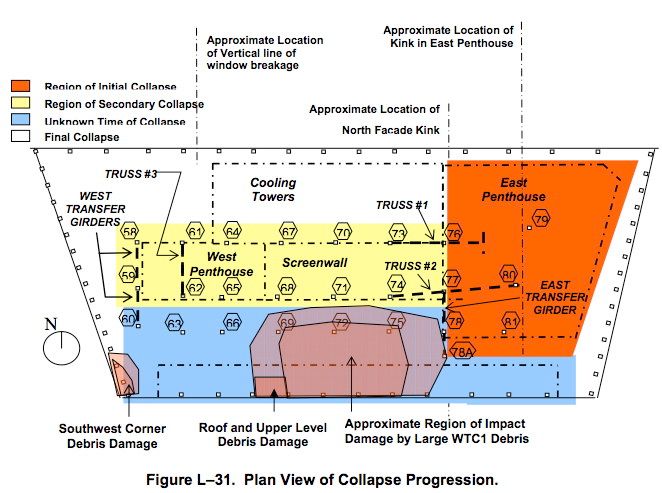
This "direct debris damage"?


NIST7WTCFigureL-31_zps7dd072fd.jpg


JayUtah said:
"Conspiracy theorists don't get it. They don't appreciate that their readers have to make decisions based on relative credibility.


I would argue that the missing credibility is yours.
 
Status
Not open for further replies.

Back
Top Bottom