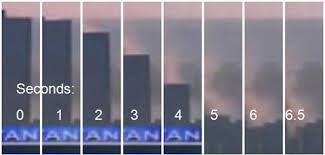
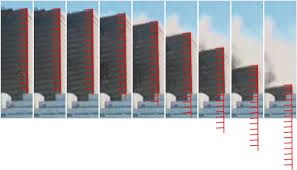
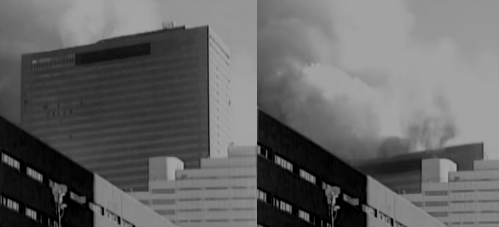
Contrast this to the venue that Harrit and Jones chose...
And we wait with bated breath to see what prestigious venue the announced computer analysis by AE911T will be published in.
Keep in mind we've already seen snippets of what may develop as their computer analysis. It was upon that basis that Gage's counsel threatened NIST with dire consequences if they did not take him seriously -- that lawsuits would ensue and that the hallowed universities of Europe -- Cambridge was mentioned -- would be called upon to endorse AE911T's extant computer analysis.
Neither of course happened. Pepper handwaved away his threats, claiming that he couldn't get a fair trial from the corrupt American judicial system. And years hence, not a peep has arisen from Cambridge or any other European university taking NIST to task and endorsing Gage.
It doesn't matter what it may "seem" to the general public.
But keep in mind the wording of MM's statement is a cursory turnabout of my wording in criticizing AE911T's plans. Unless I miss my guess, their planned activity
is aimed at the general public, most notably to convince the general public that AE911T has some sort of relevance or stature and is therefore worthy of more serious attention. AE911T most often aims their publications toward the benefit of the general public, so I think it's a reasonable guess.
In contrast the findings of NIST are certainly
available to the general public, but are written presuming a specialist's level of understanding. By the same token anyone can obtain NTSB accident reports, but the reader is presumed to understand the sciences and methods behind what is covered in those reports. The reports provide suitable public accountability in both cases, but that accountability does not include generally educating the reader in the specialized topics they cover.
So while it's valid to say that some readers won't understand the methods NIST describes in their findings, it's a different thing altogether to suggest that because of it, NIST can credibly hope to fool its readers by unfairly manipulating the methods.
Neither the model nor the NIST reports nor the paper at JSE were made for the general public - they were made for a professional, competent audience.
This is true. More importantly, the point I made to Szamboti -- which he has yet even to acknowledge, much less refute -- is that NIST's findings are not simply the dumb recitation of the results of computer modeling. Their conclusions were drawn on a consilience of investigation, one of which tools was the computer model.
The vast misrepresentation that AE911T perpetrates through Szamboti is that if some minute flaw can be found in the computer model, then the whole of NIST's findings must come crashing down as otherwise entirely unfounded. That isn't the case. But it's the argument AE911T appears to be mounting. The computer model is the straw man.
And this is a bit that you invented. Quite possibly a lie - you should be perfectly aware that NIST did not work for the benefit of AE911T or with AE911T in mind.
Indeed, but take it as a clumsy artifact of MM's turnabout ploy. What I listed was what I believe is an accurate summary of two avenues of research AE911T wishes to pursue. They wish to use computer modeling to achieve two goals: (1) prove NIST's analysis is incorrect, and (2) prove their theory of controlled demolition best fits the observation. Turning those goals about, as MM has done by changing a few words in my statement, doesn't really apply to NIST, as you've noticed, but I don't think that was necessarily his intent.
It wouldn't matter whether AE911T existed when NIST studied WTC 7, or even whether the allegations had been generally known about from any source. NIST has no power to investigate claims of wrongdoing. Therefore the notion that they were set specifically to refute any such claim is fairly unsustainable.



 but what would I know? just like the truthers I wasn't there either.