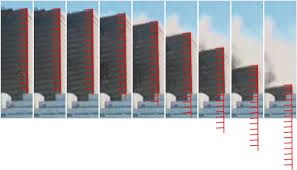
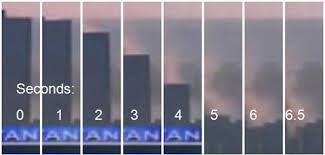
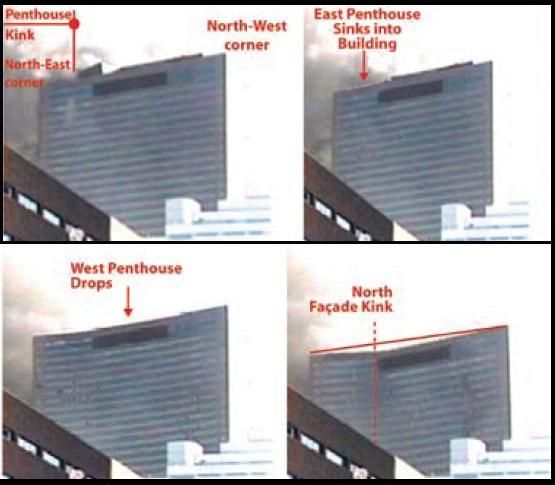
Collapses are often sudden. When one column fails, the weight is redistributed among the remaining columns. That process is very quick, in the tenths or hundredths of second.
Collapses can be sudden or they can be protracted. Loads indeed transfer at a speed commensurate with the failure of some candidate member. If a column takes 0.03 second to buckle to the point of plastic deformation, the load it carried transfers to remaining structural elements at roughly the same speed.
The response of the structural remainder to the transfered loads depends entirely upon the particulars of the structure. Factors such as redundancy, geometry, remaining reserve strength, overload factor, the eccentricity of the load, the strain rate associated with the transfer, and other hard-to-predict factors affect whether the subsequent response is instantaneous or lengthy.
Hence you will find examples of both abrupt and prolonged global failures. High-rise steel structures tend not to have as much reserve strength or structural redundancy than short, squat structures made of concrete etc. -- and several orders of magnitude less redundancy than a child's Lego structure. Different framing strategies (e.g., the aforementioned "moment-resisting frames" and others) create different properties along the elasticity-plasticity spectrum in the whole structure or regions of the structure. Hence in some cases excessive loads may result in elastic response while in other cases plastic deformation occurs.
Non-engineers typically want to reason strictly by analogy and example, generally unaware of the significant differences that exist between their toy examples, or even between apparently similar real-world constructions.
You have so far offered no explanation for the building exceeding g and you keep dismissing the explanations that you are given.
This is a prominent feature of conspiracy-style reasoning. The line of reasoning goes that if the "official" story can be shown not to explain an observation, then it must be set aside and the conspiracy theory then holds by default. In other words, "Your theory doesn't explain the evidence, therefore my theory is correct."
Here and elsewhere, this fails for two reasons. First, the "official" theory is usually given in straw-man form. That is, it's oversimplified or otherwise crippled in order to ensure it does
not explain the outcome. Here the actual work of Newton is being replaced with a cartoonish, kid-with-Legos formulation. The OP wants a "simple answer," unimpressed that the correct answer is not simple -- but it is correct.
Second, as you've identified, the conspiracy theory doesn't explain the outcome either. In holding up their theories by default -- "It's the only way to explain it" -- they never actually test those theories. That's not how useful investigation works. If failure to explain the outcome is enough to doom the official story, it's enough to doom the conspiracy theory as well.
The fluctuation of spot-checked accelerations above and below the free-fall line do indeed spell out that something more complicated is going on here. Controlled demolition doesn't explain that. Oversimplified Newtonian dynamics doesn't either, but thankfully the official explanation doesn't limit itself to the wrong, misrepresented simplifications of Newton. And since it doesn't, Newton in his full complexity can explain the observations.


 more likely soopernanothermite cutters.