• Quick note - the problem with Youtube videos not embedding on the forum appears to have been fixed, thanks to ZiprHead. If you do still see problems let me know.

'What about building 7'?

Status
Not open for further replies.
Wow that´s a lot bs about everthing but what I asked you about: the fraudulent displacement figures
My answer is simple; there is leeway to discuss whether or not the focus of their conclusions was correct and went far enough to determining future building performance approaches. If their numbers were incorrect then it's fair to criticize and justify that position with the next most probable mechanism. And there are three points to make here:

  • The "missing inch" does not change the most probabe collapse initiation location.
  • The "missing inch" does not change the end connection: "fire = collapse"
  • And you have no evidence that the figures were provided to intentionally deceive readers.
If you contest those three points, by all means... explain. But for me this discussion evolves into one of better building construction, not one of exaggerated fraud since your taking the approach of not disussing your end-conclusions

and the effect that exposure would have on everyone that has or will in the future look into the validity of the report.
The "exposure" - if anything - may show that the NIST did not go far enough to explain how building performance could be enhanced in future incidents that may emulate the WTC 7 conditions. But you're arguing that what NIST committed was fraud - a criminal act, and your discussion is frozen on that baseless assumption. I have the flexibility to understand that the numbers may or may not be correct, without having to exaggerate the implication unnecessarily.
 
Last edited:
My answer is simple; there is leeway to discuss whether or not the focus of their conclusions was correct and went far enough to determining future building performance approaches.
Yes. NIST got it wrong, and one of the most important reasons that they are held to account for this is future building safety. The recommendations that they made on the basis of a report that likely attributes collapse to the wrong initiating event are unlikely to prevent a repeat occurrence should the same circumstances arise in a similar structure.
If their numbers were incorrect then it's fair to criticize and justify that position with the next most probable mechanism.
Their numbers were incorrect in terms of girder displacement required for walk off and seat width. They've corrected the seat width, but not the displacement figure. They need to account for the plates in their analysis. As for moving on to the next most probable mechanism, I agree. Once a hypothesis is invalidated, it is time to look at alternative mechanisms.
And there are three points to make here:
The "missing inch" does not change the most probabe collapse initiation location.
Which missing inch do you mean?
Is it the inch of expansion at beam K3004 connection to C38, which is missing from the analysis because these connections were assumed to be infinately strong?
The "missing inch" does not change the end connection: "fire = collapse"
That depends on what replaces the missing inch.
And you have no evidence that the figures were provided to intentionally deceive readers.
Whether NIST did this knowingly or not doesn't change the end result and where it leaves the validity of their report. To acknowledge omissions and errors as they have, and intentionally not address the implications of those errors does not reflect well on NIST at all.
If you contest those three points, by all means... explain. But for me this discussion evolves into one of better building construction, not one of exaggerated fraud since your taking the approach of not disussing your end-conclusions
So how would you improve the C79 connection to prevent a recurrence of the same failure that NIST allege?
The "exposure" - if anything - may show that the NIST did not go far enough to explain how building performance could be enhanced in future incidents that may emulate the WTC 7 conditions.
Agreed.
But you're arguing that what NIST committed was fraud - a criminal act, and your discussion is frozen on that baseless assumption. I have the flexibility to understand that the numbers may or may not be correct, without having to exaggerate the implication unnecessarily.
Whether NIST committed fraud or not has no bearing on this discussion at all, let alone being an assumption upon which the argument is being made. In fact, one assumption in the argument that is being made deliberately weights any possible error to favour NISTs hypothesis to the maximum extent. With the exception of the inch expansion to the east of K3004 at C38.
 
Yes. NIST got it wrong, and one of the most important reasons that they are held to account for this is future building safety. The recommendations that they made on the basis of a report that likely attributes collapse to the wrong initiating event are unlikely to prevent a repeat occurrence should the same circumstances arise in a similar structure.

Which recommendations would that be? As far as a similar structure/circumstance goes, building 7 was more or less a one off. Buildings are not indestructible.

I'll list them for you to make it easy: (spoiler to reduce clutter)

The following are the 23 model building and fire code changes consistent with the NIST WTC investigation recommendations now required by the I-Codes (changes displayed in italics are ones that were approved at previous ICC hearings and incorporated at the Minneapolis hearing into the 2009 I-Codes):
*An additional (third) exit stairway for buildings more than 420 feet high.

*An increase of 50 percent in the width of exit stairways in new sprinklered buildings.

*Permitting the use of elevators for occupant evacuation in fires and other emergencies for all buildings, and as an alternative to the required additional exit stairway for buildings more than 420 feet high. Passenger elevators must meet specific criteria to be used for evacuation purposes.

*Hardening of exit stairway and passageway enclosures, and elevator shaft enclosures, in buildings—for all buildings more than 420 feet high, for buildings 75-420 feet high where failure of the enclosure would substantially jeopardize human life, and in essential facilities such as hospitals.

*Separating exit stairway enclosures by a distance not less than 30 feet or not less than one-fourth of the maximum building diagonal, whichever is less. For example, a building with a 50-foot by 50-foot floor plan would have a diagonal of about 70 feet. One-fourth of 70 is 17.5 feet, which would be the minimum distance required between exits (since it is less than 30 feet).

*A minimum of one fire service access elevator for buildings more than 120 feet high.

*Fire service access elevator lobby sizes that are a minimum of 150 square feet in area with sides at least 8 feet long.

*Keeping fire service access elevator lobbies free of storage.

*Greater reliability of sprinklers with a minimum of two water supply risers for each sprinkler zone in buildings more than 420 feet high. Each riser is required to supply sprinklers on alternate floors and will be placed in remotely located stair enclosures.

*Providing minimum structural integrity for framed and bearing wall structures

*A one-hour increase in the fire-resistance rating of structural components and assemblies in buildings more than 420 feet high.

*Explicit adoption of the "structural frame" approach to fire resistance ratings that requires all members of the primary structural frame to have the higher fire resistance rating commonly required for columns. The primary structural frame includes the columns; other structural members including the girders, beams, trusses and spandrels having direct connections to the columns; and bracing members designed to carry gravity loads.

*Broadening the definition of the primary structural frame to include bracing members essential to vertical stability (such as floor systems or cross bracing) whether or not they carry gravity loads.

*Increasing bond strength for fireproofing to nearly three times greater than currently required for buildings 75-420 feet high and seven times greater for buildings more than 420 feet high.

*Field installation requirements for fireproofing to ensure that:
installation complies with the manufacturer's instructions;
the substrates (surfaces being fireproofed) are clean and free of any condition that prevents adhesion;
testing is conducted to demonstrate that required adhesion is maintained for primed, painted or encapsulated steel surfaces; and
the finished condition of the installed fireproofing, upon complete drying or curing, does not exhibit cracks, voids, spalls, delamination or any exposure of the substrate.

*Special field inspections of fireproofing to ensure that its as-installed thickness, density and bond strength meet specified requirements and that a bonding agent is applied when the bond strength is less than required due to the effect of a primed, painted or encapsulated steel surface. The inspections are to be performed after the rough installation of mechanical, electrical, plumbing, sprinkler and ceiling systems.

*Luminous markings delineating the exit path (including vertical exit enclosures and passageways) in buildings more than 75 feet high to facilitate rapid egress and full building evacuation.

*Broadening the use of luminous markings to identify obstacles, exit doors, exit signs and floor numbers in the exit path in buildings more than 75 feet high.

*Luminous exit path markings in existing buildings more than 75 feet high with the exception of open, unenclosed stairs in historic buildings.

*Increasing the area of the Fire Command Center (the area from which all fire department operations are directed and usually housing the control panel for alarms, sprinklers, etc.) from 96 square feet to 200 square feet with at least one side 10 feet long in buildings more than 75 feet high.

*Approved radio coverage for all buildings for emergency responders within the building based upon the existing coverage level of public safety communications systems at the exterior of the building. Approved coverage includes specific requirements for signal strength, system design, installation and maintenance.

*Installing an emergency responder radio communications system to provide the required level of radio coverage throughout a building. Typical hardwired communications systems would be replaced.

*Additional Proposed Changes to U.S. Model Building and Fire Codes
Based on Recommendations from NIST's WTC Towers Investigation

The following are the nine model building and fire code change proposals consistent with the NIST WTC investigation recommendations that were not approved for the 2009 edition of the I-Codes but will be considered for resubmission at a later date after being amended:

*Requiring buildings more than 420 feet high to be designed to survive a building contents fire to burnout without more than local failure of the structural frame.

*Requiring structures not to suffer a collapse disproportionate to a local initiating failure caused by an accident or incident.

*Requiring a risk assessment and acceptable mitigation of risks for buildings more than 420 feet high with an occupant load greater than 5,000; for buildings with an occupant load greater than 10,000; and for buildings determined to be at higher than normal risk.

*Requiring use of a new standard for conducting wind tunnel testing.

*Requiring installation of stairway communication and monitoring system at every fifth floor of each exit stairway. Also requiring, in buildings more than 75 feet high, a video surveillance system in each exit stairway, elevator lobby, elevator hoistway and elevator machine room to enhance situational awareness of emergency responders.

*Requiring fire safety and evacuation plans for all occupancies and buildings where required by the International Fire Code (the International Building Code is more widely adopted across the country than the IFC; this would ensure all situations are covered).

*Requiring detailed schematic building plans, including an approved Building Information Card, to be located in fire command centers to show the type of construction, stairway access and pressurization, fuel oil tank and hazardous materials locations, standpipe availability and locations, in addition to typical floor plan and details of the building core, means of egress, elevator locations, fire protection systems, firefighting equipment and fire department access.

*Limiting the length of horizontal transfer corridors used to connect a stairwell to 50 feet or less in buildings more than 75 feet high.

*Allowing the option to design buildings more than 420 feet high using the ICC Performance Code, instead of the high-rise provisions of the International Building Code. This change will allow the performance-based NIST WTC recommendations to be considered in a holistic manner.

http://www.nist.gov/el/wtc_100108.cfm
 
Last edited:
Their numbers were incorrect in terms of girder displacement required for walk off and seat width. They've corrected the seat width, but not the displacement figure. They need to account for the plates in their analysis. As for moving on to the next most probable mechanism, I agree. Once a hypothesis is invalidated, it is time to look at alternative mechanisms.
Since you haven't demonstrated this via a complete stack-up of the position of all connected structural elements and their degree of distortions, your assertion is to my mind unsupported, and it is not our burden of proof to show NIST is right, it is yours to show them wrong.
 
Yes. NIST got it wrong, and one of the most important reasons that they are held to account for this is future building safety. The recommendations that they made on the basis of a report that likely attributes collapse to the wrong initiating event are unlikely to prevent a repeat occurrence should the same circumstances arise in a similar structure.

Their numbers were incorrect in terms of girder displacement required for walk off and seat width. They've corrected the seat width, but not the displacement figure. They need to account for the plates in their analysis. As for moving on to the next most probable mechanism, I agree. Once a hypothesis is invalidated, it is time to look at alternative mechanisms.

Which missing inch do you mean?
Is it the inch of expansion at beam K3004 connection to C38, which is missing from the analysis because these connections were assumed to be infinately strong?

That depends on what replaces the missing inch.

Whether NIST did this knowingly or not doesn't change the end result and where it leaves the validity of their report. To acknowledge omissions and errors as they have, and intentionally not address the implications of those errors does not reflect well on NIST at all.

So how would you improve the C79 connection to prevent a recurrence of the same failure that NIST allege?

Agreed.

Whether NIST committed fraud or not has no bearing on this discussion at all, let alone being an assumption upon which the argument is being made. In fact, one assumption in the argument that is being made deliberately weights any possible error to favour NISTs hypothesis to the maximum extent. With the exception of the inch expansion to the east of K3004 at C38.

Another serving of meaningless gish gallop from someone that obviously does not understand building structural design and computer modelling, and has proven to no desire to understand them. :rolleyes:
 
Whether NIST did this knowingly or not doesn't change the end result and where it leaves the validity of their report. To acknowledge omissions and errors as they have, and intentionally not address the implications of those errors does not reflect well on NIST at all.

They did address the implications. They said there was none.

You disagree. That's fine. Now show with equal rigor that these errors do indeed change the end result. That's how science works, if you have a competing theory, present it. All you're doing now is saying no and wanting them to do it again until you like it.
 
  • The "missing inch" does not change the most probabe collapse initiation location.
  • The "missing inch" does not change the end connection: "fire = collapse"
  • And you have no evidence that the figures were provided to intentionally deceive readers.

...The "exposure" - if anything - may show that the NIST did not go far enough to explain how building performance could be enhanced in future incidents that may emulate the WTC 7 conditions. But you're arguing that what NIST committed was fraud - a criminal act, and your discussion is frozen on that baseless assumption....

The fire driven collapse of the east penthouse and the whole building are two seperate issues, and neither are proven until someone proves them. NIST´s spectacular failure is a good indication that this is not an easy thing to do.

You are still talking about a "missing inch" while the reality is more like given 3inches vs needed 9 inches. It would be a lot more accurate to say that NIST would have to multiply its plausible number by 3 to make the walk off possible. But NIST tried to hide the problem.

Once researchers, be it the Council or others, realize that the report is based on this sort of mentality, NIST is no longer given the special status treatment, and the report is truly scrutinized and torn apart.

Whether or not NIST originally intended to deceive people or if this was a huge mistake or if it happened because they gave up is not really the issue. Publishing a conclusion without supporting data is simply not scientific and completely unacceptable.

NIST had the chance to honestly amend its work when it was notified of these glaring errors, but it chose to sweep it all under the rug. It is a waste of time arguing about semantics, i.e. "fraud" or "whitewash" etc. A new investigation is needed. I do think a proper investigation would lead to the cd conclusion.

If you want the discussion to progress forward, then push to resolve the walk off story. Either your buddies show the data which makes it valid, or you admit it is BS.
 
...it is not our burden of proof to show NIST is right, it is yours to show them wrong.

This is BS. The burden of proof rests on NIST. Show us the data that leads to the conclusion, not a conclusion without data, or worse, that defies the data as in this case.
 
Once researchers, be it the Council or others, realize that the report is based on this sort of mentality, NIST is no longer given the special status treatment, and the report is truly scrutinized and torn apart.

By "torn apart", you mean by unqualified layman. Naturally you could change this by publishing something (anything) in an appropriate journal.

Why do you guys avoid this? Is sticking to internet conspiracy forums your best strategy?
 
The fire driven collapse of the east penthouse and the whole building are two seperate issues, and neither are proven until someone proves them.

Ah, I see you've picked up a trick from the Holocaust deniers there; ignore the convergence of evidence and demand that every single element must separately prove the conventional narrative. So even if the building is proven to have collapsed due to fire, you can retreat to the claim that the evil conspirators hatched a fiendish plot to demolish the east mechanical penthouse of an obscure New York office block, to be carried out if that building just happens to suffer collateral damage in a terrorist attack, because otherwise the collapse of the rest of the building might have left the mechanical penthouse just hanging there in mid-air.

This is BS. The burden of proof rests on NIST.

Not in the real world, it doesn't. The reason it doesn't is that none of the things that the truth movement wants to happen (assuming, that is, that it wants some things to happen, rather than just wanting to waste everyone's time by whining) will happen unless its case is proven. So feel free to demand that the burden of proof be on everyone else, but you'll have to get used to being ignored.

Dave
 
Ah, I see you've picked up a trick from the Holocaust deniers there; ignore the convergence of evidence and demand that every single element must separately prove the conventional narrative.


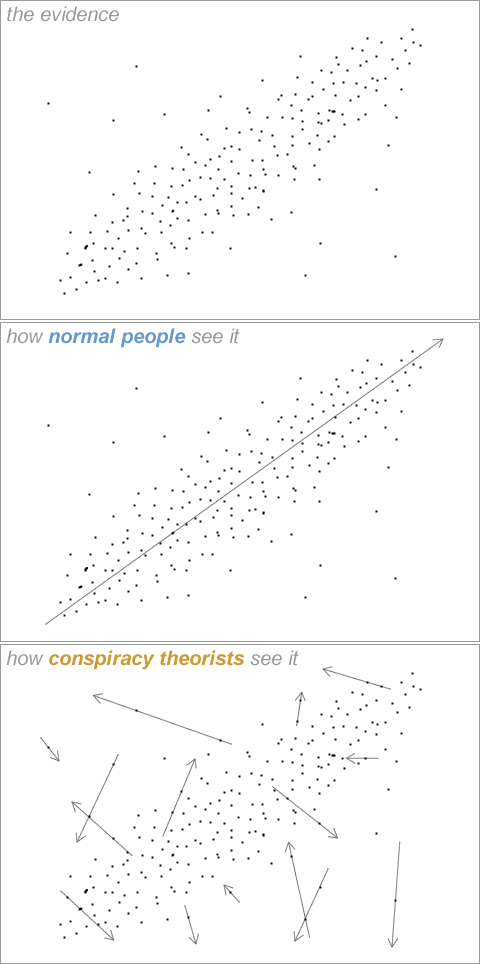
You know, I think it might be time to post this chap again:

the-evidence-v2_zps834af7e0.gif
 
Ah, I see you've picked up a trick from the Holocaust deniers there; ignore the convergence of evidence and demand that every single element must separately prove the conventional narrative. So even if the building is proven to have collapsed due to fire, you can retreat to the claim that the evil conspirators hatched a fiendish plot to demolish the east mechanical penthouse of an obscure New York office block, to be carried out if that building just happens to suffer collateral damage in a terrorist attack, because otherwise the collapse of the rest of the building might have left the mechanical penthouse just hanging there in mid-air.


Not in the real world, it doesn't. The reason it doesn't is that none of the things that the truth movement wants to happen (assuming, that is, that it wants some things to happen, rather than just wanting to waste everyone's time by whining) will happen unless its case is proven. So feel free to demand that the burden of proof be on everyone else, but you'll have to get used to being ignored. Dave

I think he has already realised this, hence living in a very insular world on DTD
 
The fire driven collapse of the east penthouse and the whole building are two seperate issues, and neither are proven until someone proves them. NIST´s spectacular failure is a good indication that this is not an easy thing to do.

It is quite comical for someone talking about spectacular failure when the organization they have involved themselves in cannot he garner the support of 0.5% of the relevant industry professionals

You are still talking about a "missing inch" while the reality is more like given 3inches vs needed 9 inches. It would be a lot more accurate to say that NIST would have to multiply its plausible number by 3 to make the walk off possible. But NIST tried to hide the problem.
It would be more accurate to say the troof movement has spent a decade on a hamster wheel.......lots of motion and never going anywhere fast. :rolleyes:

Once researchers, be it the Council or others, realize that the report is based on this sort of mentality, NIST is no longer given the special status treatment, and the report is truly scrutinized and torn apart.
LMAO....relevant professionals accept the report for what it is...only troofers still find it necessary to nit pick minutia thinking it will equate to CD

Whether or not NIST originally intended to deceive people or if this was a huge mistake or if it happened because they gave up is not really the issue. Publishing a conclusion without supporting data is simply not scientific and completely unacceptable.
There is plenty of supporting data, you simply won't accept it from your raft floating on an Egyptian river.

NIST had the chance to honestly amend its work when it was notified of these glaring errors, but it chose to sweep it all under the rug. It is a waste of time arguing about semantics, i.e. "fraud" or "whitewash" etc. A new investigation is needed. I do think a proper investigation would lead to the cd conclusion.
You want a "new" investigation.....pony up the money to do it.

If you want the discussion to progress forward, then push to resolve the walk off story. Either your buddies show the data which makes it valid, or you admit it is BS.

There is no need to "push the discussion forward....it is troofers that keep thinking they can walk it backward with their uneducated gish gallop.
 
By "torn apart", you mean by unqualified layman. Naturally you could change this by publishing something (anything) in an appropriate journal.
With all due respect I disagree with this line of progression. The peer review process is the least of concerns if the claims are grossly wrong in the context of this discussion. Considering anyway, I find this idea that the CTBUH, et al are ignorant to the NIST's final conclusions to be outright ridiculous. Building codes permeate into practically every aspect of design like tentacles, and as an architect I'm dealing with code provisions constantly when I'm dealing with projects. And ultimately provisions will cost clients money. And clients' are keen to try and manage costs on their properties as best as possible, such to the extent that we also effect similar measures at different stages of the design process. We don't call it value engineering for nothing. We're 7 years into implementation of these code provisions or past recommendations, and we as builders and designers aren't aware of those impacts after this long? Hard to believe given the exposure we get to this stuff on a routine basis
 
Last edited:
With all due respect I disagree with this line of progression. The peer review process is the least of concerns if the claims are grossly wrong in the context of this discussion. Considering anyway, I find this idea that the CTBUH, et al are ignorant to the NIST's final conclusions to be outright ridiculous. Building codes permeate into practically every aspect of design like tentacles, and as an architect I'm dealing with code provisions constantly when I'm dealing with projects. And ultimately provisions will cost clients money. And clients' are keen to try and manage costs on their properties as best as possible, such to the extent that we also effect similar measures at different stages of the design process. We don't call it value engineering for nothing. We're 7 years into implementation of these code provisions or past recommendations, and we as builders and designers aren't aware of those impacts after this long? Hard to believe given the exposure we get to this stuff on a routine basis
I agree with you in concept. The problem they face is they have no voice in the circles they claim they are not heard. This is the relevant journals. They are arguing against published studies and complaining they are not heard although they refuse to argue on equal turf.

BTW: You do not have to ask for "all due respect", I'm always open to criticism or comment on my posts.
 
Which recommendations would that be? As far as a similar structure/circumstance goes, building 7 was more or less a one off. Buildings are not indestructible.

I'll list them for you to make it easy: (spoiler to reduce clutter)

The following are the 23 model building and fire code changes consistent with the NIST WTC investigation recommendations now required by the I-Codes (changes displayed in italics are ones that were approved at previous ICC hearings and incorporated at the Minneapolis hearing into the 2009 I-Codes):
*An additional (third) exit stairway for buildings more than 420 feet high.

*An increase of 50 percent in the width of exit stairways in new sprinklered buildings.

*Permitting the use of elevators for occupant evacuation in fires and other emergencies for all buildings, and as an alternative to the required additional exit stairway for buildings more than 420 feet high. Passenger elevators must meet specific criteria to be used for evacuation purposes.

*Hardening of exit stairway and passageway enclosures, and elevator shaft enclosures, in buildings—for all buildings more than 420 feet high, for buildings 75-420 feet high where failure of the enclosure would substantially jeopardize human life, and in essential facilities such as hospitals.

*Separating exit stairway enclosures by a distance not less than 30 feet or not less than one-fourth of the maximum building diagonal, whichever is less. For example, a building with a 50-foot by 50-foot floor plan would have a diagonal of about 70 feet. One-fourth of 70 is 17.5 feet, which would be the minimum distance required between exits (since it is less than 30 feet).

*A minimum of one fire service access elevator for buildings more than 120 feet high.

*Fire service access elevator lobby sizes that are a minimum of 150 square feet in area with sides at least 8 feet long.

*Keeping fire service access elevator lobbies free of storage.

*Greater reliability of sprinklers with a minimum of two water supply risers for each sprinkler zone in buildings more than 420 feet high. Each riser is required to supply sprinklers on alternate floors and will be placed in remotely located stair enclosures.

*Providing minimum structural integrity for framed and bearing wall structures

*A one-hour increase in the fire-resistance rating of structural components and assemblies in buildings more than 420 feet high.

*Explicit adoption of the "structural frame" approach to fire resistance ratings that requires all members of the primary structural frame to have the higher fire resistance rating commonly required for columns. The primary structural frame includes the columns; other structural members including the girders, beams, trusses and spandrels having direct connections to the columns; and bracing members designed to carry gravity loads.

*Broadening the definition of the primary structural frame to include bracing members essential to vertical stability (such as floor systems or cross bracing) whether or not they carry gravity loads.

*Increasing bond strength for fireproofing to nearly three times greater than currently required for buildings 75-420 feet high and seven times greater for buildings more than 420 feet high.

*Field installation requirements for fireproofing to ensure that:
installation complies with the manufacturer's instructions;
the substrates (surfaces being fireproofed) are clean and free of any condition that prevents adhesion;
testing is conducted to demonstrate that required adhesion is maintained for primed, painted or encapsulated steel surfaces; and
the finished condition of the installed fireproofing, upon complete drying or curing, does not exhibit cracks, voids, spalls, delamination or any exposure of the substrate.

*Special field inspections of fireproofing to ensure that its as-installed thickness, density and bond strength meet specified requirements and that a bonding agent is applied when the bond strength is less than required due to the effect of a primed, painted or encapsulated steel surface. The inspections are to be performed after the rough installation of mechanical, electrical, plumbing, sprinkler and ceiling systems.

*Luminous markings delineating the exit path (including vertical exit enclosures and passageways) in buildings more than 75 feet high to facilitate rapid egress and full building evacuation.

*Broadening the use of luminous markings to identify obstacles, exit doors, exit signs and floor numbers in the exit path in buildings more than 75 feet high.

*Luminous exit path markings in existing buildings more than 75 feet high with the exception of open, unenclosed stairs in historic buildings.

*Increasing the area of the Fire Command Center (the area from which all fire department operations are directed and usually housing the control panel for alarms, sprinklers, etc.) from 96 square feet to 200 square feet with at least one side 10 feet long in buildings more than 75 feet high.

*Approved radio coverage for all buildings for emergency responders within the building based upon the existing coverage level of public safety communications systems at the exterior of the building. Approved coverage includes specific requirements for signal strength, system design, installation and maintenance.

*Installing an emergency responder radio communications system to provide the required level of radio coverage throughout a building. Typical hardwired communications systems would be replaced.

*Additional Proposed Changes to U.S. Model Building and Fire Codes
Based on Recommendations from NIST's WTC Towers Investigation

The following are the nine model building and fire code change proposals consistent with the NIST WTC investigation recommendations that were not approved for the 2009 edition of the I-Codes but will be considered for resubmission at a later date after being amended:

*Requiring buildings more than 420 feet high to be designed to survive a building contents fire to burnout without more than local failure of the structural frame.

*Requiring structures not to suffer a collapse disproportionate to a local initiating failure caused by an accident or incident.

*Requiring a risk assessment and acceptable mitigation of risks for buildings more than 420 feet high with an occupant load greater than 5,000; for buildings with an occupant load greater than 10,000; and for buildings determined to be at higher than normal risk.

*Requiring use of a new standard for conducting wind tunnel testing.

*Requiring installation of stairway communication and monitoring system at every fifth floor of each exit stairway. Also requiring, in buildings more than 75 feet high, a video surveillance system in each exit stairway, elevator lobby, elevator hoistway and elevator machine room to enhance situational awareness of emergency responders.

*Requiring fire safety and evacuation plans for all occupancies and buildings where required by the International Fire Code (the International Building Code is more widely adopted across the country than the IFC; this would ensure all situations are covered).

*Requiring detailed schematic building plans, including an approved Building Information Card, to be located in fire command centers to show the type of construction, stairway access and pressurization, fuel oil tank and hazardous materials locations, standpipe availability and locations, in addition to typical floor plan and details of the building core, means of egress, elevator locations, fire protection systems, firefighting equipment and fire department access.

*Limiting the length of horizontal transfer corridors used to connect a stairwell to 50 feet or less in buildings more than 75 feet high.

*Allowing the option to design buildings more than 420 feet high using the ICC Performance Code, instead of the high-rise provisions of the International Building Code. This change will allow the performance-based NIST WTC recommendations to be considered in a holistic manner.

http://www.nist.gov/el/wtc_100108.cfm
Wow. And all these valuable contributions, are what gerrycan is trying to ditch???
 
Yes. NIST got it wrong, and one of the most important reasons that they are held to account for this is future building safety. The recommendations that they made on the basis of a report that likely attributes collapse to the wrong initiating event are unlikely to prevent a repeat occurrence should the same circumstances arise in a similar structure.
Glad you said "likely". Because that's actually all you have: a subjective evaluation.
 
Wow. And all these valuable contributions, are what gerrycan is trying to ditch???
Yes. The idea that what the "Truthers" arguing is about public safety is laughable. The NIST threw out the blanket to cover fire control and occupant egress. To argue the NIST didn't cover the code concern is the same as arguing fire can not hurt a steel framed building.
 
Status
Not open for further replies.

Back
Top Bottom